Britvic 2 01 0 Prelim inary Results Presentation Decem ber 2 , 2 0 1 - - PDF document

britvic 2 01 0 prelim inary results presentation decem
SMART_READER_LITE
LIVE PREVIEW

Britvic 2 01 0 Prelim inary Results Presentation Decem ber 2 , 2 0 1 - - PDF document

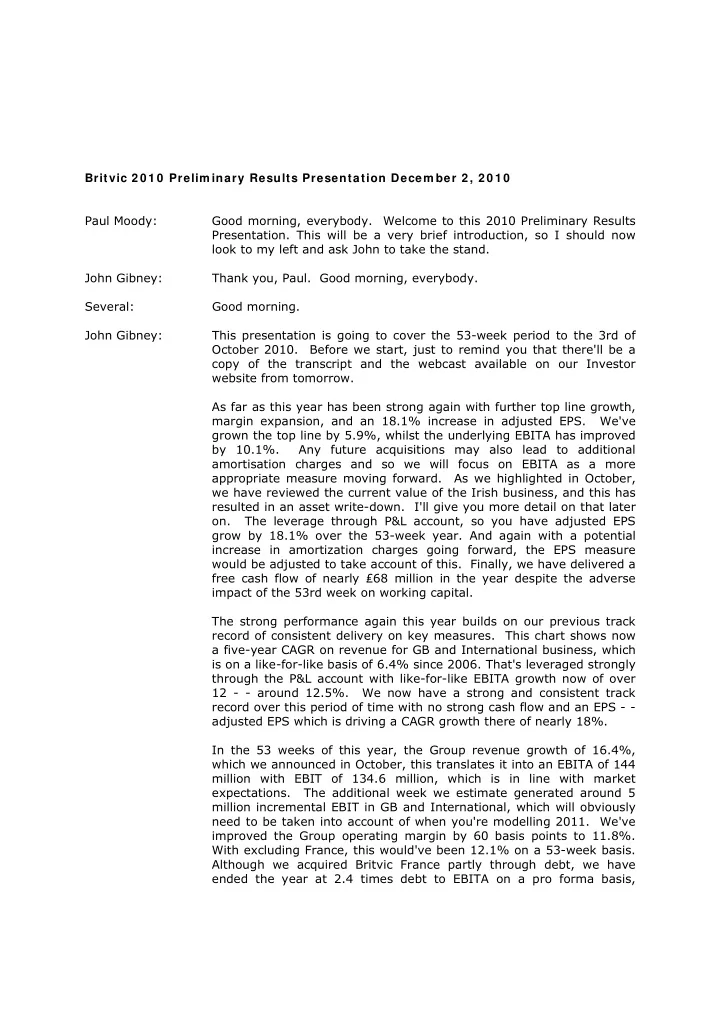
Britvic 2 01 0 Prelim inary Results Presentation Decem ber 2 , 2 0 1 0 Paul Moody: Good morning, everybody. Welcome to this 2010 Preliminary Results Presentation. This will be a very brief introduction, so I should now look to my left and ask


slide-1
SLIDE 1

Britvic 2 01 0 Prelim inary Results Presentation Decem ber 2 , 2 0 1 0 Paul Moody: Good morning, everybody. Welcome to this 2010 Preliminary Results

  • Presentation. This will be a very brief introduction, so I should now

look to my left and ask John to take the stand. John Gibney: Thank you, Paul. Good morning, everybody. Several: Good morning. John Gibney: This presentation is going to cover the 53-week period to the 3rd of October 2010. Before we start, just to remind you that there'll be a copy of the transcript and the webcast available on our Investor website from tomorrow. As far as this year has been strong again with further top line growth, margin expansion, and an 18.1% increase in adjusted EPS. We've grown the top line by 5.9%, whilst the underlying EBITA has improved by 10.1%. Any future acquisitions may also lead to additional amortisation charges and so we will focus on EBITA as a more appropriate measure moving forward. As we highlighted in October, we have reviewed the current value of the Irish business, and this has resulted in an asset write-down. I'll give you more detail on that later

  • n. The leverage through P&L account, so you have adjusted EPS

grow by 18.1% over the 53-week year. And again with a potential increase in amortization charges going forward, the EPS measure would be adjusted to take account of this. Finally, we have delivered a free cash flow of nearly ₤68 million in the year despite the adverse impact of the 53rd week on working capital. The strong performance again this year builds on our previous track record of consistent delivery on key measures. This chart shows now a five-year CAGR on revenue for GB and International business, which is on a like-for-like basis of 6.4% since 2006. That's leveraged strongly through the P&L account with like-for-like EBITA growth now of over 12 - - around 12.5%. We now have a strong and consistent track record over this period of time with no strong cash flow and an EPS - - adjusted EPS which is driving a CAGR growth there of nearly 18%. In the 53 weeks of this year, the Group revenue growth of 16.4%, which we announced in October, this translates it into an EBITA of 144 million with EBIT of 134.6 million, which is in line with market

  • expectations. The additional week we estimate generated around 5

million incremental EBIT in GB and International, which will obviously need to be taken into account of when you're modelling 2011. We've improved the Group operating margin by 60 basis points to 11.8%. With excluding France, this would've been 12.1% on a 53-week basis. Although we acquired Britvic France partly through debt, we have ended the year at 2.4 times debt to EBITA on a pro forma basis,

slide-2
SLIDE 2

exactly the same as last year despite the additional debt that we incurred on the back of the acquisition of France. Repeated strength

  • f our performance gives the Board confidence to propose a follow

dividend of 12p bringing the full year dividend to 16.7p, an increase of 11.3% on 2009. This next chart is here to try and give you a better sense of the underlying performance, so the left-hand column here of FY10 excludes France and the impact of the 53rd week. Like-for-like revenue therefore was up 5.9%, driving EBIT improvement in margin

  • f 60 basis points. If you remember, we issued guidance on EBIT

margin growth earlier in the year of 50 basis points on average through till 2013. Given the focus on EBITA for the future, I'll give some more guidance on that later in the presentation. Before that, I'll now take you through each of the reporting segments and if you bear in mind that for each of the Carbonate, Stills, and international segments, then I'll be presenting these on a 52-week comparable basis. Starting with our Carbonates business first off, we've seen a volume

  • utperformance in the marketplace of over 8 percentage points.

Alongside this, we've achieved ARP growth of 2.2%, driving revenue growth overall of 12.4%. Brand contribution in excess of 183 million represents growth of over 21% on last year, with brand contribution margin accelerating by 290 basis points this year, in part due to the success of our On-The-Go strategy and innovations launched earlier in the year. This is all despite the ongoing pressures from the Pubs and Clubs channel and a football-led promotional summer. As you can see, our revenue and market share success has not come at the price

  • f either value or indeed headline ARP. The brand contribution growth

also reflects the benefit associated with the investment that we have made in our sales capability. This will be reflected in driving selling costs and overheads which will be evident later in the presentation. This has included increased investment in our customer management ability, together with support in business areas, as well as increased in the spend at the direct point of purchase. Moving on to Britvic GB Stills, the portfolio has again delivered another strong set of results with volumes this time outpacing the marketplace by 1 percentage point, with particularly growth from Fruit Shoot and the Robinsons' brand. ARP was flat partly due to channel mix, though the strong growth of Robinsons, which is our lowest ARP brand, has been the biggest mix impact on this line. Lower RPI and commodity prices is obviously also have an impact on the need for significant price increases this year. With the rise in brand contribution margin here of 190 basis points, we saw overall brand contribution up about 8% with value again protected. As we with our Carbonates portfolio, then Stills has also benefited from our investment in customer management capability.

slide-3
SLIDE 3

Turning on to our International business, 2010 has once again been a year of double digit growth. This increase in the important part of the Group saw revenue growth of 15.2% with a particularly strong volume

  • performance. ARP here has been impacted mainly by the launch of

scale water into our travel business, which obviously has a much more lower ARP than the rest of our portfolio. We therefore expect to see a more favourable comparison for our 2011 APR number. As we've established our presence of new brands in markets, then the margin contribution has continued to rise this time by further 110 basis points. As part of the integration of our French basis, then the Britvic International division will actually take responsibility for driving the French exports through this business. We're also actively exploring franchise and export opportunities across the world, principally with Fruit Shoot and Robinsons' propositions and we're investing ahead of growth to make sure that we can capture these opportunities, and Paul will talk more about that later on. Turning now to Britvic Ireland. As guided previously, this will be the last year that we'll disclose Irish performance down passed the brand contribution level and in future we'll report on all segments of brand contribution level. It's been another tough year obviously for the Irish soft drinks market, although this year volume growth has actually delivered 1.3% growth in stark contrast to last year's 10.7% fall. However, the structural category deflation seen in the marketplace this year, as well as unprecedented levels of promotional activity have had an impact on both pricing and margin levels. We know that retail is looking to source stock as efficiently as possible, with many of them using their U.K. supply chains. We believe it's inevitable, therefore, that we have seen some leakage of profitability away from our Irish business towards are GB business as an example with the supply of 7-

  • Up. As a result of the shrinking Irish marketplace, we have utilised

the spare capacity in our supply chain to produce stock for GB, such as Mountain Dew and Robinsons. However, we've also, as we said, kept

  • n the regularly review, the carrying value of the Irish assets and

therefore we are now recognising a one-off non-cash impairment charge this year, and this charge indicate - - includes a significant write-down of both goodwill, intangible assets, and property assets. In recognition of this new outlook, we're also undergoing a review of the business model, and Paul will talk about in a bit more detail later on. Turning to France, we are delighted with the performance of Britvic France since we acquired the business early this year at the end of

  • May. If you remember, this business delivered an operating profit of

nearly €20 million in 2009 in the year to December with matching revenues of €256 million. So on a pro forma basis, full year revenues and profitability would've been higher in 2010, and this would be a good base off which to model going forward. Brand contribution margin for 2009 for comparable purposes was in the order of 26 to 27% on a full year basis. This is relevant because, as I mentioned

slide-4
SLIDE 4

earlier, then we'll disclose France alongside all the other business units now down to brand contribution level going forward. It is worth noting that the four months that we've owned this business represents seasonally the four strongest trading months for this business and equally France enjoyed a particularly strong summer, which was a benefit particularly for our service business this year. As you can see a brand contribution margin of 28.3% has upside potential over time, especially as we drive the cost and revenue synergies over the medium-term. The impact of the fair level adjustments on this business this year will result in amortisation charges of around ₤2.5 million, with depreciation increasing by between €1- and 2 million on an ongoing basis. It's worth nothing that the integration of the business has been very successful to date and we're taking a considered approach to driving initiatives such as the Fruit Shoot launch and business transformation. The programme remains on track to deliver the full €17 million that benefits it through to 2013 where there is a likelihood that some of this may be slightly more back weighted than we originally expected. Moving on now to fixed costs. We've seen an overall increase of around 16% this year, but obviously that includes the impact of the French costs for this time, excluding these and the like-for-like increase is less than 10%. There have been a number of drivers of this increase. As I mentioned earlier, we continue to invest in sales capability and supporting functions to drive our growth in top line performance, particularly with our On-The-Go brands. We've invested further in direct selling costs and the investment in customer management resource and point of purchase have been crucial to our success in GB. Related to the sales drive and also the continued establishment of group functions is an increase overhead cost of the

  • rder ₤5 million pounds a share. Also within overheads, we've seen

significant other cost increases related to long-term incentive plans, estimated around 3 million, adverse foreign exchange movements of around 2 million, additional pension costs of around 4 million, and consultancy costs of around ₤1 million. We will again investor growth next year, particularly around sales capability, continue to grow our Group capability, and to realise the franchise ambitions that we have, particularly around Fruit Shoots and Robinsons. Another strong top line performance this year means that A&P as a percentage of sales has fallen. It's also worth bearing in mind that this is consolidated in the French numbers. For the first time, France obviously has a large element of own label business and therefore doesn't attract A&P spend, so the overall A&P percentage in the French business is somewhat lower than the Group. If I reference GB and International in isolation, then the percentage of revenue is identical this year to last year. But given the strong top line growth we've had, then clearly the pound no investment in advertise and promotion has been significantly increased this year. Also worth bearing in mind that our investment in category point of purchase investment is some 70% higher since it was in 2007.

slide-5
SLIDE 5

Moving further down the P&L account, a low interest environment and another reduction in underlying debt has been outweighed by the debt based (inaudible) funding of the French acquisition; therefore, we have seen around a 6% increase in our interest costs this year with the ambition being to see a lower interest charge in 2011. The effective tax rate this year is 26.7%, an increase on last year primarily due to lower profits from Ireland which is a low tax environment, plus the addition of France, which is in a higher tax environment. Our profit after tax level, we've delivered a 20.4% improvement on last year, taken the 52-week number to 76.8 million. Moving on to exceptional items, total exceptional costs for the year are 137.9 million; although, non-cash items make up the vast majority of this number. As we stated in October, we have made a provision for the write-down in the carrying value of Britvic Ireland's assets in light

  • f the continued difficult trading conditions. The total write-down for

Ireland is ₤104.2 million. In addition, we reflected the cost in respect

  • f the structure review in Ireland. Those are some of those costs

which are going at the moment and also earlier restructuring such as the downsizing of our Northern Ireland distribution infrastructure. Our focus on Mountain Dew Energy as our lead glucose/stimulant brand has meant that our smaller energy brand Red Devil will not be the growth focus for us on energy in the future. In light of this, we've written down the value of the brand which was acquired in 2002. Also, we have written down the value of the brands Amé and Aqua Libra, which were acquired from Orchid drinks some years ago as a predominate focus for us in adult will be around J2O. The acquisition

  • f Britvic France at the end of May also incurred some one-off costs

which are reflected here as well and the other exceptional costs cover the fair value adjustments related to derivative costs and also the recognition and further 3 million charge related to vacant lease properties in Ireland. Turning on to cash flow. Capital expenditure this year has increased by 5.1 million to 45.2 million. In addition to that, we've undertaken

  • perating leases with a capital value of around 6.4 million. The

increase in pension costs this year is primarily due to increased requirements for the funding of pension schemes in Ireland. This year represents the last agreed instalment of ₤10 million for the GB pension scheme and the current tri-annual review remains underway, and we'll be able to give further guidance on that in the future. In terms of our debt facilities, our funding structure has further developed in the year with an increase in size of our bank facilities of ₤50 million on the back of the French acquisition, as well as issuing a further tranche of private placement notes. We're also in the process

  • f concluding a third tranche replacement notes in the coming week

subject to documentation and final due diligence. Our objective here is to secure long-term funding while it's locking in attractive interest

slide-6
SLIDE 6

rates, and this will take our available debt facilities to ₤825 million. We will next address the refinancing of our 2012 revolving bank facilities possibly in the coming months, and we look forward to continuing the strong relationship we have with our banking partners. Turning now to guidance for 2011. Clearly the current consumer uncertainty and lack of visibility remains that we remain cautious on the outlook for the soft drinks market. Our medium-term growth drivers remain robust and the first few weeks of this year has started firmly, although bear in mind that we are now lacking the toughest comp in terms of Q1 against last year. However, the key trading period of Christmas has only just started so we'll provide more guidance on 2011 with our Q1 trading update at the end of January. Bear in mind that our four building blocks which we described for GB and International revenue growth remain unchanged, including innovation that we expect to deliver between 1 and 2% on a top line growth on full year basis. There's obviously some risk to market growth given the current state of the economy and at our March Investor Seminar we will give you further update on growth potential in both French and Ireland. It's worth noting again that 53rd week benefit is one-off benefit for GB this year and also the acquisition period of France - - sorry the period of trading in France since acquisition of June/September is particularly strong from a seasonal impact point of view. We are increasing our guidance on raw material from 4 to 5% inflation to a range of 5 to 6% inflation by - - driven by increasing pressures predominately around juice, PET and more recently movements in sugar prices. The juice inflation would disproportionately hit our French business in the early months of the new financial year with a consequent knock on effect to margins. The private label business of course is contracted through to the end of the calendar year and therefore the opportunity to renegotiate prices doesn't deliver until January. We will increase - - continue to invest in

  • ur structures and capability, meaning a likely further ₤2 million

increase in Group overheads over and above inflation. And once there is structure in working Ireland is complete, then we can give you further details on the full financial effects. The average interest rate for 2011 is projected to be in the range of 5.5 to 6% with a predicted tax rate of between 27 and 28%. You'll see our capex run rate guidance has increased slightly as we are meeting the required capacity and chilled investment required to meet the growth of our GB business, and opportunities to lease equipment in our view are becoming increasingly scarce on an economic basis. As previously mentioned, our considered approach in France means a slight reconfiguration of the capex timing. Overall, as we continue to drive growth, our capital investment number in total will be ahead of our depreciation charge. We remain confident of our EBIT margin growth ambitions excluding the France guidance we gave you earlier in the

  • year. But our fresh focus on EBITA means that our updated guidance

is for a 50 basis point improvement in EBITA in the medium-term following on from 2011 when we'll incorporate France for the first time

slide-7
SLIDE 7
  • n a full-year basis, again bearing in mind that the margin in France is

currently lower than that in GB. Given the timing difference between commodity inflation now and our programme of recovering those costs through price increases with our customers, then we're likely to see some margin pressure in the first half, which will be recovered in the second half. In summary, Britvic has delivered another strong set of results with earnings per share up by over 18%, underling EBITA up nearly 11%, and underlying free cash flow of ₤68 million. Despite a challenging cost and consumer environment, margins are getting stronger in our

  • business. GB Carbs, Stills, and International all delivered strong

margin enhancement this year with obvious upside potential in both the French and Irish business units as well. We remain confident of

  • ur ability to deliver against our operating profit ambitions and lead by

a clear strategic focus and the investment we continue to make in the

  • Group. This has been another excellent year of growth. The challenges

in Ireland are being proactively addressed. French business is meeting

  • ur high expectations, and we are investing to exploit further franchise
  • pportunities for the business, and all of this is clearly added to the

earnings momentum growth since we floated five years ago. I'll now hand over to Paul who will take you through a review of 2010 and our On-The-Go - - sorry, our go-to-market plans for 2011. Paul Moody: Thank you, John. Good morning, everybody. Can I just check that as it were, can those at the back hear clearly? Excellent. So my presentation will cover a review of each of the three key markets in which we operate, as well as providing more detail on the factors that have led to the strong performance of our brands achieved again this year. I'll then conclude the presentation by illustrating the exciting brand plans that will be executed across each of our markets in the Group during the course of 2011. The fundamentals of our corporate strategy remain unchanged. We are focused on a clear balance between organic growth and international expansion. Our brand-base domestic strategy centred on creating and building scale brands is predicated on the four pillars of revenue growth that we presented before, and we equally we are as committed to growing the international availability of our brands as we are to considering appropriate M&A opportunities should they arise. I'll address market growth first. In GB, this year has seen 2.3% volume growth in the take-home market, and this will you note is in line with the broad guidance that we give regarding market growth. Both Carbonates and Stills have seen volume growth, while the exceptional value growth in Carbonates has seen the overall category value increase by 6.3%. Premium categories such as smoothies and

slide-8
SLIDE 8

dairy have returned to modest growth in the period, whilst pure juice has seen value growth despite a further 1% decline in volume. Turning to the Irish market and the category performance, virtually all categories have enjoyed volume growth in the grocery channel, being the channel that this data refers. Though this doesn't actually reflect the true picture as value is down 5.4% in this channel alone, clearly demonstrating the deflationary nature of the soft drinks and indeed the wider food and beverage categories in Ireland. The category performance by value has been extremely challenging as you can see. Nearly all categories have seen significant value decline whilst volumes grow highlighting that deflationary pressure. Note that this chart references exclusively the grocery channel where we to have the data to present a similar chart for both licensed and convenience and impulse, I can assure you that the trends would be more acutely down. Turning now to France, the overall market volume was up 2.2%, while value was up 3.8%. In the categories where we operate, we saw pure juice volume up 3.8% and value up 3.7%. In syrups where we effectively have 40 to 50% share of the market, we saw volume up by 3.3% and value up by 1.4%. Other categories such as carbon juice drinks saw volume growth in excess of 6%. Let me now focus on GB. This chart is I'm sure familiar to you. It demonstrates the success we've had in the last year, particularly with

  • ur strategy of driving large scale distribution opportunities for our

cold drink portfolio. Our value share within grocery has gone up by 30 basis points this year as we have driven category share gains and developed quality distribution with each of our key customers. New and updated data sources show a new share in license now renamed the Pubs and Club channel. Though a new and wider data read has been used, Britvic is still clearly number one in that channel, including being the soft drink supplier to the better performing managed retail pop sector. The cold drink strategy that we launched at the March Investor Seminar has proved to be a great success, even in the early months as we have taken 20 basis points of value share in impulse this year. Again a more accurate data read for the food service channel, illustrating purely the soft drink element of the channel at a value of 2.2 billion, shows a 40 basis point share gain to take us beyond 10% for the first time ever. Of course On-The-Go soft drinks as a whole, our value share is 60 basis points higher than it was 12 months ago. Part of the reason is our innovation pipeline which this year again focused on our On-The-Go strategy. To remind you of our 2010 innovation, this chart illustrates the programme that we executed during the year. We materially exceeded the 1 to 2% guidance that John referred to earlier on on the top line, attributable to innovation, of course the benefit rolls through strongly subsequent years. In March, we will describe in detail the

slide-9
SLIDE 9

2011 Innovation Programme and this will include product launches in each of the three business units. Let me now turn to some of the highlights of our business in GB during the last year. The permanent upsizing of no or low sugar 500ml pt to 600ml was designed to disrupt the pack and price architecture of the market to provide our brands with a competitive advantage by offering the consumer greater value in a larger resealable pack format. The consumer was attracted by the proposition of a bigger bottle with better value and the synchronised execution of the launch exceeded

  • ur business plan assumptions. Using this pack innovation to build our

presence in cold drink from a relatively low base, our brands have certainly been the primary beneficiary as we draw new entrance into the category so increasing the absolute size of that category. The impact has not only been a material increase in the rate of sale, but also increases in market share and the levels of quality distribution that we enjoy. Mountain Dew Energy has significantly and positively impacted the glucose subcategory. The brand offers consumers immediate and exhilarating every day energy in a great tasting modern format. Unquestionably Mountain Dew Energy has the potential to continue its growth trajectory through 2011, and this ambition will be fuelled by further innovation to come. The summer of 2010 was won by Pepsi in the GB market. Pepsi has been driving cola category - - has been driving cola category growth

  • ver the last several months, a global event such as the World Cup

Finals will bring a focus to the category that will drive per cap consumption and grow the absolute size of the category. While it's not a frontline sponsor of the tournament, as the challenger brand Pepsi hijacks the end market experience for consumers by brilliantly executing Win A Grand every 90 minutes. By appealing to all shoppers and consumers, we delivered a huge summer of activation on Pepsi with over 1.3 million entries to the competition. Pepsi was the most promotionally responsive cola brand. Pepsi attracted more households into the brand, consumers bought more often, and spent more per trip driving Pepsi's highest ever summer market share during the World Cup event. Driven in part by the success of 600ml brand, Pepsi reached a record 26.2% volume share of the cola category in the latest quarter, which we are confident of building on for the next year. Our focus on single serve packs has driven an 80 basis point improvement in our brand share of that particular pack segment. Robinsons continues to be a fixture in the retail calendar. The 75th Anniversary of our association with the Wimbledon Championships prove to be particularly engaging and motivating for our customers,

  • ur shoppers, and our consumers. A compelling consumer competition

supported by refresh packaging, new product format, and Robinsons select premium adult Squash innovation all combined to provide a very

slide-10
SLIDE 10

strong brand performance over the summer in particular. For the third consecutive year, Robinsons has been voted a Super Brand of the

  • Year. It's most the preferred general drinks brand based on three

main categories - quality, reliability, and distinction. It's strong position will further be supplemented in 2011 with significant innovation which will be in market by spring next year. Juicy Drench in its second full year has achieved another strong performance and continues to build incremental volume and value in the juice drinks category with a third of its sales being incremental. The brand has been the most successful soft drink brand launch in the important convenience and impulse channel in the last three years. We are confident that it will continue to make strong progress in terms

  • f both distribution and the results in volume and value share

performance. We recognize that the in-market performance of Gatorade has not matches our initial expectations; however, we remain committed to the brand and believe that it has an important role to play in our portfolio and the growth of the sports drink category. In the new year, we will be re-launching the brand with distinctive new branding, redesigned packaging, and additional flavour and this will all be supported by the strong brand equity collateral already very successfully deployed in the U.S. This program of marketing activity reflects the continued focus on our 2010 initiatives together with some of the key events that our brands will be associated with during 2011. The 2011 Innovation Programme is as comprehensive as past years and will bring added impetus to our performance in both Stills and Carbonates. Much more detail of this program will be shared in our seminar in March. Let me now turn to Britvic France, remembering we acquired this business just in May of this year. Britvic France has enjoyed a very encouraging first four to six months as part of the Group. The period

  • f integration planning has now completed having progressed

extremely well, and we are now focused on the execution of the Change Programme over the course of the next three years. Next year, we’ll see the launch of Teisseire Fruit Shoot, further innovation across both syrup and juice, and the continued transfer of capability and best practice from GB, particularly in the areas of category and channel development. After extensive market testing and research, we will launch Fruit Shoot next year in France with the iconic and reassuring Teisseire brand, where the specific French formulations will focus on the messaging around naturalness. The current market size for juice drinks in France is around 70 million litres and is currently dominated by private label and the Tetra Pak format. We absolutely believe that Fruit Shoot can and will materially reshape

slide-11
SLIDE 11

the category and accelerate growth much as the brand did in GB when we launched several years ago. In Britvic Ireland, to meet the changing requirements of our customer base and in response to the challenging market conditions, we have developed two complimentary customer engagement models to best serve specific sales channels. Currently, we are in consultation with employees and unions on the impact that this will have on how we

  • perate, and we aim to have the new structure in place during the

early part of 2011. We have confidence in the potential of the Dew [ sic] business model for the medium and long-term, though we recognize a difficult period for the market in the meantime. We will provide greater detail in our seminar in March, but we have an exciting year in 2011 both in terms of brand activity but also innovation and product launches. I’d like to give you some confidence by previewing just two examples of the Innovation Programme next year, and both

  • f these brands, while it’s not new to GB, will be completely new to

Ireland. With Mountain Dew, we plan to replicate much of the successful British execution, including driving availability, making the packs unavoidably visible, and creating true brand awareness through sampling. We are convinced that this launch will be disruptive in the positive sense for us and will bring a new dimension to the very important energy and glucose/stimulant category within Ireland. Secondly, Juicy Drench will be launched in Ireland early in the new

  • year. The innovative packs will be complimented by compelling

consumer engagement, strong creative execution building on the highly successful program that supported the launch into the GB market in 2009 and crucially will benefit from the outstanding go-to- market capability that we enjoy in Ireland, enabling us to access pretty much every convenience and impulse point-of-purchase in the island

  • f Ireland.

Our full Innovation Launch Programme for 2011 encompasses each territory and provides a comprehensive range of activities that centres

  • n the successful delivery of incremental growth beyond that delivered

by our core brands. Beyond our organic growth, we have achieved meaningful progress in

  • ur

ambition to stretch

  • ur

brands internationally, and I’d now like to give you some perspective on how that’s working. Britvic International, as part of its licensing and franchising ambitions, has recently entered into a long-term manufacturing and distribution agreement with Bickford’s in Australia for Fruit Shoot. Bickford’s is an Adelaide-base manufacturer of premium soft drinks. It has complete national go-to-market capability and has a proven track record of building premium brands. It, therefore, represents the ideal partner for Britvic. Under the agreement, Bickford’s will manufacture, market,

slide-12
SLIDE 12

and sell the brand with Britvic providing the key juice and flavour ingredients together with the brand equity stories. Bickford’s has already secured listings in both Cole’s and Woolworth’s, the two largest retailers in Australia responsible for more than 80% of grocery

  • sales. It’s also the intention to expand distribution to the remaining

grocery retailers and work to develop the brand in impulse and food service channels has already commenced. Moving to the U.S. Over the last couple of years, we’ve also been trialling Fruit Shoot in the Southeastern U.S. with Buffalo Rock, one of the largest independent Pepsi bottlers in the U.S., as part of a long- term distribution arrangement. Fruit Shoot continues to perform extraordinarily well in that market. We’re also encouraged by further trialling and distribution of Fruit Shoot on the Eastern Seaboard in recent months. We’ve been in discussion with - - about the brand with a number of bottlers in the U.S. this year, and the robust brand performance has supported a very positive response. Successful trials have taken place in two additional states leading to full commercial rollout in these states potentially in 2011. The forthcoming full launch

  • f Fruit Shoot in Belgium will potentially match the Dutch success,

though we are clear that a number of our wholly-owned brands have a relevant role to play not just in Europe, but internationally. We’re committed to developing relationships with bottling partners such as Bickford’s and Buffalo Rock as a core part of our international growth strategy. So despite the challenges, 2011 will be as big and as exciting a year for Britvic brands and innovation and international expansion as any as we have experienced over the last five. What I’d like to do now is show a short video that captures the essence of the programme we’ll be running. So in summary, there are three key important messages for you to take away. Firstly, we do recognize a potentially fragile consumer environment, especially in Ireland, although the British and French soft drinks markets have been particularly resilient in the downturn over the last couple of years, and we’ve amply demonstrated our ability to win within that challenge market. Secondly, we have a comprehensive Marketing and Innovation Programme for 2011 across each of the three business units. And finally, that our balance strategy includes material international growth, not just in the final integration of Britvic France, but also opportunities to drive our brands outside Europe in a bigger and much more effective way. So thanks very much for your attention to the presentation. I will now close the formal part of the presentation and hand over the floor to you guys for questions, which John and I will be happy to take. If you would please, indulge us by giving your name and your firm, that will be helpful. Thanks. There is a roving mike.

slide-13
SLIDE 13

Jason DeRise: Jason DeRise of UBS. Three questions generally focused on revenues outside of GB. I guess first in I reland, you show the volum es are going up in the less profitable off-trade, prices com ing dow n. I m ean w hy is it that that’s the trade-off that the soft drinks m arket is chosen to follow ? W hy isn’t prices com ing up at the reverse side have volum es fall but at least should be profitable? I m ean w hy don’t you go dow n that route to protect profitability? Secondly, in term s of France and the Fruit Shoot launch, you show ed the size of the juice m arket. Can you m aybe share the size of the children’s juice m arket and w hat share you need to take to reach your target? And then lastly, w hat kind of spend are you going to put behind Fruit Shoot in these new m arkets, the U.S., Australia, and Belgium ? Paul Moody:

  • Sorry. Could you repeat that third part, Jason?

Jason DeRise: Fruit Shoot in the U.S., Australia, and Belgium , how m uch spend are you going to put behind it? Paul Moody:

  • Okay. Yeah. I’ll take those. In terms of Ireland, what we’ve talked

about consistently is that consumers have been chasing value. So as a consequence of that, their purchasing habits have switched away from convenience and impulse, which is a combination of single-serve and therefore relatively higher ARP. And they’ve moved their purchasing habits into grocery multiple where it’s broadly multi-serve deferred, but obviously at a lower price and a lower ARP. So what you’re seeing is a phenomenon where the consumption behaviour is switching from

  • n-the-go to at-home. And as you will know from the GB business and

in fact pretty much every business, the relationship between mix - - between take-home and on-the-go is clearly quite pronounced. So the phenomenon we’re seeing is not by any design of our part, it’s simply consumers regarding their purchasing decisions much more about value within grocery, so that’s the phenomenon that we’re seeing. With regard to Teisseire Fruit Shoot in France, the kids’ juice market is about 70 million litres. In terms of our ambition, we don’t give a specific ambition, but I think we would be focusing on taking a material share of that market over the course of the three years of the

  • launch. One of the opportunities that we face is restructuring and

redefining the category with the Fruit Shoot offer away from private label Tetra Pak into clearly the Fruit Shoot brand that you know and

  • understand. We think that the addition of the Teisseire brand, which

has such a massive iconic position in French society, is going to be really important to give the endorsement to mums that Fruit Shoot is a strong brand, and clearly we would say this wouldn’t we. But the consumer research with French mums, they are very positive about the pack format and the delivery because funny enough they’re exactly the same as U.K. mums were six or seven years ago which

slide-14
SLIDE 14

was, “How can I stop the juice flying everywhere?” So we’re pretty confident the proposition… In fact, very confident, the proposition will

  • work. Teissseire gives the added re-endorsement of a brand that

people absolutely understand. With regard to the work that we’re doing in the U.S., we have a relatively modest level of investment in the U.S. business at the moment, which is done on a co-funded basis with our partners in the U.S. It’s not a franchise relationship as you would understand it. It’s more of a licensing relationship and a provision of product. But clearly as we look to continue developing the trials, if that becomes more substantial, then we would review the way that the business model

  • works. But the costs associated with investing behind the Fruit Shoot

brand in the U.S., and indeed in Australia, has already been incorporated in our 2010 numbers and is within our 2011 expectation. Jason DeRise: Just com ing back to I reland. I m ean is there a revenue m anagem ent opportunity here though? I m ean w e’ve seen it in

  • ther categories, globally. I m ean if people are m aking that

trade dow n to deferred consum ption, I m ean w hy not push the price up higher on that to try to get people to rebalance in betw een the… Or is there just the fear that if you do that and your com petitors don’t, you’re just going to lose too m uch share? I s that really the issue about m arket shares? Paul Moody: Well I think it’s… To say the first part, it’s a revenue management

  • pportunity, it clearly is. If you look at the success that we’ve enjoyed

in GB over the last couple of years, revenue management for us is as much about pack configuration, promotional structuring, promotional efficiency as it is about the absolute price. I think with regard to moving price, clearly the retail price is determined by the retailer. And quite often, over the last 12 months, you will have seen some aggressive activity led by the retailers as they are fighting for share within what we all recognize is a shrinking Irish population, or at least in terms of their disposable income. So from our perspective, we run -

  • continue to run a program of promotional activity. The retailer from

time-to-time enriches that, and that’s done across not just our category but pretty much all categories. But the key point you make is the one that we’ll be focusing on as we go through 2011 and

  • beyond. Its how can we bring the discipline and the experience of

price management, pack architecture that we’ve enjoyed in GB into the Irish market? But we shouldn’t underestimate the pursuit of value that the Irish consumer is making. Tony Bucalo: Tony… Is this on? Paul Moody: Yeah. Tony Bucalo: Tony Bucalo from Credit Suisse. The Buffalo Rock relationship you have, it seem s to be going reasonably w ell. W hat w ould be the

slide-15
SLIDE 15
  • pportunity for you to expand that deal and put it through the

Pepsi system throughout the U.S., and w hat w ould that - - w hat kind of an opportunity m ight that represent for you? Paul Moody: Yeah, you’re right. We’ve enjoyed some very good success with Buffalo Rock, and we’re now speaking to potential other partners down the Eastern Seaboard. What we want to be able to do is demonstrate a kind of - - almost a bullet proof business case. We have that, so far, with Buffalo Rock in Alabama in their territory. We will extend along the Eastern Seaboard. Is there a potential for a wider debate with the Pepsi organization? For sure, that exists. But in our planning horizon, certainly during 2011, our focus is continuing to develop the business case around Fruit Shoot, and then we will work through how best we can then exploit that opportunity within the U.S. Tony Bucalo: Okay, just one quick follow - up. W ith m ajor changes in the franchise com panies that w e’ve seen this year, both w ith the Coke, the red and blue system s, how do those changes im pact your sort of strategic thinking over the next five years, and w hat kind of changes do you expect out of either one of those com panies? Paul Moody: Okay, well I’ll comment about the Pepsi changes rather than the Coca- Cola changes because they are what they are. Clearly, as Pepsi acquired PBG and PAS in the U.S. as their primary driver, there’s clearly a consequential acquisition within Europe. We have consistently said we have an ambition to grow our footprint in Northern and Western Europe, and we’ve consistently said that we would like to do that with Pepsi if the opportunity arose. In my view, the change that they’ve gone through organizationally doesn’t impact negatively on that ambition and potentially has some opportunity for

  • us. But at the moment, our focus is on clearly integrating France and

driving that harder. It will be about developing our business within Ireland, but we would still have a very clear view about what remains a fragmented bottling network for Pepsi in Northern and Western Europe and should the opportunity arise, and that’s certainly a debate that we would have with Pepsi, but important to recognize that the decisions around territories rest with the incumbent and not with

  • Pepsi. So unless the incumbent themselves, if it’s a non-Pepsi owned

territory willing to divest, then the debate is not there. Clearly, there are now more territories in Northern/Western Europe that Pepsi themselves have control over, and that may encourage a debate. But at the moment, our focus is on optimizing what we have but keeping a close eye to what the future might be. Tony Bucalo: Thank you. Paul Moody: There’s one there and then one there.

slide-16
SLIDE 16

Jamie Norman:

  • Hello. Jamie Norman from Evolution. Tw o questions please. Could

you just give us an assessm ent of how you see the on-trade in the U.K. panning out in 20 1 1 ? Clearly, som e of the food-driven pubs w ere hit som ew hat by the W orld Cup, but it seem ed since to have recovered. So just your take on the U.K. on-trade w ould be very useful. And secondly, the input cost increases that you’re flagging for this year are clearly generic to the

  • industry. And in that context, w ould you be pretty hopeful that

you and your com petitors w ould be able to get these through w ith your custom ers, bear to pass these on? Thank you. Paul Moody:

  • Okay. I’ll take those. So on-trade in 2011, I think if reference to

2010, I think your observation is right that the World Cup had a damaging effect on food and family-led because people were at home watching the World Cup or they went to wet-led, but that you have to recognize that was just for three or four weeks. So the view that we take around the on-trade is not materially different now than it has been over the last year or two which is the food family-led quality branded operations are faring better. You would see that today with even Marstons results talking about reasonably good performance in their top end managed, and we would certainly recognize that as a continuing trend. I think as it were the bottom end of the market, where there’s lots of speculation around the number of pubs that might be divested, indeed we’ve seen that with M&B as they’ve divested some of their high-street brands. It feels to me as if there’ll be quite a lot of volatility within that wet-led part of the world, be it puncture enterprise or any divestment by existing big operators. From

  • ur perspective, and we’ve said this consistently, where we have the

largest share and where we have the greatest influence is at that top- end food-led because within those food led operations, soft drinks is a fundamental part of the offer. With the best will in the world a high street, urban corner boozer is probably not the place where soft drinks will be sold, so I think there will be continue volatility in the market. But from a Britvic perspective, we still see the opportunity to continue to drive our brands within that top end. With regard to input prices, I clearly can’t make a comment around what other people within our space may or may not be doing. It is undoubtedly the case that this year is the same as every other year, which is our customers are reluctant to take price, and that’s not new. I think there’s an expectation that it will be tougher this year than previous years. In my view, it will be just as tough. I think that this year what we have, without doing a selling job on you guys, is we have a very compelling market-proven requirement to move our cost price because our raw materials have demonstratively moved forward

  • significantly. And I think in those circumstances, it is not easy, but it

is easier in the negotiation with the customer because, of course, for most of our big customers, they also have access to that data because most of them will have own label businesses that will be suffering the same global cost pressures. So am I more or less confident? I’m

slide-17
SLIDE 17

always cautiously confident that we’ll get the price, but I do think we have a much more compelling raw material commodity price-led argument than we might have done in the past. Simon Hales: Simon Hales also from Evolution. Couple of questions. Just sticking w ith the input cost them e, I w onder if you could update us, John, on w here w e are in term s of hedging relationships - - arrangem ents for 2 0 1 1? I s there any risk that w e could see a further increase in the guidance you’re giving in relation to raw m aterial inflation? And secondly, you m entioned in the presentation that you think the synergies in France are now going to be a little bit m ore backend loaded than you originally anticipated, w hat’s driving that change of heart there? Paul Moody:

  • Okay. Do you want to take the first one?

John Gibney: Yeah, okay. Simon, in terms of the input cost and the hedging there, it will vary by area of course. In terms of juice, we’re pretty much hedged for the year. PT I think we said earlier that that’s actually pretty difficult to lock down at the moment, and that remains the case that’s quite difficult to get any hedge on that at the moment. So our guidance on that is our best guess of where we think the marketplace is going at the moment. The more recent one was on sugar. With the sugar increases that we’ve - - sugar price increases we’ve seen in Europe, again, that’s something that many companies will be phasing into, not just Britvic. We will be now about 75% hedged in that area as well. The negotiations that we normally go through on cans currently taking

  • place. That’s not unusual. This is a time of year where we renegotiate

that, but obviously we’d have a sense of where we expect that to be. So whilst it’s not hedged at the moment, pretty shortly it will, we believe, be hedged for the full year. So the real exposure that we would still have would predominantly be around PET and an element of sugar, but we’ve now locked the vast majority of our sugar requirements for the year. Paul Moody: And then addressing the synergies in France. What we’ve done clearly in the last four or five months is got much closer to the organization and understanding, the right sequencing. Broadly what we’re indicating is that the implementation of business transformation, so the implementation of SAP and Siebolt*, is probably going to be slightly further back in the timeline than it was originally planned to be, and that’s simply a reflection of ensuring that we’ve done the appropriate planning preparation and lock the transition, so the 17 million will still be realized within the space of the three-year rise and it’s just that it will come slightly towards the back. Clearly, in relation to Fruit Shoot, which was also part the synergy case, we’ll be

slide-18
SLIDE 18

launching that in the market in spring next year. We’re in the midst of negotiations with the key distributors. Those negotiations have been positively received so far, so we would expect to see that acting in market fairly soon, and that would be in line with our planning horizon

  • n Fruit Shoot.

Jonathan Cook:

  • Hi. It’s Jonathan Cook from RBS. Three questions if I can. First
  • ne, could you give us a steer on the relative profit contribution

from the franchise m odel versus the w holly-ow ned m odel? I s it half, a third, and so on a norm alized basis after you get through the initial investm ent? Secondly, you talk about investm ent and Group capability, appropriate structures, and global am bitions. I think w e’re clear on the global am bitions, but w hat exactly on the grind are the appropriate structures on the investm ent that you’re putting in place? And thirdly, in GB, you give the share num bers for the im pulse and food service channels, w hat are the targets that you expect to get to in those channels and by w hen? Thanks. Paul Moody: Do you want to take the first two? John Gibney: Yeah, the first two. So the relative profitability of the franchise model is actually a question we can’t really answer at the moment, Jonathan, so clearly we’re in the early stages of that development. What I can say you will see is clearly the way that that would work. It would be similar to, for example, with what we have with Pepsi. The revenue stream we would generate would be very much on a royalty or a concentrate model, so in terms of PETs per litre, it would be relatively

  • low. But clearly our costs associated with that would be relatively low

as well, so the fall through our margin would be expected to be reasonably attractive. But beyond that, it’s actually pretty difficult to say, but that’s no different, I would imagine, to most franchise models in any event. But as soon as we get further down that line and we’re able to do so, obviously we’ll give you more guidance on that. In terms of the investment behind group capability and structures, what that’s really about is, I think, clearly when we did the Irish acquisition, we really didn’t have any group capability at all because we were a business a unit - - we had one business unit. As we’ve been integrating in Ireland, we’ve moved a lot of the processes to a Group structure. Financial shared services would be a good example of that, clearly areas like group finance, group treasury, et cetera. As we’ve acquired France, what I’ve said too is that the structures we have are appropriate structures. They’re the right ones we would expect to have. But clearly as we grow, then that’s going to put more pressure on. We’re already integrated in France. If we were to do further acquisitions, then our view is that we need to bolster those structures even further so that we would eliminate risk on further acquisitions, and that’s really all it’s about. So it’s not a massive investment, but we believe it’s the appropriate investments to make at

slide-19
SLIDE 19

this stage to make sure that if we do get faced with further acquisitions, then we’re well equipped to deal with those. However

  • ur investment of £2 million I also spoke about, is inevitably about the

franchise opportunity as well, and that’s pretty straight forward. It’s going to be about research. It’s going to be about people actually on the ground helping us to exploit those opportunities. Paul Moody: In relation to the share targets, Jonathan, within the channels, the reason we don’t share them is because we don’t share them. What we have though is clearly we demonstrated in what’s effectively been a part year a growth of 20 to 30 basis points across each of those

  • channels. As we move into the full year, we would certainly expect to

see a performance in excess of that in the first full year, but we have a clear view. I think we know that we - - our position relative to the competition, and we would have an ambition to accelerate our growth. We're the number two player across the soft drinks market. We aren’t in those two channels, and we will have an ambition to getting there. But as you’ll see from kind of the gap that there’s some way to go, but we’ve made a positive start with the portfolio and are much more focused on the go strategy. Jonathan Cook: So is over - - m ore than 2 0 to 3 0 bps per annum an expectation that w e could w ork w ith? Paul Moody: There would be, yeah, an expectation that we would materially shift

  • ur share year-on-year. Whether one quantifies it quite as 20 or 30, it

will certainly be a progressive growth of share as we have a full year activity together with further innovation that might be relevant to that channel and that growth opportunity. Nico Lambrechts: Nico Lambrechts from Bank of America-Merrill Lynch. Three

  • questions. You m entioned innovation w as w ell ahead of your

targets this year. Could you m aybe indicate w hat percentage grow th innovation gave, and if it’s possible to split it up to GB Carbonates and GB Stills, w hat portion of the 1 0 % and 3 .5 % ? The second question is you m entioned the fixed cost or Group structure cost w ould go up higher. I think it’s an increm ental £2 m illion. That’s just the additional num ber. W hat… I n addition to inflation, w hat is your underlying inflation that you’re expecting on Group structure costs? And then lastly, A&P going dow n 5 .7 5 to 5 .3 , w e can probably do the m ath for w hat it is for a full year w ith France, but m aybe you can indicate w here w e should expect that A&P as a percent of sales to be in 20 1 1 . Paul Moody: You can do those. John Gibney:

  • Okay. Innovation, I think probably, substantially more than 1.2 - - 1

to 2% is as far as we would go on that. What I would say is that if you look at The Innovation Programme, Mountain Dew, and the

slide-20
SLIDE 20

upsizing from 500 to 600ml would have been the primary drivers of that growth. So clearly within the carbonates market where we did the 12.2% revenue growth, we’ve only got ten versus market up two. You could hazard a guess to how much that might have been delivered by those innovations. So other than it's significantly more than 1.1 to 2%, we wouldn’t say. What I wouldn’t want you to assume though is that the underlying business didn’t grow as well because that’s

  • bviously performed very, very strongly for us.

In terms of the fixed cost investment, our underlying assumption for inflation next year would be around 3%, so would it would be £2 million over and above that 3%. In terms… It would be £2 million additional to that 3% inflation that we got into, yep. And that in terms of A&P as a percentage of revenue, for the group, my guess is that it will probably come out somewhere around the 5% level because we have a much lower level within France. But I think importantly what we’re saying is that we believe that what we’re delivering in GB, which is more like a 5.7% of revenue, is a right sort

  • f amount at the moment, so we had previously talked about a higher
  • amount. But what we’re absolutely done is we are delivering a far

better return around online, around viral marketing, so our return on investment is significantly higher. I think clearly the results that we’re delivering in GB would support the fact that we’re not skimping on the grounds at the moment. Bear in mind also, I think as I flagged earlier,

  • ur investment at the point of purchase has increased by something

like 70%, so getting our brand in front of the consumer is actually vital as well to making sure that they pick them up and the efficiency of our A&P spend has increased significantly. Nico Lambrechts: And m aybe a follow -up to that. Your com m ent on I reland, should w e read it correctly that next year you w ill actually be giving the m arket a cost savings num ber after you’ve done your review , et cetera? John Gibney: Should I take that one? In terms of what the ambition is, there’s two elements to it. One is to make our operation in Ireland much more efficient from a go-to-market perspective because clearly we want to make sure that we react to the change in dynamics in the

  • marketplace. Some of that is being driven by the retailer as well as

they see different ways of servicing the marketplace, but secondly, clearly, we are looking very hard at where we can drive efficiencies and that may or may not result in cost savings. I think our ambition is clearly to restructure in a much more efficient way, but it’s really difficult to give you any more guidance on that because we are going through consultation and therefore, we can’t rule anything in or rule anything out at this stage. Jason DeRise: Thanks for taking a follow-up. Its Jason DeRise at UBS. I have som e questions for Paul and that w ould be three questions for John.

slide-21
SLIDE 21

I n w orking capital, the cash flow is negative, but I guess that is the effect of the extra w eek. Can you quantify exactly how m uch the extra w eek effect w as, and w ould you still expect that to reverse in the next year? The next question about the dividend, I guess it w asn’t clear to everybody that it w as going to be a - - based on the 52 - w eek year instead of 5 3 , so how should w e think about that going forw ard? W hat is the policy? And then lastly, could you discuss the PPA adjustm ent? W hat kind of changed from w hen you first got involved to today and w here that effect is com ing from ? John Gibney:

  • Sorry. The fair value adjustments. Was that the fair value adjustment

question? Jason DeRise: Yeah, exactly. John Gibney:

  • Okay. In terms of working capital, Jason, you’re right. That negative

is very much around the outflow from the 53rd week because without moving into October, then we incurred an additional payment run. The size of that was around a £10 million impact. That won't reverse back because until we have a yearend that goes back to a September yearend, then that payment room will always be in that week, so we will not expect to see a reversal of that next year. In terms of the dividend, you’re right. There were a couple of things which impacted the earnings growth this year. One was the 53rd

  • week. Second was the fact that we acquired France in May and

therefore, we had four really strong periods of trade, and that’s

  • bviously contributed to earnings growth as well, and we wouldn’t

want to bake that into the track record or the dividend because clearly that won’t be there next year. So the ambition is to continue to have a progressive dividend policy. We previously referenced a two times dividend cover against earnings per share, but obviously we’re now restating earnings per share as a result of the amortisation impact, so that works out more around a 2.4 coverage. So rather than probably focus on a coverage, I think what we’d be saying is that we would expect to see a - - still a progressive and a good dividend increase each year as we go forward, and there will obviously be a reference to

  • ur earnings growth per share as well, but it won’t necessarily be

identical. Jason DeRise: On to the fair value adjustm ent, this year’s dividend w as below the EPS grow th, you w ould expect it to be above the EPS grow th next year then? John Gibney:

  • No. I think if you adjusted the EPS back for those two factors, you

would have got close, not as low as 11%, but you would have got

  • closer. But I think what we’ve been doing over the previous four or

five years is rebuilding our dividend cover because we’ve actually been below two times, so our dividend growth has actually been slightly

slide-22
SLIDE 22

below our earnings growth over the last few years. So I wouldn’t expect dividends to accelerate ahead of our earnings growth going forward then. In terms of the fair value adjustment, one of the reasons why we’re moving to an EBITA measure rather than sticking with EBIT measure is in line with many businesses which are acquiring other businesses, then it’s quite difficult for the stuff you guys to model straight away because you don’t know what the fair value adjustments are and so you’ve gone through that exercise and equally you’re incurring amortisation on particularly intangible assets, which again is very difficult to identify upfront, and that’s an accounting measure as

  • pposed to necessarily an economic measure. So that’s why, first of

all, we're focused on EBITA. In terms of the impact of those fair value adjustments on a full year basis, that will be around £4 million, around 2.3/2.5 is related to amortisation, which is reflected in the value of the brands and the relationships we will now put on the balance sheet, which clearly wouldn’t have been on the balance sheet when - - (inaudible) as an independent business because a lot of that would have been internally generated goodwill. But we will register those and therefore, we’ll take that write-off. The other adjustment is primarily relating to tangible fixed assets, so property, production lines, et cetera, where

  • n a fair value basis those are significantly higher than they would

have been reflected in the books of retail when we acquired it. So again what we’re doing is we’re restating those back to their fair value, and that will actually result in additional depreciation charge of around €1.5 million a year. So that’s how that kind of value adjustment is made up, but clearly that’s not something that you guys would have been aware of until today. Jason DeRise: I just w ant to com e back to them just to m ake sure I understand it. So this year, you benefited in term s of the EPS grow th because of the 5 3 w eeks. So just thinking about the reported num ber, you tried to sm ooth it out by not reflecting that plus som e other things and it’s a bit sm oother, but then next year you’re going back to 5 2 w eeks. There’s a headw ind to your EPS, but you’re saying that the dividend w ill still follow that cover. That’s the confusing part to m e. That if you hold that at 2 .4 tim es, you w ould expect both to be in line. John Gibney: Yeah, as I said, what we’ve been doing is we’re building that dividend cover over the last few years, so hence you would have seen earnings ahead of dividend pan out previously. As I say, I think there will be a link, but I think you’d asked whether dividends would move ahead of earnings growth. That wouldn’t be the situation. You wouldn’t expect to see that.

slide-23
SLIDE 23

Andrea Pistacchi:

  • Hi. It's Andrea Pistacchi from Citigroup. Question on your m argins.

( I naudible) your contribution m argins w ere still up strongly, you attributed that I think to the bad debts from the ( inaudible) … I n the second half, you - - obviously you didn't have that pricing level anym ore. Your contribution m argin w as still up strongly and you're playing that w ith - - I guess the strong m ixed perform ance from the C-store penetration. How do you think of this benefit under gross m argin contribution going forw ard, obviously bearing in m ind the input cost pressures in - - particularly in H1 ? John Gibney: Yeah, okay. Well the guidance that we’ve given overall at EBITA level is from underlying growth of 50 basis points, and that obviously excludes the first year impact of France coming in because we’re bringing in on a full year basis now France which has an inherently lower margin than the GB and International businesses we have at the

  • moment. So the 50, I think, is a more steady state that we’d expect

to see going forward, and that would be on the back of the robustness

  • f the business model that we have. So what we’ve demonstrated is

an ability to drive more through both the general amount of overhead that we have and also the assets that we have, and therefore that creates a leverage impact as we go down the P&L account. I think next year that will be again quite lumped in the same way as this year. You saw acceleration in half one and then deceleration in half two. You’ll see exactly the reverse of that in 2011 because clearly we’re seeing higher input costs in half one which we won’t have the

  • pportunity to recover through negotiations with the retailers until the

first part of the calendar year. So our expectation is that we’ll see a deceleration in margin in the first half, but then a rebuilding of that margin in the second half overall seeking to deliver about 50 basis points for the full year. Paul Moody: Okay, I think there appears to be no other questions. So thank you very much for coming along. Thanks for the attention, and also thanks for the good quality questions. And we’ll be speaking formally next year at the seminar in March, but then clearly with the interims later in the year. Thanks very much. Please Note: - - Indicates hesitation, faltering speech, or stammering.