Briefly about Reactor Systems Examples of Industrial Reactors - - PowerPoint PPT Presentation

briefly about reactor systems
SMART_READER_LITE
LIVE PREVIEW

Briefly about Reactor Systems Examples of Industrial Reactors - - PowerPoint PPT Presentation

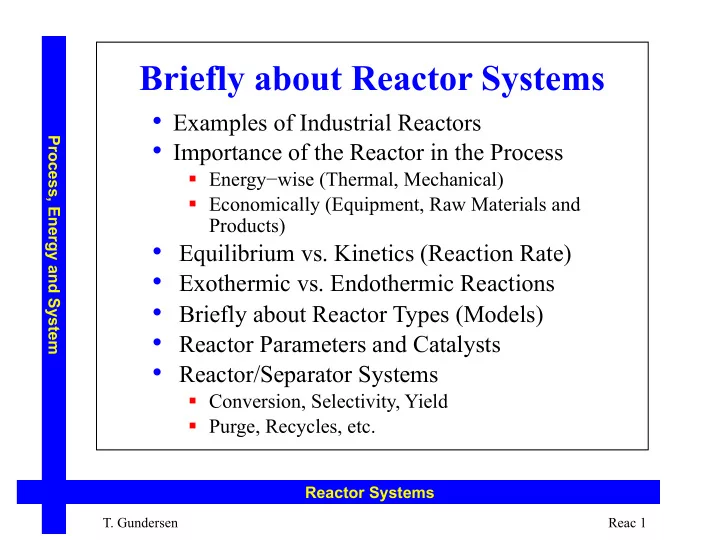
Briefly about Reactor Systems Examples of Industrial Reactors Importance of the Reactor in the Process Process, Energy and System Energy wise (Thermal, Mechanical) Economically (Equipment, Raw Materials and Products)


slide-1
SLIDE 1
  • T. Gundersen

Briefly about Reactor Systems

  • Examples of Industrial Reactors
  • Importance of the Reactor in the Process

§ Energy−wise (Thermal, Mechanical) § Economically (Equipment, Raw Materials and Products)

  • Equilibrium vs. Kinetics (Reaction Rate)
  • Exothermic vs. Endothermic Reactions
  • Briefly about Reactor Types (Models)
  • Reactor Parameters and Catalysts
  • Reactor/Separator Systems

§ Conversion, Selectivity, Yield § Purge, Recycles, etc.

Reac 1

Reactor Systems Process, Energy and System

slide-2
SLIDE 2
  • T. Gundersen

Example: The HDA Process

REACTOR TOLUENE COL. BENZENE COL. STABILIZER

Diphenyl Benzene Fuel Gas Toluene Feed Toluene Recycle H2 Feed Flash Drum Purge Compressor Gas Recycle

Reac 2

Reactor Systems Process, Energy and System

slide-3
SLIDE 3
  • T. Gundersen

Reactors, Conversion and Selectivity

Example: Toluene + H2 = Benzene + CH4 2 Benzene = Diphenyl + H2 Conversion: X = (Toluene reacted) / (feed of Toluene) Selectivity: S = (produced Benzene) / (Toluene reacted)

  • 0.60
  • 0.40
  • 0.20

0.00 0.20 0.40 0.60 0.80 1.00 0.00 0.20 0.40 0.60 0.80 1.00

Conversion (X) Selectivity (S)

Reac 3

Reactor Systems Process, Energy and System

( )

1.544

0.0036 1 1 S X = − −

slide-4
SLIDE 4
  • T. Gundersen

Conversion: X = ( RF - RX ) / RF Selectivity: S = ( PX / ( RF - RX ) ) * SF Recycle Ratio: ω = RR / FF Yield: yR = ( PX / RF ) * SF (reactor) yP = ( P / FF ) * SF (process)

(SF is Stoichiometric Factor => S and y are (0-1) normalized)

Reactors and Yield

R S FF RR P PX RX RF BP

yR = X×S yP = X×S×(1+ω)

Reac 4

Reactor Systems Process, Energy and System

slide-5
SLIDE 5
  • T. Gundersen

Briefly about Separation Systems

  • What do we mean by Separation ?

§ Cleaning, Purifying, Recovering

  • Decisions and Subtopics

§ Technology (Separation Method) § Optimal Design of one Separator § Sequence of Separators § Heat Integration of Separators

  • Separators in this Course

§ “Thermally driven” Separation Systems § Distillation (a lot), Evaporation (some) § Drying is not covered at all

Sep 1

Separation Systems Process, Energy and System

slide-6
SLIDE 6
  • T. Gundersen

Selection of Separation Method

  • Separate Phases

§ S/L, S/G, G/L, L/L è “Heterogeneous”

  • Separate Components in one Phase

§ è “Homogeneous” § Often generate a new Phase (Distillation)

  • Separation utilizes various Properties
  • f the Phases and/or Components

§ Volatility, Solubility § Permeability, Particle Size § Density, Surface Properties, etc.

Sep 2

Separation Systems Process, Energy and System

slide-7
SLIDE 7
  • T. Gundersen

Vapor/Liquid Equilibrium and Distillation

XF,i kmole/h A 0.2 20.0 B 0.3 30.0 C 0.5 50.0 Tot 1.0 100.0 Yi kmole/h A 0.474 10.88 B 0.404 9.27 C 0.122 2.80 Tot 1.000 22.95 Xi kmole/h A 0.118 9.09 B 0.269 20.72 C 0.613 47.23 Tot 1.000 77.05

P,T ΔP

F , XF,i V , Yi L , Xi

Material Balances (moles): F • XF,i = V • Yi + L • Xi Equilibrium Relations: Yi = Ki • Xi Assume: K = diag (4.0 , 1.5 , 0.2)

Sep 3

Separation Systems Process, Energy and System

slide-8
SLIDE 8
  • T. Gundersen

Typical Flowsheet for Oil & Gas Separation

Sep 4

Separation Systems Process, Energy and System

Further Drying and Compression Gas Oil From Well

slide-9
SLIDE 9
  • T. Gundersen

The “ultimate” VLE Separation is Distillation

Sep 5

Separation Systems Process, Energy and System

  • Multiple VLE Stages

§ Stagewise with Trays § Continuous with Packing Material

  • Countercurrent Flow

§ Well-known Principle with optimal use of the Driving Forces

  • Tray Efficiencies

§ Too short Residence Time for Equilibrium at each Tray/Stage

slide-10
SLIDE 10
  • T. Gundersen

Distillation can be complicated

C1-C5 C6-C10 C13-C17 C18-C25 C26-60

Sep 6

Separation Systems Process, Energy and System

slide-11
SLIDE 11
  • T. Gundersen

Distillation Columns and Energy

Sep 7

  • Typical Issues

§ Distillation is Energy intensive § Good Control of the Columns is important

  • Options to reduce Energy Consumption:

§ Best Sequence of Columns § Heat Integration between Columns § Integration with the “Background Process” § Use of a Heat Pump § Change Operating Parameters (pressure, reflux) § Change Column Configuration (“complex”)

Separation Systems Process, Energy and System

slide-12
SLIDE 12
  • T. Gundersen

F, xF QC , TC , AC QR , TR , AR L P V B, xB D, xD

1 N

Sep 8

  • “Simple” Columns:

§ 1 feed, 2 products § 1 reboiler, 1 condenser

  • “Complex” Columns:

§ > 1 feed § > 2 products (sidedraw) § Distributed reboiling and condensing (pumparound)

Separation Systems Process, Energy and System

slide-13
SLIDE 13
  • T. Gundersen

“Complex” Columns

Sep 9

  • Vapor Recompression

§ “Open” Heat Pump (next slide)

  • Thermal Coupling
  • Distributed Heat Exchange

§ Side Reboilers and Condensers

  • Side Strippers / Side Rectifiers
  • Prefractionation
  • Turbo Expander for Reflux
  • Multiple Feeds and/or Sidedraws
  • Examples of Complex Columns

§ Petlyuk, Dividing Wall, Kaibel, etc.

Separation Systems Process, Energy and System

slide-14
SLIDE 14
  • T. Gundersen

W Distillate Bottoms Feed CW

Vapor Recompression

Sep 10

Separation Systems Process, Energy and System

slide-15
SLIDE 15
  • T. Gundersen

Sequence of Distillation Columns

Sep 11

Separation Systems Process, Energy and System

Problem Definition by Thompson and King, AIChE Jl, 1972:

”Given a mixture of N chemical components that is to be separated into N pure component products by using a selection of M separation methods”

[ ]

Seq ( 1) Alt Seq

2 ( 1) ! Number of Sequences ! ( 1)! Number of Alternatives

N

N N N N N N M

⋅ − = = ⋅ − = = ⋅

slide-16
SLIDE 16
  • T. Gundersen

Example – Distillation Sequence

Sep 12

Separation Systems Process, Energy and System

Comp. Name Mole Frac. α=Ki/Kj ”CES” A Propane 0.05 2.00 5.26 B i-Butane 0.15 1.33 8.25 C n-Butane 0.25 2.40 114.50 D i-Pentane 0.20 1.25 13.46 E n-Pentane 0.35 Nadgir & Liu, AIChE Journal, 1983: F = min (D/B, B/D) Δ = (α – 1)×100 CES = f × Δ