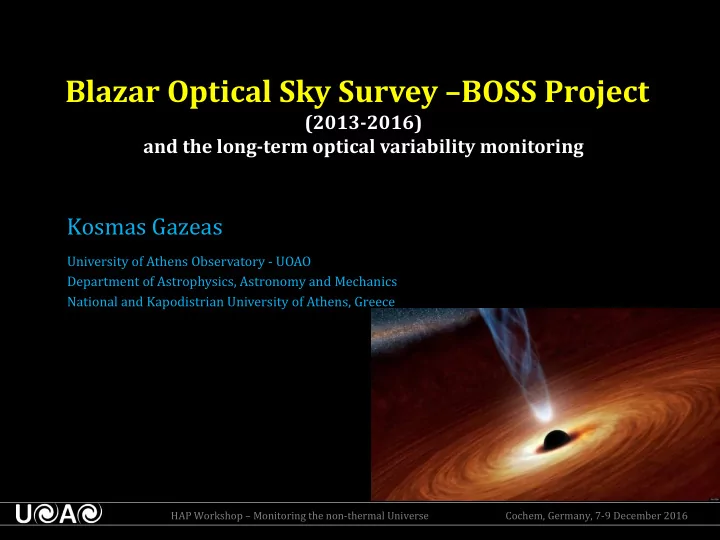
Blazar Optical Sky Survey BOSS Project (2013-2016) and the - - PowerPoint PPT Presentation

blazar optical sky survey boss project
SMART_READER_LITE
LIVE PREVIEW

Blazar Optical Sky Survey BOSS Project (2013-2016) and the - - PowerPoint PPT Presentation

Blazar Optical Sky Survey BOSS Project (2013-2016) and the long-term optical variability monitoring Kosmas Gazeas University of Athens Observatory - UOAO Department of Astrophysics, Astronomy and Mechanics National and Kapodistrian


slide-1
SLIDE 1

Kosmas Gazeas

Blazar Optical Sky Survey –BOSS Project

(2013-2016) and the long-term optical variability monitoring

University of Athens Observatory - UOAO Department of Astrophysics, Astronomy and Mechanics National and Kapodistrian University of Athens, Greece

HAP Workshop – Monitoring the non-thermal Universe Cochem, Germany, 7-9 December 2016

slide-2
SLIDE 2

Blazar Optical Sky Survey (BOSS) project is a dedicated observational survey which aims to the long-term monitoring of known blazars in optical wavelengths. The project started at the University of Athens Observatory (UOAO) in March 2013 under the coordination of Dr. Kosmas Gazeas. In the frame of BOSS Project, ground-based optical photometric observations are performed, in parallel with orbital (SWIFT/XRT, FERMI/LAT) X-ray observatories, as well as ground-based radio observatories (CARMA, OVRO).

Blazar Optical Sky Survey (BOSS) project

HAP Workshop – Monitoring the non-thermal Universe Cochem, Germany, 7-9 December 2016

slide-3
SLIDE 3

BOSS project has immediately met international attention, attracting the interest of several collaborators worldwide, such as:

  • Purdue University (USA)
  • Max Planck Institut - MPIfA (Germany)
  • University of Turku (Finland)
  • Jagiellonian University of Krakow (Poland)
  • Würzburg University (Germany)

It is currently running as an international collaboration of the University of Athens, utilizing the robotic and remotely controlled telescope at the UOAO.

Blazar Optical Sky Survey (BOSS) project

HAP Workshop – Monitoring the non-thermal Universe Cochem, Germany, 7-9 December 2016

slide-4
SLIDE 4

The blazar Mrk421 was the first target to be observed in the frame of BOSS project and soon after, several blazars were added in the list of monitoring targets. The targets are continuously observed on a daily basis, with the aim to achieve dense temporal coverage in optical wavelengths. In parallel, simultaneous observations in high and low energy bands are cross- correlated with BOSS database.

Blazar Optical Sky Survey (BOSS) project

HAP Workshop – Monitoring the non-thermal Universe Cochem, Germany, 7-9 December 2016

Mrk421 Mrk501 Mrk180 BL Lac OJ287 3C279 PKS 1510-089 1ES 1959+650

slide-5
SLIDE 5

BOSS project can contribute in High Energy Astrophysics, in the field where:

  • there is lack of low energy (optical) follow-up observations
  • there is a need for cross-correlation studies
  • multi-wavelength studies are essential for modeling purposes
  • rapid flux variability is “missed” in non-frequent monitoring campaigns

Main contribution of BOSS project

HAP Workshop – Monitoring the non-thermal Universe Cochem, Germany, 7-9 December 2016

slide-6
SLIDE 6

The robotic telescope at the University of Athens Observatory

Dome: 5 m (Observadome Inc, 1994) Telescope: 0.4 m f/8 Cassegrain (DFM Engineering Group, 1997) Operations since 2000 (first light in 1999)

Kosmas Gazeas HAP Workshop – Monitoring the non-thermal Universe Cochem, Germany, 7-9 December 2016

slide-7
SLIDE 7

Robotic and remotely controlled

Since August 2012 the telescope and dome became robotic and remotely controlled. Photometric observations can be performed entirely remotely, utilizing the network connection between the telescope control room and the user.

Kosmas Gazeas HAP Workshop – Monitoring the non-thermal Universe Cochem, Germany, 7-9 December 2016

slide-8
SLIDE 8

Results after the installation of the Auto Dome Remote Control Board in 2012

 Since 2012 the annual observing nights have dramatically increased (almost doubled)

Kosmas Gazeas HAP Workshop – Monitoring the non-thermal Universe Cochem, Germany, 7-9 December 2016

slide-9
SLIDE 9

The super massive binary black hole OJ 287

HAP Workshop – Monitoring the non-thermal Universe Cochem, Germany, 7-9 December 2016

 Continuous monitoring of the supermassive black hole binary.

slide-10
SLIDE 10

The super massive binary black hole OJ 287

HAP Workshop – Monitoring the non-thermal Universe Cochem, Germany, 7-9 December 2016

 Orbital precession of OJ287 binary black hole and the predicted flare events between 2005-2023. Valtonen et al., 2016, ApJ, 819L, 37

slide-11
SLIDE 11

The super massive binary black hole OJ 287

HAP Workshop – Monitoring the non-thermal Universe Cochem, Germany, 7-9 December 2016

December 2015 data

Valtonen et al., 2016, ApJ, 819L, 37

slide-12
SLIDE 12

The super massive binary black hole OJ 287

HAP Workshop – Monitoring the non-thermal Universe Cochem, Germany, 7-9 December 2016

2016, ApJ, 832, 47 2016, ApJ, 819L, 37 2016, Galaxies, 4, 41

slide-13
SLIDE 13

The highly active blazar Mrk421

HAP Workshop – Monitoring the non-thermal Universe Cochem, Germany, 7-9 December 2016

 In 2013 the continuous monitoring of Mrk421 started, covering ~120 days in BVRI optical bands.  Luminosity variations in all bands are cross-correlated with each other and other monitoring campaigns.

slide-14
SLIDE 14

HAP Workshop – Monitoring the non-thermal Universe Cochem, Germany, 7-9 December 2016

 Continuous monitoring of Mrk421 for a total of 370 days (2013-2014) in R-band.  Luminosity variations of this highly active blazar can be cross-correlated with orbital data and/or other monitoring campaigns in a wider range of energies.  Over 98% of these observations were obtained remotely, using automated scripts.

The highly active blazar Mrk421

slide-15
SLIDE 15

Mrk 421

Multiband sample of Mrk421 data, spreading from γ-rays (top) to radio signal (bottom). Vertical lines represent the high energy flare

  • ccurred on 12 April 2013 (MJD 56394) and

the corresponding signals detected a few days later in lower energies. A ~60 day time lag is detected, as a result of electron cooling mechanism.

2013-2014 data

slide-16
SLIDE 16

HAP Workshop – Monitoring the non-thermal Universe Cochem, Germany, 7-9 December 2016

slide-17
SLIDE 17

current status

BOSS Project

3C279, PKS1510-089, 1ES 1959+650 …observations started recently… Mrk501 Collaboration initiated with: Jagiellonian University of Krakow, Poland Würzburg University, Germany BL Lac, Mrk180 …waiting to be “adopted”…

HAP Workshop – Monitoring the non-thermal Universe Cochem, Germany, 7-9 December 2016

slide-18
SLIDE 18

BL Lac – the prototype

HAP Workshop – Monitoring the non-thermal Universe Cochem, Germany, 7-9 December 2016

 Continuous monitoring of BL Lac for a total of ~325 days (2014-2016) in R-band.

slide-19
SLIDE 19

BOSS Project Link: http://users.uoa.gr/~kgaze/boss_project.html Contact info: Kosmas Gazeas Department of Astrophysics, Astronomy and Mechanics Faculty of Physics National and Kapodistrian University of Athens GR-157 84, Zografos, Athens Greece email: kgaze@phys.uoa.gr

  • University of Athens Observatory

Blazar Optical Sky Survey –BOSS Project