Black Hole Love Story In progress RB, Medved, Ram Brustein Many - - PowerPoint PPT Presentation

black hole love story
SMART_READER_LITE
LIVE PREVIEW

Black Hole Love Story In progress RB, Medved, Ram Brustein Many - - PowerPoint PPT Presentation

RB, Sherf, Black Hole Love Story In progress RB, Medved, Ram Brustein Many papers ' 15 - Now - Love # Love # vanishes for GR BHs BSM! The case for horizon-scale corrections : implications


slide-1
SLIDE 1

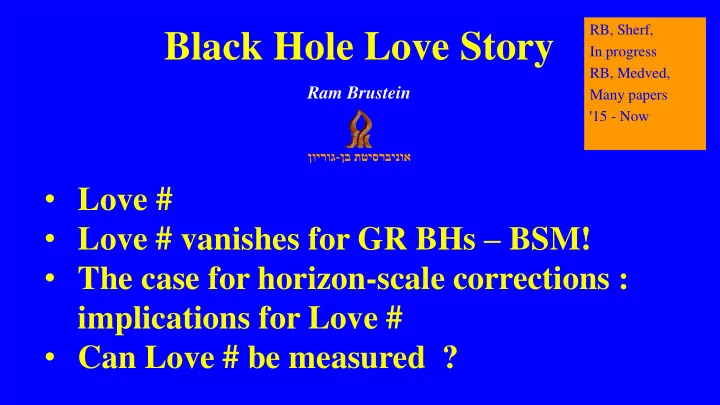
Black Hole Love Story

ןב תטיסרבינוא-ןוירוג

Ram Brustein

RB, Sherf, In progress RB, Medved, Many papers '15 - Now

  • Love #
  • Love # vanishes for GR BHs – BSM!
  • The case for horizon-scale corrections :

implications for Love #

  • Can Love # be measured ?
slide-2
SLIDE 2

Introduction

  • What is a BH ?
  • Schwarzchild/Kerr geometry correct ?
  • Probe the near horizon region
  • Probe quantum structure of BHs
slide-3
SLIDE 3

Deviations from GR

  • Q: Why expect anything besides GR during a BH merger ?
  • A: Fundamental physics principles & established facts 

Internal “quantum” structure

  • Q: What type of deviations from GR ?
  • A: Internal structure 

Additional ringdown modes, nonzero Love #

  • Q: What type of deviations from GR do not expect ?
  • A: Different talk
slide-4
SLIDE 4

Meaning of “Interior / quantum structure”

 

2 2 2 2 2 2

2

2

1 1

1

GM r

GM r

ds dt dr r d

     

Interior ~ r < 2 GM State of interior Quantum state of collapsed object Classically Causally separated from exterior

slide-5
SLIDE 5

Excited BH relaxes to equilibrium

Classically: horizon tidal deformation +ive null energy  horizon grows  Causality (Hartle ’73, Poisson + ) Quantum mechanically

  • ive null energy 

horizon shrinks  Causality (Mathur ’17, Maldacena+’17)

Ringdown/Merger – “large” deformation, short time Inspiral – “small” deformation, long time

slide-6
SLIDE 6

Excited BH relaxes to equilibrium

Ringdown/Merger – “large” deformation, short time Inspiral – “small” deformation, long time Amount of information that can be “read” determined by the degree of excitation DE/E

Can we use  Ringdown ? Inspiral, Love # to probe quantum structure ?

slide-7
SLIDE 7

Love number(s)

Blanchet LRR '06 Hinderer 0711.2420 Thorn 9706057 Porto 1606.08895

 

3

2 1 1 3 2

2

3

1

ij

i j ij i j tt ij

Q M

r

r

g n n r n n         

i

i

x r

n 

 

3 1 3

( )

ij i j ij Star

Q d x x x x    

2 ext i j

ij

x x

    

ij ij

Q   

5

3 2 2 R

k

2 5

~ ~

Q R

M Q 

2 3

~

~

Q R

MR

2

~ R 

2

~ M  

Excitation of l = 2 mode of star @ w = 0 Linear response

Newtonian

slide-8
SLIDE 8

Love number(s) for NS

Hinderer 0711.2420 Thorn 9706057

Boundary conditions

  • 1. Regularity @ r = 0
  • 2. Continuity @ r = R
slide-9
SLIDE 9

Love number(s) for NS

Hinderer 0711.2420        

2 2

2

1 2 ~ 1 2 1 2 ln 1 2 A C B C D C C

k

    

NS: C~ ¼, BH C =1/2

slide-10
SLIDE 10

Love number(s) = 0 for 4D GR BHs

  • 0906.1366 Binnington, Poisson
  • 0906.0096 Damour, Nagar – No Hair
  • Tidal deformation of BHs but Love #s = 0

1411.4711 Poisson

  • No-Hair theorem  Love #s = 0

1503.03240 Gurlebeck /. external sources

  • 1606.08895 Porto
  • Love #s in higher dimensions don’t vanish

Kol, Smolkin 1110.3764

Boundary conditions

  • 1. Regularity @ r = 0  horizon
  • 2. Continuity @ r = R  infinity

G: “The change in the geometry of the horizon is, however, not reflected in the asymptotic multipole moments”

slide-11
SLIDE 11

Love number(s) scaling for hypothetical compact objects

1701.01116v4, Cardoso et al.   

Hypothetical compact objects with radius larger than RS

Original uses x instead of 

5

| ln( /10 ) |~100

P

l M

       

2 2

2

1 2 ~ 1 2 1 2 ln 1 2 A C B C D C C

k

    

slide-12
SLIDE 12

Love # = 0 scaling for compact objects /

Requires new internal “fluid modes” (or a horizonless object) Otherwise same issue as for GR BHs: “The change in the geometry of the horizon is, however, not reflected in the asymptotic multipole moments”

The case for horizon-scale corrections : implications for Love #

slide-13
SLIDE 13

redshift

S

r R  D 

*

ln

S

r R  

1

1 1

S S S S

r RS

R R r tt R R

r

g

D

D       

     

The case for horizon-scale corrections : implications for Love #

Assume a surface @ Dr from the object’s Schwarzschild radius Introducing ln :

slide-14
SLIDE 14

BH as a bound state of strings @ Hagedorn temperature “collapsed polymer”, maximal entropy state

  • From the outside, in equilibrium, looks exactly like a BH
  • Mass and entropy scale correctly
  • Does not collapse – entropy dominated/uncertainty principle
  • Extremely sharp horizon
  • Correct rate of Hawking radiation

Two parameters: T-THag, gs

2 ~ hbar

RB, Medved

1805.11667

1607.03721

1602.07706

1505.07131

slide-15
SLIDE 15

sound

v c 

New internal “fluid modes” of quantum BHs

Hagedorn phase strings, “collapsed polymer”

  • Paremetrically smaller frequencies
  • Parematerically longer damping

times

Intrinsic dissipation Only matter that saturates KSS-like bound can support waves!

RB, Medved, Yagi

1704.05789

1701.07444 1811.12283 RB, Sherf 1902.08449

2

" "

s

g 

slide-16
SLIDE 16

Exterior Velocity = c redshift z  f ~ c/ RS (-gtt)1/2 << c/ RS

Spectrum of additional fluid modes: Frequency (without rotation)

Interior Non-Relativistic wave & frequency v/c << 1  f ~ v/RS << c/ RS redshift ~ v/c No additional relativistic modes that interfere with the GR spacetime modes Two perspectives  same estimate

1

1 1 1 | ln |

S S S S

r RS

R R r tt R R

r

g 

D

D       

      

RB, Medved

1902.07990

1805.11667

  • 1709. 03566

2 2

2,

/ " "

s

g v c 

slide-17
SLIDE 17

Sound velocities in the “collapsed polymer”

KI - Elastic modulus for mode of type I  –energy density

  • force per unit area

DL/L – fractional deformation

The case for horizon-scale corrections : implications for Love #

2 2

2

2 ~

/ " "

s

k v c g  

 

2 2 sound I I

v K p c  

 

Not a calculation yet, a reliable estimate All dimensionful parameters included in definition of k2

slide-18
SLIDE 18

Can Love be measured ?

1703.10612, Masseli +

 

 

3

5/2 5/2 2 2 2

~ ~

TD GM R r c

k k

w

LISA

LIGO +, 3rd generation

  • nly sensitive to large

values of k2 LISA sensitivity

5 4 1 2 2 4

~10 ~ 10 , :10 10 10

TD cycles

M k z N M f H 

  

 

2 2 ~10

k

2 2

2

2 ~

/ 1/10

s

k v c g  

slide-19
SLIDE 19

Black Hole Love Story

ןב תטיסרבינוא-ןוירוג

Ram Brustein

RB, Sherf, In progress RB, Medved, Many papers '15 - Now

  • Love #
  • Love # vanishes for GR BHs – BSM!
  • The case for horizon-scale corrections :

implications for Love #

  • Can Love # be measured ?
slide-20
SLIDE 20
slide-21
SLIDE 21

EV S G 

s G  

Maximal entropy Causal Entropy Bound (RB+Veneziano '99) S(V)=SBH “Maximally quantum”

slide-22
SLIDE 22

Maximal entropy Maximal positive pressure

sT p    p  

slide-23
SLIDE 23
  • Introduction

– Love, what is it good for ?

In 1911 (some authors have 1906)[1] Augustus Edward Hough Love introduced the values h and k which characterize the overall elastic response of the Earth to the tides. For elastic Earth the Love numbers lie in the range 0.304< k2 < 0.312