Binary packaging for HPC with Spack HPC, Big Data, and Data Science - - PowerPoint PPT Presentation

binary packaging for hpc with spack
SMART_READER_LITE
LIVE PREVIEW

Binary packaging for HPC with Spack HPC, Big Data, and Data Science - - PowerPoint PPT Presentation

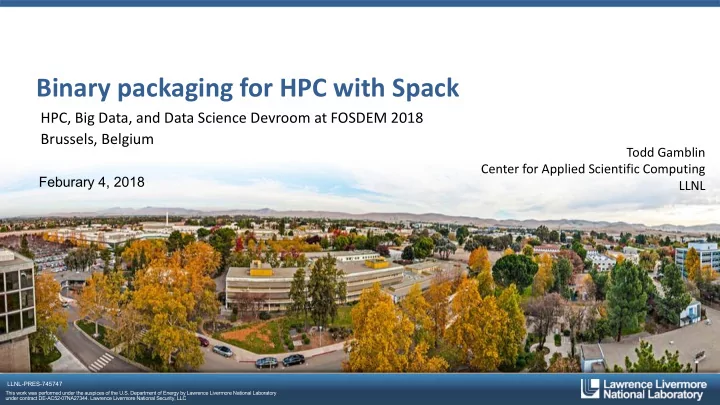
Binary packaging for HPC with Spack HPC, Big Data, and Data Science Devroom at FOSDEM 2018 Brussels, Belgium Todd Gamblin Center for Applied Scientific Computing Feburary 4, 2018 LLNL LLNL-PRES-745747 This work was performed under the


slide-1
SLIDE 1

LLNL-PRES-745747

This work was performed under the auspices of the U.S. Department of Energy by Lawrence Livermore National Laboratory under contract DE-AC52-07NA27344. Lawrence Livermore National Security, LLC

Binary packaging for HPC with Spack

HPC, Big Data, and Data Science Devroom at FOSDEM 2018 Brussels, Belgium

Todd Gamblin Center for Applied Scientific Computing LLNL Feburary 4, 2018

slide-2
SLIDE 2

LLNL-PRES-745747

2

@spackpm

github.com/spack

Spack is a general purpose, from-source package manager

§ Inspired somewhat by homebrew and nix § Targets HPC and scientific computing

— Community is growing!

§ Goals:

— Facilitate experimenting with performance options — Flexibility. Make these things easy:

  • Build packages with many different:

– compilers/versions/build options

  • Change compilers and flags in builds (keep provenance)
  • Swap implementations of ABI-incompatible libraries

– MPI, BLAS, LAPACK, others like jpeg/jpeg-turbo, etc.

— Build software stacks for scientific simulation and

analysis

— Run on laptops, Linux clusters, and some of the

largest supercomputers in the world

Spack

https://spack.io

slide-3
SLIDE 3

LLNL-PRES-745747

3

@spackpm

github.com/spack

Spec CLI syntax makes it easy to install different ways

$ spack install mpileaks unconstrained $ spack install mpileaks@3.3 @ custom version $ spack install mpileaks@3.3 %gcc@4.7.3 % custom compiler $ spack install mpileaks@3.3 %gcc@4.7.3 +threads +/- build option $ spack install mpileaks@3.3 cflags="-O3 –g3" setting compiler flags $ spack install mpileaks@3.3 ^mpich@3.2 %gcc@4.9.3 ^ dependency constraints

§ Each expression is a spec for a particular configuration

— Each clause adds a constraint to the spec — Constraints are optional – specify only what you need. — Customize install on the command line!

§ Spec syntax is recursive

— ^ (caret) adds constraints on dependencies

slide-4
SLIDE 4

LLNL-PRES-745747

4

@spackpm

github.com/spack

Spack packages are templates: they define how to build a spec

from spack import * class Dyninst(Package): """API for dynamic binary instrumentation.""” homepage = "https://paradyn.org" url = "http://www.paradyn.org/release8.1.2/DyninstAPI-8.1.2.tgz" version('8.2.1', 'abf60b7faabe7a2e’) version('8.1.2', 'bf03b33375afa66f’) version('8.1.1', 'd1a04e995b7aa709’) depends_on("cmake", type="build") depends_on("libelf", type="link") depends_on("libdwarf", type="link") depends_on("boost @1.42: +multithreaded") def install(self, spec, prefix): with working_dir('spack-build', create=True): cmake('-DBoost_INCLUDE_DIR=‘ + spec['boost'].prefix.include, '-DBoost_LIBRARY_DIR=‘ + spec['boost'].prefix.lib, '-DBoost_NO_SYSTEM_PATHS=TRUE’ '..') make() make("install")

Metadata at the class level Versions Install logic in instance methods Dependencies Patches, variants, resources, conflicts, etc. (not shown)

Simple Python DSL

Packages are classes (ala homebrew)

Directives use the same spec syntax

slide-5
SLIDE 5

LLNL-PRES-745747

5

@spackpm

github.com/spack

§

mpi is a virtual dependency

§ Install the same package built with two

different MPI implementations:

§ Virtual deps are replaced with a valid

implementation at resolution time.

— If the user didn’t pick something and there

are multiple options, Spack picks.

Depend on interfaces (not implementations) with virtual dependencies

$ spack install mpileaks ^mvapich $ spack install mpileaks ^openmpi@1.4:

mpileaks mpi callpath dyninst libdwarf libelf

class Mpileaks(Package): depends_on("mpi@2:") class Mvapich(Package): provides("mpi@1” when="@:1.8") provides("mpi@2” when="@1.9:") class Openmpi(Package): provides("mpi@:2.2" when="@1.6.5:")

Virtual dependencies can be versioned:

dependent provider provider

slide-6
SLIDE 6

LLNL-PRES-745747

6

@spackpm

github.com/spack

Spack builds packages with compiler wrappers

Spack Process

Set up environment

CC = spack/env/intel/icc SPACK_CC = /opt/ic-15.1/bin/icc CXX = spack/env/intel/icpc SPACK_CXX = /opt/ic-15.1/bin/icpc F77 = spack/env/intel/ifort SPACK_F77 = /opt/ic-15.1/bin/ifort FC = spack/env/intel/ifort SPACK_FC = /opt/ic-15.1/bin/ifort PKG_CONFIG_PATH = ... PATH = spack/env:$PATH CMAKE_PREFIX_PATH = ... LIBRARY_PATH = ...

do_install()

Install dep1 Install dep2 Install package

Build Process

Fork

install()

configure make make install

  • I /dep1-prefix/include
  • L /dep1-prefix/lib
  • Wl,-rpath=/dep1-prefix/lib

Compiler wrappers (spack-cc, spack-c++, spack-f77, spack-f90) icc icpc ifort

Similar to homebrew “shims”

Forked build process isolates environment for each build

Use compiler wrappers to add include, lib, and RPATH flags

RPATHs ensure that the correct dependencies are found automatically at runtime.

slide-7
SLIDE 7

LLNL-PRES-745747

7

@spackpm

github.com/spack

§ Each unique dependency graph is a unique

configuration.

§ Each configuration installed in a unique directory.

— Configurations of the same package can coexist.

§ Hash of directed acyclic graph (DAG) metadata is

appended to each prefix

— Note: we hash the metadata, not the artifact.

§ Installed packages automatically find dependencies

— Spack embeds RPATHs in binaries. — No need to set LD_LIBRARY_PATH — Things work the way you built them

Hashes handle combinatorial software complexity.

spack/opt/ linux-rhel7-x86_64/ gcc-4.7.2/ mpileaks-1.1-0f54bf34cadk/ intel-14.1/ hdf5-1.8.15-lkf14aq3nqiz/ bgq/ xl-12.1/ hdf5-1-8.16-fqb3a15abrwx/ ...

mpileaks mpi callpath dyninst libdwarf libelf

Installation Layout Dependency DAG

Hash

slide-8
SLIDE 8

LLNL-PRES-745747

8

@spackpm

github.com/spack

Spack’s dependency model centers around “concretization”

mpileaks ^callpath@1.0+debug ^libelf@0.8.11

User input: abstract spec Concrete spec is fully constrained and can be built.

mpileaks@2.3 %gcc@4.7.3 =linux-ppc64 mpich@3.0.4 %gcc@4.7.3 =linux-ppc64 callpath@1.0 %gcc@a4.7.3+debug =linux-ppc64 dyninst@8.1.2 %gcc@4.7.3 =linux-ppc64 libelf@0.8.11 %gcc@4.7.3 =linux-ppc64 libdwarf@20130729 %gcc@4.7.3 =linux-ppc64

Abstract, normalized spec with some dependencies.

mpileaks mpi callpath@1.0 +debug dyninst libelf@0.8.11 libdwarf

Concretize

§ Similar to other dependency resolvers, but solves for

more than just package and version.

§ Full spec is stored in a file in the installation directory

— Can reinstall same build with:

spack install –f spec.yaml

Store

spec:

  • mpileaks:

arch: linux-x86_64 compiler: name: gcc version: 4.9.2 dependencies: adept-utils: kszrtkpbzac3ss2ixcjkcorlaybnptp4 callpath: bah5f4h4d2n47mgycej2mtrnrivvxy77 mpich: aa4ar6ifj23yijqmdabeakpejcli72t3 hash: 33hjjhxi7p6gyzn5ptgyes7sghyprujh variants: {} version: '1.0'

  • adept-utils:

arch: linux-x86_64 compiler: name: gcc version: 4.9.2 dependencies: boost: teesjv7ehpe5ksspjim5dk43a7qnowlq mpich: aa4ar6ifj23yijqmdabeakpejcli72t3 hash: kszrtkpbzac3ss2ixcjkcorlaybnptp4 variants: {} version: 1.0.1 ...

spec.yaml spec.yaml Detailed provenance is stored with the installed package

slide-9
SLIDE 9

LLNL-PRES-745747

9

@spackpm

github.com/spack

Source installs are great, but they’re slow

§ Most people prefer using a binary package manager

— Binary packages typically use portable code — Binary installs are typically a lot slower than what you get from building from source

§ We’d like to have the best of both worlds:

— Optimized buids for specific machine models (skylake, haswell, ivy bridge, etc.) — Binary packages available without having to build from source

§ What’s needed?

1.

Binary packaging capability

2.

Metadata describing architecture-specific builds

3.

Good dependency resolution to select optimized or generic versions of packages

slide-10
SLIDE 10

LLNL-PRES-745747

10

@spackpm

github.com/spack

We recently released Spack v0.11

§ 2,178 packages (up from 1,114 a year ago) § Big features for users:

— Relocatable binary packages (spack buildcache) — Full support for Python 3 — Improved module support; custom module templates using jinja2

§ Many improvements for packagers:

— Multi-valued variants — Test dependency type — Packages can patch their dependencies (not just themselves)

§ Many speed improvements (to Spack itself)

https://github.com/spack/spack/releases/

slide-11
SLIDE 11

LLNL-PRES-745747

11

@spackpm

github.com/spack

Binary packaging in Spack v0.11

§ Spack v0.11 has a new spack buildcache command:

spack buildcache create <spec> # create a new binary package spack buildcache list # list available binaries spack buildcache install # install a binary package (specifically)

§ Typically, install is not needed; you can just do:

spack install --use-cache # prefer binaries if available

§ We don’t enable binaries by default yet

— We’ll make –use-cache default when we start hosting stable binaries

§ Thanks to our collaboration with Fermilab, CERN, and Kitware for this feature!

slide-12
SLIDE 12

LLNL-PRES-745747

12

@spackpm

github.com/spack

How to make a binary

1.

Set up GNU PG for binary signing

— Unsigned binaries can be created but are discouraged

spack gpg create "Todd Gamblin" tgamblin@gmail.com # create a new signing keypair spack gpg init # trust initial keypair

2.

Install something

spack install m4 # install m4 ... spack find ==> 2 installed packages.

  • - darwin-elcapitan-x86_64 / clang@8.0.0-apple ------------------

libsigsegv@2.11 m4@1.4.18

3.

Run spack buildcache create on that thing

spack buildcache create -d /path/to/mirror m4 # create a binary package in mirror

§ Binaries and metadata for the package and its dependencies will be in:

/path/to/mirror/build_cache/

slide-13
SLIDE 13

LLNL-PRES-745747

13

@spackpm

github.com/spack

Binary mirror structure

§ Binaries go in build_cache/<platform>/<compiler>/<pkg-version> § Metadata for all packages is (currently) kept at the top level

— We’ll need to index these files eventually

§ build_cache subdirectory sits inside of a Spack mirror directory

— Makes it easy to add binaries to an existing source mirror

§ This structure is very easy to host in something like S3, a web server, or a shared filesystem

mirror/ !""build_cache #""darwin-elcapitan-x86_64 $ !""clang-8.0.0-apple $ #""libsigsegv-2.11 $ $ !"" darwin-elcapitan-x86_64-clang-8.0.0-apple-libsigsegv-2.11-5rjv56uui3crfmsgsqgqab52yfhr6t4b.spack $ !""m4-1.4.18 $ !"" darwin-elcapitan-x86_64-clang-8.0.0-apple-m4-1.4.18-eqbzieloqiwxfe4drksmekvfqia7mqbu.spack #"" darwin-elcapitan-x86_64-clang-8.0.0-apple-libsigsegv-2.11-5rjv56uui3crfmsgsqgqab52yfhr6t4b.spec.yaml #"" darwin-elcapitan-x86_64-clang-8.0.0-apple-m4-1.4.18-eqbzieloqiwxfe4drksmekvfqia7mqbu.spec.yaml !"" index.html

slide-14
SLIDE 14

LLNL-PRES-745747

14

@spackpm

github.com/spack

Pointing Spack to a mirror

§ Spack v0.11 has a new spack buildcache command:

$ spack mirror add mypkgs https://example.spack-mirror.com/mirror

§ You can verify that it worked by looking at what mirrors are configured:

$ spack mirror list mypkgs https://example.spack-mirror.com/mirror

§ Mirrors can contain source tarballs and binaries

— Detailed info in docs on mirrors.yaml

slide-15
SLIDE 15

LLNL-PRES-745747

15

@spackpm

github.com/spack

How fetching works in spack

Concretize fetch source code build load mpileaks/package.py from repo fetch from user mirrors from var/spack/cache (local mirror) fetch from package URL install install relocate configure Binary available? Yes No Install from binary Build from source verify signature verify checksum

...

spack install mpileaks

slide-16
SLIDE 16

LLNL-PRES-745747

16

@spackpm

github.com/spack

What’s in a Spack binary package?

§ The binary is just a tarball § Contains:

1.

Another tarball of the installed prefix

2.

The spec.yaml:

  • describes the build (Spack metadata)
  • Contains a special entry with the checksum of the source tarball (maps spack hash to SHA256)

3.

A signature

  • tells us we can trust the spec.yaml

$ tar tzf darwin-elcapitan-x86_64-clang-8.0.0-apple-m4-1.4.18-eqbzieloqiwxfe4drksmekvfqia7mqbu.spack darwin-elcapitan-x86_64-clang-8.0.0-apple-m4-1.4.18-eqbzieloqiwxfe4drksmekvfqia7mqbu.tar.gz darwin-elcapitan-x86_64-clang-8.0.0-apple-m4-1.4.18-eqbzieloqiwxfe4drksmekvfqia7mqbu.spec.yaml darwin-elcapitan-x86_64-clang-8.0.0-apple-m4-1.4.18-eqbzieloqiwxfe4drksmekvfqia7mqbu.spec.yaml.asc

slide-17
SLIDE 17

LLNL-PRES-745747

17

@spackpm

github.com/spack

Why do we checksum source but sign binaries?

§ Other systems provide checksums for sources and binaries in their package files

— e.g., homebrew “bottles”

§ In Spack, the number of binaries associated with a source tarball can be very large!

— We could have thousands of binaries for the same source:

  • Different flags, different build options etc.

— Each of these would have a different Spack

§ Putting checksums for all of these in the package files:

— Would add a lot of extra bytes to a package repository — Is unmaintainable — Means that we have to update package.py files whenever we update a mirror

§ With signing, the client can trust one or several keys and verify a large number of

packages with a small number of public keys

slide-18
SLIDE 18

LLNL-PRES-745747

18

@spackpm

github.com/spack

What’s relocation?

§ When Spack creates a binary package, it

traverses the installation directory and examines the files

— Uses the file command

§ It records the files that need to be relocated

after installation:

— Libraries with RPATHs — Shell scripts with #! Lines

§ After installation, Spack:

— rewrites RPATHs with patchelf (Linux) or

install_name_tool (macOS)

— Rewrites #! lines to point to the Spack

installation on the installing machine

§ Install is faster b/c we record the needed

relocations at package creation time

spack/opt/ linux-rhel7-x86_64/ gcc-4.7.2/ mpileaks-1.1-0f54bf34cadk/ bin/ mpileaks-run lib/ libmpileaks.so

Installation Layout

§ We try to make root-relative RPATHs when

possible, but don’t always get everything.

§ We also rewrite RPATHs to directories within the spack

root fi the install machine uses a different layout.

§ We are not currently relocating compiler runtime paths

We should. This is work in progress

slide-19
SLIDE 19

LLNL-PRES-745747

19

@spackpm

github.com/spack

How do we decide which binaries to fetch?

§ We currently only fetch binaries if

they satisfy the exact hash result of concretization

§ This doesn’t leave a lot of room for

change in the system

— Small changes in Spack mean

having to build from source again

— Works best on a stable release

§ We are working on a new

concretizer that will consider available binary specs

— Doing this better requires a

backtracking SAT solve

mpileaks@2.3 %gcc@4.7.3 =linux-ppc64 mpich@3.0.4 %gcc@4.7.3 =linux-ppc64 callpath@1.0 %gcc@a4.7.3+debug =linux-ppc64 dyninst@8.1.2 %gcc@4.7.3 =linux-ppc64 libelf@0.8.11 %gcc@4.7.3 =linux-ppc64 libdwarf@20130729 %gcc@4.7.3 =linux-ppc64 mpileaks mpi callpath@1.0 +debug dyninst libelf@0.8.11 libdwarf

Concretize

Current In progress

Fetch exact hashes, if available

mpileaks@2.3 %gcc@4.7.3 =linux-ppc64 mpich@3.0.4 %gcc@4.7.3 =linux-ppc64 callpath@1.0 %gcc@a4.7.3+debug =linux-ppc64 dyninst@8.1.2 %gcc@4.7.3 =linux-ppc64 libelf@0.8.11 %gcc@4.7.3 =linux-ppc64 libdwarf@20130729 %gcc@4.7.3 =linux-ppc64 mpileaks mpi callpath@1.0 +debug dyninst libelf@0.8.11 libdwarf

Concretize

Prefer available binaries in concretization Download available specs from mirror

slide-20
SLIDE 20

LLNL-PRES-745747

20

@spackpm

github.com/spack

Spack can ship optimized binaries

§ The Spack architecture descriptor currently includes:

— Platform: cray, mac, linux, bgq

  • Meant to represent a family of machines with potentially many OS/target combinations

— OS: rhel6, rhel7, ubuntu14, elcapitan, sierra, centos6, centos7, etc. — Target:

  • Generic: x86_64, ppc64le, etc.
  • Specific: haswell, ivybridge, knl, power8, power9, etc.

§ Some triples:

— darwin-sierra-x86_64 — darwin-elcapitan-x86_64 — cray-cnl6-knl — cray-cnl6-haswell

§ These architecture descriptors are part of the binary metadata

— If we can fetch an index of available packages first, we can be picky about what binaries we want — This is a core spec parameter in Spack, not just a naming convention for packages

slide-21
SLIDE 21

LLNL-PRES-745747

21

@spackpm

github.com/spack

Detecting optimized architectures

§ Currently Spack will only use an optimized architecture descriptor on Cray

— We get the architecture name from the Cray Programming Environment — We can know whether we’re building for Haswell, Broadwell, KNL, etc.

§ We have work in progress that detects these names for Intel, AMD, Power,

and ARM hardware (looking at available info in /proc/cpuinfo, etc.)

— We’re planning to shift to a model where we use the specific descriptor by

default

— We would still allow a user to set preferences to build generic if they want — Important for CERN and Fermi collaborators who run heterogeneous clusters

§ Once this is done, we do plan to make arch-specific binaries available.

slide-22
SLIDE 22

LLNL-PRES-745747

22

@spackpm

github.com/spack

Some issues with optimized binaries

§ Architectures like ARM don’t lend themselves to concise descriptors.

— We may need to be more fine-grained here

§ We may need to add a more fine-grained architecture descriptor that just exposes

the instruction sets available on the machine

— E.g., instead of “haswell”, put “sse4.2, avx, avx2, etc.” — These attributes may actually be easier for packagers and maintainers to use

§ We need a setting on the user side (e.g. in packages.yaml) that lets them choose

what the minimum architecture is for compatibility

— This seems easier to do with well known system names

slide-23
SLIDE 23

LLNL-PRES-745747

23

@spackpm

github.com/spack

Tuning for optimized binaries may be tricky

§ Most compilers give you two knobs to control architecture-specific tuning:

  • march=[generic|native]
  • mtune=[generic|native]

— If you tune generic for an older architecture, it will run fine on that architecture and on

newer architectures.

— If you tune native, you’ll get code that only runs fast on the specific architecture, and may

not perform as well on future chips. § In Spack, we might want policies like this:

— “Generic tuning, with code no later than sandy bridge”, e.g. if sandy bridge is the older

architecture on a heterogeneous cluster

— “Native tuning, just for this machine”, e.g., if we know we want to optimize for a long-lived,

homogeneous cluster.

slide-24
SLIDE 24

LLNL-PRES-745747

24

@spackpm

github.com/spack

Building a primary binary mirror for Spack

§ We’re currently setting up build automation to create binaries for:

— All default package configurations in releases (result of spack install <name>) — Selected other slices of those configuration spaces, e.g.:

  • x MPI versions
  • x Compilers
  • x OS’s
  • x large-scale DOE machines (Cori, Theta, Titan, Summit, etc.)

§ Once this is done, we’ll also continuously build packages for the develop branch as PRs

come in

— We’ll need to determine when to purge old builds and binaries — Depends on analytics

§ We are currently planning to host binaries in S3

— but Jfrog/bintray sounds interesting. Maybe we should talk to them.

slide-25
SLIDE 25

LLNL-PRES-745747

25

@spackpm

github.com/spack

Summary

We built relocatable binary packaging into Spack Current projects:

1.

Binary build infrastructure

2.

Better concretization to support optimized binaries

3.

Compiler library relocation Shooting for September to have all of this done.

Spack

Come and get Spack stickers!

https://spack.io

slide-26
SLIDE 26