Big Data and Health CLS&I Study Group January 28, 2016 Gary - - PDF document

big data and health
SMART_READER_LITE
LIVE PREVIEW

Big Data and Health CLS&I Study Group January 28, 2016 Gary - - PDF document

2/5/2016 Google Maps: Satellite View Big Data and Health CLS&I Study Group January 28, 2016 Gary Marchant 3 Years Ago Today Four Characteristics of Big Data Cost efficiently Responding to the Collectively Analyzing processing the increasing


slide-1
SLIDE 1

2/5/2016 1

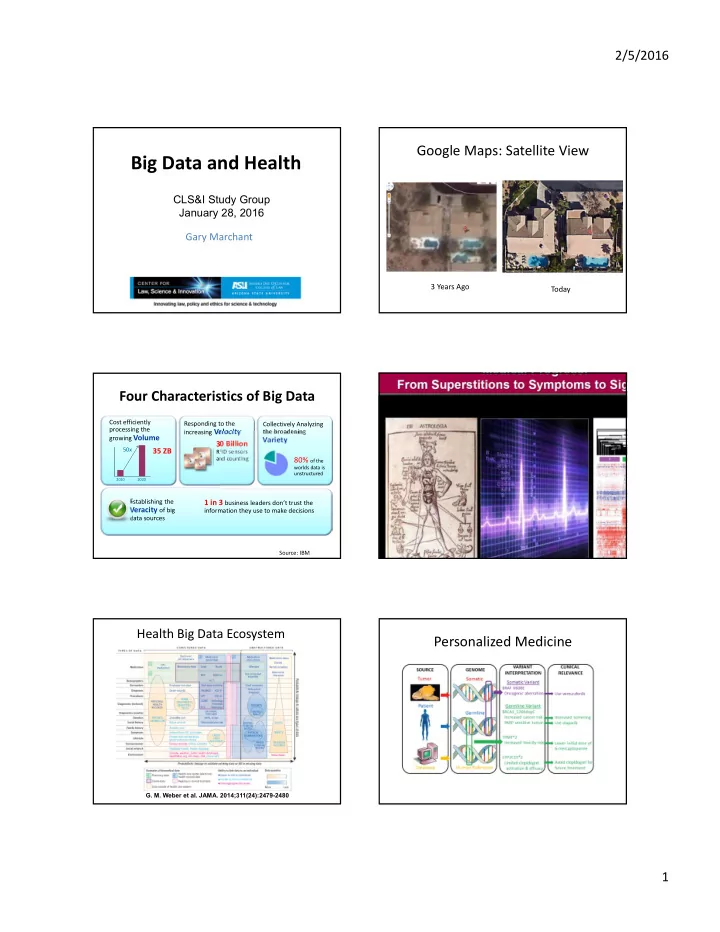
Big Data and Health

Gary Marchant CLS&I Study Group January 28, 2016

Google Maps: Satellite View

3 Years Ago Today

Four Characteristics of Big Data

Collectively Analyzing the broadening

Variety

Responding to the increasing Velocity Cost efficiently processing the growing Volume Establishing the

Veracity of big

data sources

30 Billion

RFID sensors and counting

1 in 3 business leaders don’t trust the

information they use to make decisions

50x

35 ZB

2020

80% of the

worlds data is unstructured

2010

Source: IBM

  • G. M. Weber et al. JAMA. 2014;311(24):2479-2480

Health Big Data Ecosystem

Personalized Medicine

slide-2
SLIDE 2

2/5/2016 2

Source: Stephens et al., PLOS Biology (2015)

Precision Medicine Initiative

slide-3
SLIDE 3

2/5/2016 3

The analysis reveals that the outbreak in Sierra Leone was sparked by at least two distinct viruses, introduced from Guinea at about the same time. It is unclear whether the herbalist was infected with both variants, or whether perhaps another funeral attendee was independently infected. One Ebola virus lineage disappears from patient samples taken later in the outbreak, while a third lineage appears. That lineage—tied to a nurse who was traveling to reach a hospital but died along the way—seems to have

  • riginated when one of the lineages

present at the funeral gained a new

  • mutation. This third lineage was spread,

Garry says, via a truck driver who transported the nurse, as well as others who cared for her in the town where she died.

Killer Bug is Traced at NIH Hospital WSJ

8/22/12

  • Genetic sequencing used to track deadly strain of

antibiotic‐resistant Klebsiella pneumonia strain through 18 patients at NIH hospital ( 6 of whom died)

  • Mutation profiling permitted identification of who

passed the bug to whom, where, and how (e.g., spray from sink)

  • “This level of certainty is going to change the concept
  • f hospitals’ responsibility.”

– 1 in 20 hospitalized patients picks up infection, kills 100,000 people per year

slide-4
SLIDE 4

2/5/2016 4

https://www.youtub e.com/watch?v=4z Mms2C6YUk#t=259

slide-5
SLIDE 5

2/5/2016 5

Since its launch, FoodBorne Chicago classified more than 3,700 tweets related to food poisoning in Chicago, which led to 722 food poisoning reports submitted to CDPH through FoodBorneChicago.org. Based on these reports, 526 inspections were conducted which led to critical or serious violations being found at 112 food establishments, violations which would not have been identified as quickly without the use of data from Twitter.

Sewage Monitoring

slide-6
SLIDE 6

2/5/2016 6

Louisville: Asthma Tracker

  • “More than 500 Louisville asthma sufferers

are being equipped with special, high tech inhalers – ones that collect data about where and under what circumstances the inhaler is used. By GPS plotting that information along with data from other sources about air quality – neighborhood risk factors, school conditions, etc. – we hope to get new insight into what prompts an asthma attack.” Greg Fischer, Mayor

Discussion Questions

  • 1. What are the most promising applications of big data in the health care context? How will

such big data applications improve health care quality and/or costs?

  • 2. How big a problem will “false positives” be for big data in health care? Will the

incidentalomas overwhelm our health care system and increase health care costs?

  • 3. Much of the health big data will be predictive of future disease and problems rather than

about an existing health problem. How much do you want to know about your risks and predispositions to future disease?

  • 4. How will people respond to more predictive and diagnostic data about their health?

Indifference? Feeling helpless? Anxiety? Take helpful actions in response to data?

  • 5. Who should have access to health big data, and how would they obtain access? Given that

the power of the data is proportional to the size of the data base, should there be a national health data base? What other policies can or should encourage sharing and access to data by researchers, providers, and policymakers?

  • 6. What are the privacy, liability and regulatory implications of the big data era in health care?