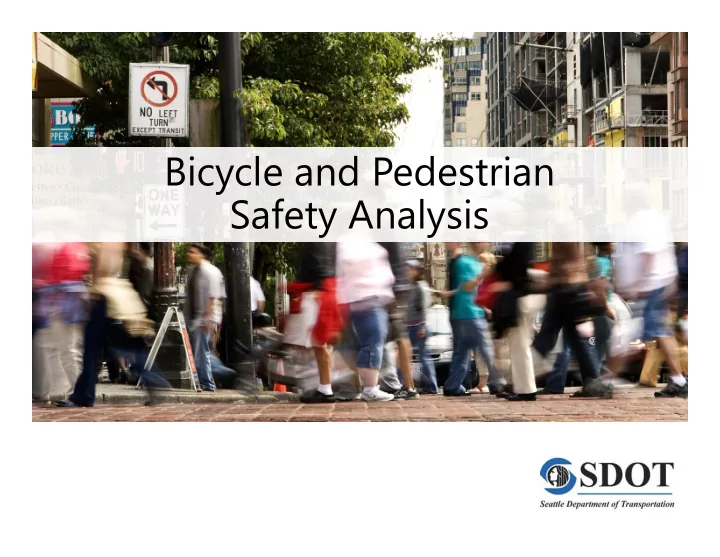
Bicycle and Pedestrian Safety Analysis What is Vision Zero? End - - PowerPoint PPT Presentation
Bicycle and Pedestrian Safety Analysis What is Vision Zero? End traffic deaths and serious injuries by 2030 Multi-faceted approach through data driven action and the many Es of Safety: Engineering Education Enforcement
What is Vision Zero?
- End traffic deaths and serious
injuries by 2030
- Multi-faceted approach through
data driven action and the many E’s of Safety:
– Engineering – Education – Enforcement – Evaluation – Equity
2
Data
3
Pedestrian and bicycle collisions make up 7% of total crashes but 47% of fatalities 9 out of 10 bike/ped collisions result in injury
Purpose of Bicycle and Pedestrian Safety Analysis
- Better understand risk factors contributing to
pedestrian and bicyclist crashes
- Proactively and systemically address risk
factors to mitigate potential crashes
- Advance Seattle’s Vision Zero Goals
Data At a Glance – Crash Data
Bicycle Collision Trends
Pedestrian Collision Trends
Data Up Close – Roadway Data
Lane Data
Crosswalk Data
Crash Data Crash Data
Crashes Associated with Lane Data Crashes Associated with Crosswalks
Exploratory Analysis
Exploratory Analysis - Bicycle
Collision Type % of T
- tal
% of Severe/Fatal Left Hook 13.9 21.5 Angle 9.4 9.9 Right Hook 7.1 2.7 Dooring 5.0 6.0
Exploratory Analysis - Pedestrian
Collision Type % of T
- tal
% of Severe/Fatal Left hook at crossing (controlled) 29.1 20.7 Angle at crossing (controlled) 23.0 31.0 Angle at midblock (uncontrolled) 21.7 33.8
Exploratory Analysis
Accounting for Exposure
Exposure = level of pedestrian/bicycling activity Pedestrian Activity
- Annualized count data
- Trip generators
Bicycle Activity
- Annualized count data
- Trip generators
- Strava data
- Bicycle Network
Trip generators: housing units (single family or multifamily), commercial destinations, transit locations, and universities or schools.
Pedestrian Volumes
Bike Volumes
A Proactive, Systemic Approach
Focusing on modeled collision rates at intersection locations based on the 5 following prioritized collision types:
- T
- tal bicycle collisions
- T
- tal pedestrian collisions
- Opposite direction bicycle collisions
- Angle bicycle collisions
- Angle pedestrian collisions
Leading Edge Analysis
Identify Risk Factors Ranked Lists of Locations by Safety Performance Factor Multivariate Analysis
A Proactive, Systemic Approach
Significant Risk Factors Identify Safety Improvements Data Analysis
Ranked list of locations where intervention may be needed
Field Investigations
INTKEY Location BOD_int Freq Pred EB Est Freq Rank Pred Rank EB Rank PSI Rank 27153 Eastlake Ave E & Fuhrman Ave E 9 6 8 1 1 1 12 26896 Stone Way N & N 34th St 1 3 2 140 2 14 12280 27112 Eastlake Ave NE & University BR 2 1 3179 3 36 12283 29515 Denny Way & Dexter Ave 1 2 2 222 4 17 12278 27157 Eastlake Ave E &Harvard Ave E 2 1 3209 5 53 12282 28783 Dexter Ave N & Harrison St 3 2 2 17 6 9 63 29795 12th Ave & E Cherry St 2 1 5281 7 79 12281 29809 12th Ave & E Jefferson St 3 2 2 19 8 10 61 25949 25th Ave NE & NE Blakeley St 5 2 3 3 9 3 8 29761 12 Ave & E Madison ST 6 2 4 2 10 2 1 29791 12th Ave & E Columbia St 2 1 5277 11 89 12279 269714 Cremona St & Nickerson ST 1 1 11860 12 113 12277 28736 Dexter Ave N & Valley ST 2 1 2 37 13 19 307 29812 Broadway & Jefferson St 1 1 5292 14 120 12276 28767 Dexter Ave N & Mercer St 5 1 3 5 15 4 6 28731 Aloha St & Dexter Ave N 1 1 1 186 16 50 11908 29740 12th Ave & E Pine St 1 1 5236 17 156 12275 26688 3rd Ave W & W Nickerson St 2 1 2 23 18 21 269 28741 Dexter Ave N & Roy St 1 1 1 187 19 56 11808 27039 Fremont Ave N & N 34th ST 4 1 3 7 20 7 10
A Proactive, Systemic Approach
How is Seattle Going to Use Findings?
- Identify locations where street or signal
design changes may be needed
- Make informed decisions around prioritizing
safety improvements
- Proactively treat locations with the intention
- f mitigating potential crashes
Key Takeaways
- Consistent and accurate crash data is key to a data-
driven approach
- Simple statistical and spatial analysis can reveal
informative patterns that may not be apparent
- Understanding exposure is key to understanding
risk, prioritizing safety improvements
Where do we go from here?
- Incorporate more regression inputs
- Validate countermeasure approaches
- Further develop predictive volume models
for the entire city
- Rerun BPSA in future with better bicycle data
after bicycle network is developed
- Promote education and enforcement