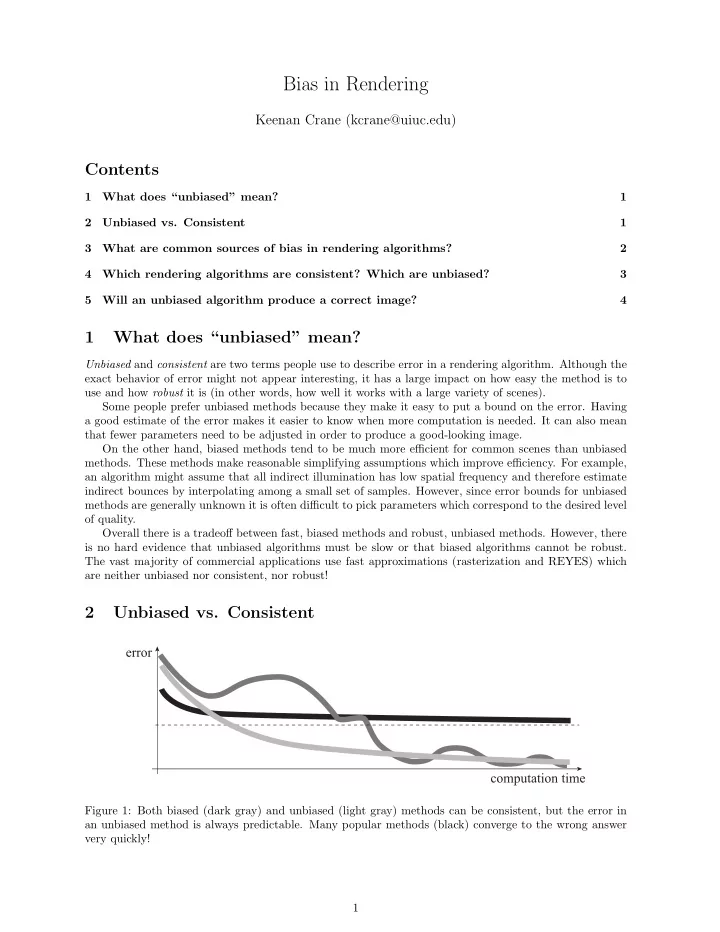

SLIDE 1
Bias in Rendering
Keenan Crane (kcrane@uiuc.edu)
Contents
1 What does “unbiased” mean? 1 2 Unbiased vs. Consistent 1 3 What are common sources of bias in rendering algorithms? 2 4 Which rendering algorithms are consistent? Which are unbiased? 3 5 Will an unbiased algorithm produce a correct image? 4
1 What does “unbiased” mean?
Unbiased and consistent are two terms people use to describe error in a rendering algorithm. Although the exact behavior of error might not appear interesting, it has a large impact on how easy the method is to use and how robust it is (in other words, how well it works with a large variety of scenes). Some people prefer unbiased methods because they make it easy to put a bound on the error. Having a good estimate of the error makes it easier to know when more computation is needed. It can also mean that fewer parameters need to be adjusted in order to produce a good-looking image. On the other hand, biased methods tend to be much more efficient for common scenes than unbiased
- methods. These methods make reasonable simplifying assumptions which improve efficiency. For example,
an algorithm might assume that all indirect illumination has low spatial frequency and therefore estimate indirect bounces by interpolating among a small set of samples. However, since error bounds for unbiased methods are generally unknown it is often difficult to pick parameters which correspond to the desired level
- f quality.