SLIDE 1 1
Verilog Synthesis Examples
CS/EE 3710 Fall 2010 Mostly from CMOS VLSI Design by Weste and Harris
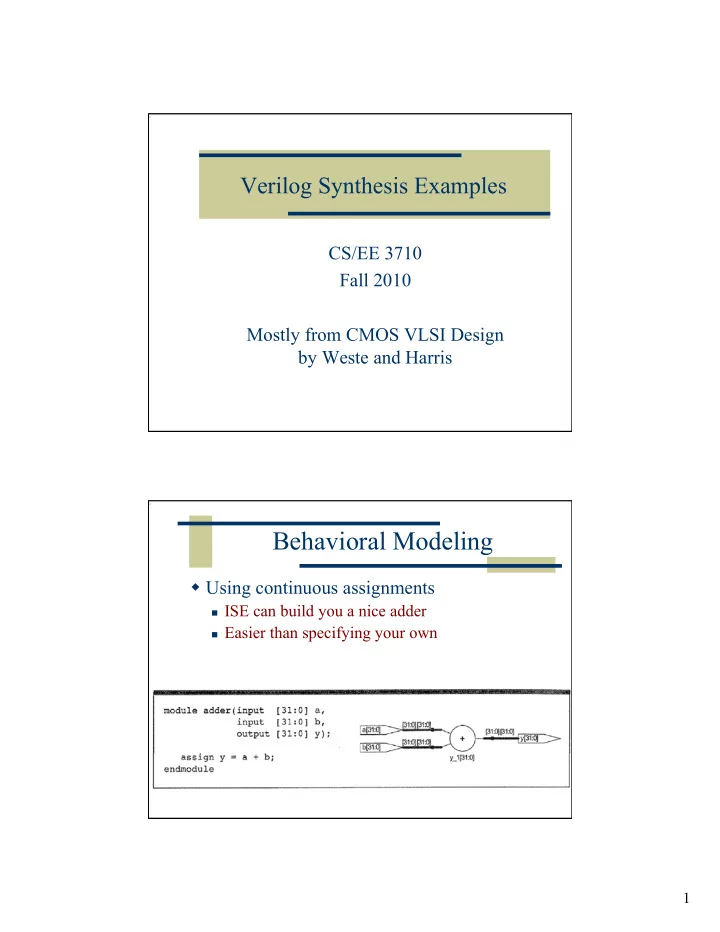
Behavioral Modeling
Using continuous assignments
ISE can build you a nice adder Easier than specifying your own
SLIDE 2
2
Bitwise Operators
Bitwise operations act on vectors (buses)
More bitwise operators
SLIDE 3 3
Reduction Operators
Apply operator to a single vector
Reduce to a single bit answer
Conditional Operator
Classic mux
Can be confusing if you get crazy
SLIDE 4
4
Using internal signals
Internal wires and regs can be used inside a module
Using internal signals
Internal wires and regs can be used inside a module
SLIDE 5 5
Operator Precedence Constants
Specified in binary, octal, decimal, or hex
Note use of underscore in long binary numbers
SLIDE 6 6
Hierarchy
Instantiate other modules in your module
Tristates
Assign the value z
Just say NO! No on-board tri-states on Spartan3e FPGAs Use MUXs instead!
SLIDE 7 7
Bit Swizzling
Sometimes useful to work on part of a bus, or combine different signals together
Use bus (vector) notation
Bit Swizzling
Sometimes useful to work on part of a bus, or combine different signals together
Use concatenation {} operator
SLIDE 8 8
Registers
Edge-triggered flip flops
Always use reset of some sort!
Registers
Can also add an enable signal
Only capture new data on clock and en
SLIDE 9
9
Counters
Behavioral
Counters
Structural
SLIDE 10 10
Comb Logic with Always blocks
Always blocks are often sequential
But, if you have all RHS variables in the
sensitivity list it can be combinational
Remember that you still must assign to a reg
type
Comb Logic with Always blocks
Always blocks are often sequential
But, if you have all RHS variables in the
sensitivity list it can be combinational
Remember that you still must assign to a reg
type
SLIDE 11
11
Decoder example (combinational) Decoder example (combinational)
Continuous assignment version is not as readable Same circuit though…
SLIDE 12
12
Seven Segment Decoder Memories
Generally translates to block RAMs on the Spartan3e FPGA
SLIDE 13
13
Shift Register? Blocking vs. Non-Blocking
Shift Register?
SLIDE 14 14
Blocking vs. Non-Blocking
Shift Register?
Finite State Machines
Divide into three sections
State register Next state logic output logic
Use parameters for state encodings
SLIDE 15
15
Example
Three states, no inputs, one output, two state bits
Example
SLIDE 16
16
Mealy vs. Moore Mealy example
Output is true if input is the same as it was on the last two cycles
SLIDE 17
17
Mealy Example Parameterized Modules
SLIDE 18 18
Verilog Style Guide
Use only non-blocking assignments in always blocks Define combinational logic using assign statements whenever practical
Unless if or case makes things more readable When modeling combinational logic with
always blocks, if a signal is assigned in one branch of an if or case, it needs to be assigned in all branches
Verilog Style Guide
Include default statements in your case statements Use parameters to define state names and constants Properly indent your code Use comments liberally Use meaningful variable names Do NOT ignore synthesis warnings unless you know what they mean!
SLIDE 19 19
Verilog Style Guide
Be very careful if you use both edges of the clock
It’s much safer to stick with one I.e. @(posedge clock) only
Be certain not to imply latches
Watch for synthesis warnings about implied
latches
Provide a reset on all registers
Verilog Style Guide
Provide a common clock to all registers
Avoid gated clocks Use enables instead