Before long we will find ourselves looking forward to Easter. But, in - - PowerPoint PPT Presentation

before long we will find ourselves looking forward to
SMART_READER_LITE
LIVE PREVIEW

Before long we will find ourselves looking forward to Easter. But, in - - PowerPoint PPT Presentation

Before long we will find ourselves looking forward to Easter. But, in The Presentation of Christ in the Temple (Candlemas) fact Easter was never really out of our minds even at the height of the Collect Christmas season. The road to Bethlehem,


slide-1
SLIDE 1

The Presentation of Christ in the Temple (Candlemas) Collect Almighty and ever-living God, clothed in majesty, whose beloved Son was this day presented in the Temple, in substance of our flesh: grant that we may be presented to you with pure and clean hearts, by your Son Jesus Christ our Lord, who is alive and reigns with you, in the unity of the Holy Spirit,

  • ne God, now and for ever.

Post Communion Lord, you fulfilled the hope of Simeon and Anna, who lived to welcome the Messiah: may we, who have received these gifts beyond words, prepare to meet Christ Jesus when he comes to bring us to eternal life; for he is alive and reigns, now and for ever. Readings - Malachi 3.1-5 - ‘See, I am sending my messenger... He is like a refiner’s fire

  • who can endure His coming?’ - The Day of the Lord -

Hebrews 2.14-end - ‘He had to become like His brothers and sisters in every respect, so that He might be a merciful and faithful High Priest...’

Jesus the Man, so able to deal with our sin and Death.

Luke 2.22-40 - Simeon and Anna and the Presentation in the Temple.

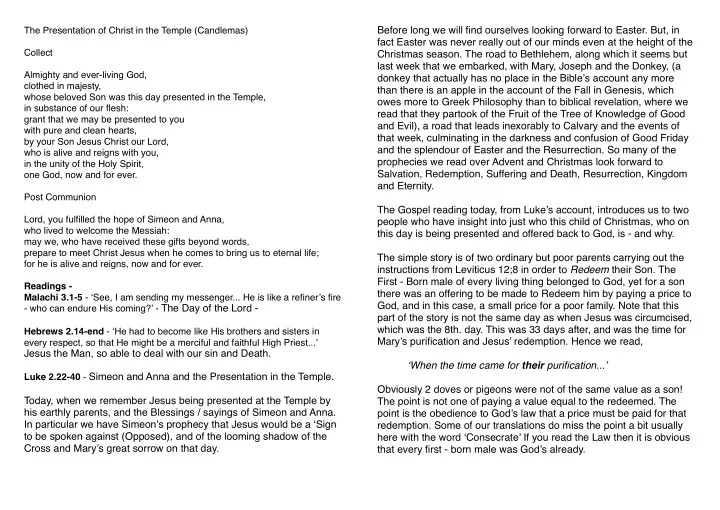
Today, when we remember Jesus being presented at the Temple by his earthly parents, and the Blessings / sayings of Simeon and Anna. In particular we have Simeon’s prophecy that Jesus would be a ‘Sign to be spoken against (Opposed), and of the looming shadow of the Cross and Mary’s great sorrow on that day. Before long we will find ourselves looking forward to Easter. But, in fact Easter was never really out of our minds even at the height of the Christmas season. The road to Bethlehem, along which it seems but last week that we embarked, with Mary, Joseph and the Donkey, (a donkey that actually has no place in the Bible’s account any more than there is an apple in the account of the Fall in Genesis, which

  • wes more to Greek Philosophy than to biblical revelation, where we

read that they partook of the Fruit of the Tree of Knowledge of Good and Evil), a road that leads inexorably to Calvary and the events of that week, culminating in the darkness and confusion of Good Friday and the splendour of Easter and the Resurrection. So many of the prophecies we read over Advent and Christmas look forward to Salvation, Redemption, Suffering and Death, Resurrection, Kingdom and Eternity. The Gospel reading today, from Luke’s account, introduces us to two people who have insight into just who this child of Christmas, who on this day is being presented and offered back to God, is - and why. The simple story is of two ordinary but poor parents carrying out the instructions from Leviticus 12;8 in order to Redeem their Son. The First - Born male of every living thing belonged to God, yet for a son there was an offering to be made to Redeem him by paying a price to God, and in this case, a small price for a poor family. Note that this part of the story is not the same day as when Jesus was circumcised, which was the 8th. day. This was 33 days after, and was the time for Mary’s purification and Jesus’ redemption. Hence we read, ‘When the time came for their purification...’ Obviously 2 doves or pigeons were not of the same value as a son! The point is not one of paying a value equal to the redeemed. The point is the obedience to God’s law that a price must be paid for that

  • redemption. Some of our translations do miss the point a bit usually

here with the word ‘Consecrate’ If you read the Law then it is obvious that every first - born male was God’s already.

slide-2
SLIDE 2

In the case of most 1st. born animals they were to be literally given back to God. The redemption purchased by payment of the price laid

  • ut did not negate the requirement for the child to be consecrated to

God however. The difference was the price. In the case of most clean animals the price of consecration was their own lives - they were sacrificed and became ‘The Priests’ Portion’ The child was redeemed, but remained God’s for the rest of His life. This puts new meaning into Paul’s comment, ‘For you are not your own, but you have been bought with a price...’ So, what about the two people they and we meet in the Temple? Simeon - First we meet Old Simeon. In fact the account does not tell us his age,

  • r refer to him as old. He is ‘...a man... who was righteous...awaiting

the consolation of Israel...’ God had told him that he would not die before he had seen what God had promised for His People - the promised One - the Messiah. On this day Simeon is ‘Moved by the Holy Spirit’ to go to the Temple. Unlike Anna, who we will meet later on, Simeon, whilst a regular in the Temple, came to and went from that place of worship, with the implication that he had a home to go to and possibly employment or

  • ther tasks and interests in the wider world. What we do see in him

however is someone whose life is guided by the Holy Spirit. Simeon is a listener. He listens for the still, small voice of direction in his life, and acts upon it. This particular day he is led by the Spirit to be in the right place at the right time. I wonder what excitement was in his heart that day? Every day was one of expectation for Simeon; of ‘looking for the consolation of Israel’ This day doubtless felt different from the rest. Simeon was not alone in this hope, but he does seem to have been somewhat unique in his response to that hope. In a land under

  • ccupation there were many for whom the promise of Salvation held
  • ut the hope of deliverance from oppression by Rome and who would

and did often do anything to try to bring it about. Simeon, we are told, looked forward to God’s work amongst His People, and responded by living a righteous life before God and the World. The work was God’s. It was his Master (for Simeon regards himself as a slave, vs. 29 ‘servant’ is better rendered ‘slave’) who would bring these things to

  • pass. Simeon’s part was to be ready, and to live a life that would

witness to that trust and faith. As a result, Simeon’s understanding of what God would do was wider than that of his fellow Jews of that time. In Simeon’s words, words we know so well from Evensong on a Sunday Evening, we find a promise that is not limited to the Jewish gamut, but is extended into the presence of and for ‘all peoples’ - extended to all, i.e. to you and to me. Simeon it is too that introduces the darker side of the story that is to unfold over the next 30 years or so. He is the one who sees Mary’s sorrow, even on this day of joy. Mary listened to Simeon, and to Wise Men and Shepherds, and we are told that she lay up these memories in her heart. I wonder if, when things got very black for her, that Mary found some strength in Simeon’s words. Yes, there would be sorrow, but there was also a great promise. I wonder what Simeon did afterwards? We are given no clue. Tradition has it that he was old and that his Benediction, which is so often used at the end of life, was a personal one too, and that he died soon afterwards, released by his God. I wonder though! Did he in fact live

  • n, continuing in his witness to God’s work in Christ?

Anna - In what was a Patriarchal society, (or at least, we are told it was so!), today we meet Anna, who is a Prophet, (The original does not give the title in the feminine other than so far as is needed for grammatical correctness, no diminutive being implied- she was an acknowledged ‘Prophet’ just as any man with her gifts would have been), and who is to be found in the Temple, (all the time! - not just on High Days and

slide-3
SLIDE 3

Holy Days). In fact the original says she ‘...was not departing from the temple...’ Anna is old - very old. She had been married, (probably quite young - say 15 years old or so when betrothed), for 7 years, making her about 22 when she was widowed, and had been a widow now for some 84 years, making her 106 if you take the translation as presented in the

  • TNIV. Certainly she was old enough to merit being described as ‘Very

Old!’ Why had Anna not re-married? It would have been the expected thing, and indeed, there was likely some man who had both right and

  • bligation to take her as his and care for her in place of her Husband.

Yet Anna worshipped God night and day, and fasted and prayed. Perhaps after her Husband’s early death she had been drawn to the Temple as a place of refuge and solace, and had got into the habit of being there (a good sort of habit to adopt I would think). Maybe, over time she had allowed her priorities, (her ‘Love’), to become different and to be to ascribe worship where it belonged, as is found in the Psalm 96; 7 - 10? I wonder if that Psalm was in fact her favourite? I think that the Psalm draws out Anna’s way of looking at life rather well - Ascribe to the Lord the Glory due to His Name; bring an

  • ffering and come into His courts.

Anna wanted others to come to a similar relationship with their God as they had found. One that put things in the right perspective - kept them in the right frame of mind - that guided their desires and pointed their praise. Anna was to be found in the right place at the right time. She loved the Temple, not because it was a beautiful place, (though doubtless it was), and not because all the right people came there. Neither did she come for a good time, or to hear a good sermon, (though doubtless on

  • ccasion she did both!). Anna came to the Temple to Praise God, and

to Pray. And she also had a reputation for being in tune with her God’s will and thoughts, so she must have been in the habit already of doing what she did on this special day - she publicly gave thanks to God and spoke to those around about Jesus. So there we have these two characters. Neither are mentioned again in the Bible accounts, and yet both are remembered every time we read the account in Luke of the presentation of Jesus. Both were in the right place at the right time. Yet this was no chance or accident. One followed God’s leading and deliberately went to the Temple, even though he had not been told what he would see that day. But Simeon did recognise in a human child the chosen one of God who would bring Salvation to his People. Anna was there by choice and habit, and was in tune with her God. She was bold enough to speak out about the Child to anyone who would listen. Maybe that is the essence of Mission and Discipleship? If we were more like both of them what would our lives, our world and our Church be like? - I wonder???... This Presentation at the temple, and so into the public realm, (for until these rituals had been completed neither Mother nor Child were allowed into the public domain), is also a key theological moment in Luke’s account. Jesus is presented simply as a child, a human child. As Firstborn Male he is redeemed, just as any other Jewish child must

  • be. From his 8th day onwards He is subject to and fulfilling the very

Law that His purpose was to fulfil, on behalf of us all. The credentials

  • utlined in Hebrews 2 are here being established, and aligning Him

with us, as One of us and One for us. These are the credentials essential if Jesus was to be able to become for us what we celebrate at this table week by week.

‘He had to become like His brothers and sisters in every respect, so that He might be a merciful and faithful High Priest...’ Jesus the Man, so able to

deal with our sin and Death’ AMEN