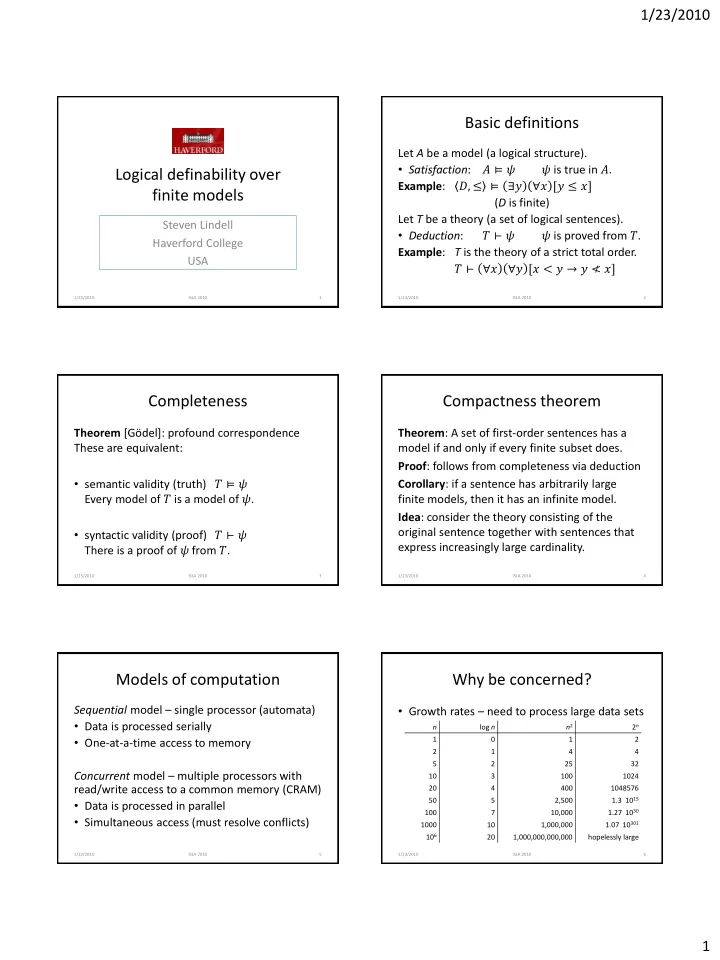

SLIDE 1
1/23/2010 1
Logical definability over finite models
Steven Lindell Haverford College USA
1/23/2010 ISLA 2010 1
Basic definitions
Let A be a model (a logical structure).
- Satisfaction: 𝐵 ⊨ 𝜔
𝜔 is true in 𝐵. Example: 𝐸, ≤ ⊨ ∃𝑧 ∀𝑦 ,𝑧 ≤ 𝑦- (D is finite) Let T be a theory (a set of logical sentences).
- Deduction:
𝑈 ⊢ 𝜔 𝜔 is proved from 𝑈. Example: T is the theory of a strict total order. 𝑈 ⊢ ∀𝑦 ∀𝑧 ,𝑦 < 𝑧 → 𝑧 ≮ 𝑦-
1/23/2010 ISLA 2010 2
Completeness
Theorem [Gödel]: profound correspondence These are equivalent:
- semantic validity (truth) 𝑈 ⊨ 𝜔
Every model of 𝑈 is a model of 𝜔.
- syntactic validity (proof) 𝑈 ⊢ 𝜔
There is a proof of 𝜔 from 𝑈.
1/23/2010 ISLA 2010 3
Compactness theorem
Theorem: A set of first-order sentences has a model if and only if every finite subset does. Proof: follows from completeness via deduction Corollary: if a sentence has arbitrarily large finite models, then it has an infinite model. Idea: consider the theory consisting of the
- riginal sentence together with sentences that
express increasingly large cardinality.
1/23/2010 ISLA 2010 4
Models of computation
Sequential model – single processor (automata)
- Data is processed serially
- One-at-a-time access to memory
Concurrent model – multiple processors with read/write access to a common memory (CRAM)
- Data is processed in parallel
- Simultaneous access (must resolve conflicts)
1/23/2010 ISLA 2010 5
Why be concerned?
- Growth rates – need to process large data sets
n log n n2 2n 1 1 2 2 1 4 4 5 2 25 32 10 3 100 1024 20 4 400 1048576 50 5 2,500 1.3 1015 100 7 10,000 1.27 1030 1000 10 1,000,000 1.07 10301 106 20 1,000,000,000,000 hopelessly large
1/23/2010 ISLA 2010 6