SLIDE 1
Barratt Interim Statement to 31st December 2006
SLIDE 2 2 Chairman’s Statement 3 Chief Executive’s Review 4-7 Consolidated Income Statement 8 Consolidated Balance Sheet 9 Consolidated Cash Flow Statement 10 Notes to the Financial Statements 11-13 Group Structure 14
contents
Barratt Developments PLC Interim Statement for the half year ended 31 December 2006. Registered in England No. 604574.
Barratt is Britain’s best-known housebuilder and since 1958 we have sold more than 300,000 new homes. We are also at the forefront of urban regeneration, with over 80% of
- ur developments on brownfield land, and lead the way in social housing provision.
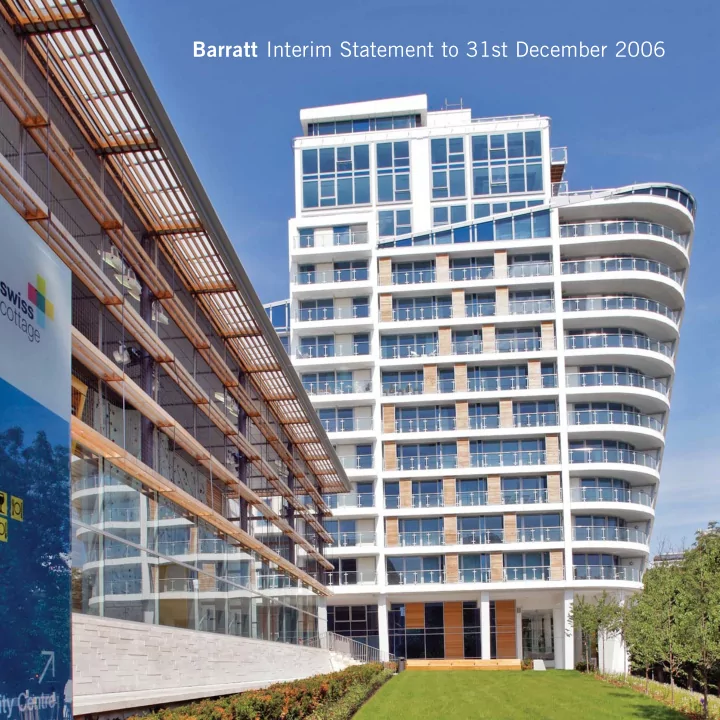
Left: Capital East, London E16. One of the largest single redevelopment schemes in Docklands, providing around 700 homes. Far left: Tachbrook Triangle, London SW1. This award-winning mixed-use development included the careful refurbishment of listed Georgian houses. Front cover: Visage, Swiss Cottage, London NW3. A ground-breaking public/private partnership scheme for 166 homes, plus community facilities.
SLIDE 3 3
Charles Toner, Group Chairman, Barratt Developments PLC
chairman’s statement
I am pleased to report another strong trading performance for the six months ended 31 December 2006. Pre-tax profits increased to £180.2m, up 10% on the first half of 2005 at £163.9m. Basic earnings per share increased to 52.6p, up 9% from the 48.2p delivered in 2005. As a result of this strong first half performance, and as already indicated on 5 February 2007, an interim dividend
- f 11.38p per share will be paid on 25 May 2007, to
shareholders on the register on 30 March 2007. This interim dividend will be 4.6 times covered and represents an increase of 10% over last year’s 10.34p per share payment. This performance, together with increased investment in land in the first half, positions us to achieve growth going
- forward. Whatever the uncertainties are over the likely
strength of the market for the rest of this year, we will continue to focus on our operational performance and on driving improved overhead efficiencies through increased scale and strict control of build costs to support our margins. This is a good foundation upon which to build and we have a strong management team in place led by Mark Clare our new Chief Executive who joined us in October 2006. He is ably supported by a highly skilled team operating across Great Britain which has demonstrated its ability to succeed in a competitive market place. Mark succeeds David Pretty who has retired after 27 years with the Group, including 16 years as a Board Member and four years as Chief Executive. Geoff Hester has also retired from the Board and will leave the Group at the end of June. This follows the integration of the KingsOak business into the Barratt divisional structure. Geoff made a substantial contribution to the growth of the Group over the last ten years, seven of them as a Board Member. We wish them both a long and happy retirement. Looking ahead we are well placed to continue our growth. The housing market is sound and the underlying business is
- strong. We hope to capitalise on this position as we look to
complete the acquisition and integration of Wilson Bowden. This will bring new capabilities to the Group which, when combined with our track record of growth and operational efficiency, will create a formidable player in the housing market committed to increasing shareholder value. Finally, I would like to thank all our people right across the business for their continuing efforts that have, once again, delivered outstanding results.
Charles Toner, Chairman 28 February 2007
SLIDE 4 4
OPERATIONS
Our housebuilding turnover was £1,190.8m (2005: £1,166.8m) up by 2%. Total completions increased by 2.9% to 7,206 (2005: 7,003) at an average selling price of £165,000, (2005: £162,9001). The average selling price was constrained by the highly competitive market and changes to the product mix. Private completions were 4% higher at 5,791 (2005: 5,569), at an increased average selling price of £184,200, up 1.2%. Social housing completions decreased by 1.3% to 1,415, at an average selling price of £86,600, down 2% (2005: £88,4001) again as a result of mix changes. Housebuild operating margins increased to 16.3% up from 14.8% during the same period in 2005. This margin improvement resulted from a combination of a number of higher margin sites coming through to completion in the six months to December 2006 as well as continued focus on
- verhead efficiencies and strict control of building costs.
Pre-tax profit increased by 10% from £163.9m to £180.2m. As previously indicated, our return on capital employed, which for the six months ended 31 December 2006 was 26.9%, is likely to reduce to between 20% to 25% going
- forward. This is as a result of increased land investment and
- ther work in progress to underpin future growth and the
need to establish the right balance between ROACE and margin to deliver higher value going forward. Our KingsOak divisions have been integrated into the Barratt Regional operating structure and this has enabled us to reduce costs and make better use of our land bank and management across both brands. We have opened a new KingsOak division in Yorkshire focusing on the higher end of the housing market.
SALES
We have delivered a solid sales performance in the first half with good sales rates and robust visitor levels. All areas and regions sold at a satisfactory rate during the first six months. Looking forward, total reservations are now 25% better than a year ago with forward sales at 31 December 2006 of approximately £1,030m (2005: £700m). This has now increased to £1,368m which, together with completions to date, secures 83% of the full year’s expected volumes.
LAND
In the six months to December 2006, we have continued to strengthen our land position. Our land bank has increased 11.9% to c.70,500 plots (December 2005: c.63,000), including 8,000 plots (December 2005: 7,000 plots) agreed subject to contract. This equates to 4.8 years’ supply at 2005/6 volumes (December 2005: 4.3 years). The continued investment in land and work in progress has resulted in the business running higher average gearing levels. We spent £462m on land in the first half compared to £431m in the six months to the end of December 2005, an increase of £31m (7%). We currently expect to spend approximately £1billion on land over the full year compared to £841m in 2006. Despite inherent ongoing difficulties in the planning system, we achieved an increased level of planning approvals in the first half of 10,516 plots, up 7% over last year. 96% of land required for 2007/8 is now owned or contracted, and over 79% for 2008/9.
chief executive’s review
Mark Clare, Group Chief Executive, Barratt Developments PLC
1 The average selling price for social housing completions for the six months to 31 December 2005 has been adjusted to exclude the revenue
received in the period in respect of stage payments for the land element of units which were not physically completed, to be consistent with the treatment in the six months to 31 December 2006. This had a negligible profit impact in the six months to 31 December 2005 and no profit impact for the year ended 30 June 2006.
SLIDE 5 FINANCING
At the half year borrowings were £226.7 million and average gearing was 17% in the period. Gearing is likely to increase towards an average of 25% as a result of rising land investment and work in progress, before taking account of the impact of the acquisition of Wilson Bowden.
HOUSING MARKET
The housing market in the first half was highly competitive but stable, with good buyer confidence being sustained despite the increase in interest rates. The fundamentals of the market remain sound with demand continuing to outstrip supply. These market conditions have underpinned a robust sales performance in the first two months of 2007 despite a further interest rate increase. With the spring selling period still to come, it remains too early to be certain of future trends, but given the fundamentals of the market our expectation remains that we will perform satisfactorily.
GROUP STRATEGY
During the six months to December 2006, we took the
- pportunity to assess our market position and future outlook.
We have identified significant strengths in terms of our geographic and product diversity, our position in urban regeneration and brownfield developments and social housing partnerships. This is supported by a strong
- perational performance culture across the Group which has
delivered strong organic growth. We believe that these capabilities make Barratt one of the most successful housebuilders in the UK, accounting, approximately, for a 9% share of a highly fragmented national market. Given the significant undersupply situation that exists in the sector we expect the total market size to grow. Continuing consolidation also seems inevitable and going forward, we believe that the most robust companies in the sector will have the most success. We firmly believe that rapid organic growth, one of our historic strengths, is the way to deliver maximum value to shareholders. To deliver our ambition for the company we have identified a number of key areas for management’s attention to facilitate growth:
- Increase our investment in people
- Focus on cost control and efficiency improvement
- Accelerate land investment, particularly strategic land
- Participate more fully in the upper end of the housing
market
- Focus on leveraging larger, especially mixed-use,
development opportunities. We have already made progress in each of these areas over the last few months and we believe our ability to deliver will be substantially increased once we have completed the proposed acquisition of Wilson Bowden.
CORE STRENGTHS
During the six months to December we continued to reinforce our core strengths. Geographic and Product Diversity Our wide geographic spread and extensive product range continues to be an important strength that insulates the Group from over-dependence on any one geographic area or market
- sector. At the end of December we had some 450 sites
under construction across England, Scotland and Wales. We have progressed several large-scale multi-tenure
- projects. For example, agreement has been reached with
Barnet Council and Metropolitan Housing Partnership, for the regeneration of the West Hendon Estate, which will provide around 2,000 new homes and community facilities. In Leeds we commenced a major regeneration project to create 325 homes on a former industrial site. Affordable first-time buyer homes from £90,000 are planned and 50 have been allocated to the Government’s First-Time Buyers’ Initiative. Homes for rent, shared ownership and sale are being provided in a major mixed-use scheme in the London Borough of Croydon. Around 800 new homes are planned along with community and commercial facilities including workshops and a medical centre. Our iPad product targeted at first time buyers is expanding
- rapidly. We have now completed over 40 iPads on two sites
and at the end of 2006 had 125 under construction on seven further sites. We have 15 additional sites for 687 soon to start and a further 44 sites for 1,725 in the pipeline. Urban Regeneration We continue to be a leader of the regeneration of Britain’s cities and urban areas across England, Scotland and Wales. Over 80% of our homes were built on brownfield sites. 5
SLIDE 6 6
City Point, Brighton. A former railway goods yard is being transformed into a mixed-tenure scheme of 248 contemporary homes.
“We have benefited from a strong first half to the year with pre-tax profits up 10%, a strengthened land bank and forward sales at record levels”
SLIDE 7 Our urban regeneration activities are not solely undertaken within London and the South East. In Swansea for example, a new project will provide over 560 new homes on a former factory site. This development will create a thriving new community and retail centre close to the city’s rugby and football stadium. In Leicester we are creating a sustainable new community of up to 1,000 new homes plus shops and community amenities. This project achieved the best overall score in The Commission for Architecture and the Built Environment’s (CABE) recent audit of housing design quality in the Midlands. One of the largest programmes we’ve undertaken in recent years is in South Lanarkshire, West Scotland. Here, Barratt and AMEC Developments are working together, alongside a PFI project being promoted by AMEC to renew schools. Barratt has secured 9 sites to build almost 1,400 new homes which will reinforce our position as a leading housebuilder in Scotland. Social Housing Our social partnerships continue to contribute to the success of the Group. We are one of the industry’s leading providers of affordable housing, whether it is for low cost homes for sale, rent, shared ownership or special needs. This key sector has growth potential and, with our strengths and experience, we are well positioned to participate. We have been awarded funding to provide more than 300 new homes around the country as part of the Government’s First-Time Buyers’ Initiative designed to help people get onto the property ladder. We have received around £30 million to support the initiative at 9 developments located in Brighton, Bristol, Ely, Gravesend, Leeds, Liverpool, Romford, Southampton and Watford. During the period, we built 1,415 homes for our housing association partners, at an average selling price of £86,600. This included 60 affordable homes in Hatfield for rent and shared ownership through Aldwyck Housing Association. A further 96 affordable homes will be provided in the second phase for Circle Anglia Housing Association, whilst in Edinburgh, close to Princes Street, we are transforming two large warehouses into 242 homes, including 36 affordable homes.
CUSTOMER CARE AND QUALITY
We are committed to enhancing the level of customer service across the organisation and independently compiled buyer surveys show continued improvement. Applying the same rating system as used in the Home Builders Federation/MORI surveys to our own scores, we believe that 61% of our divisions are now at 4 star level or above. We are targeting further improvements and are embedding our Customer Charter and Code of Practice for all staff, suppliers and subcontractors. This will continue to be an important area of management focus over the next year. We are continuing to invest in general skills training and over a third of our work force has now achieved the Construction Skills Certification Scheme standard. We remain on track to have a fully carded and qualified workforce by 2010. Our Apprentice scheme, which currently has over 500 participants, is one of the largest in the industry as we continue to work to address the national construction skills shortage. We have also stepped up our investment in our graduate recruitment programme to add additional talented people who will form part of the future management of the company. Our approach continues to be recognised in a series of external awards. In 2006 we were named What House? Housebuilder of the Year. Additionally we were recently named 2006 Homebuilder of the Year by Your New Home
- magazine. These awards are a testament to the efforts,
ideas and talents of our people.
OUTLOOK
We have benefited from a strong first half to the year with pre-tax profits up 10%, a strengthened land bank and forward sales at record levels. Whilst the fundamentals of the housing market remain sound, there is uncertainty over further changes to interest rates and the effect these may have on housing demand. That said, the market is stable with good visitor levels and interest being shown going into the key spring selling season. There is no doubt that over the next six months our focus must be on achieving cost reduction targets whilst completing the proposed acquisition of Wilson Bowden. Meanwhile work is continuing to ensure we can rapidly integrate these two businesses as soon as we are able to proceed. 7
Mark Clare, Chief Executive 28 February 2007
SLIDE 8
8 (Unaudited) Half year ended Year ended 31 December 31 December 30 June 2006 2005 2006 Note £m £m £m Continuing operations Revenue 1,194.4 1,172.0 2,431.4 Cost of sales (957.6) (953.9) (1,940.6) Gross profit 236.8 218.1 490.8 Net operating expenses (44.6) (46.9) (81.2) Profit from operations 192.2 171.2 409.6 Finance income 0.3 0.4 2.0 Finance costs (12.3) (7.7) (20.2) Profit before tax 180.2 163.9 391.4 Tax expense 3 (54.1) (49.1) (116.4) Profit for the period from continuing operations all attributed to equity shareholders 126.1 114.8 275.0 Dividends Payments to shareholders - £m 4 49.7 42.8 67.5 Proposed/paid dividends per ordinary share Interim 4 11.38p 10.34p 10.34p Final 4 – – 20.69p Earnings per share – continuing basis Basic 5 52.6p 48.2p 115.3p Diluted 5 51.6p 47.5p 113.3p £m £m £m Profit for the period 126.1 114.8 275.0 Revaluation of available for sale assets 1.8 – (4.5) Tax on revaluation of available for sale assets (0.5) – 1.3 Total recognised income for the period all attributed to equity shareholders 127.4 114.8 271.8
Consolidated Income Statement
for the half year ended 31 December 2006
Consolidated Statement of Recognised Income and Expense
SLIDE 9
9 (Unaudited) at 31 December at 31 December at 30 June 2006 2005 2006 Note £m £m £m Assets Non-current assets Property, plant and equipment 12.8 10.8 12.1 Available for sale assets 31.2 – 31.3 Trade and other receivables 2.4 5.8 3.5 Deferred tax 39.2 40.0 40.4 85.6 56.6 87.3 Current assets Inventories 2,964.4 2,574.8 2,644.4 Trade and other receivables 36.0 63.0 39.5 Cash and cash equivalents 68.6 113.4 43.3 3,069.0 2,751.2 2,727.2 Total assets 3,154.6 2,807.8 2,814.5 Liabilities Current liabilities Loans and borrowings 292.6 106.9 5.9 Trade and other payables 959.8 1,027.7 988.3 Current tax liabilities 59.8 56.4 65.7 1,312.2 1,191.0 1,059.9 Non-current liabilities Loans and borrowings 2.7 3.2 2.5 Trade and other payables 130.4 118.8 124.3 Retirement benefit obligations 84.3 89.5 87.9 217.4 211.5 214.7 Total liabilities 1,529.6 1,402.5 1,274.6 Net assets 1,625.0 1,405.3 1,539.9 Equity Share capital 24.4 24.3 24.3 Share premium 204.7 201.4 202.3 Retained earnings 1,395.9 1,179.6 1,313.3 Total equity 7 1,625.0 1,405.3 1,539.9
Consolidated Balance Sheet
at 31 December 2006
SLIDE 10
Half year ended Year ended (Unaudited) 31 December 31 December 30 June 2006 2005 2006 Note £m £m £m Net cash outflow from operating activities 6 (215.6) (236.7) (182.1) Cash flows from investing activities Purchases of property, plant and equipment (4.4) (0.6) (3.3) Proceeds from sale of property, plant and equipment 1.6 0.2 2.0 Interest received 0.3 0.4 2.0 Net cash (outflow)/inflow from investing activities (2.5) – 0.7 Cash flows from financing activities Proceeds from issue of share capital 2.5 3.6 4.5 Disposal of own shares 3.7 2.3 2.4 Dividends paid 4 (49.7) (42.8) (67.5) Loan drawdowns 286.9 101.9 0.2 Net cash inflow/(outflow) from financing activities 243.4 65.0 (60.4) Net increase/(decrease) in cash and cash equivalents 25.3 (171.7) (241.8) Cash and cash equivalents at beginning of period 43.3 285.1 285.1 Cash and cash equivalents at end of period 68.6 113.4 43.3 Reconciliation of net cash flow to net (debt)/cash Net increase/(decrease) in cash and cash equivalents 25.3 (171.7) (241.8) Cash inflow from increase in debt (286.9) (101.9) (0.2) Movement in net debt in the period (261.6) (273.6) (242.0) Opening net cash 34.9 276.9 276.9 Closing net (debt)/cash (226.7) 3.3 34.9 Net (debt)/cash Cash and cash equivalents 68.6 113.4 43.3 Loans and borrowings (295.3) (110.1) (8.4) Net (debt)/cash (226.7) 3.3 34.9 All cash flows are from continuing operations.
Consolidated Cash Flow Statement
for the half year ended 31 December 2006 10
SLIDE 11
This financial information comprises the consolidated interim balance sheets as of 31 December 2006 and 31 December 2005 and related consolidated interim statements of income, recognised income and expense and cash flows for the six months then ended (hereinafter referred to as 'financial information'). The results for the first half of the financial year have not been audited. The financial information has been prepared in accordance with the Listing Rules of the Financial Services Authority. The financial information does not constitute statutory accounts within the meaning of the Companies Act 1985. A copy of the statutory accounts for the year ended 30 June 2006, prepared under IFRS, on which the auditors gave an unqualified opinion which did not contain a statement made under either s237(2) or s237(3) of the Companies Act 1985, has been filed with the Registrar of Companies.
The interim financial statements have been prepared using accounting policies and methods of computation consistent with those applied in the preparation of the Group’s Annual Report and Accounts for the year ended 30 June 2006.
Half year ended Year ended 31 December 31 December 30 June 2006 2005 2006 £m £m £m Current taxation (53.4) (51.5) (117.9) Deferred taxation (0.7) 2.4 1.5 (54.1) (49.1) (116.4) Corporation tax for the interim period is charged at 30% (half year ended to 31 December 2005: 30%), representing the best estimate of the corporation tax rate.
Half year ended Year ended 31 December 31 December 30 June 2006 2005 2006 £m £m £m Final dividend 49.7 42.8 42.8 Interim dividend – – 24.7 49.7 42.8 67.5 Proposed interim dividend for the half year ended 31 December 2006 of 11.38p (2005: 10.34p) per share 27.4 24.7 The proposed interim dividend has not been included as a liability as at 31 December 2006.
Notes to the Financial Statements (Unaudited)
11
SLIDE 12 12
Notes to the Financial Statements (Unaudited)
DIVIDEND PAYMENT DATES Final paid 29 November 2006 18 November 2005 Interim proposed/paid 25 May 2007 26 May 2006
Basic earnings per share is calculated by dividing the earnings attributable to ordinary shareholders of £126.1m (half year to 31 December 2005: £114.8m and year ended 30 June 2006: £275.0m) by the weighted average number of ordinary shares in issue, excluding those held by the Employee Benefit Trust which are treated as cancelled, which were 239.8m (half year to 31 December 2005: 238.0m and year ended 30 June 2006: 238.5m). For diluted earnings per share, the weighted average number of ordinary shares in issue is adjusted to assume conversion of all potentially dilutive ordinary shares from the start of the accounting period, giving a figure of 244.3m (half year to 31 December 2005: 241.7m and year ended 30 June 2006: 242.8m).
- 6. Note to the Cash Flow Statement
Half year ended Year ended 31 December 31 December 30 June 2006 2005 2006 £m £m £m Cash flows from operating activities Profit from continuing operations 126.1 114.8 275.0 Depreciation and non cash items (1.8) 3.5 (10.9) Taxation 54.1 49.1 116.4 Finance income (0.3) (0.4) (2.0) Finance costs 12.3 7.7 20.2 Movements in working capital Increase in inventories (320.0) (195.8) (253.3) Decrease/(increase) in trade and other receivables 4.6 (34.5) (8.7) Decrease in trade and other payables (22.4) (122.7) (163.9) Decrease/(increase) in available for sale assets 0.1 – (31.3) Interest paid (9.0) (2.6) (10.7) Tax paid (59.3) (55.8) (112.9) Net cash outflow from operating activities (215.6) (236.7) (182.1)
SLIDE 13 Half year ended Year ended 31 December 31 December 30 June 2006 2005 2006 £m £m £m Profit for the period 126.1 114.8 275.0 Disposal of own shares 3.7 2.3 2.4 Dividends (49.7) (42.8) (67.5) Issue of share capital 2.5 3.6 4.5 Equity share options issued 1.2 1.8 3.1 Revaluation of available for sale assets 1.8 – (4.5) Tax on revaluation of available for sale assets (0.5) – 1.3 Net increase in equity 85.1 79.7 214.3 Opening equity 1,539.9 1,325.6 1,325.6 Closing equity 1,625.0 1,405.3 1,539.9
- 7. Reconciliation of Movements in Consolidated Equity
13
Notes to the Financial Statements (Unaudited)
SLIDE 14 14 COMMERCIAL PROPERTY
Group Structure
BARRATT NORTH PRINCIPAL SUBSIDIARY UNDERTAKINGS BARRATT HOMES GROUP OFFICE Barratt Homes Ltd. KingsOak Homes Ltd. Barratt Commercial Ltd.
NORTHERN REGION
Barratt Leeds, Barratt Newcastle, Barratt York, Barratt East Scotland, Barratt West Scotland, Barratt North Scotland, KingsOak Yorkshire
CENTRAL REGION
Barratt Chester, Barratt Manchester, Barratt Northampton, Barratt Sheffield, Barratt Urban Regeneration, KingsOak Milton Keynes
MIDLANDS AND
Barratt East Midlands, Barratt Mercia, Barratt South Wales, Barratt West Midlands,
SOUTH WALES REGION
KingsOak South Midlands BARRATT SOUTH
WEST REGION
Barratt Bristol, Barratt Exeter, Barratt Southampton, KingsOak Southampton, KingsOak South West
SOUTHERN REGION
Barratt Southern Counties, Barratt North London, Barratt East Anglia, KingsOak Thames Valley, KingsOak North London
LONDON AND
Barratt East London, Barratt West London, Barratt Eastern Counties, Barratt Kent,
THAMES GATEWAY REGION
Barratt Thames Gateway HOUSEBUILD Barratt Developments PLC, Rotterdam House, 116 Quayside, Newcastle upon Tyne, NE1 3DA. Tel: 0191 227 2000 Fax: 0191 227 2001 www.barratthomes.co.uk www.barratt-investor-relations.co.uk www.kingsoakhomes.co.uk
SLIDE 15 WINNER HOUSEBUILDER OF THE YEAR
I N N O V AT O R O F T H E Y E A R Quality award winners Customer Service National Winner Management Today
Back cover: We are building homes for all market sectors and building on over 450 developments nationwide. Award-winning style: Barratt homes feature well-planned interiors for today’s lifestyles.
current awards
15
SLIDE 16 www.barratthomes.co.uk www.barratt-investor-relations.co.uk www.kingsoakhomes.co.uk