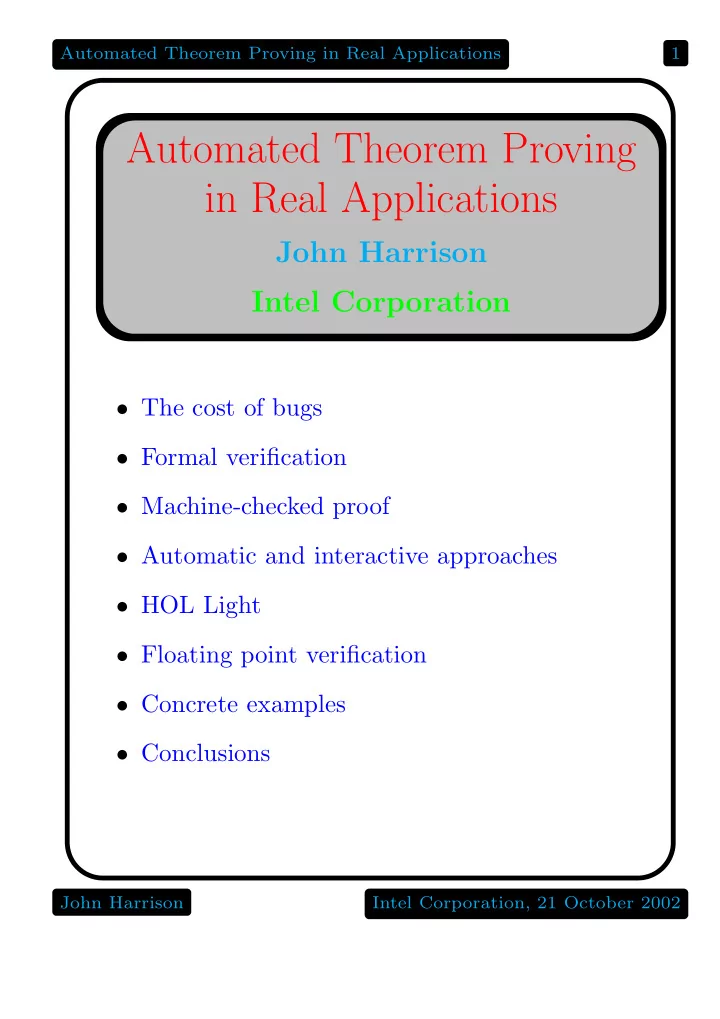
Automated Theorem Proving in Real Applications John Harrison Intel - - PDF document

automated theorem proving in real applications
SMART_READER_LITE
LIVE PREVIEW

Automated Theorem Proving in Real Applications John Harrison Intel - - PDF document

Automated Theorem Proving in Real Applications 1 Automated Theorem Proving in Real Applications John Harrison Intel Corporation The cost of bugs Formal verification Machine-checked proof Automatic and interactive approaches


slide-1
SLIDE 1

Automated Theorem Proving in Real Applications 1

Automated Theorem Proving in Real Applications

John Harrison Intel Corporation

  • The cost of bugs
  • Formal verification
  • Machine-checked proof
  • Automatic and interactive approaches
  • HOL Light
  • Floating point verification
  • Concrete examples
  • Conclusions

John Harrison Intel Corporation, 21 October 2002

slide-2
SLIDE 2

Automated Theorem Proving in Real Applications 2

The human cost of bugs

Computers are often used in safety-critical systems where a failure could cause loss of life.

  • Heart pacemakers
  • Aircraft
  • Nuclear reactor controllers
  • Car engine management systems
  • Radiation therapy machines
  • Telephone exchanges (!)
  • ...

John Harrison Intel Corporation, 21 October 2002

slide-3
SLIDE 3

Automated Theorem Proving in Real Applications 3

Financial cost of bugs

Even when not a matter of life and death, bugs can be financially serious if a faulty product has to be recalled or replaced.

  • 1994 FDIV bug in the IntelPentium

processor: US $500 million.

  • Today, new products are ramped much

faster... So Intel is especially interested in all techniques to reduce errors.

John Harrison Intel Corporation, 21 October 2002

slide-4
SLIDE 4

Automated Theorem Proving in Real Applications 4

Complexity of designs

At the same time, market pressures are leading to more and more complex designs where bugs are more likely.

  • A 4-fold increase in bugs in Intel processor

designs per generation.

  • Approximately 8000 bugs introduced during

design of the Pentium 4. Fortunately, pre-silicon detection rates are now very close to 100%. Just enough to tread water...

John Harrison Intel Corporation, 21 October 2002

slide-5
SLIDE 5

Automated Theorem Proving in Real Applications 5

Limits of testing

Bugs are usually detected by extensive testing, including pre-silicon simulation.

  • Slow — especially pre-silicon
  • Too many possibilities to test them all

For example:

  • 2160 possible pairs of floating point numbers

(possible inputs to an adder).

  • Vastly higher number of possible states of a

complex microarchitecture.

John Harrison Intel Corporation, 21 October 2002

slide-6
SLIDE 6

Automated Theorem Proving in Real Applications 6

Formal verification

Formal verification: mathematically prove the correctness of a design with respect to a mathematical formal specification. Actual system Design model Formal specification Actual requirements ✻ ✻ ✻

John Harrison Intel Corporation, 21 October 2002

slide-7
SLIDE 7

Automated Theorem Proving in Real Applications 7

Verification vs. testing

Verification has some advantages over testing:

  • Exhaustive.
  • Improves our intellectual grasp of the system.

However:

  • Difficult and time-consuming.
  • Only as reliable as the formal models used.
  • How can we be sure the proof is right?

John Harrison Intel Corporation, 21 October 2002

slide-8
SLIDE 8

Automated Theorem Proving in Real Applications 8

Analogy with mathematics

Sometimes even a huge weight of empirical evidence can be misleading.

  • π(n) = number of primes ≤ n
  • li(n) =

n

0 du/ln(u)

Littlewood proved in 1914 that π(n) − li(n) changes sign infinitely often. No change of sign at all had ever been found despite testing up to n = 1010 (in the days before computers). Similarly, extensive testing of hardware or software may still miss errors that would be revealed by a formal proof.

John Harrison Intel Corporation, 21 October 2002

slide-9
SLIDE 9

Automated Theorem Proving in Real Applications 9

Formal verification is hard

Writing out a completely formal proof of correctness for real-world hardware and software is difficult.

  • Must specify intended behaviour formally
  • Need to make many hidden assumptions

explicit

  • Requires long detailed proofs, difficult to

review The state of the art is quite limited. Software verification has been around since the 60s, but there have been few major successes.

John Harrison Intel Corporation, 21 October 2002

slide-10
SLIDE 10

Automated Theorem Proving in Real Applications 10

Faulty hand proofs

“Synchronizing clocks in the presence of faults” (Lamport & Melliar-Smith, JACM 1985) This introduced the Interactive Convergence Algorithm for clock synchronization, and presented a ‘proof’ of it.

  • Presented five supporting lemmas and one

main correctness theorem.

  • Lemmas 1, 2, and 3 were all false.
  • The proof of the main induction in the final

theorem was wrong.

  • The main result, however, was correct!

John Harrison Intel Corporation, 21 October 2002

slide-11
SLIDE 11

Automated Theorem Proving in Real Applications 11

Machine-checked proof

A more promising approach is to have the proof checked (or even generated) by a computer program.

  • It can reduce the risk of mistakes.
  • The computer can automate some parts of

the proofs. There are limits on the power of automation, so detailed human guidance is usually necessary.

John Harrison Intel Corporation, 21 October 2002

slide-12
SLIDE 12

Automated Theorem Proving in Real Applications 12

Automatic verification?

Many problems can be attacked using decision methods with (in principle!) limited human intervention, e.g.

  • Boolean equivalence checking
  • Temporal logic model checking
  • Symbolic trajectory evaluation

This probably accounts for the relative success of formal verification in hardware. However, sometimes we need more general theorem proving, especially for the kinds of applications I’m interested in...

John Harrison Intel Corporation, 21 October 2002

slide-13
SLIDE 13

Automated Theorem Proving in Real Applications 13

Levels of verification

My job involves verifying higher-level floating-point algorithms based on assumed correct behavior of hardware primitives. gate-level description fma correct sin correct ✻ ✻ We will assume that all the operations used obey the underlying specifications as given in the Architecture Manual and the IEEE Standard for Binary Floating-Point Arithmetic. This is a typical specification for lower-level verification (someone else’s job).

John Harrison Intel Corporation, 21 October 2002

slide-14
SLIDE 14

Automated Theorem Proving in Real Applications 14

The spectrum of theorem provers

From interactive proof checkers to fully automatic theorem provers.

AUTOMATH (de Bruijn) Stanford LCF (Milner) Mizar (Trybulec) . . . . . . PVS (Owre, Rushby, Shankar) . . . . . . ACL2 (Boyer, Kaufmann, Moore) Otter (McCune)

John Harrison Intel Corporation, 21 October 2002

slide-15
SLIDE 15

Automated Theorem Proving in Real Applications 15

Automation vs. expressiveness

Tools like Boolean tautology checkers and symbolic model checkers are:

  • Completely automatic
  • Efficient enough for nontrivial problems
  • Incapable even of expressing, let alone

proving, many interesting properties. On the other hand, proof checkers like Mizar:

  • Can prove essentially any mathematical

theorem in principle

  • Require detailed and explicit human guidance

even for relatively simple problems. To verify interesting floating-point algorithms, we need automation and expressiveness.

John Harrison Intel Corporation, 21 October 2002

slide-16
SLIDE 16

Automated Theorem Proving in Real Applications 16

HOL Light

HOL Light is based on the approach to theorem proving pioneered in Edinburgh LCF in the 70s.

  • All theorems created by low-level primitive

rules.

  • Guaranteed by using an abstract type of

theorems; no need to store proofs.

  • ML available for implementing derived rules

by arbitrary programming. The system can be extended reliably without making unsafe modifications The user controls the means of production (of theorems).

John Harrison Intel Corporation, 21 October 2002

slide-17
SLIDE 17

Automated Theorem Proving in Real Applications 17

Other LCF theorem provers

There are many versions of HOL:

  • HOL88
  • hol90
  • ProofPower
  • HOL Light
  • hol98
  • HOL 4

and several other provers based on LCF:

  • Coq
  • Isabelle
  • Nuprl

John Harrison Intel Corporation, 21 October 2002

slide-18
SLIDE 18

Automated Theorem Proving in Real Applications 18

Floating point verification

We’ve used HOL Light to verify the accuracy of floating point algorithms (used in hardware and software) for:

  • Division and square root
  • Transcendental function such as sin, exp,

atan. This involves background work in formalizing:

  • Real analysis
  • Basic floating point arithmetic

John Harrison Intel Corporation, 21 October 2002

slide-19
SLIDE 19

Automated Theorem Proving in Real Applications 19

Existing real analysis theory

  • Definitional construction of real numbers
  • Basic topology
  • General limit operations
  • Sequences and series
  • Limits of real functions
  • Differentiation
  • Power series and Taylor expansions
  • Transcendental functions
  • Gauge integration

John Harrison Intel Corporation, 21 October 2002

slide-20
SLIDE 20

Automated Theorem Proving in Real Applications 20

Examples of useful theorems

|- sin(x + y) = sin(x) * cos(y) + cos(x) * sin(y) |- tan(&n * pi) = &0 |- &0 < x /\ &0 < y ==> (ln(x / y) = ln(x) - ln(y)) |- f contl x /\ g contl (f x) ==> (g o f) contl x |- (!x. a <= x /\ x <= b ==> (f diffl (f’ x)) x) /\ f(a) <= K /\ f(b) <= K /\ (!x. a <= x /\ x <= b /\ (f’(x) = &0) ==> f(x) <= K) ==> !x. a <= x /\ x <= b ==> f(x) <= K

John Harrison Intel Corporation, 21 October 2002

slide-21
SLIDE 21

Automated Theorem Proving in Real Applications 21

HOL floating point theory

Generic floating point theory in HOL. Can be applied to all the required formats, and

  • thers supported in software.

Precise specification of floating point rounding, floating point exceptions etc. Typical theorems include monotonicity of rounding: |- ~(precision fmt = 0) /\ x <= y ==> round fmt rc x <= round fmt rc y and subtraction of nearby floating point numbers: |- a IN iformat fmt /\ b IN iformat fmt /\ a / &2 <= b /\ b <= &2 * a ==> (b - a) IN iformat fmt

John Harrison Intel Corporation, 21 October 2002

slide-22
SLIDE 22

Automated Theorem Proving in Real Applications 22

Example: tangent algorithm

Works essentially as follows.

  • The input number X is first reduced to r

with approximately |r| ≤ π/4 such that X = r + Nπ/2 for some integer N. We now need to calculate ±tan(r) or ±cot(r) depending on N modulo 4.

  • If the reduced argument r is still not small

enough, it is separated into its leading few bits B and the trailing part x = r − B, and the overall result computed from tan(x) and pre-stored functions of B, e.g. tan(B + x) = tan(B) +

1 sin(B)cos(B)tan(x)

cot(B) − tan(x)

  • Now a power series approximation is used for

tan(r), cot(r) or tan(x) as appropriate.

John Harrison Intel Corporation, 21 October 2002

slide-23
SLIDE 23

Automated Theorem Proving in Real Applications 23

Overview of the verification

To verify this algorithm, we need to prove:

  • The range reduction to obtain r is done

accurately.

  • The mathematical facts used to reconstruct

the result from components are applicable.

  • The pre-stored constants such as tan(B) are

sufficiently accurate.

  • The power series approximation does not

introduce too much error in approximation.

  • The rounding errors involved in computing

with floating point arithmetic are within bounds. Most of these parts are non-trivial. Moreover, some of them require more pure mathematics than might be expected.

John Harrison Intel Corporation, 21 October 2002

slide-24
SLIDE 24

Automated Theorem Proving in Real Applications 24

Why mathematics?

Controlling the error in range reduction becomes difficult when the reduced argument X − Nπ/2 is small. To check that the computation is accurate enough, we need to know: How close can a floating point number be to an integer multiple of π/2? Even deriving the power series (for 0 < |x| < π): cot(x) = 1/x − 1 3x − 1 45x3 − 2 945x5 − . . . is much harder than you might expect.

John Harrison Intel Corporation, 21 October 2002

slide-25
SLIDE 25

Automated Theorem Proving in Real Applications 25

Square root example

Several square root algorithms work by a final rounding of a more accurate intermediate result S∗. For perfect rounding, we should ensure that the two real numbers √a and S∗ never fall on

  • pposite sides of a midpoint between two floating

point numbers, as here: ✲ ✻ ✻ √a S∗ Rather than analyzing the rounding of the final approximation explicitly, we can just appeal to general properties of the square root function.

John Harrison Intel Corporation, 21 October 2002

slide-26
SLIDE 26

Automated Theorem Proving in Real Applications 26

Exclusion zones

It would suffice if we knew for any midpoint m that: |√a − S∗| < |√a − m| In that case √a and S∗ cannot lie on opposite sides of m. Here is the formal theorem in HOL: |- ¬(precision fmt = 0) ∧ (∀m. m IN midpoints fmt ⇒ abs(x - y) < abs(x - m)) ⇒ (round fmt Nearest x = round fmt Nearest y) And this is possible to prove, because in fact every midpoint m is surrounded by an ‘exclusion zone’ of width δm > 0 within which the square root of a floating point number cannot occur. However, this δ can be quite small, considered as a relative error. If the floating point format has precision p, then we can have δm ≈ |m|/22p+3.

John Harrison Intel Corporation, 21 October 2002

slide-27
SLIDE 27

Automated Theorem Proving in Real Applications 27

Difficult cases

The fused multiply-add (fma) can help us to achieve just under twice the accuracy, and HOL can prove this with a simple relative error analysis: |√a − S∗| < 2−2p+1|√a| This is not quite enough, because the ‘exclusion zones’ are smaller in some cases: |√a − m| < 2−2p−3|√a| However, we only need to consider the set of ‘difficult cases’: D = {a | ∃m. |√a − m| < 2−2p+1|√a|} If we can find this set of points D and check that the algorithm runs correctly on them, we will have a complete proof. This approach is due to Marius Cornea, and is especially amenable to semi-automated formalization.

John Harrison Intel Corporation, 21 October 2002

slide-28
SLIDE 28

Automated Theorem Proving in Real Applications 28

Isolating difficult cases

The difficult cases (considering mantissas as integers) can be characterized as solutions of diophantine equations of the form: 2qa = k2 + d We consider the equations separately for each chosen d. For example, we might be interested in the solutions, if any, of: 254a = k2 − 7 We can solve the equations in HOL automatically by programming a simple recursive algorithm based on even/odd case analysis of k leading to successive reduction of the exponent (‘Hensel lifting’). Thus, all parts of the proof are integrated, and

  • ften automated: pure mathematics, analytical

error bounds, finding and testing difficult cases.

John Harrison Intel Corporation, 21 October 2002

slide-29
SLIDE 29

Automated Theorem Proving in Real Applications 29

Conclusions

  • Formal verification of mathematical

algorithms is industrially important, and can be attacked with current theorem proving technology.

  • A large part of the work involves building up

general theories about both pure mathematics and special properties of floating point numbers.

  • It is easy to underestimate the amount of

pure mathematics needed for obtaining very practical results.

  • The mathematics required is often the sort

that is not found in current textbooks: very concrete results but with a proof!

  • Using HOL Light, we can confidently

integrate all the different aspects of the proof, using programmability to automate tedious parts.

John Harrison Intel Corporation, 21 October 2002