
jonas.kvarnstrom@liu.se – 2020
Auto tomat mated d Pla lanning ing
Planni ning ngunder Uncert rtainty nty
Jonas Kvarnström Department of Computer and Information Science Linköping University
2
jonkv@ida jonkv@ida
2
Multiple iple Outcome comes
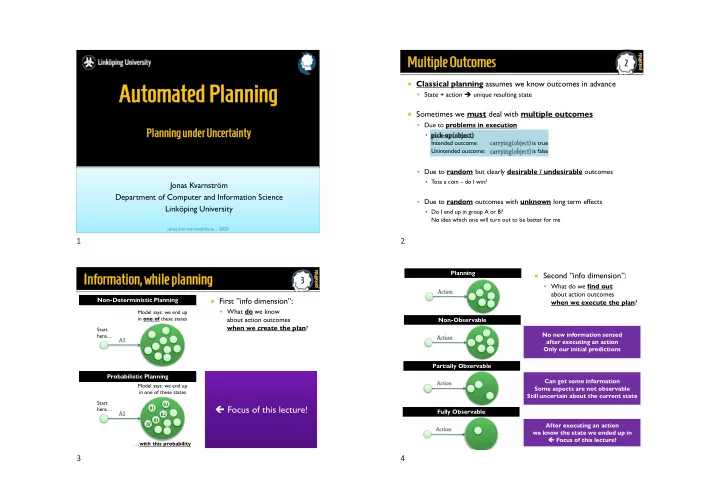
Classical planning assumes we know outcomes in advance ▪ State + action ➔ unique resulting state Sometimes we must deal with multiple outcomes ▪ Due to problems in execution ▪ Intended outcome: is true Unintended outcome: is false ▪ Due to random but clearly desirable / undesirable outcomes ▪ Toss a coin – do I win? ▪ Due to random outcomes with unknown long term effects ▪ Do I end up in group A or B? No idea which one will turn out to be better for me
3
jonkv@ida jonkv@ida
3
Infor
- rmation,
mation, while le planning ing
First ”info dimension”: ▪ What do we know about action outcomes when we create the plan?
Start here… Model says: we end up in one of these states
Non-Deterministic Planning Probabilistic Planning
Focus of this lecture!
Start here…
0.1 0.2 .07 0.1 .03
Model says: we end up in one of these states …with this probability
Second ”info dimension”: ▪ What do we find out about action outcomes when we execute the plan? Planning Non-Observable Partially Observable Fully Observable No new information sensed after executing an action Only our initial predictions Can get some information Some aspects are not observable Still uncertain about the current state After executing an action we know the state we ended up in Focus of this lecture!
1 2 3 4