Australian environment Reserved letters: 45% of Australia Post - - PowerPoint PPT Presentation

australian environment
SMART_READER_LITE
LIVE PREVIEW

Australian environment Reserved letters: 45% of Australia Post - - PowerPoint PPT Presentation

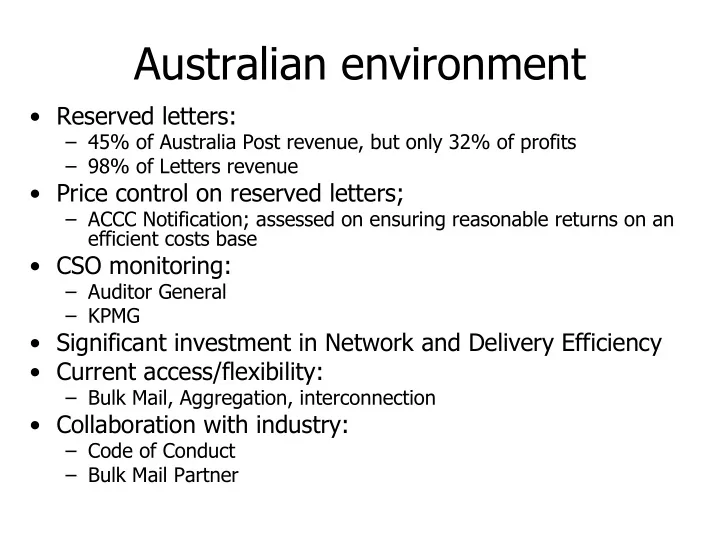
Australian environment Reserved letters: 45% of Australia Post revenue, but only 32% of profits 98% of Letters revenue Price control on reserved letters; ACCC Notification; assessed on ensuring reasonable returns on an


slide-1
SLIDE 1

Australian environment

  • Reserved letters:

– 45% of Australia Post revenue, but only 32% of profits – 98% of Letters revenue

  • Price control on reserved letters;

– ACCC Notification; assessed on ensuring reasonable returns on an efficient costs base

  • CSO monitoring:

– Auditor General – KPMG

  • Significant investment in Network and Delivery Efficiency
  • Current access/flexibility:

– Bulk Mail, Aggregation, interconnection

  • Collaboration with industry:

– Code of Conduct – Bulk Mail Partner

slide-2
SLIDE 2

Community Service Obligations

  • Post must provide a Letter service:

– Letter service up to 500g

  • Principle purpose of Letter service:

– to carry reserved letters, and – to carry letters between Australia and overseas countries

  • Provide single uniform price for standard

postal articles carried by ordinary post.

  • Ensure letter service is:

– reasonably accessible, and – performance standards meet social, industrial and commercial needs.

slide-3
SLIDE 3

Domestic Letters

  • Reserved Letters 39% of total market:

– 4b from 10b

  • Private operators exist at varying levels;

– covering over 90% of residential… to – servicing niche business markets.

  • Part of the Communications Market:

– under severe pressure from substitutes

slide-4
SLIDE 4

Letters part of the communications market

  • 5,000

10,000 15,000 20,000 25,000 30,000

1960 1996 2003

Postal Services Other Telecommunications

Communications market growing Postal Services share falling

  • 10,000.0

20,000.0 30,000.0 40,000.0 1960 1996 2003 10.0% 20.0% 30.0% 40.0% 50.0% Comms market Postal Services Share

slide-5
SLIDE 5

World Mail Growth Slowing

Domestic Mail Growth Average Growth 95-00 compared to 00-02

  • 4.0%
  • 2.0%

0.0% 2.0% 4.0% 6.0% Western Europe USA Canada Aust 95-00 00-02

slide-6
SLIDE 6

Pressures from Substitution Increasing

Av per Month 40 50 60 70 80 90 1994 1995 1996 1997 1998 1999 2000 2001 2002 2003

Use of Cheques Declining, as…. Uptake of Credit Cards increase

5.0 6.0 7.0 8.0 9.0 10.0 11.0 1994 1995 1996 1997 1998 1999 2000 2001 2002 2003

slide-7
SLIDE 7

Future Directions

  • Continue to improve productivity
  • Seek volume growth from Mail Marketing
  • Promote the value of paper based communications
  • Continued collaboration with other suppliers essential to

enhance letter value chain

slide-8
SLIDE 8

Postal Regulatory Environment

  • Current system strikes a balance between

commercial and social imperatives.

– Post must act commercially, but has community service

  • bligations;
  • commercial obligation a major stimulus that has driven

improvements in Post’s businesses - and not just reserved.

– Minister retains certain public interest powers; – Reserved Prices subject to ACCC notification

  • ACCC considers the efficiency of costs;

– Public Interest performance standards set by Regulation and are independently monitored

slide-9
SLIDE 9

Outcomes of Current Regulation

  • Prices
  • Efficiency
  • Service Quality
  • Innovation
  • Profitability
slide-10
SLIDE 10

Outcomes of Current Regulation

  • Prices:

– BPR delivery virtually same price as 1992 (gst ex) – Actual reductions for bulk users (38.25 to 34c)

$0.45 $0.60 $0.45 $0.38 $0.51 $0.34 $0.25 $0.35 $0.45 $0.55 $0.65 Price in 1992 92 price at CPI Todays Price BPR PreSort Letters

slide-11
SLIDE 11

Outcomes of Current Regulation

Third lowest BPR in OECD Countries (PPP)

39 43 50 51 56 67 71 79 80 81 83 90 119 KOREA NEW ZEALAND AUSTRALIA UNITED STATES CANADA NETHERLANDS UNITED KINGDOM ITALY SWITZERLAND JAPAN FRANCE GERMANY HUNGARY

slide-12
SLIDE 12

Outcomes of Current Regulation

Efficiency

  • Labour productivity

more than doubled that

  • f Australian economy
  • Sustained improvement

in Total Factor productivity ahead of the Australian Economy

Total Factor Productivity

1 2 3 4 5 6

75-81 82-88 89-99 % Change

Post Australia

slide-13
SLIDE 13

Outcomes of Current Regulation

  • Service Quality

– Independently measured and improving

90.0% 92.0% 94.0% 96.0% 98.0% 93/94 94/95 95/96 96/97 97/98 98/99 99/00 00/01 01 /02 02/03 03/04

% delivered on time

slide-14
SLIDE 14

Outcomes of Current Regulation

Innovation:

  • Future Post ($800m)
  • Express Post
  • Aggregation,
  • Retail Network,
  • Logistics
  • Data
  • StarTrack/AaE
  • Asia Pacific Express consortium
slide-15
SLIDE 15

Outcomes of Current Regulation

Profitability

– Profits grown in non-letters area – BPR constant

$- $100 $200 $300 $400 $500 92-93 93-94 94-95 95-96 96-97 97-98 98-99 99-00 00-01 01-02 02-03

slide-16
SLIDE 16

Post View on Regulation

  • A Government decision
  • Supports phased reductions in reserved

service;

– assess impacts for unintended consequences.

  • Supports CSO cost funded from the Letters

service revenues

  • Has supported government legislation to

legitimise aggregation and DX practices.

slide-17
SLIDE 17

Access

  • Post has worked with the Postal Industry

to develop non-mandated bulk mail access:

– Prices substantially lower than BPR – Prices have had regard to, among other things,

  • costs saved to Post;
  • statutory requirements for reserved services

(CSO obligations);

  • Post to generate commercial return
slide-18
SLIDE 18

Work Share Pricing

$0.50 $0.45 $0.42 $0.37

$0.30 $0.35 $0.40 $0.45 $0.50 $0.55 BPR Clean Mail Barcode Residue Barcode Direct Tray

slide-19
SLIDE 19

Access

  • Important principles underlying current

regime:

– access at points equipped to accept mail – discounts offered relate to cost savings (top down, retail less)

  • This recognises access should not act as a

disincentive to investment

  • Benefit of network recognised by

customers:

– MMUA “importance.. of two way network cant be

  • veremphasised..”
slide-20
SLIDE 20

End to End Letters Network

Mailing Houses SPBs - 16,000 nationally Originating Mail Centre - 31 Metro & country facilities Terminating Mail Centre - 31 Metro & country facilities Delivery Centre - 314 facilities nationally Retail Facilities - 4500 (2582 in remote and rural areas)

Lodgement Points Transport and Processing Final Delivery Lodgements at:

  • Street Posting Boxes (SPBs),
  • Retail Outlets,
  • Mail Centres

Servicing 1.1 million customers in our outlets daily - Delivering to 9.4 million delivery points

Delivery Points - 9.4 million

slide-21
SLIDE 21

Letter Value Chain

Postal Process & Delivery Consolidate & Drop Ship Fulfill Letter- Shop Print Data Process- ing List Manage- ment Create

Transaction processing (e.g., billing) Apply postage, presort Aggregate mail; enter downstream 3rd party order-taking and fulfillment of products, books, reports, etc Process and deliver in the postal network Print inserts, catalogues, documents Clean addresses and target mail

1. 2. 3. 4. 5. 6. 7. 8. 1. 2. 3. 4. 5. 6. 7. 8.

Design & create communications piece Adapted from a Luis Jimenez presentation Street post boxes Post Offices Outstations Delivery Centre Cancel Stamps, Face mail Read address/apply barcode Sort to Postman Round Manual Sort Mail Processing Centre

Postal Process

slide-22
SLIDE 22

Access Points

Street post boxes Post Office, Business Centre Terminating Mail Centre Originating Mail Centre Delivery Centre

Access Points into Postal Process

Australia Post Transport

slide-23
SLIDE 23

Letters Business Model

  • Investment in latest sorting technology and

most efficient network configuration

– $800m on Future Post.

  • Reduction of other costs across the network.

– Move to part-time, contract, LPOs, Air-by-road

  • Exercise price restraint:

– BPR virtually at same price as 1992

  • Work with Customers/Industry Players