ASTM meeting Belfast 23-24 September 2014 Notified body - - PDF document

astm meeting belfast
SMART_READER_LITE
LIVE PREVIEW

ASTM meeting Belfast 23-24 September 2014 Notified body - - PDF document

02.10.2014 ASTM meeting Belfast 23-24 September 2014 Notified body perspective: Sterile packaging validation: testing challenges, issues, and mistakes that you see in the industry Dr. Matthias Mondon TV SD Product Service GmbH Market


slide-1
SLIDE 1

02.10.2014 1

TÜV SÜD Product Service GmbH

ASTM meeting Belfast

23-24 September 2014

Notified body perspective: Sterile packaging validation: testing challenges, issues, and mistakes that you see in the industry

  • Dr. Matthias Mondon

TÜV SÜD Product Service GmbH

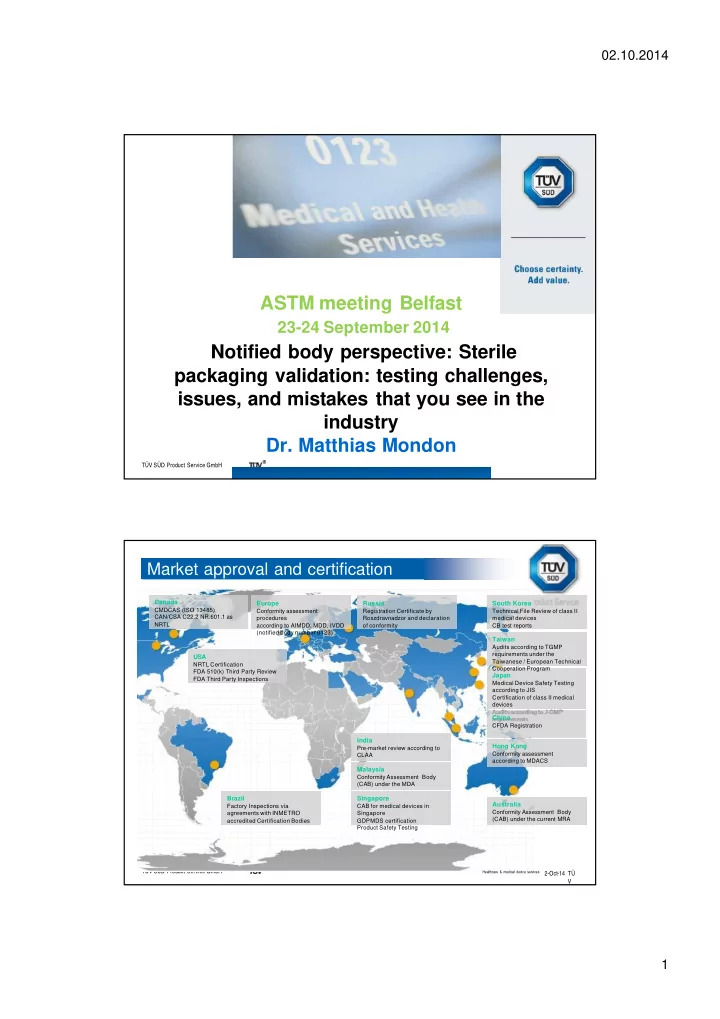
Market approval and certification

TÜ V Japan Medical Device Safety Testing according to JIS Certification of class II medical devices Audits according to J-GMP requirements China CFDA Registration Europe Conformity assessment procedures according to AIMDD, MDD, IVDD (notified body number 0123) Australia Conformity Assessment Body (CAB) under the current MRA Canada CMDCAS (ISO 13485) CAN/CSA C22.2 NR.601.1 as NRTL USA NRTL Certification FDA 510(k) Third Party Review FDA Third Party Inspections Taiwan Audits according to TGMP requirements under the Taiwanese / European Technical Cooperation Program Brazil Factory Inspections via agreements with INMETRO accredited Certification Bodies Russia Registration Certificate by Roszdravnadzor and declaration

  • f conformity

Hong Kong Conformity assessment according to MDACS Singapore CAB for medical devices in Singapore GDPMDS certification Product Safety Testing India Pre-market review according to CLAA Malaysia Conformity Assessment Body (CAB) under the MDA South Korea Technical File Review of class II medical devices CB test reports 2-Oct-14

Healthcare & medical device services

slide-2
SLIDE 2

02.10.2014 2

TÜV SÜD Product Service GmbH

1

One-stop technical solution provider

800

locations worldwide employees worldwide

20,190

million Euro in sales revenue 2013

1,900 150

years of experience

TÜV SÜD Product Services

TÜV SÜD in numbers: Growing from strength to strength

TÜ V SÜ 2-Oct-14

Healthcare & medical device services

TÜV SÜD Product Service GmbH

Our heritage: 148 years of business success

Establishment of a Mannheim-based steam boiler inspection association by 21 operators and owners

  • f steam boilers, with the objective of protecting

man, the environment and property against the risk emanating from a new and largely unknown form of technology 1866 First vehicle periodic technical inspection (PTI) 1910 1958 Development of a Bavaria-wide network of vehicle inspection centres in the late 1950s 1926 Introduction of the “TÜV mark / stamp” in Germany 1990s Conglomeration of TÜVs from the southern part of Germany to form TÜV SÜD and the expansion of business operations into Asia TÜV SÜD pursues a strategy of internationalisation and growth Today 2006 Expansion of services in ASEAN by acquiring Singapore-based PSB Group 2009 Launch of Turkey-wide vehicle inspection by TÜVTURK

2-Oct-14

Healthcare & medical device services

slide-3
SLIDE 3

02.10.2014 3

TÜV SÜD Product Service GmbH

Auditing and system certification services

Quality management § ISO 13485 § ISO 9001 § ISO 15378 Risk management system § ISO 14971 Health care providers / hospitals § Good Dialysis Practice § DIN EN 15224 Environmental § ISO 14001 A selection of our auditing services

TÜ V

For market access § Europe: MDD 93/42 § U.S.: 21 CFR 820 § Japan: J-GMP § Canada: CMDCAS § Taiwan: Taiwan GMP

2-Oct-14

Healthcare & medical device services

TÜV SÜD Product Service GmbH

Our asset. Your advantage.

TÜV SÜD: A brand synonymous with quality and safety. Our certification marks and certificates are excellent marketing tools for our customers. Our test reports provide customers with the confidence to market their products’ safety, quality and sustainability attributes.

> 46,000 system certificates

TÜ V

> 320,000 product certificates

2-Oct-14

Healthcare & medical device services

slide-4
SLIDE 4

02.10.2014 4

TÜV SÜD Product Service GmbH

ASTM meeting Belfast

23-24 September 2014

Notified body perspective: Sterile packaging validation: testing challenges, issues, and mistakes that you see in the industry

  • Dr. Matthias Mondon

TÜV SÜD Product Service GmbH

Why Packaging validation?

Ever bought Bananas? Is something missing? Yes correct, the Packaging!

02.10.2014

  • Dr. Jan Havel

8

slide-5
SLIDE 5

02.10.2014 5

TÜV SÜD Product Service GmbH

Why Packaging validation?

Is this all? We will get back to it

02.10.2014

  • Dr. Jan Havel

9

TÜV SÜD Product Service GmbH

Why Packaging validation?

Also, medical devices must be packed safely!

Where does that requirement come from? EC-Directive 93/42/EEC for Medical Devices

02.10.2014 10

Medical Device 93/42 EEC

  • Dr. Jan Havel
slide-6
SLIDE 6

02.10.2014 6

TÜV SÜD Product Service GmbH

93/42 EEC Article 3:

Medical devices, must meet the essential requirements (MDD Annex I).

93/42 EEC Article 11:

Compliance to Essential Requiremnts (MDD Annex I) must be demonstrated by a Conformity Assessment Procedure (e.G. Annex II.3).

Medical device 93/42 EEC Annex e.g. II, V

Why Conformity?

TÜV SÜD Product Service GmbH

Contents

02.10.2014 12

Standard Requirements ISO 11607 Documentation

  • Definition of the

packaging

  • Validated Methods
  • Typical Test methods

and Sampling size

  • Worst Case Definition

Problems arising from packaging processes Typical failures in validation procedures

Introduction MDD Requirements

  • Regulatory Requirements
  • Usability
  • Dr. Jan Havel
slide-7
SLIDE 7

02.10.2014 7

TÜV SÜD Product Service GmbH

Regulatory Requirements of the MDD

Directive 93/42/EEC (MDD) Essential Requirements:

  • 3) The devices must achieve the performances intended by the

manufacturer and be designed, manufactured and packaged in such a way that they are suitable for one or more of the functions referred to in Article 1 (2) (a), as specified by the manufacturer..

  • 5) The devices must be designed, manufactured and packed in such a

way that their characteristics and performances during their intended use will not be adversely affected during transport and storage taking account of the instructions and information provided by the manufacturer.

02.10.2014 13

  • Dr. Jan Havel

TÜV SÜD Product Service GmbH

Regulatory Requirements of the MDD

Directive 93/42/EEC (MDD) Essential Requirements:

  • 7.2) The devices must be designed, manufactured and packed in such a way

as to minimize the risk posed by contaminants and residues to the persons involved in the transport, storage and use of the devices and to the patients…

  • 8.3) Devices delivered in a sterile state must be designed, manufactured and

packed in a non-reusable pack and/or according to appropriate procedures to ensure that they are sterile when placed on the market and remain sterile, under the storage and transport conditions laid down, until the protective packaging is damaged or opened.

  • 8.1) The design must allow easy handling and, where necessary, minimize

contamination of the device by the patient or vice versa during use

02.10.2014 14

  • Dr. Jan Havel
slide-8
SLIDE 8

02.10.2014 8

TÜV SÜD Product Service GmbH

Regulatory Requirements of the MDD

Directive 93/42/EEC (MDD) Essential Requirements:

  • 8.4) Devices delivered in a sterile state must have been manufactured and

sterilized by an appropriate, validated method (8.4)

02.10.2014 15

  • Dr. Jan Havel

TÜV SÜD Product Service GmbH

Validation Requirements according to 7.5.2 of EN ISO 13485:2003

  • The organization shall validate any processes for

production and service provision where the output cannot be verified by subsequent monitoring or measurement.

  • http://www.imdrf.org/docs/ghtf/final/sg3/technical-docs/ghtf-

sg3-n99-10-2004-qms-process-guidance-04010.pdf

  • (previously GHTF)

02.10.2014 16

  • Dr. Jan Havel
slide-9
SLIDE 9

02.10.2014 9

TÜV SÜD Product Service GmbH

Packaging Validation

  • Harmonized standard for packaging validation:

– EN ISO 11607-1 – EN ISO 11607-2

  • Harmonised standards refering to packaging validation

– EN ISO 13485 Quality Management System – EN ISO 14937 Sterilization of medical devices – EN ISO 17664 reprocessing of medical devices

02.10.2014 17

EN ISO 17664 3.9 3.11 EN ISO 14937 E.4.3

  • Dr. Jan Havel

TÜV SÜD Product Service GmbH

Responsibility for purchased Items

  • The requirements on materials referenced shall apply to those

used in preformed sterile barrier systems, as well as sterile barrier systems (Are the pre-shaped sealing-seams appropriate and compatible with the own production process and the own storage conditions?) Prefabricated packages are not assessed and documented

02.10.2014 18

ISO 11607-1:2009 5.1.1

What do I do if What do I do if the package is prefabricated?

  • Dr. Jan Havel
slide-10
SLIDE 10

02.10.2014 10

TÜV SÜD Product Service GmbH

Contents

02.10.2014 19

Standard Requirements ISO 11607 Documentation

  • Definition of the

packaging

  • Validated Methods
  • Typical Test methods

and Sampling size

  • Worst Case Definition

Problems arising from packaging processes Typical failures in validation procedures

Introduction MDD Requirements

  • Regulatory Requirements
  • Usability
  • Dr. Jan Havel

TÜV SÜD Product Service GmbH

Misleading labeling

02.10.2014 20

Does the packaging labeling show the real content? How will this product be aseptically presented? There are 4 possibilities to attach the label to indicate the information on the content.

MDD Annex I 8.1, ISO 11607-1:2009 5.1.9; 6.2.2

  • Dr. Jan Havel
slide-11
SLIDE 11

02.10.2014 11

TÜV SÜD Product Service GmbH

Aseptic presentation

02.10.2014 21

MDD Annex I 8.1, ISO 11607-1:2009 5.1.9; 6.2.2

  • Dr. Jan Havel

How to open a package is not addressed in a risk based approach and not supported by tests / documentedevidence How is the producthanded over in the sterile field in the operation room?

TÜV SÜD Product Service GmbH

Contents

02.10.2014 22

Standard Requirements ISO 11607 Documentation

  • Definition of the

packaging

  • Validated Methods
  • Typical Test methods

and Sampling size

  • Worst Case Definition

Problems arising from packaging processes Typical failures in validation procedures

Introduction MDD Requirements

  • Regulatory Requirements
  • Usability
  • Dr. Jan Havel
slide-12
SLIDE 12

02.10.2014 12

TÜV SÜD Product Service GmbH

Documentation Requirements – Definition of the packaging – Validated Methods – Justificaton for selected tests

  • Sampling sizes
  • Validation process for „worst case“-Products

02.10.2014 23

  • Dr. Jan Havel

TÜV SÜD Product Service GmbH

Contents

02.10.2014 24

Standard Requirements ISO 11607 Documentation

  • Definition of the

packaging

  • Validated Methods
  • Typical Test methods

and Sampling size

  • Worst Case Definition

Problems arising from packaging processes Typical failures in validation procedures

Introduction MDD Requirements

  • Regulatory Requirements
  • Usability
  • Dr. Jan Havel
slide-13
SLIDE 13

02.10.2014 13

TÜV SÜD Product Service GmbH

Documentation Requirements ISO 11607-1

7.1 The following information shall be provided with the material, preformed sterile barrier system or sterile barrier system:

  • the type, size or grade;

3 Terms and definitions 3.9 packaging material any material used in the fabrication or sealing of a packaging system 3.10 packaging system combination of the sterile barrier system and protective packaging 3.13 protective packaging configuration of materials designed to prevent damage to the sterile barrier system and its contents from the time of their assembly until the point of use 3.22 sterile barrier system minimum package that prevents ingress of microorganisms and allows aseptic presentation of the product at the point of use

02.10.2014 25

  • Dr. Jan Havel

TÜV SÜD Product Service GmbH

Why Packaging validation?

Is this all? No! There is also a bag, a carton box and perhaps another wrap

02.10.2014

  • Dr. Jan Havel

26

slide-14
SLIDE 14

02.10.2014 14

TÜV SÜD Product Service GmbH

Documentation Requirements ASTM D 4169

  • 5. Test Specimen
  • 5.1 Test specimens consist of representative samples of

complete shipping units, including actual contents.

  • 3. Terminology:
  • 3.2.7 shipping unit—the smallest complete unit that will be

subjected to the distribution environment, for example, a shipping container and its contents. Definition of the packaging and the device is essential e.g. actual contents also include desiccant pouches, SBS carton pieces for protection, Tyvek pieces for protection, which need to be defined.

02.10.2014 27

  • Dr. Jan Havel

TÜV SÜD Product Service GmbH

Contents

02.10.2014 28

Standard Requirements ISO 11607 Documentation

  • Definition of the

packaging

  • Validated Methods
  • Typical Test methods

and Sampling size

  • Worst Case Definition

Problems arising from packaging processes Typical failures in validation procedures

Introduction MDD Requirements

  • Regulatory Requirements
  • Usability
  • Dr. Jan Havel
slide-15
SLIDE 15

02.10.2014 15

TÜV SÜD Product Service GmbH

Validated methods

  • Laboratories used for testing of packaging systems, must

demonstrate compliance of the provided validated test methods.

02.10.2014 29

Validated T est methods? e.G. Using an accredited T estlab ISO 17025 (not compulsory)

ISO 11607-1:2009 4.2.1,4.5.3,4.5.4

  • Dr. Jan Havel

TÜV SÜD Product Service GmbH

Contents

02.10.2014 30

Standard Requirements ISO 11607 Documentation

  • Definition of the

packaging

  • Validated Methods
  • Typical Test methods

and Sampling size

  • Worst Case Definition

Problems arising from packaging processes Typical failures in validation procedures

Introduction MDD Requirements

  • Regulatory Requirements
  • Usability
  • Dr. Jan Havel
slide-16
SLIDE 16

02.10.2014 16

TÜV SÜD Product Service GmbH

Rationale of test-methods The test method validation shall demonstrate the suitability of the method including:

  • a rationale for the selection of the appropriate tests for the

packaging system

  • the establishment of acceptance criteria; repeatability;

reproducibility;

  • and sensitivity for integrity tests
  • Sampling plans shall be based upon statistically valid rationale.

(e.g. ISO 2859-1, ISO 186)

02.10.2014 31

ISO 11607-1:2009 4.3; 4.4.2/3

  • Dr. Jan Havel

TÜV SÜD Product Service GmbH

Rationale of test-methods

  • We perform our packaging validations according:

02.10.2014 32

accelerated aging ASTM F1980 biocompatibility ISO 10993-1 integrity ASTM F1929 microbial barrier DIN 58953-6 Peel-open characteristic EN868-5 Performance testing ASTM D4169 Seal strength EN 868-5 Visual inspection ASTM F1886

  • Dr. Jan Havel
slide-17
SLIDE 17

02.10.2014 17

TÜV SÜD Product Service GmbH

Performance requirements for sterile packaging Packaging validations must consider the following aspects :

  • Integrity of the sterile barrier system shall be demonstrated

after sterilization and subsequent performance testing (6.3.1)

  • Performance testing shall be conducted on the "worst case“

packaging system produced at the specified process limits of forming and sealing (including sterilization effects) (6.1.6/6.3.4) (storage and transport (6.3.5))

  • packaging stability /integrity of the product lifecycle (6.4)

(physical protection 6.1.2, microbial barrier properties 5.2, presentation in aseptic manner 6.2.2) has to be established.

02.10.2014 33

ISO 11607-1:2009 6.1.1;6.1.2;6.1.4;6.1.4;6.2.2;6.3.1;6.3.4;6.3.5;6.4.7

  • Dr. Jan Havel

TÜV SÜD Product Service GmbH

Selection of appropriate test methods

02.10.2014 34

Mikrobial barrier properties Life cycle Seal strength Aseptic presentation Performance evaluation over the planned life cycle What do I proof, and how?

  • Dr. Jan Havel
slide-18
SLIDE 18

02.10.2014 18

TÜV SÜD Product Service GmbH

Selection of appropriate test methods

02.10.2014 35

Visual inspection is not suitable to be the sole test method!

  • Dr. Jan Havel

TÜV SÜD Product Service GmbH

The logic connection – an example:

02.10.2014 36

Life- cycle Aseptical presentation Mikrobial Barrier accelerated aging biocompatibility ISO 10993-1 integrity microbial barrier DIN 58953-6 Peel-open characteristic Performance testing Seal strength Visual inspection ASTM F1980; EN 868-8 ASTM F1929; ASTM F2227 ASTM D4169; ISTA1,2,3; EN 868-8

EN 868-5; ASTM F 88; ASTM F 2054; ASTM F 1140

ASTM F1886; EN 868-8

  • Dr. Jan Havel

ASTM F1886

slide-19
SLIDE 19

02.10.2014 19

TÜV SÜD Product Service GmbH

Validation-plan

  • The validation plan should reflect the rationale for the packaging

test: – Is the order for the test sequences logical? – For which statements regarding packing characteristics was by what standard (state of the art) investigated? – Are the acceptance criteria logical for the corresponding type

  • f packaging? (E.g. permeability)
  • Material
  • Sterilization method
  • fixation in the packaging system

– Are all the parameters tested based on a risk assessment

02.10.2014 37

  • Dr. Jan Havel

TÜV SÜD Product Service GmbH

Justification of sample size

  • Based on the risk assessment in risk management

– In case of a risk reduction of 10X for In-sterility due to a specific packaging problem.

02.10.2014 38

What process safety is necessary to verify the Risk control measure?

  • Dr. Jan Havel
slide-20
SLIDE 20

02.10.2014 20

TÜV SÜD Product Service GmbH

Justification of sample size ASTM D4169:

  • 5.3 The number of test replications depends on the desired
  • bjectives of the testing and the availability of duplicate

products and shipping containers. Replicate testing is recommended to improve the reliability of the test results.

02.10.2014 39

  • Dr. Jan Havel

TÜV SÜD Product Service GmbH

Contents

02.10.2014 40

Standard Requirements ISO 11607 Documentation

  • Definition of the

packaging

  • Validated Methods
  • Typical Test methods

and Sampling size

  • Worst Case Definition

Typical failures in packaging processes Typical failures in validation procedures

Introduction MDD Requirements

  • Regulatory Requirements
  • Usability
  • Dr. Jan Havel
slide-21
SLIDE 21

02.10.2014 21

TÜV SÜD Product Service GmbH

„Worst case“ Product

  • What is a test under the most severe considerable conditions for

the packaging system?

02.10.2014 41

Seal temperature: 120 ± 10°C Seal Pressure: 5 ± 1 bar Time: 0,5 ± 0,2 sec.

ISO 11607-2:2006 5.3.2; 5.4.3; 5.4.4

  • Dr. Jan Havel

TÜV SÜD Product Service GmbH

„Worst case“ Product

  • What is the most severe product / packaging configuration for

testing ?

  • Different pouch sizes
  • Different products in packages

02.10.2014 42

ISO 11607-2:2006 5.3.2; 5.4.3; 5.4.4

  • Dr. Jan Havel
slide-22
SLIDE 22

02.10.2014 22

TÜV SÜD Product Service GmbH

Contents

02.10.2014 43

Standard Requirements ISO 11607 Documentation

  • Definition of the

packaging

  • Validated Methods
  • Typical Test methods

and Sampling size

  • Worst Case Definition

Problems arising from packaging processes Typical failures in validation procedures

Introduction MDD Requirements

  • Regulatory Requirements
  • Usability
  • Dr. Jan Havel

TÜV SÜD Product Service GmbH

problems arising from packaging processes

  • Changes in processes, machines, materials, process aids are

not rated as significant and are not reported to the notified body

  • Assumption of same type of packaging equipment to operate

„equivalent“ without further investigation. (Machine / Tool combination different)

  • Use of a non released process aid (e.g lubricant) for a

packaging machine. Contamination of product (e.g. for class III product significant change)

  • E.g. Tyvek Transistion

02.10.2014 44

  • Dr. Jan Havel
slide-23
SLIDE 23

02.10.2014 23

TÜV SÜD Product Service GmbH

Contents

02.10.2014 45

Standard Requirements ISO 11607 Documentation

  • Definition of the

packaging

  • Validated Methods
  • Typical Test methods

and Sampling size

  • Worst Case Definition

Problems arising from packaging processes Typical failures in validation procedures

Introduction MDD Requirements

  • Regulatory Requirements
  • Usability
  • Dr. Jan Havel

TÜV SÜD Product Service GmbH

Typical failures in validation protocols

  • Insufficient statistical sound sample sizes at packaging PQ (3

samples tested) – no risk based approach.

  • No justification on the applied test methods – only standards

stated.

  • Assumption that methods from standards are generally valid.

Missing evidence of test method validation. (e.g. other dyes in dye penetration test)

  • Packaging PQ not performed by 3 runs covering process

tolerances.

  • OQ not investigated on both – upper and lower sealing tolerance

to justify worst case decision for PQ.

02.10.2014 46

  • Dr. Jan Havel
slide-24
SLIDE 24

02.10.2014 24

TÜV SÜD Product Service GmbH

Typical failures in validation protocols

  • Seal strength testing without considering aseptic presentation

state of the art or rational for deviation.

  • Equipment not validated at the manufacturing place/position
  • PQ not performed with different lots of raw material. Failure of

new material Lot under routine conditions due to material variation.

  • No independent acceptance criteria for peel force but related to

the machine

02.10.2014 47

  • Dr. Jan Havel

TÜV SÜD Product Service GmbH

Typical failures in validation protocols

  • Packaging performance testing:

– Transport simulation not checked by integrity testing of the sterile barrier – No standard followed; the tests are not validated (sending the product back and forth to an affiliate is not standardized and validated.) – Accelerated aging insufficient due to calculation problems. – Wrong storage temperature assumed. – Missing integrity or seal strength testing after shelf life. – Poor traceability of the packaging lots used for validation.

02.10.2014 48

  • Dr. Jan Havel
slide-25
SLIDE 25

02.10.2014 25

TÜV SÜD Product Service GmbH

Typical failures in validation protocols

  • Assumptions that preformed sterile barrier systems are in

compliance without further testing.

  • Supplier not certified to EN ISO 13485.
  • Missing evidence of process validation.
  • Not all parts of the EN ISO 11607-1 and -2 are addressed

(check for each requirement – TUEV SUED has a checklist available to be bought but everyone can read the standard)

02.10.2014 49

  • Dr. Jan Havel

TÜV SÜD Product Service GmbH

Summary: Validation protocol - logical contents

  • What is the product?

– How does the product look like, what is the packaging system like? – Who are the suppliers, what are the packaging system materials? – Where will be delivered and what is the product life cycle?

  • What is the Process?

– What are the routine manufacturing steps (Parameter of packaging, Parameter of Sealing machines) – Is the packing plant and the laboratory equipped with an appropriate quality management system to guarantee validated processes?

  • Validation rationale

– What is the worst case for the packaging process and packaging (Performance testing, including traceability to lot numbers) – Sample size, detection methods, test tolerances – Description and justification of deviations (in the report)

  • Revalidation requirements

02.10.2014 50

  • Dr. Jan Havel
slide-26
SLIDE 26

02.10.2014 26

TÜV SÜD Product Service GmbH

Acknowledgements

  • For Visual Material:

– Multivak – Shutterstock

02.10.2014 51

  • Dr. Jan Havel