Aspects of End of Life Care Chaplain Rebekah Wagner, MA, BCC - - PowerPoint PPT Presentation

aspects of end of life care
SMART_READER_LITE
LIVE PREVIEW

Aspects of End of Life Care Chaplain Rebekah Wagner, MA, BCC - - PowerPoint PPT Presentation

Engaging the Religious Aspects of End of Life Care Chaplain Rebekah Wagner, MA, BCC Manager of Spiritual Services Why Health Care Professionals other than Chaplains Need to Address Spirituality There are many reasons why health care


slide-1
SLIDE 1

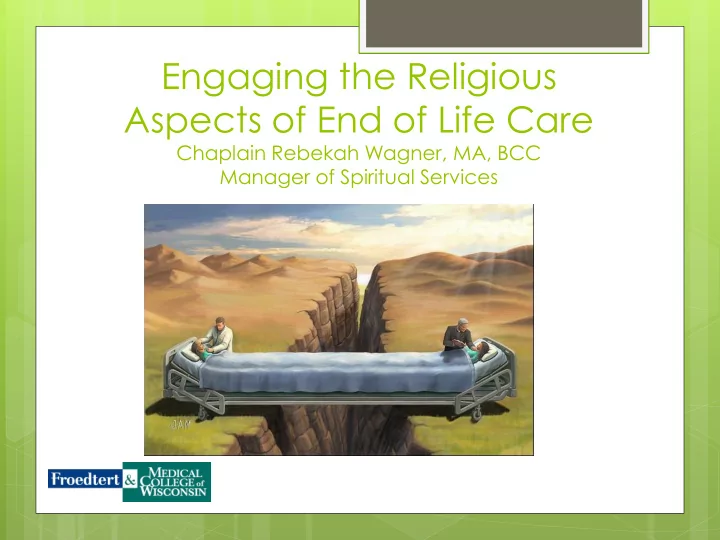
Engaging the Religious Aspects of End of Life Care

Chaplain Rebekah Wagner, MA, BCC Manager of Spiritual Services

slide-2
SLIDE 2
slide-3
SLIDE 3
slide-4
SLIDE 4
slide-5
SLIDE 5
slide-6
SLIDE 6
slide-7
SLIDE 7
slide-8
SLIDE 8
slide-9
SLIDE 9
slide-10
SLIDE 10

Why Health Care Professionals other than Chaplains Need to Address Spirituality

 There are many reasons why health care

professionals need to assess and address the religious and spiritual needs of patients and cannot leave this entirely up to chaplains and

  • ther clergy. The patient is a unique person

with physical, psychological, social and spiritual needs that must be addressed if health care is to be maximized and the whole person treated. –Harold Koenig, MD

(Bolded text by presenter)

slide-11
SLIDE 11

Graphic found in: Cultural Issues in End-Of-Life Decision Making, p. 6

slide-12
SLIDE 12

Religious Aspects of Serious Illness and Facing Death

 These beliefs influence how patients and

families respond to illness and how they regard death and dying.

 Often religious beliefs become more

important to people as they face death

 Humans in general hunger for rituals at

times of transition

 What we do can impact not only a

person’s body but also their soul

slide-13
SLIDE 13

Illness and Death Tend to Bring Up Spiritual and Religious Questions

 Why me?  Do I still have worth when I can’t do the

things I used to do?

 Do I need forgiveness for something I

have done?

 Is there anything undone or are there

relationships that are yet to be reconciled?

 Who will be with me as I go through this?

slide-14
SLIDE 14

Yet research shows…

 Patient’s desire to be asked about their spiritual

needs exceeds the practice of being asked

 Patients often experience spiritual distress at end

  • f life, yet they are often not screened for spiritual

distress or seen by a chaplain

 Patients and family members who bring up spiritual

  • r religious issues in family meetings are not feeling

heard

 Most doctors and nurses do not feel comfortable

addressing spiritual or religious needs

 (Koenig)

slide-15
SLIDE 15

Religion is the Oldest Form of Medicine

 Now, in western culture, we separate the

body and soul/spirit

 In Eastern culture and medicine, integration

  • f body and spirit remain.

 (in Christian, Muslim and Jewish

religions)patients often see the medical system and medical professionals as an extension of God’s healing power

 So…it is a complicated mix of old and new

beliefs that don’t always make sense to health care professionals

slide-16
SLIDE 16

Palliative Care sets the bar for interdisciplinary collaboration!

slide-17
SLIDE 17

Ok, so we just refer chaplains more often…

 Why this simple solution won’t work

slide-18
SLIDE 18

Why Don’t Patients Ask for a Chaplain More Often? (Or Say No When You Ask if They Want to See a Chaplain)

 I’m not religious  I’m not dying’  I have my own…

(Pastor/Rabbi/Imam/Monk)

 I’m doing fine, why do

you think I need to talk to someone?

slide-19
SLIDE 19

Why Health Care Professionals Don’t Want to Talk about Religion?

 That’s not my area. That’s what chaplains

are for.

 That is a private subject. I don’t want to

  • ffend someone.

 What if they want to pray with me?  I don’t want them to ask about my

religious preferences.

slide-20
SLIDE 20

The Theology Behind many of These Demands for Care often are Very Complicated

 Is this truly what the community believes

  • r their individual interpretation?

 Has this been an important part of their

lives or is this an example of “foxhole” religion?

 What exactly do they mean? How do

they understand what they are asking for?

slide-21
SLIDE 21

“Keep all the life support going. We’re waiting for a miracle”

 This can mean a variety of things…  “I believe that everything is possible with

God so the physicians prognosis doesn’t mean anything to me.

slide-22
SLIDE 22

“Keep all the life support going. We’re waiting for a miracle”

 “I hope that you’re wrong and I refuse to give

up or think negatively.”

 “I’m not willing to (or just can’t) receive this

information.”

 “I’m angry about the medical care so why

would I believe you. I have to fight to get all the care I deserve/need.”

slide-23
SLIDE 23

Public/Health Care Worker Divide

 When asked if “miracles still occur today

as in ancient times?” 79% of the 35,000+ people asked said “yes.” This date was not predicated on a certain religion or even whether they were religious.

 The only group whose answers differed

significantly were Jehovah’s Witnesses. Only 30% agreed.

(2007 survey by Pew Forum of Religion and Public Life)

slide-24
SLIDE 24

Differences in Religiosity of Health Care Professionals versus Patients/Families

 One study found that 50% of the public

believes that a miracle could save a patient even when physicians say there is no hope (Jacobs et al. 2008)

 Cancer patients and families rank faith in

God as second most important factor in medical decision making after physician recommendations

slide-25
SLIDE 25

In comparison…

 Of nearly 1000 trauma professionals

surveyed by Jacobs and Burns in 2008,

  • nly 20% believe in miracles.
slide-26
SLIDE 26

Differences in religiosity of health care professionals versus patients/families

 91% of patients reported faith in God

versus 64% of physicians. (Maugans & Wadland, 1991)

slide-27
SLIDE 27

All Religious Coping is not the same…

 Research shows that people with

negative religious coping…

 have 19-28% increased mortality  Poor outcomes for BMT  Overall poorer quality of life and end of

life outcomes

slide-28
SLIDE 28

R-COPE

 The Brief RCOPE is a 14-item measure of

religious coping with major life stressors. As the most commonly used measure of religious coping in the literature, it has helped contribute to the growth of knowledge about the roles religion serves in the process of dealing with crisis, trauma, and transition

(Pargament, Feuille & Budzy 2011)

slide-29
SLIDE 29

Religious Coping (+)

 Looked for a stronger relationship with God  Sought God’s love and care  Sought help from God in letting go of my anger  Tried to put my plans into actions together with

God

 Tried to see how God might be trying to

strengthen me in this situation

 Asked forgiveness for my sins  Focused on religion to stop worrying about my

problems

(Paragament brief R-COPE)

slide-30
SLIDE 30

Religious Coping (-)

 Wondered whether God had abandoned me  Felt punished by God for my lack of devotion  Wondered what I did for God to punish me  Questioned God’s love for me  Wondered whether my church had

abandoned me

 Decided the devil made this happen  Questioned the power of God

(Pargament brief R-COPE)

slide-31
SLIDE 31

Medical Decisions Most Affected by Religious Beliefs

 Use of advanced directive  DNR  Approach to artificial nutrition  Advance life support

slide-32
SLIDE 32

Why Engage in This if it is so Complicated?

 Increased patient satisfaction  Less adversarial relationships  More satisfaction of health care

professionals in dealing with difficult situations

 Most patients want to be asked about

their spiritual or religious needs.

slide-33
SLIDE 33

Why it is so complicated…

 “Every life is different from any that has

gone before it, and so is every death. The Uniqueness of each of us extends even to the way we die.” (Nuland, 1994) “Individual personalities, experiences and situations often have more influence on behavior and choice than does native culture or religion.” (Hallenbeck, 1996)

(Cultural Issues in End of Life Decision Making, Ed. Braun et al. p. 64 &321)

slide-34
SLIDE 34

“Every person is … Like all others, Like some others, Like no other.”

Kluckhohn & Murray 1953

slide-35
SLIDE 35

Did you hear about the time when the Priest, the Rabbi and the Pastor went fishing…

 Sounds like one of those typically jokes  These jokes are so funny because they play on

stereotypes that everyone understands. But when you’re one of the characters, it is easy to be

  • ffended that you are being portrayed in a certain

way that might or might not fit you.

slide-36
SLIDE 36

Concept of Cultural Humility

 Will serve us better than cultural

competence.

 Cultural competence infers that we can

master the topic

 Instead we need to come to the patient

and family curious to know more about how they feel and how cultural and religious beliefs are influencing them personally

slide-37
SLIDE 37

So if the Point is Don’t Assume You Know Anything…

 What am I going to talk about today?  In order to be respectful and to spot

potential issues, it is helpful to have a basic understanding of what might be a concern and then be able to check it out for accuracy.

slide-38
SLIDE 38

And use your resources- Chaplain as Spiritual Specialist

 Whether in an outpatient or an inpatient

setting, the chaplain should be fully integrated into the healthcare team. As I indicated before, the chaplain or pastoral counselor is at the core of the spiritual care team because he or she is the only person fully trained to address spiritual needs. Consequently, the chaplain should be actively involved in hospital rounds and in discussions involving patients in the clinic

slide-39
SLIDE 39

Chaplain Visits Desired versus Patients that saw a Chaplain (Need for Spiritual Generalists)

 In a survey of 1591 patients at the Mayo

Clinic, researchers found that 70% of hospitalized patients wanted to see a chaplain, but only 43% were visited by a chaplain, which is over double the national rate, which is about 20%. The proportion of OUTPATIENTS seen by a chaplain or pastoral counselor is probably in the single digits

Piderman KM, Marek DV, Jenkins SM, et al. Predicting Patients’ Expectations of Hospital Chaplains: A Multisite Survey. Mayo Clinic Proceedings. 2010;85(11):1002-

  • 1010. doi:10.4065/mcp.2010.0168.
slide-40
SLIDE 40

So between the resistance to seeing a chaplain, and limited chaplain resources…

 We need your help!  And the patients and families want to

engage in respectful dialogue about how their beliefs influence their choices at end of life

 “ Patients and families who feel that they

have had a chance to share their stories, concerns, and hopes will be more likely to trust the practitioners and to feel comfortable with the advice and guidance offered.”

(Cultural Issues in End-of-Life Decision Making, p. 310)

slide-41
SLIDE 41

A few overview slides about the most common religions

 This is true for the Midwest region.  If you are from out of this region, your mix

  • f religions encountered may be different

 Even the major religions have regional

nuances.

 Again, when in doubt, ask, be curious!

slide-42
SLIDE 42

Caucasian Christian (Mainline Protestant)

 Trust that they will go to heaven after

death

 Often want prayer during illness and

especially at the time of death for final ritual

 Value quality of life, autonomy

slide-43
SLIDE 43

Take-aways

 Religion, even when important, is less likely

to be primary driver of end of life decisions

 Least likely to invoke miracle language or

primary religious influence on medical decision making

 Individual(s) make decision rather than

group

slide-44
SLIDE 44

Evangelical Christians (esp. African American)

 Religion plays a greater role than for mainline

protestants

 Prayer as primary way to cope with stress  Believe in faith healing  Have trust issues with medical establishment-

less likely to have HCPOA, DNR or Hospice

 Aggressive end of life care may be reflection

  • f trust issues, test of faith or allowing for

God’s miracle to occur

 Quality of life is not a primary value

slide-45
SLIDE 45

Take-aways

 Need high level of patient-doctor

communication

 Tend to make decisions as a group- need

to allow time for this to occur

 Perceived pressure to change treatment

preferences often results in communication breakdown

slide-46
SLIDE 46

Hispanic Christians (predominantly Catholic)

 Many different subgroups-difficult to

generalize

 Some general principles are emphasis on

family rather than individual (familioso)

 Respect for hierarchy (jerarquisimo)  Need to develop trust over time

(personalismo)

 Belief that spirits, good and bad, influence

health (espirito)

 Emphasis on present (presentisimo)

slide-47
SLIDE 47

Hispanic Christians cont.

 Acceptance of death as a part of life

(Dia de los Muertos)

 But least likely to have DNR  Likely to want aggressive end of life care  Low use of Hospice  Against Autopsy (understanding that the

body needs to be whole for reunion with God)

slide-48
SLIDE 48

Roman Catholic

 Believe that there is an afterlife and that they

will meet their creator for a time of judgment

 Place high importance on Sacraments-

especially anointing, confession and communion at end of life

 Pray for their loved one through the

intercession of the saints

 Many ask for Priest advice on whether

forgoing or withdrawing life support or nutrition is allowed or is considered Euthanasia

slide-49
SLIDE 49

Take-aways

 Issues are likely to revolve around forgoing

  • r with-holding nutrition/hydration and

ventilator

 Sacramental care is very important,

schedule extubations etc. around Priest

 Concerned with being right with God at

time of death

slide-50
SLIDE 50

Jewish

 Pikuah Nefesh (saving life) is highest value  Death is seen as a part of life but our duty

is to embrace life until the end

 Dying person should never be left alone  Likely want Rabbi to advise them on

medical treatment (particularly Orthodox

  • r Conservative)
slide-51
SLIDE 51

Take-aways

 Often surrounded by and advised by

community

 Life is considered sacred, quality of life

does not enter consideration

 Death can be allowed but never

hastened

 Decisions likely to involve Rabbi

slide-52
SLIDE 52

Muslim

 Different sects and ethnicities influence views  Believe that everything, including illness and death

come from Allah (God)

 Focus in life is in living a life worthy of meeting

Allah in the next life

 Part of the religious practice is to pray daily prayers

so that they are ready for death at any time

 Gender issues- will prefer same sex caregivers  All forms of treatment are considered voluntary  Suicide though is forbidden so can not choose

death, just can allow death

slide-53
SLIDE 53

Take-aways

 Assign same sex health care professionals

whenever possible

 Provide for modesty and privacy  Allow for prayer and fasting as able  If patient/family feel something is forbidden

by faith, ask about that rather than challenge it

 Allow Imam to visit and advise  Allow for death rituals and do not allow non-

Muslim to touch dead body without gloves.

slide-54
SLIDE 54

Jehovah’s Witness

 Believe that they will “sleep” until God

resurrects them from the dead then some will go to Heaven and others to a paradise on Earth

 Prefer only to pray with people from their

religion

 Medical treatments with whole blood

products prohibited (some fractions of blood products allowed)

slide-55
SLIDE 55

Take-aways

 Tend to not talk about religion with others not

in their community unless about medical treatments that are allowed or not

 Allow for Elders in the church to visit and

minister to them for spiritual/religious support

 Most hospitals have Jehovah’s Witness liason

committee and volunteers to visit their patients

slide-56
SLIDE 56

Hindu

 Illness is seen as a disruption of homeostasis.  Believe in re-incarnation-soul moves to

another body until achievement of Nirvana

 Healthcare decisions made by eldest son  End of life rituals can include tying of a thread

around the neck and wrist of the dying patient, sprinkling with water from the Ganges

  • r placing a basil leaf on the tongue.

 Sacred threads or other Holy objects should

not be removed from the body after death.

 Body is cremated as they believe that burning

releases the spirit

slide-57
SLIDE 57

Take-aways

 May refuse medication as they want to be

alert and may feel that suffering may help their spiritual growth

 There is a notion of good death, how to die

and a bad death is greatly feared. Good karma leads to good birth and bad karma to bad rebirth.

 Because death is viewed as a transition rather

than a final conclusion, Hindu attitudes on end-of-life care options may radically differ from perspectives shaped by the Western tradition of bioethics

slide-58
SLIDE 58

Buddhism

 All existences are mutually related and mutually

dependent

 Interwoven reality- no one event has a single

cause

 Suffering comes from clinging to false beliefs such

as “life continues forever.”

 Karma- deeds committed in the present life have

influence on the next life

 Object to brain death criterion, only stopping of

the heart is considered death

 Because life is transient, should not resist death

with aggressive measures

slide-59
SLIDE 59

Take-aways

 Decision on end of life usually made by

family consensus as we live interdependent not independent lives

 Do not allow autopsy or organ donation

  • r accept organ donation as our bodies

are not ours to give away nor should we take another life to save ours

slide-60
SLIDE 60

Research indicates that

  • nly about 10% of

physicians conduct a spiritual assessment. Why is this so?

slide-61
SLIDE 61

So, what is a reasonable expectation for how a health care professionals could address religious/spiritual needs?

  • 1. Conduct a basic spiritual screeningre coping,
  • 2. Document patients’ responses in the EMR
  • 3. Alert the spiritual care team if spiritual needs are identified,

and…

  • 4. Follow-up to ensure that spiritual needs are met

So What is the Role of a Spiritual Generalist

slide-62
SLIDE 62
  • My favorite: “People often find spirituality
  • r religion helpful when dealing with

serious illness. Is this true for you?”

  • If yes, Would you please tell me more

about that. How might your beliefs affect your medical care?

  • If no, “What does help you maintain

hope in the midst of difficult times? Are there ways this might affect your medical care that I should be aware of?”

Basic screening questions

slide-63
SLIDE 63

Examples

 I am a Christian and I believe that God is

going to heal me from this illness. I don’t want to talk about anything that might be negative.

 I like to be in nature. Being inside makes

me feel restless and anxious. Do you think we could arrange for me to get outside?

slide-64
SLIDE 64

VALUE model family meetings

Value and appreciate family

comments

Acknowledge / address emotions Listen actively Understand the patient as person Elicit family questions

Lautrette A, et al. N Engl J Med 2007; 356:469-478. http://depts.washington.edu/eolcare/instruments/index.html

slide-65
SLIDE 65

LEARN model of family meetings

L-Listen to the patient’s perspective E-Explain and share one’s perspective A-Acknowledge difference and similarities between the two perspectives R-Recommend treatment N-Negotiate mutually agreed upon plan

Berlin, EA, Fowkes, WC. A teaching framework for cross-cultural health care. West J Med. 1983:139.

slide-66
SLIDE 66

AMEN

slide-67
SLIDE 67

So how do we know when we are successful?

 A successful outcome, according to the

AMEN protocol's developers, is one where the clinician joins with and is actively engaging with the patient or family, allowing ongoing conversation in an atmosphere of openness and collaboration

slide-68
SLIDE 68

Case study 1

 55 y.o. AA male with C5-6 quadriplegia

secondary to a traumatic fall 5 years ago. Now has stage 4 decubiti with staph, respiratory failure, end stage kidney and heart failure. Patient/family are Pentecostal Christians and refuse to talk about any limits to care.

 How might you handle this?

slide-69
SLIDE 69

Case Study 2

 Patient is a 65 y.o. Asian female who is

  • Buddhist. Pt. has stage 4 endometrial

cancer that has spread to multiple boney

  • sites. Patient appears to be in pain but

refuses all pain medications other than tylenol.

 How might you address this?

slide-70
SLIDE 70

What Questions Do You Have?

slide-71
SLIDE 71

Contact Information

Chaplain Rebekah Wagner, MA, BCC Froedtert Hospital Spiritual Services Department 9200 W Wisconsin Ave Milwaukee, WI 53226 414-805-4660 Rebekah.wagner@Froedtert.com

slide-72
SLIDE 72

References

 Balboni, T., Balboni, M., Paulk, M., Phelps, A., Wright, A., Peteet, J.,

Block, S., Lathan, C., VanderWeele, T. and Prigerson, H. (2011). Support of cancer patients' spiritual needs and associations with medical care costs at the end of life. Cancer, 117(23), pp.5383- 5391.

 Balboni, T., Fitchett, G., Handzo, G., Johnson, K., Koenig, H.,

Pargament, K., Puchalski, C., Sinclair, S., Taylor, E. and Steinhauser,

  • K. (2017). State of the Science of Spirituality and Palliative Care

Research Part II: Screening, Assessment, and Interventions. Journal

  • f Pain and Symptom Management, 54(3), pp.441-453.

 Braun, K. (2010). Cultural issues in end-of-life decision making.

Thousand Oaks, Calif: Sage Publications.

 Cooper, R., Ferguson, A., Bodurtha, J. and Smith, T. (2014). AMEN in

Challenging Conversations: Bridging the Gaps Between Faith, Hope, and Medicine. Journal of Oncology Practice, 10(4), pp.e191- e195.

slide-73
SLIDE 73

References

Edwards, A., Pang, N., Shiu, V. and Chan, C. (2010). Review: The understanding

  • f spirituality and the potential role of spiritual care in end-of-life and palliative

care: a meta-study of qualitative research. Palliative Medicine, 24(8), pp.753- 770

Handzo, G. and Koenig, H. (2004). Spiritual Care: Whose Job Is It Anyway?. Southern Medical Journal, 97(12), pp.1242-1244.

Heilig, S. (1994). CQ Interview with Sherwin Nuland on How We Die. Cambridge Quarterly of Healthcare Ethics, 3(04), p.624.

Jeuland, J., Fitchett, G., Schulman-Green, D. and Kapo, J. (2017). Chaplains Working in Palliative Care: Who They Are and What They Do. Journal of Palliative Medicine, 20(5), pp.502-508.

slide-74
SLIDE 74

References

 Koenig, H. (2008). Medicine, religion, and health. West

Conshohocken, Pa.: Templeton Foundation Press

 Koenig, H., Perno, K., Erkanli, A. and Hamilton, T. (2017). Effects of a

12-Month Educational Intervention on Clinicians’ Attitudes/Practices Regarding the Screening Spiritual History. Southern Medical Journal, 110(6), pp.412-418.

 Koenig, H., Perno, K. and Hamilton, T. (2017). Integrating Spirituality

Into Outpatient Practice in the Adventist Health System. Southern Medical Journal, 110(1), pp.1-7.

Koenig, H., Perno, K. and Hamilton, T. (2017). The spiritual history in

  • utpatient practice: attitudes and practices of health professionals in the

Adventist Health System. BMC Medical Education, 17(1).

The medical manual for religio-cultural competence. (2009). Tanenbaum Center for Interreligious Understanding.

slide-75
SLIDE 75

References

Otis-Green, S., Ferrell, B., Borneman, T., Puchalski, C., Uman, G. and Garcia, A. (2012). Integrating Spiritual Care within Palliative Care: An Overview of Nine Demonstration Projects. Journal of Palliative Medicine, 15(2), pp.154-162.

Pargament, K., Feuille, M. and Burdzy, D. (2011). The Brief RCOPE: Current Psychometric Status of a Short Measure of Religious Coping. Religions, 2(4), pp.51-76

Puchalski, C., Ferrell, B., Virani, R., Otis-Green, S., Baird, P., Bull, J., Chochinov, H., Handzo, G., Nelson-Becker, H., Prince-Paul, M., Pugliese,

  • K. and Sulmasy, D. (2009). Improving the Quality of Spiritual Care as a

Dimension of Palliative Care: The Report of the Consensus Conference. Journal of Palliative Medicine, 12(10), pp.885-904.

Schmidt R. The Role of Chaplaincy in Caring for the Seriously Ill #347. The Role of Chaplaincy in Caring for the Seriously Ill #347. 2018;21(3):2018 21:3, 389-390 .

Widera, E., Rosenfeld, K., Fromme, E., Sulmasy, D. and Arnold, R. (2011). Approaching Patients and Family Members Who Hope for a Miracle. Journal of Pain and Symptom Management, 42(1), pp.119-125.