
SLIDE 1
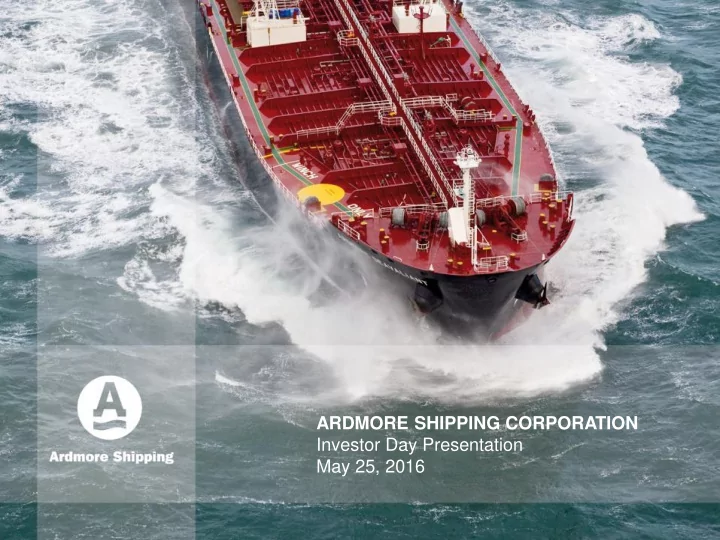
ARDMORE SHIPPING CORPORATION Investor Day Presentation May 25, 2016
ARDMORE SHIPPING CORPORATION Investor Day Presentation May 25, 2016 - - PowerPoint PPT Presentation
ARDMORE SHIPPING CORPORATION Investor Day Presentation May 25, 2016 Disclaimer This presentation contains certain statements that may be deemed to be forward -looking statements within the meaning of applicable U.S. federal securities
ARDMORE SHIPPING CORPORATION Investor Day Presentation May 25, 2016
Modern Fleet of Eco-design and Eco-mod built at high quality Korean and Japanese shipyards with upgrades to improve fuel efficiency and commercial capability 2
Disclaimer
This presentation contains certain statements that may be deemed to be “forward-looking statements” within the meaning of applicable U.S. federal securities laws. All statements, other than statements of historical facts, that address activities, events or developments that Ardmore Shipping Corporation (“Ardmore” or the “Company”) expects, projects, believes or anticipates will or may occur in the future, including, without limitation, statements about: future operating or financial results; global and regional economic conditions and trends; pending vessel acquisitions or possible upgrades to vessels; the Company’s business strategy and expected capital spending or
and liquidity, including ability to obtain financing in the future to fund capital expenditures, acquisitions and other general corporate activities; the Company’s share repurchase program; ability to enter into fixed-rate charters after the current charters expire and the Company’s ability to earn income in the spot market; expectations of the availability of vessels to purchase and the time it may take to construct new vessels and vessels’ useful lives are forward-looking statements. Although the Company believes that its expectations stated in this presentation are based on reasonable assumptions, actual results may differ from those projected in the forward-looking statements. Factors that might cause or contribute to such a discrepancy include, but are not limited to, the risk factors described in the Company's filings with the Securities and Exchange Commission (the "SEC"), including the Company’s Annual Report on Form 20-F for the year ended December 31, 2015. This presentation is for information purposes only and does not constitute an offer to buy or sell securities of the Company. For more complete information about the Company, the information in this presentation should be read together with the Company 's filings with the SEC which may be accessed on the SEC website at www.sec.gov.
Modern Fleet of Eco-design and Eco-mod built at high quality Korean and Japanese shipyards with upgrades to improve fuel efficiency and commerical capability 3
Investor Day May 25th, 2016
Agenda
I. Welcome and Presenter Introduction Anthony Gurnee - CEO II. Overview of Ardmore Shipping Anthony Gurnee - CEO III. Charter Update and Trading Patterns Gernot Ruppelt - SVP IV. Asia Pacific: A Growing Market for Refined Products Al Troner - President APEC(Guest Speaker) V. Demand & Supply Outlook and Financial Review Paul Tivnan - CFO VI. Closing Remarks Anthony Gurnee - CEO VII. Q&A
Modern Fleet of Eco-design and Eco-mod built at high quality Korean and Japanese shipyards with upgrades to improve fuel efficiency and commercial capability 4
Introduction
Modern Fleet of Eco-design and Eco-mod built at high quality Korean and Japanese shipyards with upgrades to improve fuel efficiency and commercial capability 5
Our Company
long-term, strategy based on service excellence and operating efficiency
chemical tankers.
employment in spot and time charter markets
income of $6.7 mln, equating to $0.26 per share in 1Q16
and increases the dividend by $0.19 / share(1)
1. Realized across a full fleet of 22 ships. Calculation based on: ($1,000 day x 363 revenue days x 22 ships) / 25.9mln shares = $0.31 per share. $0.31 x 60% = Dividend of $0.19 per share
6
Ardmore Fleet – May 2016
Modern “Eco” Fleet Average age of ~4.2 yrs Upgraded for enhanced commercial capability Built at high-quality yards in Korea and Japan Quality fleet = lower operating cost, higher utilization and maximum value appreciation Complementary fleet High Quality Vessels
Fleet List
Vessel Name Type Dwt IMO Constructed Country Employment Specification In Operation Ardmore Seavaliant Product/Chemical 49,998 2/3 Feb-13 Korea Spot Eco-design Ardmore Seaventure Product/Chemical 49,998 2/3 Jun-13 Korea Spot Eco-design Ardmore Seavantage Product/Chemical 49,997 2/3 Jan-14 Korea Time Charter Eco-design Ardmore Seavanguard Product/Chemical 49,998 2/3 Feb-14 Korea Time Charter Eco-design Ardmore Sealion Product/Chemical 49,999 2/3 May-15 Korea Pool Eco-design Ardmore Seafox Product/Chemical 49,999 2/3 Jun-15 Korea Pool Eco-design Ardmore Seawolf Product/Chemical 49,999 2/3 Aug-15 Korea Pool Eco-design Ardmore Seahawk Product/Chemical 49,999 2/3 Nov-15 Korea Pool Eco-design Ardmore Endeavour Product/Chemical 49,997 2/3 Jul-13 Korea Spot Eco-design Ardmore Seafarer Product/Chemical 45,744 3 Aug-04 Japan Spot Eco-mod Ardmore Seatrader Product 47,141 — Dec-02 Japan Spot Eco-mod Ardmore Seamaster Product/Chemical 45,840 3 Sep-04 Japan Spot Eco-mod Ardmore Seamariner Product 45,726 — Oct-06 Japan Spot Eco-mod Ardmore Sealeader Product 47,463 — Aug-08 Japan Spot Eco-mod Ardmore Sealifter Product 47,472 — Jul-08 Japan Spot Eco-mod Ardmore Dauntless Product/Chemical 37,764 2 Feb-15 Korea Pool Eco-design Ardmore Defender Product/Chemical 37,791 2 Feb-15 Korea Pool Eco-design Ardmore Centurion Product/Chemical 29,006 2 Nov-05 Korea Spot Eco-mod Ardmore Cherokee Product/Chemical 25,215 2 Jan-15 Japan Pool Eco-design Ardmore Cheyenne Product/Chemical 25,217 2 Mar-15 Japan Time Charter Eco-design Ardmore Chinook Product/Chemical 25,217 2 Jul-15 Japan Time Charter Eco-design Ardmore Chippewa Product/Chemical 25,217 2 Nov-15 Japan Time Charter Eco-design Total 22 934,797 4.2(1)
7
Consistent and Focused Strategy
breakeven and maximum ship value appreciation
day
Cost Efficiency
adjusted to maximize TCE
all times for time-charter opportunities
charterers: service excellence
TCE
Highly Effective Chartering Strategy
2 Superior Operational And Financial Performance 3
Consistent Focus on MR Product and Chemical Tankers
1
Value Added Service = Max Earnings
4
Modern Fleet of Eco-design and Eco-mod built at high quality Korean and Japanese shipyards with upgrades to improve fuel efficiency and commercial capability 8
Charter Update and Trading Patterns
9
Chartering Profile
Revenue Day Estimates 2Q16(1) Fleet Employment Profile
1. Includes estimated drydock days for 2Q16
31% 69%
1Q 2016
25% 75%
2Q 2016 E
Vessel Employment TC Expiry Ardmore Seavantage Time Charter Jan-17 Ardmore Seavanguard Time Charter Feb-17 Ardmore Cheyenne Time Charter Mar-17 Ardmore Chinook Time Charter Jul-16 Ardmore Chippewa Time Charter Nov-16 Ardmore Seavaliant Spot n/a Ardmore Seaventure Spot n/a Ardmore Endeavour Spot n/a Ardmore Seafarer Spot n/a Ardmore Sealifter Spot n/a Ardmore Sealeader Spot n/a Ardmore Seatrader Spot n/a Ardmore Seamaster Spot n/a Ardmore Seamariner Spot n/a Ardmore Centurion Spot n/a Ardmore Sealion Pool n/a Ardmore Seafox Pool n/a Ardmore Seawolf Pool n/a Ardmore Seahawk Pool n/a Ardmore Dauntless Pool n/a Ardmore Defender Pool n/a Ardmore Cherokee Pool n/a
622 519 273 91 182 273 59 MR Eco-design MR Eco-mod Prod/Chem Eco-design Prod/Chem Eco-mod Spot / Pool TC Days
10
Charter Market Active Heading into Summer
1. Time Charter Equivalent (“TCE”) daily rate is the gross charter rate or gross pool rate, as appropriate, per revenue day plus Communication Victualing and Entertainment Income (“CVE). For vessels employed on voyage charters, TCE is the net rate after deducting voyage
Time Charter Equivalent ($ / day)(1)
+27% YoY +20% YoY +37% YoY +18% YoY
17,149 17,806 19,020 16,599 12,228 17,131 18,038 17,833 17,367 12,499 18,309 19,149 20,223 17,507 13,417
MR ECO-DES MR ECO-MOD PROD/CHEM ECO-DES PROD/CHEM ECO-MOD 1Q15 1Q16 FY 2015
11
Regional Presence in Key Global Markets
12
Extensive Global Customer Base
Strong support from key players through consistent track record in commercial and operational performance
13
Key Market Movers in 2015
Strong inter-regional movements between West and East
14
Freight Trends in 2016
Mixed Aromatics into China
15
Freight Trends in 2016
West Africa Imports
16
Freight Trends in 2016
Exports from Asia to American markets
17
Freight Trends in 2016
Strong Import Demand from Australia and New Zealand
18
Freight Trends in 2016
Strong Activity Within Asia due to Regional Arbitrage
19
Freight Trends in 2016
Long-Haul Trades into East and South Africa
20
Freight Trends in 2016
Brazil Becoming a Two-Way Trade
21
Freight Trends in 2016
North American Driving Demand Keeping Classic TA Route Busy
22
Freight Trends in 2016
Distillate Finding Markets in Multiple Locations and Necessitating Strong Trading Flexibility
23
Freight Trends in 2016
MR Segment Continues to Evolve and Benefit from Structural Demand and Global Arbitrage Opportunities
Modern Fleet of Eco-design and Eco-mod built at high quality Korean and Japanese shipyards with upgrades to improve fuel efficiency and commercial capability 24
Asia Pacific: A Growing Market for Refined Products
Al Troner, President Asia Pacific Energy Consulting (APEC) Houston, Texas Tel/Dir: (281) 759 4440 Email: apenergy@apecconsulting.com
25
26
27
28
29
30
31
32
33
34
Source: Oil Market Intelligence, Energy Intelligence Group
35
36
37
38
Note: All values in MBD
39
40
Refinery = Grassroots; CDU = Crude Distillation Unit; VDU = Vacuum Distillation Unit; HDS = Hydrodesulfurization, Gas
*Projected date for Coker only
41
Plant Refinery CDU VDU HDS Coker When Minatitlan
2018? Guanajuato
Post 2020 Salamanca
2016 Tula
2019- 2020?* Cadereyta
2017 Ciudad Madero
2017 Salina Cruz
2017
42
43
44
Note: All values rounded to MBD * Indian fiscal year ends March 31st
45
46
T-95 is Temperature at which 95 vol% distills; PAH = Polycyclic Aromatic Hydrocarbons
47
Sulfur %mass (max) Cetane Density T-95* PAH
Urban Rural (Index) (max) (Deg C max) (%max) India
EU
48
Notes: Numbers within parentheses indicate a net import volume; Volumes in MBD
49
50
Note: Volumes in MBD * As at 1/2015; ** For China, only counting plants of >40 MBD base capacity
51
Size Giant Large Minimal Country China** Singapore Brunei
Base Capacity
Severe Secondary
Hydrocracking
52
53
54
Country India Indonesia Malaysia Vietnam Pakistan LPG
Gasoline
GO/Diesel
Fuel Oil
55
56
57
58
59
60
Note: Volumes in MBD
61
62
63
64
65
66
Units MBD Vol% Light Products 12,641 45.2 Mid-Distillate 10,778 38.6 Sub Total 23,419 83.8
TOTAL
28 MMBD 100%
Type MBD Total Severe Secondary 15,072 Hydrocracking (HDC) Only 4,011 HDC% of Severe 26.6
Total Base Capacity
37,919
Demand for Light Products while refining capacity geared to Middle Distillate
67
68
69
70
71
Modern Fleet of Eco-design and Eco-mod built at high quality Korean and Japanese shipyards with upgrades to improve fuel efficiency and commercial capability 72
Demand & Supply Outlook and Financial Review
95.5 96.0 96.5 97.0 97.5 98.0 98.5 99.0 99.5 100.0 100.5 101.0
2015 2016e 2017e 2018e MMbpd
73
Demand: Seaborne Volumes Growing at 4% CAGR
+27% YoY +18% YoY
Estimate of 2016 Seaborne Imports / Exports(1) Seaborne Volume of Oil Products Traded(1)
1. Source: Clarksons Shipping Intelligence Network, forecast for 2016 according to Clarkson’s data 2. Source: IEA Medium Term Market Report 2016 and management estimates
Import Export Net Imports as % Total Exports as % Total Middle East 1.4 2.8 1.4 6.1% 12.1% North America 1.8 3.2 1.4 7.8% 13.9% China 0.6 0.6 0.0 2.6% 2.6% Asia (ex China) 8.0 5.7
34.6% 24.7% Europe 7.2 6.0
31.2% 26.0% Latin America 1.8 0.6
7.8% 2.6% Africa 1.4 0.4
6.1% 1.7% FSU n/a 3.1 n/a n/a 13.4% Other 0.9 0.7
3.9% 3.0% Total Trade MMbpd 23.1 23.1 100% 100% 0.0 5.0 10.0 15.0 20.0 25.0 2000 2001 2002 2003 2004 2005 2006 2007 2008 2009 2010 2011 2012 2013 2014 2015 2016e MMbpd CAGR +4%
driven by refinery expansion and increased output
and Middle East
export until late 2015 – significant increases in distillate exports Global Refinery Capacity Additions (2)
+1.1mbd +1.4mbd +1.3mbd
74
Demand: Refinery Dislocation Increasing Voyage Distances
Global Refinery Developments (2015-2020) (1) Global Refinery Capacity Growth (2)
1. Source: IEA Medium Term Market Report 2015 and management estimates 2. Source: IEA Medium Term Market Report 2016 and management estimates
capacity by 2021
come on stream in 2016 resulting in net capacity growth of ~0.5 million bpd
gasoline, resulting in higher outputs worldwide
0% 10% 20% 30% 40% 50% 60% 10 20 30 40 50 60 70 80 90 100 1996 1997 1998 1999 2000 2001 2002 2003 2004 2005 2006 2007 2008 2009 2010 2011 2012 2013 2014 2015 2016 OB as % Fleet Million DWT Fleet (DWT) Orderbook (% Fleet)
75
Supply: Orderbook at Historical Lows
MR Product Tanker Orderbook and Fleet Development(1)
1. Source: Clarksons Shipping Intelligence Network and Management Estimates 2. Based on management estimates 3. Assumes no new orders placed in 2016
Currently ~8.1%
0.0% 1.0% 2.0% 3.0% 4.0% 5.0% 6.0% 7.0%
2 4 6 8 10 12 14 Growth % Number of Ships Supply Shortfall Vessel Deliveries Scrapping Demand Growth Net Fleet Growth %
76
Deliveries Reducing: Demand to Exceed Supply in Late 2016
1. Source: Clarksons World Fleet Register, forecast based on management estimates
Vessel Demand Exceeding Supply
MR Product Tanker Vessel Delivery Schedule(1)
5% - 6% Demand Growth
77
Scrapping Set to Continue: ~25 Ships Per Year
+27% YoY +20% YoY +37% YoY +18% YoY
1. Source: Clarksons World Fleet Register (MR Product Tanker Fleet 25,000 – 59,999 DWT)
MR Tanker Profile(1)
20 40 60 80 100 120 140 160 180 1977-1981 1982 1983 1984 1985 1986 1987 1988 1989 1990 1991 1992 1993 1994 1995 1996 1997 1998 1999 2000 2001 2002 2003 2004 2005 2006 2007 2008 2009 2010 2011 2012 2013 2014 2015 2016 Number of Vessels
>20 years old:167 MRs (~8% Fleet) >15 years old: 358 MRs (~18% Fleet)
4 4 3 6 7 5 4 2 2 5 7 2 5 10 15 20 25 2007 2008 2015
Number of Years to Deliver at Least One MR Tanker
China Korea Japan Other
78
+20% YoY +37% YoY +18% YoY
Shipyard Capacity(1)
2008 levels(2) (20 yards in 2008 v 12 in 2015)
cost
1. Source: Clarksons World Fleet Register, forecast based on management estimates 2. Based on number of yards to deliver at least one MR Product Tanker in 2008 and 2015 and management estimates
Modern Fleet of Eco-design and Eco-mod built at high quality Korean and Japanese shipyards with upgrades to improve fuel efficiency and commercial capability 79
Financial Review
and timing of deliveries
1Q16 with EPS of $0.26
position
debt maturities to 2022 with additional committed debt for further growth
as a public company
80
1. Data sourced from most recent public filings 2. Source: CEFOR (Nordic Association of Marine Insurers)
Average OPEX ($ / day)(1)
+27% YoY +20% YoY +37% YoY +18% YoY 4,500 5,000 5,500 6,000 6,500 7,000 7,500 8,000 Ardmore
Transparent and Low Cost Corporate Structure
Vessel Type TCE per day TCE per day TCE per day MR Product (50k) $18,500 $21,500 $24,250 MR Chem (25-37k) $16,500 $17,500 $18,000
81
Every $1,000 / day increase in rates equals 31 cents per share in EPS and Cashflow & dividend increase
Earnings Per Share(1)
1. Management estimates based on a full fleet of 22 vessels operating in the spot market for 363 revenue days / ship 2. Realized across a full fleet of 22 ships. Calculation based on: ($1,000 day x 363 revenue days x 22 ships) / 25.9 mln shares = $0.31 per share. $0.31 x 60% = Dividend of $0.19 per share
Dividend Per Share(1)
Revenue Days Increasing and Significant Earnings Power
$1.12 $1.83 $2.46 $0.67 $1.10 $1.47
Base Rates Rates FY2015 Upside Rates - 3Q15
82
Strong Balance Sheet with Conservative Capital Structure
Debt Profile
1. Gross Debt excludes impact of netting of deferred finance fees as required under US GAAP ($424.3 mln - $12.1 mln = $412 mln) 2. Capital Lease Obligation of $26.7 mln excludes netting of deferred finance fees as required under US GAPP ($26.7 mln - $0.5 mln = $26.3 mln)
$397.6 $692.8 $26.7 $9.4 $9.4 $9.4 Vessel Assets @ 1Q16 Gross Debt @ 1Q16 2Q 2016 3Q 2016 4Q 2016 Senior Debt Repayments
Modern Fleet of Eco-design and Eco-mod built at high quality Korean and Japanese shipyards with upgrades to improve fuel efficiency and commercial capability 83
Closing Remarks
Modern Fleet of Eco-design and Eco-mod built at high quality Korean and Japanese shipyards with upgrades to improve fuel efficiency and commercial capability 84
Closing Remarks
remaining financially conservative.