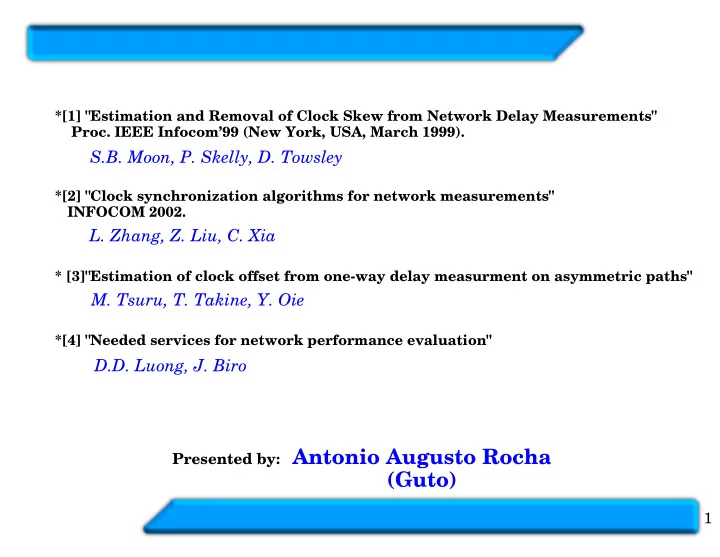
SLIDE 1 Antonio Augusto Rocha (Guto)
Presented by: 1
*[1] "Estimation and Removal of Clock Skew from Network Delay Measurements"
- Proc. IEEE Infocom’99 (New York, USA, March 1999).
*[2] "Clock synchronization algorithms for network measurements" INFOCOM 2002. * [3]"Estimation of clock offset from one-way delay measurment on asymmetric paths" *[4] "Needed services for network performance evaluation"
D.D. Luong, J. Biro S.B. Moon, P. Skelly, D. Towsley
- L. Zhang, Z. Liu, C. Xia
- M. Tsuru, T. Takine, Y. Oie
SLIDE 2
Presentation format
4 papers to present Different format in this presentation
Clock Terminology Define the Clock´s problems Explain the methods proposed to solve each problem Traffic Generator Experiments/results with TG
2
Overview:
Conclusions and considerations Not a full paper Methods proposed, pointing the papers
SLIDE 3 Clock Terminology
3
C (t): Instant "t" in clock C ;
x x
Frequency: Growing rate of clock C ;
x
C : represent the clock of machine X;
x
t and t : Instants "t" of sending and receiving a packet;
s r
Suposed Delay = C (t ) - C (t );
b r a s
SLIDE 4 Problems
With GPS that is valid;
The difference between the clocks at intant "t" may be different of zero C (t ) != C (t ) : Offset The difference of clocks rate (frequency) may change, skew change: Drift The frequency of clocks ( C’ and C’ ) are not the same : SKEW
Some problems must be considered: If NOT, the function D= C (t ) - C (t ) is NOT valid;
The O.S. break may cause noises in the results: Noise
4
b r a s b a b s a s
The clocks may be abruptly shifted (UPDATE): Shift
SLIDE 5
Skew
The difference in the clocks frequency cause a tendencius growing in the trace. Algorithms proposed in [1,2] try to solve this problem.
Find a line All trace points cover this line Figure show this event, x-aix (# seq of pack) and y-aix(delay) As close as possible from those poitns
5
1.6504e+08 1.6506e+08 1.6508e+08 1.651e+08 1.6512e+08 1.6514e+08 1.6516e+08 1000 2000 3000 4000 5000 6000
SLIDE 6
Skew (cont.)
[1] propose a algorithm, based on linear programming, to solve the problem
In this proposal, try to estimate parameters:
6
the objective function minimizes the sum of the distance between the line and the data points. Many possibilities.
1.6504e+08 1.6506e+08 1.6508e+08 1.651e+08 1.6512e+08 1.6514e+08 1.6516e+08 1000 2000 3000 4000 5000 6000
SLIDE 7
Skew (cont.)
7
[2] propose an algorithm to solve this problem based on computation of the convex hull.
1.6496e+08 1.64965e+08 1.6497e+08 1.64975e+08 1.6498e+08 1.64985e+08 1.6499e+08 1.64995e+08 1.65e+08 1.65005e+08 1.6501e+08 1.65015e+08 1.05067e+15 1.05067e+15 1.05067e+15 1.05067e+15 1.05067e+15 1.05067e+15 1.05067e+15 1.05067e+15 1.05067e+15 1.05067e+15 1.05067e+15 1.6504e+08 1.6506e+08 1.6508e+08 1.651e+08 1.6512e+08 1.6514e+08 1.6516e+08 1000 2000 3000 4000 5000 6000
Convex Hull (all points) Estimate Points X, line cover X is used.
SLIDE 8 Offset
The difference between the sender and the receiver clock introduce a fake value in the delay computation
Asymmetric path = different capacity of transmission along the path. Exist other proposal, but they do NOT consider the possibility
8
This value may be so different resulting in a "packet being send after received" [3,4] propose a method to solve this problems:
SLIDE 9
Offset (cont.)
The algorithm variate the packet size of probes, in both directions, and take the minimal value (without SKEW) for each sample size.
9
Identify a linear decrease. the diference of the points when both lines touch the y-aix, is considered twice the offset value.
This simulate a packet of size zero, or propagation time.
SLIDE 10
Drift
Changes in the clock frequency It is possible SKEW change; Unvalidate the Skew estimation; NTP change the Drift of a clock:
10
First time the Clock is sincronized Drift clocks are adjusted to keep sincronization
1.6504e+08 1.6506e+08 1.6508e+08 1.651e+08 1.6512e+08 1.6514e+08 1.6516e+08 1000 2000 3000 4000 5000 6000 1.6504e+08 1.6506e+08 1.6508e+08 1.651e+08 1.6512e+08 1.6514e+08 1.6516e+08 1000 2000 3000 4000 5000 6000
SLIDE 11
Shift
Caused by a clock adjust in one of the two nodes; It can cause a wrong skew estimation; Figure(B) In the trace, an abrubt shift in the delays; Figure(A) [2] propose a way to estimate SKEW with Shifts in the trace.
11
Problems with this proposal; Traffic Generetor has a solution implemented, we are comparing both;
SLIDE 12
Noise
Not in any paper, and not in the literature We experimented this problems in ours traces
Ignore -> Could bring problems in the delay distribution estimation, it could be the responseble by the LONG TAIL of a distribution.
12
Consequence is noises in the trace, Figure shows the exemple;
Remove -> The Traffic Generator is implementing a method to consider this noises (O.S. breaks).
Caused by a Operational Sistem break Option:
SLIDE 13
Traffic Generator
Tool to estimate end-to-end caracteristics
13
One-way delay Implemented algorithms proposed by [2,3] (Skew and Offset) Methods proposed by us (Shift, Noise)
SLIDE 14
Estimating Delay Distribution
14
Tool try to estimate the delay distribution Used in the Don’s Class
SLIDE 15
Conclusion and Considerations
Traffic Generator is a unique tool for estimating end-to-end network caracteristics The methods proposed are good solution to estimate delay without Sinchronization equipaments
Create more realistics models to be simulated Know the caracteristics of our National Research Network Increase the quality of some multimidia application produced by the lab.
15
The tool has been usefull to: Estimate the parameters in One-way is very important, the "round trip way" do NOT consider the differences between the ways.
SLIDE 16
END... Thanks!!!
16