Antitrust Risks in E-Commerce Distribution: Avoiding RPM, MAP and - - PowerPoint PPT Presentation

antitrust risks in e commerce distribution avoiding rpm
SMART_READER_LITE
LIVE PREVIEW

Antitrust Risks in E-Commerce Distribution: Avoiding RPM, MAP and - - PowerPoint PPT Presentation

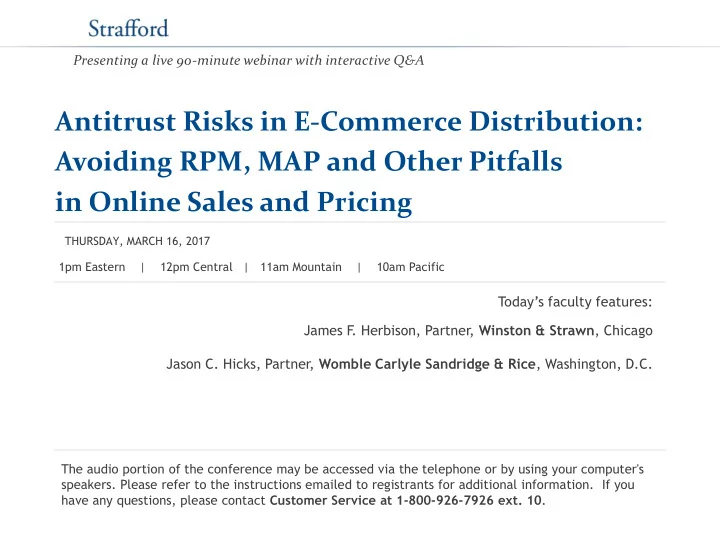
Presenting a live 90-minute webinar with interactive Q&A Antitrust Risks in E-Commerce Distribution: Avoiding RPM, MAP and Other Pitfalls in Online Sales and Pricing THURSDAY, MARCH 16, 2017 1pm Eastern | 12pm Central | 11am


slide-1
SLIDE 1

The audio portion of the conference may be accessed via the telephone or by using your computer's

  • speakers. Please refer to the instructions emailed to registrants for additional information. If you

have any questions, please contact Customer Service at 1-800-926-7926 ext. 10.

Presenting a live 90-minute webinar with interactive Q&A

Antitrust Risks in E-Commerce Distribution: Avoiding RPM, MAP and Other Pitfalls in Online Sales and Pricing

Today’s faculty features:

1pm Eastern | 12pm Central | 11am Mountain | 10am Pacific THURSDAY, MARCH 16, 2017

​ James F . Herbison, Partner, Winston & Strawn, Chicago Jason C. Hicks, Partner, Womble Carlyle Sandridge & Rice, Washington, D.C.

slide-2
SLIDE 2

Tips for Optimal Quality

Sound Quality If you are listening via your computer speakers, please note that the quality

  • f your sound will vary depending on the speed and quality of your internet

connection. If the sound quality is not satisfactory, you may listen via the phone: dial 1-866-755-4350 and enter your PIN when prompted. Otherwise, please send us a chat or e-mail sound@straffordpub.com immediately so we can address the problem. If you dialed in and have any difficulties during the call, press *0 for assistance. Viewing Quality To maximize your screen, press the F11 key on your keyboard. To exit full screen, press the F11 key again.

FOR LIVE EVENT ONLY

slide-3
SLIDE 3

Continuing Education Credits

In order for us to process your continuing education credit, you must confirm your participation in this webinar by completing and submitting the Attendance Affirmation/Evaluation after the webinar. A link to the Attendance Affirmation/Evaluation will be in the thank you email that you will receive immediately following the program. For additional information about continuing education, call us at 1-800-926-7926

  • ext. 35.

FOR LIVE EVENT ONLY

slide-4
SLIDE 4

Program Materials

If you have not printed the conference materials for this program, please complete the following steps:

  • Click on the ^ symbol next to “Conference Materials” in the middle of the left-

hand column on your screen.

  • Click on the tab labeled “Handouts” that appears, and there you will see a

PDF of the slides for today's program.

  • Double click on the PDF and a separate page will open.
  • Print the slides by clicking on the printer icon.

FOR LIVE EVENT ONLY

slide-5
SLIDE 5

Managing Antitrust Risk in E- Commerce Distribution

Jason C. Hicks Womble Carlyle Sandridge Rice LLP 1200 Nineteenth Street, NW, Suite 500 Washington, DC 20036 (202) 857-4536 | jahicks@wcsr.com

5

slide-6
SLIDE 6

E-Commerce v. Traditional Distribution

  • Same rules. Different context.
  • Increased choices and information.
  • Role of intermediaries.
  • Direct sales.
  • Wider geographic market.
  • Protecting and promoting brand.
  • Taking advantage of e-commerce opportunities

without abandoning traditional distribution channels.

6

slide-7
SLIDE 7

Topics

  • 1. Resale Price Maintenance
  • 2. Minimum Advertised Price
  • 3. Price Discrimination (Robinson Patman Act)

7

slide-8
SLIDE 8

Part I: Resale Price Maintenance

8

slide-9
SLIDE 9

Resale Price Maintenance

  • Resale price maintenance occurs when a

manufacturer attempts to control the price at which a distributor or retailer resells the manufacturer’s product.

  • Resale price maintenance can be problematic

under federal antitrust law or state law.

9

slide-10
SLIDE 10

Federal Laws Governing RPM

  • The Sherman Act, 15 U.S.C. 1

– Prohibits “every contract, combination … or conspiracy, in restraint of trade…” – Resale price maintenance analyzed as vertical price fixing. – Before 2007: Dr. Miles Med. Co. v. John D. Park & Sons Co., 220 U.S. 373 (1911) (holding that vertical minimum price fixing agreements per se unlawful)

10

slide-11
SLIDE 11

Colgate Policies

  • United States v. Colgate Co., 250 U.S. 300 (1919).

– Colgate held that manufacturers can choose with whom to do business. – Colgate policy: Manufacturer publicly announces a suggested resale price and then unilaterally announces that it will not do business with companies that sell below the suggested price. – No agreement – Retailers free to discount

11

slide-12
SLIDE 12

Colgate Policies

  • Colgate policies legal, but cumbersome

– Requires at will supply agreements – Risk that discussions or second chances are interpreted as an “agreement.” – Hard to enforce online when manufacturer may not know which of its distributors are selling products over Internet.

12

slide-13
SLIDE 13

Leegin and Rule of Reason

  • Leegin Creative Leather Products, Inc. v. PSKS,

Inc., 127 S. Ct. 2705 (2007)

– Overruled Dr. Miles. – Held that vertical resale price maintenance agreements evaluated under the “rule of reason” in federal antitrust cases. – Resale price agreements no longer per se illegal.

13

slide-14
SLIDE 14

Leegin and Rule of Reason

  • Types of pro-competitive justifications

recognized in Leegin:

– Encourages investment in a product or service – Alleviates the “free-rider” problem – Provides consumers with choices of products in different price-point categories

14

slide-15
SLIDE 15

Leegin and Rule of Reason

  • The Court said RPM may still be anticompetitive

if:

– Designed to obtain monopoly profits. – Facilitates a horizontal agreement among retailers to fix resale prices. – Abused by a powerful manufacturer with “market power.” – Used by all or most manufacturers such that consumers do not have a choice between high- service and low-price brands.

15

slide-16
SLIDE 16

RPM After Leegin

  • Uncertainty as to how federal courts will apply the rule
  • f reason to RPM agreements.

– Is RPM inherently suspect or presumptively lawful? – Should courts apply the “quick look” analysis or full fledged rule of reason? – Important factors may be:

  • Does manufacturer have market power?
  • Proper justifications for policy.
  • Was the source or impetus of the policy the manufacturer or

retailers?

  • High end or low end products.
  • Do other manufacturers in industry have same policy?

16

slide-17
SLIDE 17

State Law

  • RPM may still be per se illegal under some

state law.

– States have their own antitrust laws. – State antitrust law can be more strict than federal antitrust law. – Some states have taken action to enforce per se rule against RPM agreements.

17

slide-18
SLIDE 18

State Law

  • Interstate nature of e-commerce

– Internet sales may occur in any number of states. – Online sellers have to consider laws of all states where goods may be purchased online. – Lowest common denominator rule – Have to comply with the laws of the strictest state in which business operates/sells.

18

slide-19
SLIDE 19

State Law

  • Maryland

– After Leegin, Maryland enacted a specific law that made RPM agreements per se illegal.

  • California

– Attorney General’s office consistently asserts that the Cartwright Act makes minimum RPM agreements per se illegal. California Supreme Court has not weighed in, but prevailing opinion in lower courts is that RPM agreements are per se illegal.

19

slide-20
SLIDE 20

State Law

  • New York

– Attorney General argued that existing NY statute made minimum RPM agreements per se illegal. New York Appellate Division disagreed in Tempur Pedic.

  • Kansas

– In 2012, the Kansas Supreme Court held that RPM was per se illegal under state law. O’Brien v. Leegin Creative Leather Products, Inc. But on April 16, 2013, the Kansas legislature enacted a statute effectively

  • verruling that decision and re-establishing the rule
  • f reason analysis.

20

slide-21
SLIDE 21

International Laws

  • Global implications of e-commerce:

– Application of international competition law to internet sales in foreign countries. – EU competition law often more strict that US antitrust law. – Changes in Canadian competition law. – Competition law in emerging markets such as China. – Colgate policies under international competition law?

21

slide-22
SLIDE 22

Bottom Line

  • Electronic commerce raises unique issues because of the

possible application of different state law or international law on the sale of goods over the internet.

  • RPM analyzed under rule of reasons under federal law.
  • Some states still consider minimum RPM agreements per-

se illegal.

  • Some foreign countries may consider RPM agreements per

se illegal.

  • Some foreign countries may not recognize Colgate

doctrine.

22

slide-23
SLIDE 23

E-Commerce Affects on RPM Agreements

  • E-Commerce does not alter the analysis of RPM

agreements.

  • Same rules. Different context.
  • E-commerce makes businesses susceptible to

more jurisdictions.

  • E-commerce makes it more difficult to control

downstream sales.

  • E-commerce makes it more difficult to

implement Colgate policy.

23

slide-24
SLIDE 24

Part III: Price Discrimination and the Robinson Patman Act

24

slide-25
SLIDE 25

Robinson Patman Act

  • Section 2 of the Clayton Act is known as the

Robinson Patman Act (“RPA”).

  • Subsection 2(a) of the RPA prohibits restricts

sellers’ ability to charge different prices for commodities of like grade or quality that they sell to competing buyers if the discrimination adversely affects competition.

  • There are exceptions to the restrictions.

25

slide-26
SLIDE 26

Enforcement of the RPA

  • The Act is enforced through both government

mechanisms and private litigation.

26

slide-27
SLIDE 27

Elements of RP Act – Differences in Price

  • First element of the RPA is a difference in

price in reasonably contemporaneous sales to two different buyers

– The price at issue is the net price paid by the purchasers after accounting for all discounts, and includes freight and delivery terms. – Numerous federal courts have held that a mere sales offer, bid or price quote cannot satisfy the two sales requirement

27

slide-28
SLIDE 28

Elements of RP Act – Commodities

  • To violate the Act, a seller must charge

different prices for “commodities,” which can include “goods, wares, merchandise, machinery or supplies.”

– “Commodities” confines the reach of the RP Act to tangible products or goods rather than intangible products or services. – Dominant nature of a transaction.

28

slide-29
SLIDE 29

Elements of RP Act – Like Quality and Grade

  • Brand name and labels not determinants of

“grade and quality.”

  • Bona fide physical differences

– Extent of difference required is unclear – Customized products present particular issues

29

slide-30
SLIDE 30

Elements of RP Act – Competitive Injury

  • The Act prohibits discrimination where “the

effect of such discrimination may be substantially to lessen competition or tend to create a monopoly in any line of commerce, or to injure, destroy, or prevent competition with any person who either grants or knowingly receives the benefit of such discrimination, or with customers

  • f either of them . . .”
  • Types of injury

– Primary line; secondary line; tertiary line

30

slide-31
SLIDE 31

Elements of RP Act – Competitive Injury (cont)

  • Primary line injury

– Actual or threatened injury is to competition between the seller granting the discriminatory discount and other sellers – A plaintiff must show the possibility of harm through either a detailed analysis of market conditions or an inference of harm through proof

  • f predatory pricing

31

slide-32
SLIDE 32

Elements of RP Act – Competitive Injury (cont)

  • In a secondary line RP Act case, the actual or

threatened injury is to competition between the favored buyer who receives the different price and the disfavored customers of the seller

– May be directly established by proffering evidence of displaced sales or proof of a substantial price discrimination between competing purchasers

32

slide-33
SLIDE 33

Defenses to Alleged RP Act Violation

  • Meeting Competition
  • Cost Justification
  • Changing Conditions
  • Functional Availability
  • Functional Discount

33

slide-34
SLIDE 34

Defenses – Meeting Competition

  • A seller may rebut an alleged prima facie violation of

the RP Act by showing that the “lower price or the furnishing of services or facilities . . . was made in good faith to meet an equally low price of a competitor, or the services or facilities furnished by a competitor.”

– Affirmative defense available to a seller that acts “in good faith to meet an equally low price of a competitor.” – Genuine, reasonable response to prevailing competitive circumstances

34

slide-35
SLIDE 35

Defenses – Cost Justification

  • “Differences which make only due allowances for

difference in cost of manufacture, sale, or delivery resulting from the differing methods or quantities” are excepted from the ban on price discrimination under the RP Act.

– May charge a lower price to one purchaser where it is “justified by savings in the seller’s costs of manufacture, delivery or sale.” – Extends only to the actual cost differences

35

slide-36
SLIDE 36

Defenses – Functional Availability

  • No violation if the lower price was made

available to the disfavored purchaser.

– Competing purchaser must know about the lower price. – Lower price must be functionally available (not just theoretically available).

36

slide-37
SLIDE 37

Defenses – Functional Discount

  • A creation of case law; not explicitly recognized

in the RP Act.

– In Texaco v. Hasbrouck, the US Supreme Court stated that, “a functional discount is one given to a purchaser based on its role in the supplier’s distributive system, reflecting, at least in a generalized sense, the services performed by the purchaser for the supplier.” – A price difference “that merely accords due recognition and reimbursement for actual marketing functions” is not illegal.

37

slide-38
SLIDE 38

Direct Sales to Consumers

  • Where favored purchaser is a direct-buying

consumer, most courts have held that the disfavored reseller cannot bring RP Act claim because competition is not harmed.

38

slide-39
SLIDE 39

Internet Commerce & The RP Act

  • Are there regional geographic markets

justifying regional price differences?

  • Which companies are actually competing with

a manufacturer or reseller?

  • Functional discounts to brick & mortar stores

still available?

39

slide-40
SLIDE 40

Thank You

Jason C. Hicks Womble Carlyle Sandridge Rice LLP 1200 Nineteenth Street, NW, Suite 500 Washington, DC 20036 (202) 857-4536 | jahicks@wcsr.com

40

slide-41
SLIDE 41

Antitrust Risks in E-Commerce Distribution

Avoiding RPM, MAP and Other Antitrust Pitfalls in Online Sales and Pricing

James F. Herbison Christopher P. Wilson Winston & Strawn LLP 35 West Wacker Drive Chicago, IL 60601 (312) 558-5600 jherbison@winston.com cpwilson@winston.com

slide-42
SLIDE 42

What is a MAP?

  • Minimum Advertised Price Policy
  • Implemented by manufacturers and applicable to all retailers or

resellers of covered product(s)

  • Under the policy, retailers/resellers supplied by the manufacturer

are typically prohibited from advertising a product below a specified price

  • Somewhat similar to MSRP, though the MAP does not directly

affect the price charged by the reseller

42

slide-43
SLIDE 43

What is a MAP? (cont.)

  • MAP policies are often implemented through cooperative

advertising agreements or rebate-type agreements, particularly for retailers/resellers with physical sales locations

  • MAP policies governing internet advertisements may not always

include such cooperative agreements, given the low cost of internet advertising relative to traditional sales

  • All MAP policies generally include a clear method of enforcement

in response to violations

  • E.g., loss of cooperative advertising funds, temporary or permanent

loss of manufacturer supply

43

slide-44
SLIDE 44

What is a MAP? (cont.)

  • Thrust of a MAP policy: The manufacturer is not dictating the

ultimate price a reseller charges for the product, only the minimum price for which the reseller can advertise the product

  • MAP is distinguishable from resale price maintenance, which can

establish an actual sale price (or floor/ceiling) and thus increase the risk of possible antitrust scrutiny

  • Resellers generally retain the authority to advertise a product at a

different price than is required under a MAP policy, but do so recognizing the risk of sanction for deviation from the MAP

44

slide-45
SLIDE 45

Why Implement a MAP Policy?

  • Manufacturers often implement MAP policies to:
  • 1. Maintain price integrity
  • 2. Maintain goodwill of product
  • 3. Ensure consistent pricing across sales outlets
  • 4. Address “Free Rider” Concerns

45

slide-46
SLIDE 46

MAP Analysis

  • Where does MAP fit into traditional antitrust / RPM analysis?
  • Federal Treatment of MAP – Rule of Reason
  • State Law and Court Divergence from Federal Treatment

46

slide-47
SLIDE 47

MAP and Federal Antitrust Law

  • Federal courts (post-Leegin), FTC, and DOJ typically view

MAP policies as non-price vertical restraints, subject to the Rule of Reason

  • The Supreme Court in Leegin recognized several of the

concerns underlying manufacturer interest in MAP policies, such as goodwill/brand maintenance and the problem of “free riders”

47

slide-48
SLIDE 48

MAP and Federal Antitrust Law (cont.)

  • There have not been any recent FTC/DOJ challenges to MAP

policies, but a policy that 1) effectively operates as RPM or 2) invites collusion among competitors may also invite federal scrutiny

  • Two FTC investigations are illustrative:
  • 2000: FTC complaint alleged that compact disc manufacturers adopted MAP

policies that “effectively precluded many retailers from communicating prices below MAP to their customers,” and thus found that the policies were intended to “limit retail price competition and stabilize retail prices in the industry”

  • 2009: FTC complaint alleged that a music merchant trade association
  • rganized events at which retailers “were encouraged to discuss strategies for

implementing” manufacturers’ MAP polices in order to restrict price competition and increase retail prices

48

slide-49
SLIDE 49

Recent Federal Cases Involving MAP Policies

  • In re: Pool Products Distribution Market Antitrust Litigation

(E.D.La. Jul. 1, 2016)

  • Plaintiff purchasers alleged in relevant part that the defendant

distributor and manufacturers enforced MAP policies which “stifl[ed] discount prices that may otherwise have competed with supra- competitive prices” allegedly set by the distributor

  • The court granted summary judgment for the defendant distributor on
  • ther grounds, but noted that the MAP policies in question “applied to

the price at which dealers could advertise their products, not the prices at which distributors could sell their products”

49

slide-50
SLIDE 50

Recent Federal Cases Involving MAP Policies (cont.)

  • In re National Association of Music Merchants, Musical

Instruments and Equipment Antitrust Litigation (9th Cir. 2015)

  • Plaintiff purchasers alleged that defendant musical instrument

manufacturers entered into an agreement to adopt MAP policies, at the behest of the dominant musical instrument retailer, in violation of the Sherman Act

  • The 9th Circuit affirmed dismissal of the complaint, finding that

implementation of the MAPs constituted independent (if parallel) responses to pressure from the dominant retailer

50

slide-51
SLIDE 51

MAPs and State Law

  • Post-Leegin, state and federal law may conflict in assessing

MAP/RPM policies

  • National Association of Attorneys General (NAAG) –

Guidelines (non-binding) state that MAP policies are to be treated as a form of vertical price restraint

  • Two states – California and Maryland – have statutes

declaring RPM agreements per se illegal, post-Leegin, and many others have statutes that could interpret RPM as per se illegal

51

slide-52
SLIDE 52

MAPs and State Law (cont.)

  • Pre- and post-Leegin history suggests that states can and

will challenge improper MAP policies

  • In re Compact Disc Minimum Advertised Price Antitrust Litigation (D.

Maine, 2000): 43 State Attorneys General filed suit against CD merchants, following FTC investigation, alleging state and federal antitrust violations

  • Bahl v. Metabolife Int’l Inc. (Cal. Ct. App. 4th Dist., 2003): California

Attorney General filed an amicus brief indicating that MAP policies which “fix, tamper, or interfere” with prices would be considered per se illegal under California antitrust statues

  • State v. Herman Miller (S.D.N.Y., 2008): Illinois, New York, and

Michigan filed suit against manufacturer for implementing MAP policy prohibiting advertising below MAP, including in both in-store and

  • nline advertisements, and thus unlawfully interfering with pricing

52

slide-53
SLIDE 53

MAPs and State Law (cont.)

  • A MAP policy that is uniformly subject to the Rule of

Reason on the federal level may face per se illegal

  • bjections at the state level
  • The divergence between federal and state law is

immediately relevant to e-commerce, where inter- state transactions are prevalent and can be easily conducted

53

slide-54
SLIDE 54

MAP Implementation Considerations

  • A distributor implementing a MAP policy may avoid

potential antitrust violations by acting unilaterally

  • The distributor should unilaterally develop the policy
  • The distributor may legally act against a retailer who does

not comply with the MAP policy, provided it does so unilaterally

  • A MAP policy should also be broadly and

consistently enforced, and applicable both to online and off-line advertising

54

slide-55
SLIDE 55

MAP Implementation Considerations (cont.)

  • Antitrust issues may arise when there is evidence
  • f an agreement
  • Retailers agree to comply with a MAP policy on the

condition or with the understanding that other retailers will do so as well

  • A group of manufacturers agrees to enforce MAP policies
  • nline with the goal of stabilizing market prices
  • Communications or negotiations between a

manufacturer and its resellers regarding when a violation may be sanctioned can raise the spectre

  • f an agreement

55

slide-56
SLIDE 56

MAP Implementation Considerations (cont.)

  • A MAP policy should also avoid a structure that

effectively eliminates the reseller’s ability to set its

  • wn price and thus raises RPM issues
  • Critical to this point is ensuring that the MAP policy

provides avenues through which the actual price may be communicated to the customer

56

slide-57
SLIDE 57

MAP Implementation Considerations (cont.)

  • It is important to define which “advertisements” are

subject to the MAP, to clarify how to communicate the actual price to a customer

  • Direct communications with a customer are generally not

considered “advertisements”

  • Internet – Customer-initiated inquiries, “point-of-sale”

interfaces (e.g., “shopping cart” or “checkout” page online)

  • Brick-and-Mortar – Customer in the store or on a phone call

57

slide-58
SLIDE 58

MAP Implementation Considerations (cont.)

  • How far can a MAP policy go in restricting when a

below-MAP price can be displayed online?

  • Some federal case law suggests that MAP policies that

provide any avenue to learn the final purchase price (e.g., “call/email for price,” purchase confirmation pages) are sufficient

  • Although MAP policies with such restrictions have been

implemented, they may nevertheless be more vulnerable to challenge

58

slide-59
SLIDE 59

MAP Challenges

  • Although MAP policies have proliferated in recent years,

federal courts have yet to provide definitive guidance on what terms may push a valid MAP policy into invalid RPM territory

  • Minimal scrutiny of MAP policies by state and local agencies

in recent years is not guaranteed to continue

  • Further analysis of MAP policies in e-commerce will

continue

59

slide-60
SLIDE 60

Thank You

James F. Herbison Christopher P. Wilson Winston & Strawn LLP 35 West Wacker Drive Chicago, IL 60601 (312) 558-5600 jherbison@winston.com cpwilson@winston.com

60