
ACAPS Briefing Note: Rohingya Crisis 1 Briefing Note – 08 September 2017
MYANMAR AND BANGLADESH
Rohingya displacement and protection crisis
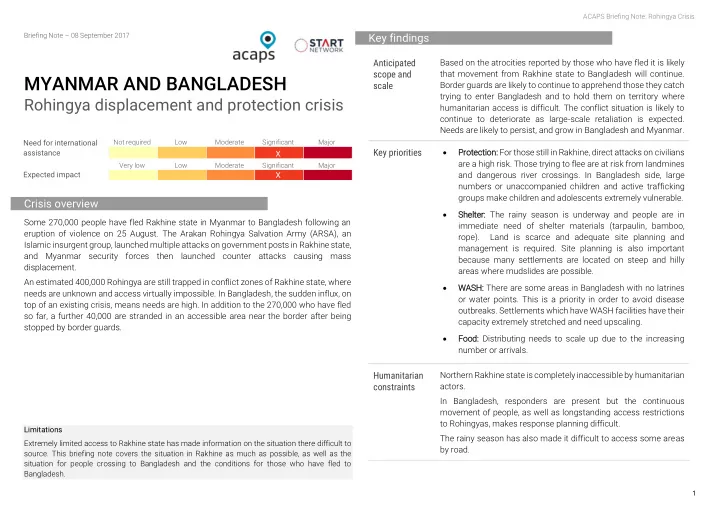
Need for international assistance
Not required Low Moderate Significant Major
X
Very low Low Moderate Significant Major
Expected impact X
Crisis overview
Some 270,000 people have fled Rakhine state in Myanmar to Bangladesh following an eruption of violence on 25 August. The Arakan Rohingya Salvation Army (ARSA), an Islamic insurgent group, launched multiple attacks on government posts in Rakhine state, and Myanmar security forces then launched counter attacks causing mass displacement. An estimated 400,000 Rohingya are still trapped in conflict zones of Rakhine state, where needs are unknown and access virtually impossible. In Bangladesh, the sudden influx, on top of an existing crisis, means needs are high. In addition to the 270,000 who have fled so far, a further 40,000 are stranded in an accessible area near the border after being stopped by border guards.
Limitations Extremely limited access to Rakhine state has made information on the situation there difficult to
- source. This briefing note covers the situation in Rakhine as much as possible, as well as the
situation for people crossing to Bangladesh and the conditions for those who have fled to Bangladesh.
Key findings
Anticipated scope and scale
Based on the atrocities reported by those who have fled it is likely that movement from Rakhine state to Bangladesh will continue. Border guards are likely to continue to apprehend those they catch trying to enter Bangladesh and to hold them on territory where humanitarian access is difficult. The conflict situation is likely to continue to deteriorate as large-scale retaliation is expected. Needs are likely to persist, and grow in Bangladesh and Myanmar.
Key priorities
Pro rotection: For those still in Rakhine, direct attacks on civilians are a high risk. Those trying to flee are at risk from landmines and dangerous river crossings. In Bangladesh side, large numbers or unaccompanied children and active trafficking groups make children and adolescents extremely vulnerable. Sh Shelter: r: The rainy season is underway and people are in immediate need of shelter materials (tarpaulin, bamboo, rope). Land is scarce and adequate site planning and management is required. Site planning is also important because many settlements are located on steep and hilly areas where mudslides are possible. WASH SH: There are some areas in Bangladesh with no latrines
- r water points. This is a priority in order to avoid disease
- utbreaks. Settlements which have WASH facilities have their
capacity extremely stretched and need upscaling. Food: d: Distributing needs to scale up due to the increasing number or arrivals.
Humanitarian constraints
Northern Rakhine state is completely inaccessible by humanitarian actors. In Bangladesh, responders are present but the continuous movement of people, as well as longstanding access restrictions to Rohingyas, makes response planning difficult. The rainy season has also made it difficult to access some areas by road.