ANNEX IV 'ANNEX XVII REPORTING ON ASSET ENCUMBRANCE Table of - - PDF document

annex iv
SMART_READER_LITE
LIVE PREVIEW

ANNEX IV 'ANNEX XVII REPORTING ON ASSET ENCUMBRANCE Table of - - PDF document

ANNEX IV 'ANNEX XVII REPORTING ON ASSET ENCUMBRANCE Table of Contents GENERAL INSTRUCTIONS ................................................................... 2 1. S TRUCTURE AND CONVENTIONS


slide-1
SLIDE 1

1

ANNEX IV

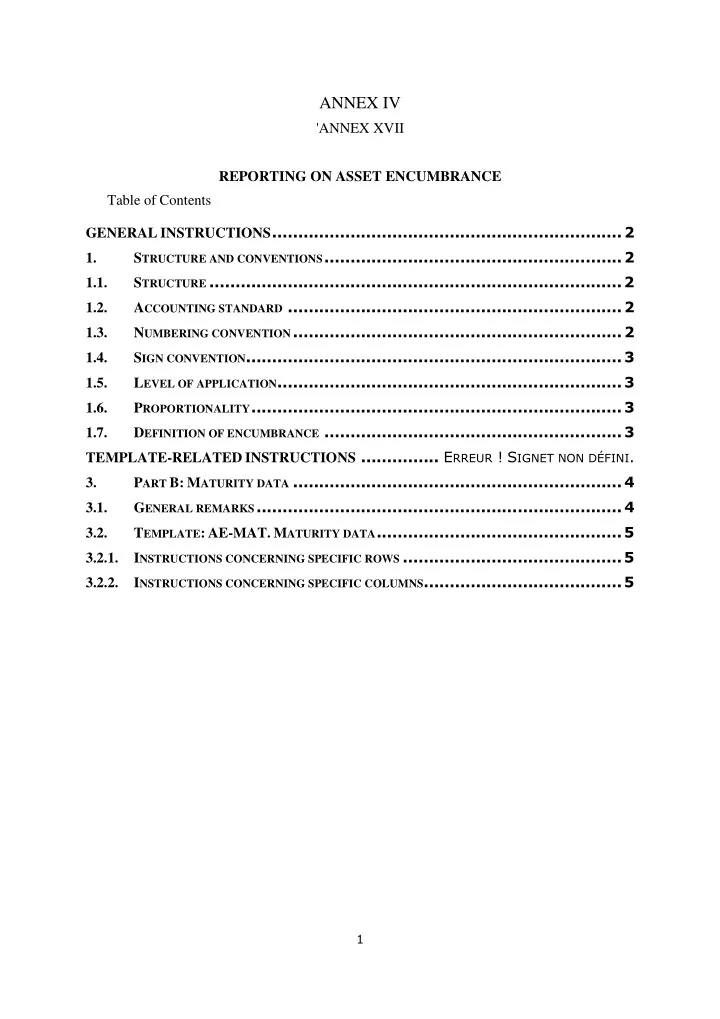
'ANNEX XVII REPORTING ON ASSET ENCUMBRANCE Table of Contents GENERAL INSTRUCTIONS ................................................................... 2 1. STRUCTURE AND CONVENTIONS ......................................................... 2 1.1. STRUCTURE ............................................................................... 2 1.2. ACCOUNTING STANDARD ................................................................ 2 1.3. NUMBERING CONVENTION ............................................................... 2 1.4. SIGN CONVENTION ........................................................................ 3 1.5. LEVEL OF APPLICATION .................................................................. 3 1.6. PROPORTIONALITY ....................................................................... 3 1.7. DEFINITION OF ENCUMBRANCE ......................................................... 3 TEMPLATE-RELATED INSTRUCTIONS ............... ERREUR ! SIGNET NON DÉFINI. 3. PART B: MATURITY DATA ............................................................... 4 3.1. GENERAL REMARKS ...................................................................... 4 3.2. TEMPLATE: AE-MAT. MATURITY DATA ............................................... 5 3.2.1. INSTRUCTIONS CONCERNING SPECIFIC ROWS .......................................... 5 3.2.2. INSTRUCTIONS CONCERNING SPECIFIC COLUMNS...................................... 5

slide-2
SLIDE 2

2

GENERAL INSTRUCTIONS

  • 1. Structure and conventions

1.1. Structure

  • 1. The framework consists of five sets of templates which comprise a total of nine

templates according to the following scheme: (a) Part A: Encumbrance overview:

  • AE-ASS template. Assets of the reporting institution
  • AE-COL template. Collateral received by the reporting institution
  • AE-NPL. Own covered bonds and asset-backed securities (hereinafter

'ABS') issued and not yet pledged

  • AE-SOU. Sources of encumbrance

(b) Part B: Maturity data:

  • AE-MAT template. Maturity data

(c) Part C: Contingent encumbrance

  • AE-CONT template. Contingent encumbrance

(d) Part D: Covered bonds

  • AE-CB template. Covered bonds issuance

(e) Part E: Advanced data:

  • AE-ADV-1 template. Advanced template for assets of the reporting

institution

  • AE-ADV-2 template. Advanced template for collateral received by the

reporting institution

  • 2. For each template legal references are provided as well as further detailed information

regarding more general aspects of the reporting. 1.2. Accounting standard

  • 3. Institutions shall report carrying amounts under the accounting framework they use

for the reporting of financial information in accordance with Articles 9 to 11. Institutions that are not required to report financial information shall use their respective accounting framework.

  • 4. For the purposes of this Annex “IAS” and “IFRS” refer to the international

accounting standards as defined in Article 2 of Regulation (EC) No 1606/2002. For institutions which report under IFRS standards, references have been inserted to the relevant IFRS standards. 1.3. Numbering convention

  • 5. The following general notation is used in these instructions to refer to the columns,

rows and cells of a template: {Template; Row; Column}. An asterisk sign is used to

slide-3
SLIDE 3

3

indicate that the validation is applied to the whole row or column. For example {AE- ASS; *; 2} refers to the data point of any row for column 2 of the AE-ASS template.

  • 6. In the case of validations within a template the following notation is used to refer to

data points from that template: {Row; Column}. 1.4. Sign convention

  • 7. Templates in Annex XVI shall follow the sign convention described in paragraphs 9

and 10 of Part I of Annex V. 1.5. Level of application

  • 8. The level of application of the reporting on asset encumbrance follows that of the

reporting requirements on own funds under the first subparagraph of Article 99 (1) of Regulation (EU) No 575/2013. Consequently, institutions that are not subject to prudential requirements in accordance with Article 7 of Regulation (EU) 575/2013 are not required to report information on asset encumbrance. 1.6. Proportionality

  • 9. For the purpose of Article 16a(2)(b) the asset encumbrance level shall be calculated

as follows:

  • Carrying

amount

  • f

encumbered assets and collateral = {AE- ASS;010;010}+{AE-COL;130;010}.

  • Total assets and collateral = {AE-ASS;010;010} + {AE-ASS;010;060}+{AE-

COL;130;010}+{AE-COL;130;040}.

  • Asset encumbrance ratio = (Carrying amount of encumbered assets and

collateral)/(Total assets and collateral)

  • 10. For the purpose of Article 16a(2)(a) the sum of total assets shall be calculated as

follows:

  • Total assets = {AE-ASS;010;010} + {AE-ASS;010;060}

1.7. Definition of encumbrance

  • 11. For the purpose of this Annex and Annex XVI an asset shall be treated as encumbered

if it has been pledged or if it is subject to any form of arrangement to secure, collateralise or credit enhance any transaction from which it cannot be freely withdrawn. It is important to note, that assets pledged that are subject to any restrictions in withdrawal, such as for instance assets that require prior approval before withdrawal

  • r replacement by other assets, should be considered encumbered. The definition is

not based on an explicit legal definition, such as title transfer, but rather on economic principles, as the legal frameworks may differ in this respect across countries. The

slide-4
SLIDE 4

4

definition is however closely linked to contractual conditions. The EBA sees the following types of contracts being well covered by the definition (this is a non- exhaustive list):

  • secured financing transactions, including repurchase contracts and agreements,

securities lending and other forms of secured lending;

  • various collateral agreements, for instance collateral placed for the market

value of derivatives transactions;

  • financial guarantees that are collateralised. It should be noted, that if there is

no impediment to withdrawal of collateral, such as prior approval, for the unused part of guarantee, then only the used amount should be allocated (on a pro-rata allocation);

  • collateral placed at clearing systems, CCPs and other infrastructure institutions

as a condition for access to service. This includes default funds and initial margins;

  • central bank facilities. Pre-positioned assets should not be considered

encumbered, unless the central bank does not allow withdrawal of any assets placed without prior approval. As for unused financial guarantees, the unused part, i.e. above the minimum amount required by the central bank, should be allocated on a pro-rata basis among the assets placed at the central bank;

  • underlying assets from securitisation structures, where the financial assets

have not been de-recognised from the institution’s financial assets. The assets that are underlying retained securities do not count as encumbered, unless these securities are pledged or provided as collateral in any way to secure a transaction;

  • assets in cover pools used for covered bond issuance. The assets that are

underlying covered bonds count as encumbered, except in certain situations where the institution holds the corresponding covered bonds (‘own-issued bonds’);

  • as a general principle, assets which are being placed at facilities that are not

used and can be freely withdrawn should not be considered encumbered.

  • 2. Part B: Maturity data

2.1. General remarks

  • 12. The template included in Part B shows a general overview of the amount of

encumbered assets and collateral received re-used that fall under the defined intervals

  • f the matching liabilities’ residual maturity.
slide-5
SLIDE 5

5

2.2. Template: AE-MAT. Maturity data 2.2.1. Instructions concerning specific rows Rows Legal references and instructions 010 Encumbered assets For the purpose of this template, encumbered assets include:

  • The assets of the reporting institution (see instruction in row 010 of

the Template AE-ASS), which are reported at their carrying amount

  • And the own debt securities issued other than covered bonds or

securitisations (see row 240 of the AE-COL template), which are reported at fair value. These amounts are distributed among the set of residual maturity buckets specified in the columns according to the residual maturity of the source

  • f its encumbrance (matching liability, contingent liability or securities

lending transaction). 020 Collateral received re-used (receiving leg) See instructions for row 130 of the AE-COL template and column 040 of the AE-SOU template. The amounts are reported at fair value and distributed among the set of residual maturity buckets specified in the columns according to the residual maturity of the transaction that generated for the entity the reception of the collateral that is being re-used (receiving leg). 030 Collateral received re-used (re-using leg) See instructions for row 130 of the AE-COL template and column 040 of the AE-SOU template. The amounts are reported at fair value and distributed among the set of residual maturity buckets specified in the columns according to the residual maturity of the source of its encumbrance (re-using leg): matching liability, contingent liability or securities lending transaction. 2.2.2. Instructions concerning specific columns Columns Legal references and instructions 010 Open maturity On demand, without a specific maturity date 020 Overnight

slide-6
SLIDE 6

6

Due date earlier or equal to 1 day 030 >1 day<=1wk Due date later than 1 day and earlier than or equal to 1 week 040 >1 wk<=2wks Due date later than 1 week and earlier than or equal to 2 weeks 050 >2wks <=1mth Due date later than 2 weeks and earlier than or equal to 1 month 060 >1mth <=3mths Due date later than 1 month and earlier than or equal to 3 months 070 >3mths <=6mths Due date later than 3 months and earlier than or equal to 6 months 080 >6mths<=1yr Due date later than 6 months and earlier than or equal to 1 year 090 >1yr <=2yrs Due date later than 1 year and earlier than or equal to 2 years 100 >2yrs <=3yrs Due date later than 2 years and earlier than or equal to 3 years 110 >3yrs <=5yrs Due date later than 3 years and earlier than or equal to 5 years 120 >5yrs <=10yrs Due date later than 5 years and earlier than or equal to 10 years 130 >10yrs Due date later than 10 years