and Other Coverage Pitfalls Coordinating With Other Policies; - - PowerPoint PPT Presentation

and other coverage pitfalls
SMART_READER_LITE
LIVE PREVIEW

and Other Coverage Pitfalls Coordinating With Other Policies; - - PowerPoint PPT Presentation

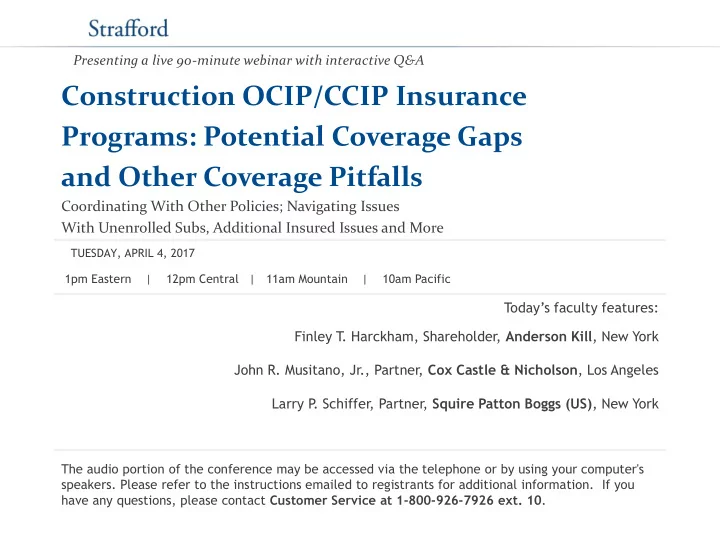
Presenting a live 90-minute webinar with interactive Q&A Construction OCIP/CCIP Insurance Programs: Potential Coverage Gaps and Other Coverage Pitfalls Coordinating With Other Policies; Navigating Issues With Unenrolled Subs, Additional


slide-1
SLIDE 1

The audio portion of the conference may be accessed via the telephone or by using your computer's

  • speakers. Please refer to the instructions emailed to registrants for additional information. If you

have any questions, please contact Customer Service at 1-800-926-7926 ext. 10.

Presenting a live 90-minute webinar with interactive Q&A

Construction OCIP/CCIP Insurance Programs: Potential Coverage Gaps and Other Coverage Pitfalls

Coordinating With Other Policies; Navigating Issues With Unenrolled Subs, Additional Insured Issues and More

Today’s faculty features:

1pm Eastern | 12pm Central | 11am Mountain | 10am Pacific TUESDAY, APRIL 4, 2017

Finley T . Harckham, Shareholder, Anderson Kill, New York John R. Musitano, Jr., Partner, Cox Castle & Nicholson, Los Angeles Larry P . Schiffer, Partner, Squire Patton Boggs (US), New York

slide-2
SLIDE 2

Tips for Optimal Quality

Sound Quality If you are listening via your computer speakers, please note that the quality

  • f your sound will vary depending on the speed and quality of your internet

connection. If the sound quality is not satisfactory, you may listen via the phone: dial 1-866-871-8924 and enter your PIN when prompted. Otherwise, please send us a chat or e-mail sound@straffordpub.com immediately so we can address the problem. If you dialed in and have any difficulties during the call, press *0 for assistance. Viewing Quality To maximize your screen, press the F11 key on your keyboard. To exit full screen, press the F11 key again.

FOR LIVE EVENT ONLY

slide-3
SLIDE 3

Continuing Education Credits

In order for us to process your continuing education credit, you must confirm your participation in this webinar by completing and submitting the Attendance Affirmation/Evaluation after the webinar. A link to the Attendance Affirmation/Evaluation will be in the thank you email that you will receive immediately following the program. For additional information about continuing education, call us at 1-800-926-7926

  • ext. 35.

FOR LIVE EVENT ONLY

slide-4
SLIDE 4

Program Materials

If you have not printed the conference materials for this program, please complete the following steps:

  • Click on the ^ symbol next to “Conference Materials” in the middle of the left-

hand column on your screen.

  • Click on the tab labeled “Handouts” that appears, and there you will see a

PDF of the slides for today's program.

  • Double click on the PDF and a separate page will open.
  • Print the slides by clicking on the printer icon.

FOR LIVE EVENT ONLY

slide-5
SLIDE 5

Construction OCIP/CCIP Insurance Programs: Potential Coverage Gaps and Other Coverage Pitfalls

Finley T. Harckham, Shareholder Anderson Kill, New York fharckham@andersonkill.com John R. Musitano, Jr., Partner Cox Castle & Nicholson, Los Angeles jmusitano@coxcastle.com Larry P. Schiffer, Partner Squire Patton Boggs (US) LLP, New York larry.schiffer@squirepb.com

CLE webinar on Tuesday, April 4, 2017 @ 1:00pm EDT Strafford Live CLE Webinars

slide-6
SLIDE 6

Introduction

  • Insurance Goals as a Component of a Comprehensive

Risk Management Strategy

  • Avoid, Minimize, Shift & Insure Risks

6

slide-7
SLIDE 7

Introduction

  • The Rise of Owner/Contractor Controlled

Insurance Programs

  • Litigation exposures
  • Changing insurance market
  • Direct and indirect costs

7

slide-8
SLIDE 8

Controlled Insurance Programs “101”

  • Commercial General Liability Insurance (CGL)

Programs

  • Conventional CGL policies
  • “Wrap-Up” or Controlled Insurance Policy (OCIP
  • r CCIP)
  • CIPs bundled with other coverages
  • Key Differences Between CIPs and Conventional CGL

Programs

  • Advantages and Suitability of CIPs Depending on

Project Factors

8

slide-9
SLIDE 9

Types of Controlled Insurance Programs

 OCIPs  CCIPs  “Project Specific”  “Rolling Wraps

9

slide-10
SLIDE 10

OCIP v. CCIP

 OCIP v. CCIP Comparisons

 The Metrics  OCIPs – Pros and Cons  CCIPs – Pros and Cons

10

slide-11
SLIDE 11

Procuring CIP Coverage

  • Risk Management Team
  • Analysis and Negotiation of Components Key

to Specific Project

  • Contractual Implementation of the OCIP (The

OCIP Exhibit)

  • Integration of the OCIP With Other Risk

Transfer Provisions in the Construction Contracts

11

slide-12
SLIDE 12

Negotiating the CIP

  • Goals May Vary by Type of Project
  • New Construction v. Rehab/Conversion
  • For-Sale v. Other (e.g., Apartments)
  • Interplay With Other Coverage Types
  • Interplay With Other CGL Policies

12

slide-13
SLIDE 13

Integration of the CIP into Project Documents

  • Statutes Requiring Disclosures to Wrap-Up

Participants

  • Anti-Indemnification Statutes – Effect of CIP
  • n Scope of Indemnity

13

slide-14
SLIDE 14

Integration of the CIP into Project Documents

  • Construction Documents – OCIP Exhibit, OCIP Manual
  • Key Drafting Points
  • Statutory disclosures
  • Eligibility and enrollment procedures for those parties

which are eligible

  • Summaries of coverages and limits, and coverages not

provided

  • Responsibility for SIRs/Deductibles
  • Sponsor disclaimers
  • Joint defense
  • Duties of participating parties
  • Integrating CIP with Other Risk Management Provisions

14

slide-15
SLIDE 15

Claims Issues Arising From OCIP/CCIP Policies

  • Wrap Policies Meant to Address All Claims Arising From the Project
  • Scope of coverages included in the wrap-up policy
  • Limits provided
  • Participation in the wrap-up policy by all possible players
  • Specific to the project
  • Relationship Between the Wrap-Up Policy and Other Policies
  • Project participants have their own insurance covering them for

their operations

  • CGL policies issued to participants not solely specific to the

project

  • Workers’ Compensation policies issued to contractors and

subcontractors

  • Other general policies

15

slide-16
SLIDE 16

Claims Issues Arising From OCIP/CCIP Policies

  • Coordination (If Any) Between Wrap-Up Policies and Other Policies
  • Exclusions
  • Endorsements
  • Who pays the premium
  • Geographic and site specificity
  • General Policies Excess to OCIP/CCIP
  • Endorsements
  • Other insurance clause

16

slide-17
SLIDE 17

Claims Issues Arising From OCIP/CCIP Policies

  • When Claims Arise
  • Efforts to maximize availability of limits
  • Large losses often result in non-wrap-up carriers being noticed for

claims

  • Requests to defend
  • Requests to indemnify
  • Allocation/Coordination
  • Question is whether non-wrap policies have any obligation to

respond to claims that should be addressed by an OCIP/CCIP

17

slide-18
SLIDE 18

Claims Issues Arising From OCIP/CCIP Policies

  • Duty to Defend and Wrap-Up Policies
  • Duty to defend broader than duty to indemnify
  • Limits on defense costs
  • Triggering of standard policies when defense limit on wrap-up policy

exhausts

  • Question of What Policy Must Respond to a Loss at the Project
  • Recent case Structure Tone, Inc. v. National Cas. Co., 130 A.D.3d 405 (N.Y.
  • App. Div. 2015)
  • Wrap-up policy exclusionary language in subcontractor’s CGL policy was

triggered precluding coverage for the loss

  • Certificate of Insurance produced by project owner’s broker did not bind

the subcontractor’s carrier when there was no agency agreement between the broker and the carrier

18

slide-19
SLIDE 19

Claims Issues Arising From OCIP/CCIP Policies

  • What Happens When an OCIP/CCIP Carrier Goes Insolvent?
  • State insurance guaranty funds may take over the claims
  • Many states have separate funds for property and casualty policies

and workers’ compensation policies

  • Guaranty funds have subject matter limits and caps on payments
  • Can Other Carriers Become Responsible?
  • CGL and workers’ compensation carriers that issued regular non-

site specific policies to project participants

  • Exclusions – particularly wrap-up exclusions
  • Excess liability

19

slide-20
SLIDE 20

Claims Issues Arising From OCIP/CCIP Policies

  • What Happens When the OCIP/CCIP Insolvency Occurs While Claims Are

Being Paid?

  • Virginia Surety Co. v. Adjustable Forms, Inc., 382 Ill. App. 3d 663 (Ill. App.

1st Dist. 2008)

  • Other Insurance provision in non-OCIP Workers’ Comp policy
  • “This policy covers all of your workplaces listed in Items ___ on the

Information Page; and it covers all other workplaces in Item ___ states unless you have other insurance or are self-insured for such workplaces”

  • Non-OCIP carrier did not collect and retain premium from the insured at

the location covered by the OCIP

  • Premium for the location was received by the OCIP carrier
  • OCIP carrier becomes insolvent
  • Guaranty fund must continue to pay the claim

20

slide-21
SLIDE 21

Claims Issues Arising From OCIP/CCIP Policies

  • Workers’ Compensation Distinctions
  • Policies typically enumerate state and workplace locations
  • Premiums are collected only for payrolls on covered worksites
  • Hard to conclude that a workers’ compensation carrier that did

not receive premium based on payroll at a specific worksite should nevertheless be liable for losses when the OCIP carrier fails

  • Typically have the exclusion for other insurance covering specific

workplaces

  • Best practice to have specific endorsements excluding specific

projects covered by wrap-up policies

21

slide-22
SLIDE 22

Claim Issues – Case Study

The Incident

  • Major explosion at power plant under construction
  • Multiple fatalities and numerous other injuries
  • Hundreds of millions in property damage

22

slide-23
SLIDE 23

Claim Issues – Case Study

The Coverage

  • CCIP for project with CGL and Workers Compensation coverage
  • Some, but not all, subcontractors enrolled
  • GL limits of $50 million
  • Defense coverage limited to $1 million primary policy

23

slide-24
SLIDE 24

Claim Issues – Case Study

Dispute – How Should Settlement Costs Be Allocated?

  • CCIP vs. coverage of non-enrolled subcontractors
  • Goal was to settle claims as to all defendants to extinguish cross-

claims

  • A percentage sharing was agreed
  • If CCIP exhausted, allocation among
  • Program policies of contractor and subcontractors
  • Considerations
  • Liability exposure
  • “Other insurance” clauses
  • “Additional insured” provisions
  • Never resolved

24

slide-25
SLIDE 25

Claim Issues – Case Study

Dispute – Should CCIP Be Used to Pay Claims or Settlements For Individual Enrollees?

  • One subcontractor settled a group of personal injury claims on its own
  • The contractor incurred liquidated damages
  • CCIP considered interpleader action
  • Result – CCIP funds used only to extinguish claims against all defendants

25

slide-26
SLIDE 26

Claim Issues – Case Study

Dispute – What to Do about Limited Defense Coverage?

  • The CCIP was to have $50 million in defense coverage outside of limits
  • But actually only the primary had defense coverage
  • The owner looked to the contractor
  • The contractor’s primary program coverage was endorsed as excess to the

CCIP

  • So its primary refused to defend
  • Contractor was defended as an additional insured under a non-CCIP

subcontractor’s policy

  • Owner’s defense costs were claimed against the broker in a malpractice

action

26

slide-27
SLIDE 27

Claim Issues – Case Study

Dispute – The Contractor’s Practice Program Excess Policies Were Not Endorsed as Excess of Wrap?

  • The contractor’s own tower of GL coverage should have been endorsed as

excess of wrap over the CCIP

  • Only the primary was endorsed
  • Contractor had to purchase retroactive excess coverage
  • Contractor had to sue brokers

27

slide-28
SLIDE 28

Claim Issues – Case Study

Dispute – With a CCIP, is the Contractor the “Employer” of the Subcontractors’ Employees for Purposes of the Workers Compensation Claim Bar?

  • The contractor claimed to be the “principal employer” because it paid the

premiums for the workers comp coverage

  • Trial court agreed
  • So, injured subcontractor employees claims against the contractor

were dismissed

  • Decision has been affirmed by the Connecticut Supreme Court

28

slide-29
SLIDE 29

THANK YOU!

John R. Musitano, Jr., Esq. Partner Cox, Castle & Nicholson LLP 2029 Century Park East Suite 2100 Los Angeles, CA 90067 P: 310.284.2212 E: jmusitano@coxcastle.com www.coxcastle.com Larry P. Schiffer Partner Squire Patton Boggs (US) LLP 30 Rockefeller Plaza 23rd Floor New York, NY 10112 P: 646.557.5194 E: larry.schiffer@squirepb.com www.squirepb.com Finley Harckham Shareholder Anderson Kill P.C. 1251 Avenue of the Americas 42nd Floor New York, NY 10020 P: 212.278.1543 E: fharckham@andersonkill.com www.andersonkill.com.com

29