And all I've outlined here today are And all I've outlined here - - PowerPoint PPT Presentation

and all i ve outlined here today are and all i ve
SMART_READER_LITE
LIVE PREVIEW

And all I've outlined here today are And all I've outlined here - - PowerPoint PPT Presentation

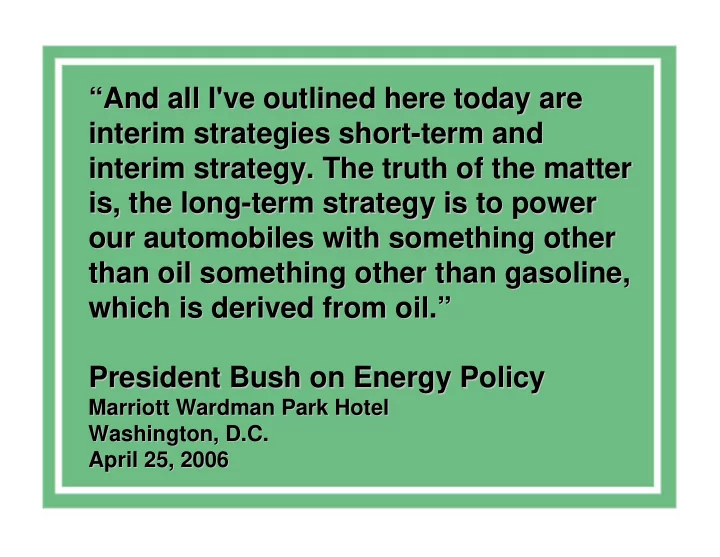
And all I've outlined here today are And all I've outlined here today are interim strategies short- -term and term and interim strategies short interim strategy. The truth of the matter interim strategy. The truth of the matter is,


slide-1
SLIDE 1

“ “And all I've outlined here today are And all I've outlined here today are interim strategies short interim strategies short-

  • term and

term and interim strategy. The truth of the matter interim strategy. The truth of the matter is, the long is, the long-

  • term strategy is to power

term strategy is to power

  • ur automobiles with something other
  • ur automobiles with something other

than oil something other than gasoline, than oil something other than gasoline, which is derived from oil. which is derived from oil.” ” President Bush on Energy Policy President Bush on Energy Policy

Marriott Wardman Park Hotel Marriott Wardman Park Hotel Washington, D.C. Washington, D.C. April 25, 2006 April 25, 2006

slide-2
SLIDE 2

Grant Landrum Grant Landrum Joline Munoz Joline Munoz

slide-3
SLIDE 3

Outline Outline

  • Introduction to Biodiesel

Introduction to Biodiesel

  • Biodiesel vs. Petrol Diesel

Biodiesel vs. Petrol Diesel

  • Oil Sources

Oil Sources

  • Our Source

Our Source

  • Location Selection

Location Selection

  • Genetic Modification

Genetic Modification

  • Scenarios Evaluated

Scenarios Evaluated

  • Transesterfication

Transesterfication

  • Byproducts

Byproducts

  • Economics

Economics

  • Conclusions

Conclusions

slide-4
SLIDE 4

What is Biodiesel? What is Biodiesel?

  • Biodiesel is a completely natural, alternative fuel source

Biodiesel is a completely natural, alternative fuel source that is applicable in almost all situations in which petrol that is applicable in almost all situations in which petrol diesel is used. diesel is used.

Transesterification Transesterification

Triglyceride + Alcohol Methyl Esters + Gly Triglyceride + Alcohol Methyl Esters + Glycerol cerol (Oil) (Bi (Oil) (Biodiesel)

  • diesel)

– – Oil can come from animal oil / fats, vegetable oil, and waste Oil can come from animal oil / fats, vegetable oil, and waste

  • il from restaurants (after degumming)
  • il from restaurants (after degumming)

Introduction Introduction

Base Base Catalyst Catalyst

slide-5
SLIDE 5

Triglycerides Alcohol Glycerol Methyl Esters

slide-6
SLIDE 6

Biodiesel vs. Petrol Biodiesel vs. Petrol-

  • Diesel

Diesel

  • Biodiesel

Biodiesel

– – Reduces emissions Reduces emissions – – Cetane #: 48 Cetane #: 48-

  • 65

65 – – Increases lubricity Increases lubricity – – Longer engine life Longer engine life – – Higher Flash Point Higher Flash Point – – Requires no modification Requires no modification – – Dissolves rubber and Dissolves rubber and some plastic some plastic – – Slightly lower heating Slightly lower heating value value

  • Petroleum Diesel

Petroleum Diesel

– – High High emissions emissions – – Cetane #: 40 Cetane #: 40-

  • 55

55 – – Low sulfur diesel lacks Low sulfur diesel lacks lubricity lubricity – – High sulfur High sulfur

  • poisons catalyst in

poisons catalyst in exhaust system exhaust system

  • Reduces effective

Reduces effective reduction of reduction of emissions in exhaust emissions in exhaust system system

slide-7
SLIDE 7

http://www.biodiesel.org/pdf_files/fuelfactsheets/BTU_Content_Final_Oct2005.pdf

slide-8
SLIDE 8

http://www.biodiesel.org/resources/reportsdatabase/reports/gen/19940101_gen-297.pdf

slide-9
SLIDE 9

http://www.biodiesel.org/pdf_files/fuelfactsheets/Environment_Safety1.pdf

slide-10
SLIDE 10

http://www.propelbiofuels.com/site/aboutbiodiesel.html

slide-11
SLIDE 11

Potential Oil Sources Potential Oil Sources

slide-12
SLIDE 12

http://www.uscanola.com/index.asp?Type=B_BASIC&SEC={5CDA1D60-89B2-4F79-B96F-0B5AB2FBF781}

slide-13
SLIDE 13

Soybean Soybean

  • Biodiesel plants in U.S. use soy

Biodiesel plants in U.S. use soy

  • Commodity Credit Corporation (CCC)

Commodity Credit Corporation (CCC)

– – Incentives: $1.45 Incentives: $1.45 -

  • 1.47 / gallon till mid

1.47 / gallon till mid-

  • 2006

2006

  • 30% of the plants are not profitable without government

30% of the plants are not profitable without government incentives incentives

  • 24% are still unprofitable with incentives

24% are still unprofitable with incentives

– – High cost oil feed stock for biodiesel High cost oil feed stock for biodiesel – – High production costs High production costs – – Increase lipid content Increase lipid content-

  • lower production costs

lower production costs

http://www.farmgate.uiuc.edu/archive/2006/04/what_is_the_fut.htm http://www.farmgate.uiuc.edu/archive/2006/04/what_is_the_fut.html l

slide-14
SLIDE 14

Land Requirements Land Requirements

slide-15
SLIDE 15

Algae Algae

  • NREL Aquatic Species Program Study

NREL Aquatic Species Program Study ( (National Renewable Energy Laboratory National Renewable Energy Laboratory) ) – – Factors to consider Factors to consider

  • High adaptability to variety of

High adaptability to variety of environments environments

  • Large growth rate

Large growth rate

  • Higher lipid content

Higher lipid content

slide-16
SLIDE 16

Algae Requirements Algae Requirements

  • Growth

Growth

– – Sunlight Sunlight – – CO CO2

2

– – Nutrients (N and Si) Nutrients (N and Si) – – Water ( Water (can be saline can be saline) ) – – Warm Climate Warm Climate – – Circulation or Aeration Circulation or Aeration 6H 6H2

2O + 6CO

O + 6CO2

2

C C6

6H

H12

12O

O6

6+ 6O

+ 6O2

2

slide-17
SLIDE 17

Algae Algae

  • Environment

Environment – – Different Media Different Media

  • Type I: 2,000 to 16,000 mg/l

Type I: 2,000 to 16,000 mg/l

  • Type 2: 1,500 to 26,000 mg/l

Type 2: 1,500 to 26,000 mg/l

  • Seawater

Seawater – – Majority algae survive well in seawater Majority algae survive well in seawater

slide-18
SLIDE 18

Brine Water Source Brine Water Source

  • Hueco Bolson Aquifer

Hueco Bolson Aquifer

– – Salt concentrations Salt concentrations range from 1000 to range from 1000 to 3000 mg/L 3000 mg/L

  • 600 times the amount

600 times the amount

  • f fresh water
  • f fresh water
  • Possible alternative to

Possible alternative to evaporation ponds evaporation ponds-

  • reinjection

reinjection

http://www.twdb.state.tx.us/publications/reports/GroundWaterReports/GWReports/R345%20Aquifers%20of%20Texas/Majors/hueco.pdf

slide-19
SLIDE 19

Algae Selection Algae Selection

  • Arizona State University

Arizona State University -

  • New Mexico / Texas Area

New Mexico / Texas Area – – Amphora Bacillariophyceae Amphora Bacillariophyceae

  • Hard to harvest (10 X 4

Hard to harvest (10 X 4 m m) )

  • Salinity: ~9000

Salinity: ~9000-

  • 18000 mg/L

18000 mg/L – – Oscillatoria Cynaophyceae Oscillatoria Cynaophyceae

  • Adaptive

Adaptive

  • Harder to harvest (0.2 X 0.1

Harder to harvest (0.2 X 0.1 m m) )

  • Salinity: ~2000

Salinity: ~2000-

  • 12000 mg/L

12000 mg/L

slide-20
SLIDE 20

The Process The Process

Ponds Ponds Ponds Biodiesel Plant Sugars BiodieseltoMarket AlgaeandWater AlgaeandWater AlgaeandWater Diesel Refinery Natural GasPlant C O2 CO2 CO2 P r

  • t

e i n Oil Algae Harvesting/ OilExtraction X a n t h a n

  • G

u m Fermentation Plant G l y c e r

  • l
slide-21
SLIDE 21

Location: West TX Location: West TX

Newman Power Plant, El Paso TX. Newman Power Plant, El Paso TX.

  • 24 oil refineries

24 oil refineries

  • 8% diesel transportation

8% diesel transportation

slide-22
SLIDE 22

Pond Nutrients Pond Nutrients

A Study of the Energetics and Economics of Microalgal Mass Culture with the Marine Chlorophyte Tetrase/mis suecica: Implications for Use of Power Plant Stack Gases*

slide-23
SLIDE 23

Algae Algae

  • Lipid Content

Lipid Content

– – Starvation Starvation

  • A minimum amount of food (nitrogen source or Si

A minimum amount of food (nitrogen source or Si source) added to ponds source) added to ponds

  • 7

7-

  • day cycle, algae have run out of food and have begun

day cycle, algae have run out of food and have begun to starve to starve

– – Pro Pro-

  • Causes many different algae to increase lipid content

Causes many different algae to increase lipid content – – Con Con-

  • Stuns cell growth

Stuns cell growth

– – Genetic Engineering Genetic Engineering

  • Metabolic processes in the specific algae

Metabolic processes in the specific algae

  • Manipulate these processes to maximize lipids

Manipulate these processes to maximize lipids

slide-24
SLIDE 24

Overall Metabolic Pathway

  • f

Lipid Synthesis

slide-25
SLIDE 25

Genetic engineering Genetic engineering algae starting with algae starting with glucose glucose-

  • 6

6-

  • phosphate

phosphate Want to produce Want to produce dihydroxy dihydroxy-

  • acetone

acetone-

  • phosphate

phosphate Entner Entner-

  • Doudoroff

Doudoroff & Glycolysis I & Glycolysis I

http://biocyc.org/

100 mol 50 mol 50 mol 50 mol 100 mol 25 mol

slide-26
SLIDE 26

Phospholipid Phospholipid Biosynthesis Biosynthesis Want to produce Want to produce glycerol glycerol-

  • 3

3-

  • phosphate

phosphate

  • r L
  • r L-
  • phosphatidate

phosphatidate

http://biocyc.org/

75 mol 37.5 mol 37.5 mol

slide-27
SLIDE 27

Triacylglycerol Triacylglycerol Biosynthesis Biosynthesis

http://biocyc.org/ Now 56.25 mol tri / 100 mol G Now 56.25 mol tri / 100 mol G-

  • 6

6-

  • P

P Initially 37.5 mol tri / 100 mol G Initially 37.5 mol tri / 100 mol G-

  • 6

6-

  • P

P

slide-28
SLIDE 28

Genetic Engineering Genetic Engineering

  • Why genetically modify the algae?

Why genetically modify the algae?

– – Maximize algal lipid content Maximize algal lipid content

  • How to genetic engineer the algae?

How to genetic engineer the algae?

– – Complete genome study on the species Complete genome study on the species – – Isolation, Manipulation, and Re Isolation, Manipulation, and Re-

  • introduction

introduction – – Polymerase Chain Reaction Polymerase Chain Reaction (PCR) (PCR) – – Loss of Function / Gain of Function / Tracking Loss of Function / Gain of Function / Tracking

slide-29
SLIDE 29

What is a genome? What is a genome?

  • Contains all the biological information

Contains all the biological information needed to build / maintain a living example needed to build / maintain a living example

  • f that organism
  • f that organism
  • Biological information

Biological information in a genome is in a genome is encoded in its DNA encoded in its DNA and is divided into and is divided into discrete units called discrete units called genes genes

http://darwin.bio.uci.edu/~faculty/wagner/hsvimg04.jpg

slide-30
SLIDE 30

Nucleic Acid Hybridization Nucleic Acid Hybridization

  • DNA is separated into its two strands

DNA is separated into its two strands

  • C

CRNA

RNA >> C

>> CDNA

DNA the RNA will replace one of

the RNA will replace one of the DNA strands in this region the DNA strands in this region

http://7e.devbio.com/image.php?id=126

slide-31
SLIDE 31

Complementary DNA (cDNA) Complementary DNA (cDNA)

http://7e.devbio.com/image.php?id=127

  • RNA isolated and

RNA isolated and converted to cDNA converted to cDNA

  • cDNA isolated

cDNA isolated – – raising the pH raising the pH ( (denature helix denature helix) ) – – cleaving RNA cleaving RNA

slide-32
SLIDE 32

Reverse Transcription Reverse Transcription Polymerase Chain Reaction Polymerase Chain Reaction

(1) (1) Denaturing at 94 Denaturing at 94° °C C (2) (2) Annealing at 68 Annealing at 68° °C C (3) (3) Extension at 72 Extension at 72° °C C (4) (4) Rinse and Repeat Rinse and Repeat

  • PCR followed by transcription with

PCR followed by transcription with reverse transcriptase (to convert the reverse transcriptase (to convert the R RNA NA to to cDNA cDNA) )

  • E

Expression mapping xpression mapping: determining when : determining when and where certain and where certain genes genes are are expressed expressed

slide-33
SLIDE 33

Options Options

  • 15 year production term

15 year production term

  • Evaluate profitability based on different starting capital

Evaluate profitability based on different starting capital investments investments

  • Expansion vs. One time Build

Expansion vs. One time Build

  • Possibility of recycling profits advantage

Possibility of recycling profits advantage

slide-34
SLIDE 34

Options Cont. Options Cont.

  • Varied Lipid Content to evaluate profitability

Varied Lipid Content to evaluate profitability based on different lipid yields based on different lipid yields

slide-35
SLIDE 35

The Process The Process

Ponds Ponds Ponds Biodiesel Plant Sugars BiodieseltoMarket AlgaeandWater AlgaeandWater AlgaeandWater Diesel Refinery Natural GasPlant C O2 CO2 CO2 P r

  • t

e i n Oil Algae Harvesting/ OilExtraction X a n t h a n

  • G

u m Fermentation Plant G l y c e r

  • l
slide-36
SLIDE 36

Pond Production Plan Pond Production Plan

1.

  • 1. 7 day cycle

7 day cycle 2.

  • 2. Drain at night

Drain at night 3.

  • 3. Refill pond w/ ~85% old water

Refill pond w/ ~85% old water 4.

  • 4. Pump rest to evaporation pond

Pump rest to evaporation pond 5.

  • 5. Add ~15% reclaimed water

Add ~15% reclaimed water

slide-37
SLIDE 37

Ponds Ponds

  • Length = 1835 m

Length = 1835 m

  • Width = 179 m

Width = 179 m

  • Based on 1 mile

Based on 1 mile2

2

( (8 ponds to per mile 8 ponds to per mile2

2)

) – – 7 ponds for growth 7 ponds for growth – – 1 pond for cyclic process 1 pond for cyclic process

|------------1835 meters------| |-179 meters-|

slide-38
SLIDE 38

Ponds Ponds

  • Evaporation Ponds

Evaporation Ponds

– – According to NREL According to NREL

  • West Texas Region 1 cm water/day will evaporate

West Texas Region 1 cm water/day will evaporate

– – Brine Waste disposed at land fill $8/yd Brine Waste disposed at land fill $8/yd3

3

– – Supplement with reclaimed water. Supplement with reclaimed water. $0.94/1000 gallons. $0.94/1000 gallons.

slide-39
SLIDE 39

The Process The Process

Ponds Ponds Ponds Biodiesel Plant Sugars BiodieseltoMarket AlgaeandWater AlgaeandWater AlgaeandWater Diesel Refinery Natural GasPlant C O2 CO2 CO2 P r

  • t

e i n Oil Algae Harvesting/ OilExtraction X a n t h a n

  • G

u m Fermentation Plant G l y c e r

  • l
slide-40
SLIDE 40

Harvesting / Oil Extraction Harvesting / Oil Extraction

slide-41
SLIDE 41

Harvesting Harvesting

  • Empty ponds overnight

Empty ponds overnight

  • Belt Filtration

Belt Filtration (0.04 (0.04 -

  • 4% solids)

4% solids)

  • Centrifuge

Centrifuge (4% (4% -

  • 60% solids)

60% solids)

  • Dryer

Dryer (60% (60% -

  • 90% solids)

90% solids)

Independent High Pressure Section

Free drainage zone

Low Pressure Zone

High Pressure Zone

Belt Filtration Belt Filtration

slide-42
SLIDE 42

Oil Extraction Oil Extraction

  • Mechanical press yields 70% oil

Mechanical press yields 70% oil

  • Immersion extractor w/ hexane yields 95

Immersion extractor w/ hexane yields 95-

  • 99% oil

99% oil

slide-43
SLIDE 43

The Process The Process

Ponds Ponds Ponds Biodiesel Plant Sugars BiodieseltoMarket AlgaeandWater AlgaeandWater AlgaeandWater Diesel Refinery Natural GasPlant C O2 CO2 CO2 P r

  • t

e i n Oil Algae Harvesting/ OilExtraction X a n t h a n

  • G

u m Fermentation Plant G l y c e r

  • l
slide-44
SLIDE 44

Transesterification Transesterification

*A process model to estimate biodiesel production costs (Michael *A process model to estimate biodiesel production costs (Michael J. Haas*,

  • J. Haas*,

Andrew J. Andrew J. McAloon McAloon, et al) , et al)

slide-45
SLIDE 45

Transesterification Transesterification

  • Base Catalyzed Reaction Model

Base Catalyzed Reaction Model

  • KOH as catalyst; interchangeable w/

KOH as catalyst; interchangeable w/ NaOH NaOH

  • MeOH

MeOH = cheap, eases separation = cheap, eases separation

  • 6:1 ratio of

6:1 ratio of MeOH MeOH to triglyceride to triglyceride

– – Highest yield Highest yield – – Actual stoichiometry is 3:1 Actual stoichiometry is 3:1

  • 90% conversion assume in each reactor

90% conversion assume in each reactor

  • Yields 99% total conversion

Yields 99% total conversion

slide-46
SLIDE 46

Kinetics Kinetics

] / ) ( * / ) ( / ) ( * / ) ( [ ) (

1 1 2 1 2 3 2 1 1 1 1

υ ξ υ ξ ξ υ ξ ξ ξ υ ξ ξ + − + + − − − − − + =

− − R Di MeOH Tri Tri Tri

F F k F F k V F F

3 2 1

R Glycerol MeOH Mono R Mono MeOH Di R Di MeOH Tri + ⇔ + + ⇔ + + ⇔ +

Mole Balance on Triglyceride Reaction Mole Balance on Triglyceride Reaction Three reactions that compose transesterifcation Three reactions that compose transesterifcation

* *Tri

Tri-

  • tryglyceride

tryglyceride, Di , Di-

  • diglyceride

diglyceride, Mono , Mono-

  • monoglyceride

monoglyceride, , MeOH MeOH-

  • methanol, R

methanol, R1

1-

  • methy ester 1, R

methy ester 1, R2

2-

  • methyl ester 2, R

methyl ester 2, R3

3-

  • methyl ester 3

methyl ester 3

slide-47
SLIDE 47

The Process The Process

Ponds Ponds Ponds Biodiesel Plant Sugars BiodieseltoMarket AlgaeandWater AlgaeandWater AlgaeandWater Diesel Refinery Natural GasPlant C O2 CO2 CO2 P r

  • t

e i n Oil Algae Harvesting/ OilExtraction X a n t h a n

  • G

u m Fermentation Plant G l y c e r

  • l
slide-48
SLIDE 48

Byproducts Byproducts

  • What are we going to do with the biomass?

What are we going to do with the biomass? – – Pyrolysis of biomass Pyrolysis of biomass – –Yields bio Yields bio-

  • oil, charcoal, and flue gas
  • il, charcoal, and flue gas

– – Fermentation of carbohydrates / sell Fermentation of carbohydrates / sell protein protein – –Yields a multitude products Yields a multitude products

  • Glycerol produced during

Glycerol produced during transesterfication transesterfication

slide-49
SLIDE 49

Pyrolysis of Biomass Pyrolysis of Biomass

  • Produces Bio

Produces Bio-

  • oil (
  • il (Don

Don’ ’t know its composition) t know its composition) – – Burns at half the heating value of diesel Burns at half the heating value of diesel – – Stability questioned Stability questioned – – Acidic Acidic

  • Questionable Market

Questionable Market – – $ 2 MM / yr for 100 $ 2 MM / yr for 100 tpd tpd facility facility ( (Dynamotive Dynamotive) )

  • Algae contain very small amounts of lignin, an

Algae contain very small amounts of lignin, an important constituent in the pyrolysis process important constituent in the pyrolysis process

slide-50
SLIDE 50

Acid Hydrolysis of Biomass Acid Hydrolysis of Biomass

  • Increases glucose

Increases glucose yield yield

  • Low concentration

Low concentration acids and high acids and high temperatures to temperatures to process the process the cellulosic biomass cellulosic biomass

slide-51
SLIDE 51

Two Stage Acid Hydrolysis Two Stage Acid Hydrolysis

  • Stage 1:

Stage 1:

– – Targets Targets hemicellulose hemicellulose – – 0.7% sulfuric acid 0.7% sulfuric acid – – 190 190° °C C

  • Stage 2:

Stage 2:

– – Targets cellulose Targets cellulose – – 0.4% sulfuric acid 0.4% sulfuric acid – – 215 215° °C C

E)12

Biomass Stage1 Stage2 Filter Filter Neutralizer Fermenters Protein Glucose Gypsum

slide-52
SLIDE 52

Fermentations Fermentations

  • Succinic

Succinic acid w/ acid w/ Escherichia coli Escherichia coli

– – 59 hour fermentation 59 hour fermentation – – 0.105 kg glucose/L 0.105 kg glucose/L – – 54 fermenters at 7 mi 54 fermenters at 7 mi2

2

  • Propionic

Propionic acid w/ acid w/ Propionibacterium Propionibacterium freudenreichii freudenreichii ssp ssp. . Shermanii Shermanii

– – 148 hour fermentation 148 hour fermentation – – 0.02 kg glucose/L 0.02 kg glucose/L – – 115 fermenters at 7 mi 115 fermenters at 7 mi2

2

slide-53
SLIDE 53

fermenters fermenter m L e glu kg hrs fermented hrs day e glu kg _ # ) / )( / cos _ ( 1000 ) 24 _ )( / cos _ (

3

=

slide-54
SLIDE 54

Fermentations Cont. Fermentations Cont.

  • 2,3

2,3-

  • Butanediol w/

Butanediol w/ Aerobacter Aerobacter aerogenes aerogenes

– – 0.195 kg glucose/L 0.195 kg glucose/L – – 35 fermenters at 7 mi 35 fermenters at 7 mi2

2

– – 390 tons at $1.98/kg 390 tons at $1.98/kg

  • Butyric acid w/

Butyric acid w/ Clostridium Clostridium butyricum butyricum

– – 48 hour fermentation 48 hour fermentation – – 0.016 kg glucose/L 0.016 kg glucose/L – – 145 fermenters at 7 mi 145 fermenters at 7 mi2

2

slide-55
SLIDE 55

Fermentation Cont. Fermentation Cont.

  • Ethanol w/

Ethanol w/ Saccharomyces Saccharomyces cerevisiae cerevisiae

– – 18 18 -

  • 94 hour fermentation

94 hour fermentation – – 0.05 0.05 -

  • 0.2 kg glucose/L

0.2 kg glucose/L – – 5.1 5.1 -

  • 91.8 g ethanol/L

91.8 g ethanol/L – – 16 fermenters at 7 mi 16 fermenters at 7 mi2

2

– – Selling price $1.91/gallon Selling price $1.91/gallon – – 30,000 gallon/batch 30,000 gallon/batch – – $13 M/yr (revenue) $13 M/yr (revenue)

slide-56
SLIDE 56

Hyaluronic Hyaluronic Acid Acid

  • Low temperatures

Low temperatures (28 (28o

  • C) and high glucose

C) and high glucose concentration (40 g/L) concentration (40 g/L)

  • Hyaluronic

Hyaluronic acid acid $100,000 / kg $100,000 / kg

  • Small market requires

Small market requires extreme purity extreme purity

*Aerobic cultivation of *Aerobic cultivation of Streptococcus Streptococcus zooepidemicus zooepidemicus and the role of NADH and the role of NADH oxidase

  • xidase

Barrie Fong Barrie Fong Chong Chong, Lars K. Nielsen , Lars K. Nielsen

slide-57
SLIDE 57

Xanthan Gum Xanthan Gum

Xanthan Gum: $ 11 / kg Xanthan Gum: $ 11 / kg Market volume: 40 Market volume: 40 – – 50 M tons/yr 50 M tons/yr Multiple industries: Multiple industries: Food: Beverages, Dairy, Sauces, Food: Beverages, Dairy, Sauces, Meats, Frozen Deserts, Bakery Meats, Frozen Deserts, Bakery Consumer / Industrial: Cleaners, Consumer / Industrial: Cleaners, Oral Care, Paints, Cosmetics, Oral Care, Paints, Cosmetics, Pharmaceutical, Printing Pharmaceutical, Printing Oil: Mud's / Drilling Fluids Oil: Mud's / Drilling Fluids Paper: Paper:

Characterization of xanthan gum biosynthesis in a centrifugal, packed-bed reactor using metabolic flux analysis Chia-Hua Hsu, Y. Martin Lo http://www.apsnet.org/education/IntroPlantP ath/Topics/plantdisease/images/fig07.jpg

slide-58
SLIDE 58

Traditional Xanthan Fermentation Traditional Xanthan Fermentation

Xanthan production by Xanthan production by Xanthomonas Xanthomonas campestris campestris in in batch cultures batch cultures M.

  • M. Papagianni

Papagianni a, S.K. a, S.K. Psomas Psomas a, L. a, L. Batsilas Batsilas a, S.V. a, S.V. Paras Paras a, D.A. a, D.A. Kyriakidis Kyriakidis b, M. b, M. Liakopoulou Liakopoulou-

  • Kyriakides

Kyriakides

  • Production dependent

upon mixing speed

  • Aeration is an issue
  • 72 hour fermentation
  • 0.05 kg glucose/L
  • 77 fermenters at 7 mi2
slide-59
SLIDE 59

CPBR Xanthan Fermentation CPBR Xanthan Fermentation

Xanthan Gum Fermentation by Xanthomonas campestris Immobilized in a Novel Centrifugal Fibrous-Bed Bioreactor Shang-Tian Yang, Yang-Ming Lo, and David B. Min

  • 24 hour fermentation
  • 0.05 kg glucose/L
  • 26 fermenters at 7 mi2
  • Repeatable fermentations
  • nce cells adsorbed
  • Cell-free broth
slide-60
SLIDE 60

Centrifugal Packed Bed Reactor Centrifugal Packed Bed Reactor

Xanthan Gum Fermentation by Xanthomonas campestris Immobilized in a Novel Centrifugal Fibrous-Bed Bioreactor Shang-Tian Yang, Yang-Ming Lo, and David B. Min

  • Produces cell-free

broth with elevated productivity

  • Improves the energy-

intensive, low-yield process due to limited aeration

http://www.vikingpump.com/products/rotary_lobe_pum ps/images/LobePumpLarge.gif

slide-61
SLIDE 61

Xanthan Production Xanthan Production

  • 4.4 tons xanthan gum / batch

4.4 tons xanthan gum / batch

slide-62
SLIDE 62

What to do with the glycerol? What to do with the glycerol?

– – Foods and Beverages Foods and Beverages

  • Soft Drinks, Candies, Meat & Cheese Casings

Soft Drinks, Candies, Meat & Cheese Casings

– – Drugs Drugs

  • Capsules, Suppositories, Lozenges, Gargles

Capsules, Suppositories, Lozenges, Gargles

– – Cosmetics / Toiletries Cosmetics / Toiletries

  • Emollient (softening agent)

Emollient (softening agent)

  • Moisturizer

Moisturizer

– – Tobacco Tobacco – – Paper / Printing Paper / Printing – – Textiles Textiles

  • Lubricant

Lubricant

Sell at $0.15/lb Sell at $0.15/lb

slide-63
SLIDE 63

Cost Breakdown Cost Breakdown

slide-64
SLIDE 64

Economics Economics

  • Biodiesel: $2.00/gallon

Biodiesel: $2.00/gallon

  • Payout Time

Payout Time

– – Option B : 5 Option B : 5 -

  • 7

7

slide-65
SLIDE 65

Pricing Pricing

Cost B20 = Cost B20 = %Diesel * Production * Cost %Diesel * Production * Cost + % + %BioDiesel BioDiesel * Production * (Cost * Production * (Cost – – α α) )

  • Profit =

Profit = Production * (Selling Price Production * (Selling Price – – Cost B20) Cost B20) – – Production * (Selling Price Production * (Selling Price – – Cost) Cost) Solved for Solved for α α such that their equipment costs are paid off such that their equipment costs are paid off in one year ( in one year (α α = .05) = .05) Sell to biodiesel to refinery for B20 (20% Biodiesel) blend Sell to biodiesel to refinery for B20 (20% Biodiesel) blend $0.72/gallon $0.72/gallon

slide-66
SLIDE 66

Risk Analysis Risk Analysis

  • Risk Curves, and

Risk Curves, and Minimax Minimax

  • Explain high TCI and low ROI

Explain high TCI and low ROI

slide-67
SLIDE 67

Risk Risk

  • The risk is extremely large since everything relies on productio

The risk is extremely large since everything relies on production of algae. n of algae.

– – Cold weather Cold weather – – Alternative algae take over Alternative algae take over – – High Cost of Making Ponds and Harvesting Algae High Cost of Making Ponds and Harvesting Algae – – Overall high TCI and long payout time Overall high TCI and long payout time

  • Varied Selling price of Biodiesel

Varied Selling price of Biodiesel

slide-68
SLIDE 68

Price Effects Price Effects

  • As biodiesel price increases NPW goes up
  • $3.14/gallon biodiesel becomes more profitable

than byproduct fermentation

  • $9.50/gallon Option A becomes Profitable
slide-69
SLIDE 69

Conclusion Conclusion

  • Algae

Algae

– – Good source for oil Good source for oil – – High Cost Harvesting High Cost Harvesting – – High TCI High TCI – – Profitable but risky Profitable but risky – – Further research is necessary to make the Further research is necessary to make the process more economically feasible process more economically feasible

slide-70
SLIDE 70

Recommendations Recommendations

  • Evaluate algae types with onsite experimentation

Evaluate algae types with onsite experimentation

  • Explore the cost of bioreactors with the rising diesel

Explore the cost of bioreactors with the rising diesel prices prices

  • Explore more economical ways of harvesting

Explore more economical ways of harvesting

  • Utilize Tax Incentives

Utilize Tax Incentives

slide-71
SLIDE 71

Questions? Questions?