Analytic Expressions for Minimum Energy Consumption in - - PDF document

analytic expressions for minimum energy consumption in
SMART_READER_LITE
LIVE PREVIEW

Analytic Expressions for Minimum Energy Consumption in - - PDF document

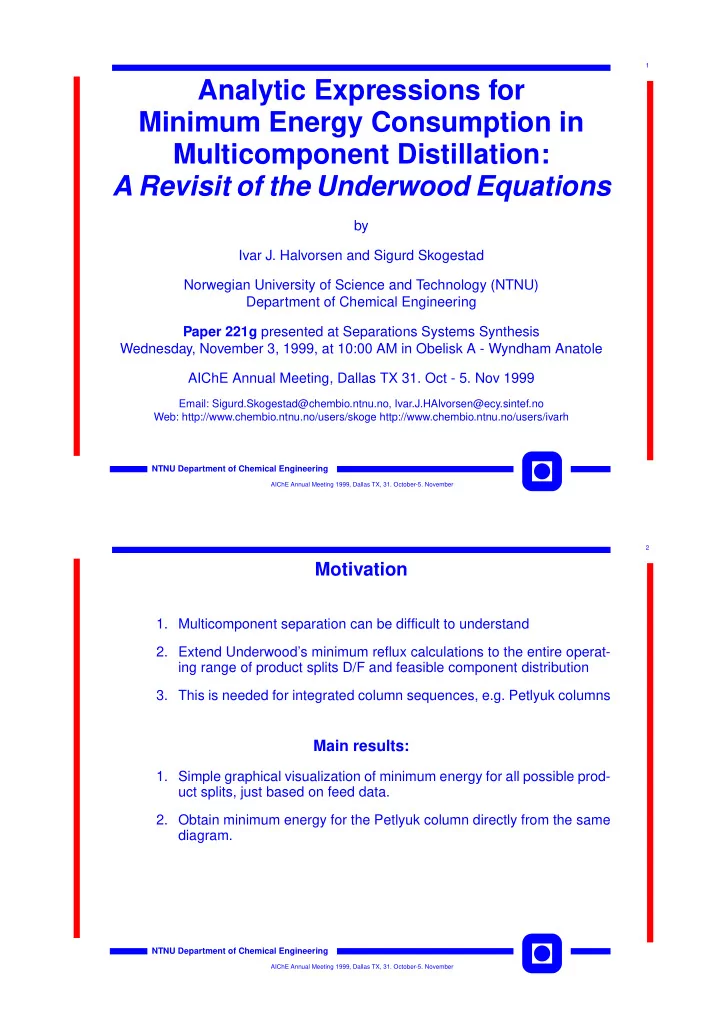
1 Analytic Expressions for Minimum Energy Consumption in Multicomponent Distillation: A Revisit of the Underwood Equations by Ivar J. Halvorsen and Sigurd Skogestad Norwegian University of Science and Technology (NTNU) Department of Chemical


slide-1
SLIDE 1

AIChE Annual Meeting 1999, Dallas TX, 31. October-5. November

NTNU Department of Chemical Engineering

1

Analytic Expressions for Minimum Energy Consumption in Multicomponent Distillation: A Revisit of the Underwood Equations

by Ivar J. Halvorsen and Sigurd Skogestad Norwegian University of Science and Technology (NTNU) Department of Chemical Engineering Paper 221g presented at Separations Systems Synthesis Wednesday, November 3, 1999, at 10:00 AM in Obelisk A - Wyndham Anatole AIChE Annual Meeting, Dallas TX 31. Oct - 5. Nov 1999

Email: Sigurd.Skogestad@chembio.ntnu.no, Ivar.J.HAlvorsen@ecy.sintef.no Web: http://www.chembio.ntnu.no/users/skoge http://www.chembio.ntnu.no/users/ivarh

AIChE Annual Meeting 1999, Dallas TX, 31. October-5. November

NTNU Department of Chemical Engineering

2

Motivation

  • 1. Multicomponent separation can be difficult to understand
  • 2. Extend Underwood’s minimum reflux calculations to the entire operat-

ing range of product splits D/F and feasible component distribution

  • 3. This is needed for integrated column sequences, e.g. Petlyuk columns

Main results:

  • 1. Simple graphical visualization of minimum energy for all possible prod-

uct splits, just based on feed data.

  • 2. Obtain minimum energy for the Petlyuk column directly from the same

diagram.

slide-2
SLIDE 2

AIChE Annual Meeting 1999, Dallas TX, 31. October-5. November

NTNU Department of Chemical Engineering

3

Result 1: Visualize Vmin=f(D,splits)

D B F, z, q xd,rd xb,rb V L Top section Bottom section A,B,C

D/F

ABC AB ABC A BC AB BC ABC ABC ABC C ABC

V/F

AIChE Annual Meeting 1999, Dallas TX, 31. October-5. November

NTNU Department of Chemical Engineering

4

Result 2: Find Vmin for the Petlyuk column directly from the diagram:

1 2 3 4 5 6

A B C ABC

Vmin

Petlyuk

D/F

BC A C AB

V/F

Vmin

AB/C

  • Vmin

A/BC

  • Vmin

Petlyuk

max Vmin

A/BC Vmin AB/C

, ( ) =

slide-3
SLIDE 3

AIChE Annual Meeting 1999, Dallas TX, 31. October-5. November

NTNU Department of Chemical Engineering

5

Selected references:

Classical references for multicomponent distillation

  • Underwood (1946, 1948a,b), Fractional distillation of multicomponent mixtures
  • Shiras (1950), Calculation of Minimum Reflux in Distillation Columns
  • Franklin, Forsyth (1953), The interpretation of minimum reflux conditions in mul-

ticomponent distillation Minimum energy expressions for Petlyuk arrangements

  • Fidkowski, Krolikowski (1986), Thermally Coupled Columns: Optimization proc.
  • Carlberg, Westerberg (1989) Temperature-Heat Diagrams for Complex Col-
  • umns. 3. Underwood’s Method for the Petlyuk Column.

Books:

  • King (1980), Separation Processes.
  • Stichlmair (1998), Distillation: Principles and Practice.

AIChE Annual Meeting 1999, Dallas TX, 31. October-5. November

NTNU Department of Chemical Engineering

6

Important: The two product distillation column has only two degrees of freedom (DOF)

  • Binary mixtures:

#DOFs == #components: ==> We may specify a product completely

  • Multicomponent:

#DOFs < #components ==> We cannot specify all components in a product, just two!

Nice Implication of just two DOFs:

  • Visualize the entire operating range in 2 dimensions.
  • We choose the D-V plane
slide-4
SLIDE 4

AIChE Annual Meeting 1999, Dallas TX, 31. October-5. November

NTNU Department of Chemical Engineering

7

Revisit of Underwood’s Equations

Starting points:

  • 1. Net transport of a component through a stage
  • 2. Vapour liquid equilibrium (VLE):

Ln+1 Ln Vn-1 Vn yi,n xi,n yi,n+1 xi,n+1 Stage n Stage n+1 wi (1)

(w is defined positive upwards)

wi is constant in a section: Assume:

  • constant molar flows
  • constant relative volatility

wi Vnyi n

,

L –

n 1 + xi n 1 + ,

= yi αixi αixi

i

  • =

AIChE Annual Meeting 1999, Dallas TX, 31. October-5. November

NTNU Department of Chemical Engineering

8

  • 3. Divide the material balance with V, multiply with the “Underwood” factor

, and take the sum over all components: (2)

  • 4. The solutions for

which sets the left-hand side equal to one defines the Underwood roots: Definition equation: , (3) (for the top section we can also use ) Note the relations: for the top section, and the bottom section: , where the recoveries and , and we trivially have

αi αi φ – ( ) ⁄ 1 V

  • αiwi

αi φ – ( )

  • i

αi

2xi n ,

αi φ – ( )

  • i

αixi n

, i

  • L

V

  • αixi n

1 + ,

αi φ – ( )

  • i

– = φ V αiwi αi φ – ( )

  • i

= VT αiri D

,

zi αi φ – ( )

  • F

i

αixi D

,

αi φ – ( )

  • D

i

= = wi wi T

,

wi D

,

Dxi D

,

ri D

,

ziF = = = = wi wi Botoom

,

wi B

,

B – ( )xi B

,

ri B

,

– ( )ziF = = = = ri D

,

Dxi D

,

Fzi

  • wi D

,

Fzi

  • =

= ri B

,

Bxi B

,

Fzi

  • w

i B ,

Fzi

  • =

= ri B

,

ri D

,

+ 1 =

slide-5
SLIDE 5

AIChE Annual Meeting 1999, Dallas TX, 31. October-5. November

NTNU Department of Chemical Engineering

9

  • 5. Simplify to:

where (4)

  • 6. Can derive by division of equations :

(compare to for binary) (5) Together with , we have now Nc equations in order to compute xn+m Underwood equations can be used to relate the composition on one stage to a composition on another stage in a multicomponent separation. Minimum energy computations:

L V

  • E xn

1 +

φ , ( ) φE xn φ , ( ) αixi n

, i

  • =

E xn φ , ( ) αixi n

,

αi φ – ( )

  • i

= E xn

m +

φk , ( ) E xn

m +

φ j , ( )

     φk φ j

     m E xn φ j , ( ) E xn φk , ( )

     = xD 1 xD –

  • αN

xB 1 xB –

  • =

xi n

m + , i

1 = m ∞ →

AIChE Annual Meeting 1999, Dallas TX, 31. October-5. November

NTNU Department of Chemical Engineering

10

Underwood equations for the two product column:

Definition of UW-roots in the top section: (6) Definition of UW-roots in the bottom section: (7) Note that and normally (8) For the roots obey: (9) Note the difference between the roots in the top ( ) and in the bottom ( )! F VT VB VT-VB=(1-q)F z,q

VT αiwi T

,

αi φ – ( )

  • i

= V B αiwi B

,

αi ψ – ( )

  • i

= wi B

,

wi D

,

wi F

,

– = wi F

,

ziF = wi D

,

> and wi B

,

< α1 φ1 α2 φ3 …… αNc φNc > > > > > > ψ1 α >

1

ψ2 α2 ψ3 …ψNc

1 –

αNc > > > > > φ ψ

slide-6
SLIDE 6

AIChE Annual Meeting 1999, Dallas TX, 31. October-5. November

NTNU Department of Chemical Engineering

11

Underwood roots in the top and bottom approach the common roots (ϕ) as vapour flow is reduced

Minimum energy: (Infinite energy: .) V αNc α3 α2 α1 φNc φ2 φ1 ψNc ψ3 ψ1 ψ2 ϕ1 ϕ2 ϕNc-1

... ...

< < < < < <

V Vmin → ⇔ φi ψi

1 +

ϕi → → V ∞ → φi αi and ψi αi → → ⇒

AIChE Annual Meeting 1999, Dallas TX, 31. October-5. November

NTNU Department of Chemical Engineering

12

Underwood’s minimum reflux result

Underwood roots in the top and bottom sections are defined by: and where (10) As the vapour flow is reduced, the roots in the top section decrease, and the roots in the bottom section increase. Minimum reflux occur when the roots coincide (11) Recall that VT-VB=(1-q)F where q is the liquid fraction in the feed. By subtracting equation from we obtain the well known Underwood’s “feed” equation: (12) Nc-1 common roots obey: Feed equation is only valid for the active common roots, but fortunately it can be solved once for all the Nc-1 potential common roots, and these depend only on the feed properties: . The actual active common roots depends on the operation.

VT αiwi T

,

αi φ – ( )

  • i

= V B αiwi B

,

αi ψ – ( )

  • i

= wi B

,

wi T

,

ziF – = Vmin φi ⇔ ψi

1 +

ϕi = = 1 q – ( ) αizi αi ϕ – ( )

  • i

= α1 ϕ1 α2 ϕ2 …ϕNc

1 –

αNc > > > > > α z q , ,

slide-7
SLIDE 7

AIChE Annual Meeting 1999, Dallas TX, 31. October-5. November

NTNU Department of Chemical Engineering

13

Underwood equations, examples of approach:

Binary example (Nc=2, components A,B):

There is one common root , easily solved from the feed eq.: We can specify both product rates in the top (wA,wB), thus:

Ternary example (Nc=3, components A,B and C):

There are two common roots ( ), easily solved from the feed eq.

  • TRAP: There are only 2 DOFs => We cannot specify all 3 of wA,wB and wC.

Example: We specify wA=0.9zAF , and wB=0.5zBF, what is Vmin and what is wC? When does apply, and when does apply, and do sometimes both apply?

KEY: Determine the non-distributing / distributing components!

ϕ 1 q – ( ) αAzA αA ϕ –

  • αBzB

αB ϕ –

  • +

= Vmin

T

αAwA αA ϕ –

  • αBwB

αB ϕ –

  • +

= αA ϕ1 αB ϕ2 α3 > > > > ϕ1 ϕ2

AIChE Annual Meeting 1999, Dallas TX, 31. October-5. November

NTNU Department of Chemical Engineering

14

Summary of Underwood’s Equations for Minimum Energy Calculations

VT αiwi T

,

αi φ – ( )

  • i

= V B αiwi B

,

αi ψ – ( )

  • i

= 1 q – ( ) αizi αi ϕ – ( )

  • i

=

Feed equation gives common “Vmin”-roots ϕ “Top section” “Bottom section” wi,B=wi,T-Fzi,F F ,z,q Top and bottom equations gives “real” - roots and

φ ψ

Underwood: When one or more pairs coincide, then , and V=Vmin How to compute: V=? D=? wi,T=? KEY: DISTRIBUTION

φi ψi

1 +

, φi ψi

1 +

ϕi = =

wi,T wi,F=Fzi,F wi,B VT-VB=(1-q)F

slide-8
SLIDE 8

AIChE Annual Meeting 1999, Dallas TX, 31. October-5. November

NTNU Department of Chemical Engineering

15

How to use Underwood’s minimum energy results:

  • 1. Compute all the common roots from the feed

equation:

  • 2. Determine the total set (ND) of the distributed components

(including components at the limit of being distributed) There will be NA=ND-1 active Underwood roots that correspond to these distributed components.

  • 3. Apply the set of definition equations (in the top or in

the bottom) corresponding to each active root. This gives NA equations and NA unknowns when we specify 2 DOFs. (The non-distributed compo- nents have recoveries of either 1 or 0)

1 q – ( ) aizi ai ϕ – ( )

  • i

= Vmin

T

airi D

,

zi ai ϕa1 – ( )

  • i

1 = Nc

=

  • Vmin

T

airi D

,

zi ai ϕaNa – ( )

  • i

1 = Nc

=

AIChE Annual Meeting 1999, Dallas TX, 31. October-5. November

NTNU Department of Chemical Engineering

16

Visualisation of minimum energy and component distri- bution for the ternary example (feed components ABC)

1

VT/F

D/F

1-q PAC PAB PBC

ABC

D=V-L V L ABC AB ABC A BC A BC AB C ABC C AB BC ABC ABC ABC “The preferred Sharp A/BC split Sharp AB/C split split” ϕ1 ϕ2 ϕ1,ϕ2 αΑ>ϕ1>αΒ>ϕ2>αC V>Vmin above the “mountains” V=Vmin in the “mountain-sides” and below Note: Vmin=f(spec.) Active roots

slide-9
SLIDE 9

AIChE Annual Meeting 1999, Dallas TX, 31. October-5. November

NTNU Department of Chemical Engineering

17

Visualization of the operation in the D-V plane

  • Any feasible point in the 2-dimensional plane spanned by 2 independent

DOFs (here D,V) determines the operation completely.

  • In every polygon region, a particular set of components distribute.
  • The “active Underwood roots” are always adjacent, and are in the set laying

between the volatilities of the distributed components. Thus each polygon region corresponds to a set of active Underwood roots.

  • On the straight line boundaries between the polygon regions, one particular

component is at the limit of being distributed to both products.

  • The “mountain” tops: Sharp splits between adjacent key components

(neighbours i relative volatility)

  • Minimum points: “Preferred split”, or optimal distribution of intermediate

components.

AIChE Annual Meeting 1999, Dallas TX, 31. October-5. November

NTNU Department of Chemical Engineering

18

Ternary Example: Specification of 95% recovery of light and heavy components in the products

0.2 0.4 0.6 0.8 1 0.5 1 1.5 Distillate flow D/F Vapour flow V/F Feed: α = [4 2 1] z = [0.33 0.33 0.33] q = 1.0 At the solution: Vmin = 0.70 D = 0.45 RD = [0.95 0.35 0.05] rA,D=0.95 rC,B=0.95 Solution point distribution boundaries

slide-10
SLIDE 10

AIChE Annual Meeting 1999, Dallas TX, 31. October-5. November

NTNU Department of Chemical Engineering

19

5-Component example:

All computations are generalized and is valid for any number of components.

1

V

D

A B C E AB BC CD DE ABC BCD CDE ABCD BCDE ABCDE

Pij marks Vmin for sharp split of keys i, j. V>Vmin all above the “mountains”

1-q PAE PAD PAC PBD PCE PBE PAB PBC PCD PDE B

ABCDE

D V L D DISTRIBUTING COMPONENTS

AIChE Annual Meeting 1999, Dallas TX, 31. October-5. November

NTNU Department of Chemical Engineering

20

Ternary example: Composition Profile Behaviour

Top Feed Bottom 0.2 0.4 0.6 0.8 1 Preferred split Composition profile Top Feed Bottom 0.2 0.4 0.6 0.8 1 Sharp A/BC split Composition profile Top Feed Bottom 0.2 0.4 0.6 0.8 1 Sharp A/BC split Top Feed Bottom 0.2 0.4 0.6 0.8 1 Sharp A/C to the right of preferred split A B C

slide-11
SLIDE 11

AIChE Annual Meeting 1999, Dallas TX, 31. October-5. November

NTNU Department of Chemical Engineering

21

Example of computation: Procedure for sharp split between adjacent components (the mountain tops):

Key components j and j+1 ( and ). The procedure is then simply:

  • 1. Compute the common root (

) for which from the feed equation:

  • 2. Compute the minimum energy by applying the definition equation for

. . Note that the recoveries

r j D

,

1 = r j

1 + D ,

= ϕ j α j ϕ j α j

1 +

> > 1 q – ( ) aizi ai ϕ – ( )

  • i

=

ϕ j

Vmin

T

F

  • aizi

ai ϕ j – ( )

  • i

1 = j

= ri D

,

1 for i j ≤ for i j >    =

AIChE Annual Meeting 1999, Dallas TX, 31. October-5. November

NTNU Department of Chemical Engineering

22

Example of computation: Procedure for the “preferred split”, i.e. when all components distribute:

  • 1. Compute all the Nc-1 common roots ( )from the feed equation.
  • 2. Set

and solve the following linear equation set ( equations) with respect to ( variables): (13)

ϕ r1 D

,

1 and rNc D

,

= = Nc 1 – VT r2 D

,

r3 D

,

…rNc

1 –

, , Nc 1 – VT airi D

,

zi ai ϕ1 – ( )

  • i

1 = Nc

=

  • VT

airi D

,

zi ai ϕNc

1 –

– ( )

  • i

1 = Nc

=

slide-12
SLIDE 12

AIChE Annual Meeting 1999, Dallas TX, 31. October-5. November

NTNU Department of Chemical Engineering

23

Simple Matlab™ function prototypes

[ϕ] =UWroots(α,z,q) Compute the common roots from the feed equation [Vs,Ds,Rs]=UWmulti(α,z,q) Compute all the polygon points in the D-V plane [V,D,R]=UWrspec(α,z,q,ri,rj) Compute an operation point from specification the recoveries (r) of keys i,j [V,D,R]=UWxspec(α,z,q,xi,xj) Compute an operation point from specification the product composition (x) of keys i,j [R] =UWvdspec(α,z,q,V,D)Compute all recoveries R as function of V and D V: Normalized top section vapour flow (F=1) D: Normalized distillate product flow (F=1) R: All component recoveries R=[r1,r2,r3,....rNc] (in the distillate product) α: Relative volatilities α=[α1,α2,α3,....αNc] z : Feed composition z=[z1,z2,z3,....zNc] q : Feed liquid fraction Note that the distillate flow D=FRzT, and the top composition xi,D=rizi/(D/F)

AIChE Annual Meeting 1999, Dallas TX, 31. October-5. November

NTNU Department of Chemical Engineering

24

PART 2: Underwood equations for fully thermally coupled columns:

Recall that we only use the net material flow w the definition of the Underwood roots, thus the equations can also be applied for fully thermally coupled sections1:

  • 1. In this case we cannot ensure that the net material flow from the feed to the top always is positive. We may have situations with “reverse” transport
  • f some components. This may lead to some special treatment of the equations, but Underwood’s equations are still useful as they are based on the true

material balance.

Ordinary 2-product Or for structures like these: condenser reboiler 3 4 1 2 5 6 3 4 1 2 5 6 PETLYUK Modified

slide-13
SLIDE 13

AIChE Annual Meeting 1999, Dallas TX, 31. October-5. November

NTNU Department of Chemical Engineering

25

Application to Petlyuk Arrangements

=>The “feed” equation for column (34) equals the “top” equation for column (12) thus the roots =>The “feed” equation for column (56) equals the “bottom” equation for column (12) thus the roots Assume operation at the “Preferred split” for the prefractionator.

  • Then all roots of the feed-equation in (12) are also roots
  • f the top and bottom equations of (12)
  • Then all roots also carry over as the minimum energy

roots for column (34) and (56)

VS3 VS4 – VS1 = ϕi

S34

φi

S1

= VS6 VS5 – VS2 = ϕi

S56

ψi

S2

= ϕi

S12

φi

S1

ψi

1 + S2

= =

1 2 3 4 5 6

AIChE Annual Meeting 1999, Dallas TX, 31. October-5. November

NTNU Department of Chemical Engineering

26

Illustration of how Underwood roots carry over to the next column through the full thermal coupling

VS3 αiwi S3

,

αi φS3 – ( )

  • i

= VS4 αi wi S3

,

wi S1

,

– ( ) αi ψS4 – ( )

  • i

= VS1 αiwi S1

,

αi ϕS34 – ( )

  • i

=

Identical equations =>

  • r “

“=

ϕS34 φS1 = 1 qS34 – ( ) VS1

“Feed equation” “Top equation” “Top equation” Real Feed equation

VS1 αiwi S1

,

αi φS1 – ( )

  • i

=

“Bottom equation” VS1=VS3-VS4

1 q – αizi αi ϕ – ( )

  • i

=

wi,S1=wi,S3-wi,S4 LS1=LS3-LS4 S1 S3 S4 S2 F q z

slide-14
SLIDE 14

AIChE Annual Meeting 1999, Dallas TX, 31. October-5. November

NTNU Department of Chemical Engineering

27

Minimum vapour flow in the upper part of the main column (34):

Prefractionator at its preferred split implies: All roots “carry over” to the main column: (14) Example: Normalized ternary feed (F=1, ). Pure top product implies: . This is a sharp A/BC split and a point PAB in a DV-plane for column (34). Identical UW-roots implies identical Vmin-expression as at PAB the DV-plane for the prefractionator column (12). At PAB is the only active root (omit superscript ): which is identical to for prefractionator! (15)

Vmin

S3

αiwi

S3

αi ϕS34 –

  • i

αiwi

S3

αi ϕS12 –

  • i

= = α α1 α2 1 , , [ ] = w1

S3

z1 and w2

S3

, w2

S3

= = = ϕ1

S12

ϕS12 ϕ = Vmin

S3

α1z1 α1 ϕ1 –

  • =

Vmin

A/BC

AIChE Annual Meeting 1999, Dallas TX, 31. October-5. November

NTNU Department of Chemical Engineering

28

Minimum energy for the Petlyuk column, sharp product splits:

(16) There are several degrees of freedom in operation, but it can be shown (e.g. Fid- kowski (1986)) that when the prefractionator is operated at the preferred split, the

  • ptimum can be expressed as1:

, (note that ) (17) Similarly as for , we find: = for prefractionator! (18)

For our ternary example, and sharp product splits we obtain:

(19) This result is identical to the minimum reflux result of Fidkowski (1986).(for q=1)

  • 1. The optimum is really flat for operation in a region on one side of the preferred split, always including the preferred split point, but let us skip that here.

Vmin

Petlyuk

min VS6 ( ) subject to product purity specifications , = Vmin

Petlyuk

max Vmin

S3

1 q – ( ) Vmin

S6

, – ( ) = VS6 VS3 1 q – ( ) – = Vmin

S3

Vmin

S6

α3z3 α3 ϕ2 –

  • =

Vmin

AB/C

Vmin

Petlyuk

max α1z1 α1 ϕ1 –

  • 1

q – ( ) α3z3 α3 ϕ2 –

  • ,

–       =

slide-15
SLIDE 15

AIChE Annual Meeting 1999, Dallas TX, 31. October-5. November

NTNU Department of Chemical Engineering

29

Non-sharp product splits:

With our approach we can very easily put up the expression for non-sharp prod- ucts too. Assume we specify small amounts of the intermediate component 2 in both top and bottom, and that the recoveries of light and heavy keys in the top and bottom in slightly less than one. (Then the side-stream i also defined). We can assume that the same UW-roots will apply since we are not far from the sharp split points, and the result can be written directly from our knowledge of the definition equations for the Underwood roots for sections 3 and 6: (20) The expression is exact for Note, if => , and may be infeasible!1

  • 1. This example shows that some product specifications are infeasible to combine with minimum energy operation.

Vmin

Petlyuk

max α1r1

S3z1

α1 ϕ1 –

  • α2r2

S3z2

α2 ϕ1 –

  • 1

q – ( ) r3

S6z3

1 ϕ2 –

  • α2r2

S6z2

α2 ϕ2 –

  • +

, – +       = r1

S3

1 r2

S3

0 and r3

S6

1 r2

S6

≈ , ≈ ≈ , ≈ Vmin

Petlyuk

Vmin

S6

= VS3 Vmin

S3

> r1

S3

1 <

AIChE Annual Meeting 1999, Dallas TX, 31. October-5. November

NTNU Department of Chemical Engineering

30

Super-simple procedure for the minimum energy require- ment for 3 product Petlyuk Column

  • 1. Compute the Minimum energy “mountains” for the feed to the

prefractionator

  • 2. Compute the energy requirement to produce the Petlyuk top product

specification in a single column, and plot it into the diagram ( )

  • 3. Compute the energy requirement to produce the Petlyuk bottom prod-

uct specification in a single column and plot it into the diagram ( )

  • 4. The minimum energy requirement for the Petlyuk column is simply the

maximum value of 2 and 3 (adjusted for 1-q):

  • 5. This also gives us information of the extent of the flat region. If the dif-

ference is large, there is a large flat region. This procedure also holds for non-sharp splits, and even for any multicomponent feed mixture (Nc>3).

Vmin

A/BC

Vmin

AB/C

Vmin

Petlyuk

max Vmin

A/BC Vmin AB/C

, ( ) =

slide-16
SLIDE 16

AIChE Annual Meeting 1999, Dallas TX, 31. October-5. November

NTNU Department of Chemical Engineering

31

Example: Application to a 3 product Petlyuk Column:

0.2 0.4 0.6 0.8 1 0.2 0.4 0.6 0.8 1 1.2 1.4 1.6 1.8 2 Prefractionator Distillate flow DS1/F Vapour flow V/F Feed: α = [4 2 1] z = [0.33 0.33 0.33] q = 1.0 Vmin

Petlyuk =1.37

Vmin

Conventional=2.03

Petlyuk savings = 33% Vmin

Petlyuk=max(Vmin A/BC,Vmin AB/C)

Vmin

A/BC

Vmin

AB/C

Dbal Dpref Vmin

Petlyuk(DS1)

Sharp A/BC split Sharp AB/C split Preferred split (sharp A/C) Vmin

S3 =f(DS3) for DS1=Dbal

distribution boundaries

AIChE Annual Meeting 1999, Dallas TX, 31. October-5. November

NTNU Department of Chemical Engineering

32

Example: application to 3-product Petlyuk arrangement with 5-component feed

We want pure A+B in the top, and pure C+D in the side and pure E in the bottom Solution: Operate the prefractionator between PBal and PBE The energy requirement to the Petlyuk column is found as max(PBC,PDE)=PBC

1 V

D

A B C D E AB BC CD DE ABC BCD CDE ABCD BCDE ABCDE PAE PAD PAC PBD PCE PBE PAB PBC PCD PDE PBal

E ABCD E AB CD CDE AB Max = Minimum energy:

slide-17
SLIDE 17

AIChE Annual Meeting 1999, Dallas TX, 31. October-5. November

NTNU Department of Chemical Engineering

33

Conclusions

  • Underwood’s equations are very useful for minimum energy calculations
  • Results can be visualized in the D-V plane as a set of

informative “mountain” regions.

  • Underwood roots can “carry” over to the next column.
  • Determine minimum energy requirements for Petlyuk column with a quick

glance at the D-V plane plots. V D C AB C A B CB A Max = Here! V D ==>