
SLIDE 1
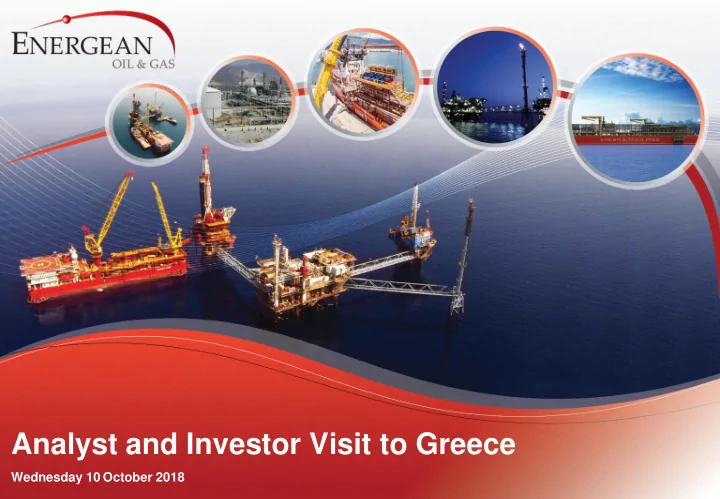
Analyst and Investor Visit to Greece
Wednesday 10 October 2018
Analyst and Investor Visit to Greece Wednesday 10 October 2018 - - PowerPoint PPT Presentation
Analyst and Investor Visit to Greece Wednesday 10 October 2018 Disclaimer This presentation may contain forward-looking statements and information that both represents managements current expectations and beliefs and are subject to the usual
Wednesday 10 October 2018
2
This presentation may contain forward-looking statements and information that both represents management’s current expectations and beliefs and are subject to the usual risk factors and uncertainties associated with the oil and gas exploration and production business and with any statement about the future. Whilst Energean believes that such expectations and beliefs are reasonable in the light of the information available at this time, the actual outcomes may be materially different from the said statements, owing to factors beyond Energean’s knowledge or control (or within Energean’s control where, for example, the Company decides on a change in strategy). Energean undertakes no obligation whatsoever to revise any such forward looking statements to reflect any changes (in expectations, beliefs, circumstances, events, the Group’s plans or strategy or otherwise). Accordingly, no reliance may be placed on such forward looking statements or any figures therein.
3
Senior Management Executive Committee
Mathios Rigas Chief Executive Officer
private equity experience mainly in the oil & gas sector Panos Benos Chief Financial Officer
& gas experience both in banking & industry
Chief Growth Officer
Mubadala
Mubadala Iman Hill Chief Operating Officer
BG Group and Shell Matt Brown HSE
chemicals
Vassilis Tsetoglou HSE Manager, Greece & The Adriatic
environments. Fred Riddiford Reservoir Engineering Manager
David Donaldson Managing Director Prinos Asset
Halliburton Vassilis Zenios Project Execution Manager
heavy lift installation.
Dennis Anestoudis Exploration Manager
Costas Ioannidis Kavala Oil Installation Manager
effective operations, maintenance and security of the facilities
3
Kate Sloan
Head of Investor Relations
Dimitris Gontikas Country Manager - Greece
in the private and public sectors
4
2018 Total Man-hours (as of 30/09/18): 873,865 Implementation of the Offshore Safety Directive Participation in the EU Emissions Trading System Participation in EU Blue Growth Policy through Horizon 2020 program Compliance with National legislation and European Directives OSRL membership for the provision oil spill response services Annual health program: zero occupational diseases Annual training & competency program for all employees Certified training courses Waste management through licensed companies Regular safety & environmental drills Fatality Lost Time Injuries Rest workday cases Medical cases First Aid cases Near Misses
4
5
Quarterly production growth Recent progress and work programme
replacement of Prinos infill drilling with Epsilon Extended Reach
guidance $17-19 /bbl
expected 2H 2018
production late 2019
wells, recompletions and workovers and Epsilon Extended Reach Well
Prinos Location
27,500 bopd capacity
Platforms Delta Processing Owned Rig
5
Prinos Existing Infrastructure
0.0 0.5 1.0 1.5 2.0 2.5 3.0 3.5 4.0 4.5 5.0 1Q 2017 2Q 2017 3Q 2017 4Q 2017 1Q 2018 2Q 2018 3Q to date
kboed 3Q 2018
6
6
7
7
Source: Company, NSAI CPR.
Prinos and Katakolo Production Profile
bopd Production Estimates December 2007
for $1.5 mn (plus acquired indebtedness) – Prinos license relatively close to expiry March 2013
extension of Prinos licenses 2008 - 2013
restructuring and drilling of appraisal wells May - July 2013
Third Point
drilling campaigns
Life of Field Prinos Production Profile
Prinos before Energean ownership
brought on stream in 1981 by NAPC
departure of NAPC in 1999 bopd 10,000 20,000 30,000 1981 1991 2001 2011 2021 2031 Prinos Prinos North Epsilon 3,000 6,000 9,000 12,000 15,000 2000 2003 2006 2009 2012 2015 2018 2021 2024
Prinos Prinos North Epsilon Katakolo
> 10,000 bopd by 2021
Prinos before Energean ownership
brought on stream in 1981 by NAPC
departure of NAPC in 1999
8
8
profits resulting from its contractual operations
Operator, provided that the purpose of funds granted is exclusively the financing of petroleum operations
Fiscal Terms
Total Royalties Average Daily Production 0% Up to 2,500 bbls 3% From 2,501 to 5,000 bbls 6% From 5,001 to 10,000 bbls 10% > 10,001 bbls Field Development License Expiration Date Extensions Available Prinos Dec-24 2 at 5 years each Epsilon Jun-29 2 at 5 years each Prinos North Dec-24 2 at 5 years each South Kavala Nov-17 Nov-18
License expiration dates and possible extensions
Historical Prinos infrastructure and wells (pre-existing to the 1999 lease agreement):
responsibility of the Greek state.
is liable only for decommissioning any additional wells and any infrastructure it adds in the area.
Post Signature(1999):
State is responsible for the remaining 50%.
Abandonment Liabilities
9
9
BP Offtake Agreement
Notes: Notes (1) Calculated as avg. monthly dated Brent plus the Urals differential to Brent for that period, for the month of lifting or the month prior to the month of lifting at BP’s option. (2) API escalator of Average dated Brent for month M/150*(API-29.5) where API is up to a maximum of 33.
10
10
12 31 21 22 23
Production Facilities (Lamda Platform) and three production wells
price
Key EPCIC Terms Key Financing Terms
11
11 26.8 26.3 8.0 16.7 16.0 16.9 20 40 60 80 H1 2017 H1 2018
Revenue (US$mn) Adjusted EBITDAX (US$mn) Operating Cashflow (US$mn)
6.1 7.1 3.1 2.6 1.0 1.1 0.8 1.1 1.1 1.3 12.1 13.2 10 20 H1 2017 H1 2018
Total Other Machinery Repairs and Maintenance Consumptions Electricity and Fuel
Cost of Production Breakdown (US$mn) Revenue, EBITDAx and OCF (US$mn)
26.2 19.2 12.0 13.2 20 40 $/boe
Production Costs ($/boe) Production Costs ($MM) Production (boepd) 2.534
H1 2017 H1 2018
3.801
20 40
US$mn
Efficient and Cost Conscious Operator
10.8 11.6 12.6 5.7 6.0 5.8
1.7 2.2 1.7 1.4 2.0 2.5
2.1 2.4 2.7 21.7 24.3 25.3 10 20 30 2015 2016 2017 28.4 39.7 57.8
16.2 20.7
29.1
10 30 50 2015 2016 2017 15.2 41.0 19.1 24.7 22.0 24.3 25.3 20 40 60 80
$/boe
US$mn
2015 2017 2016 80 40 20 60
1,459 2,803 3,490 569.134 417.566 Barrels sold (bbls)
12
rotation and basement exhumation tectonics, on the North Aegean during Miocene-Pleistocene.
narrow NE-SW trending Prinos Basin (30km long and 15km wide), that rapidly filled with >5km of sediments.
Evaporitic (Miocene), the Evaporitic (Messinian) and the Post- Evaporitic Sequences (Plio-Pleistocene).
12
13
Production Figures 3Q18:
4080 bopd
10500 bwpd
17500 bwpd
11000 Nm3/hr Derrick & Drill floor
ALPHA BETA ENERGEAN FORCE Flare DELTA
Produced Water Treatment
How it Works
declines
pressure
Sea Water Injection
Energean Valiant Energean Wave
13
14
14
10.Steam Generation & Distribution
Located on the edge of a nature reserve, Energean’s neighbors are fish farms, agriculture wild life & the sea
Sigma is self sufficient:
15
Source: Daily Drilling Report ( DDR)
Rig Availability
75.00 80.00 85.00 90.00 95.00 100.00 Rig Availability % Productive time %
15 Month January February March April May June July August September Operating Hours Per Month 744 672 744 720 744 720 744 744 720 Operating Hours - As per program 672 648 733 631 720 697 559 703 675 Non rig related NPT (Hours) 48 12 10 86 23 22 185 40 40 Rig Equipment Related NPT (Hours) 24 12 2 4 2 2
6 GPA / Incident / Planned Maint/WOW
126 180 241
96.77% 98.21% 99.73% 99.51% 99.80% 99.72% 100.00% 99.80% 99.17% Productive time % 90.36% 96.39% 98.45% 87.64% 96.74% 96.74% 75.13% 94.42% 93.68%
16
Eastern Saddle 16
17
Energean 100% working interest 18.4 mmbbls 2P reserves Expected production > 5,000 bopd in 2020 Three vertical wells tied to Lamda platform &
First Oil accelerated through decision to drill extended reach well: expected onstream December 2018 First Oil from three vertical wells expected in 4Q 2019 Funded by Prinos Cash Flows & RBL Facility (L+3%)
17
18
1
Epsilon field
Development Concept and Design
from Prinos Delta
Energean Tendor Assist Drilling Rig, Workover Rig or Jack up rig. Project Execution
ERW from Prinos A platform
drilling of 3 initial vertical wells by Jack up Rig
pipelines umbilicals): Q3 2019
installed 2H 2019
reserves Project Development Cost: c.$155m
18
19
19
drills 3 wells
fabricated at GSP shipyard
frame installed
piles
final commissioning 80% complete by YE’18 40% complete by YE’18 On Track First oil from vertical wells 2H19
EWR to accelerate production First Oil – December ‘18
1 2 3 4 5 6
20
20
GSP BASE FABRICATION FACILITY (PREVIOUS SIMILAR PROJECT) , AGINA, CONSTANZA ROMANIA 500 NM TRANSPORT FROM CONSTANZA TO PRINOS FIELD
21
Prinos & South Kavala Blocks:
Discoveries etc.)
resources):
Ranking
21
22
39%
through further development of the Prinos Field
Surfactants
EOR scheme significantly reduces Opex
22
23
Calfrac Licenses (Ownership - Hellenic Petroleum 25%, Calfrac 75%)
23
24
Kappa Platform Sigma site To be connected with a 32 km pipeline
field producing since 1981 (89 % RF; 52 m water depth; GIIP 0.96*109 m3 )
network.
Ideal candidate for UGS Field Key Facts
Development Fund (HRADF) is tendering for an external consultant to provide financial advisory services in relation to underground facilities in South Kavala.
permits and licenses in the area, has already completed the update the technical and economic model (gas market), in order to continue operate the field in the future. Current Status
24
25
first pilot hole to be converted to an injection well shortly after FID
assessment to be submitted in 4Q18
be decided in 2019
Katakolo overview
12
25
26
$49.9 million cap
Western Greece JV with Repsol Montenegro Key Highlights
+ training Four year optional second exploration period: – 1 exploration well of not less than 2,800 m ENI operates 4 blocks to the south, work programme commences 2019, which Energean believes includes one well
Source: Company
13
26
27
Transfer 37 years experience of working safely in environmentally sensitive locations in NE Greece to every area we
Safety of Offshore Oil & Gas Operations Directive
Gulf of Kavala: Over 10 Blue Flags Every Year for the Last 10 Years Energean’s HSE Mission Thasos: Traditional tourist destination in the Aegean
27
28
Oil & Gas Technology
28
29
Support the 4th Olympia Marathon & the Association of Paraplegics in the Ileia Prefecture, Western Greece Donate difibillators to municipalities of the Ioannina Prefecture, Western Greece Support Petrochem Day, organized by students
National Technical University of Athens Energean Kavala BC Kavala, Donation for the replacement of tires for the only crane vehicle of the Fire Service department of Eastern Macedonia OUR VISION: The company’s objective is to generate sustainable growth. We are therefore committed to conducting
business responsibly, which means safeguarding the health and safety of our employees, caring for our environment, supporting the local communities in which we operate, meeting their expectations and needs and contributing to the sustainable development
those communities. Honour World Environment Day by cleaning with Energean’s divers the seabed of the main port of Kavala 29
30
High operational leverage (UOC goes down as production grows)
Very good fiscal term
Energean’s operating capabilities
has been exploited
control
>10,000 bopd by 2021
30
31
31
32
32
33
33
Asphaltene Precipitation is the major flow assurance challenge in Prinos
Continuous injection Asphaltene Inhibitor
Treatment There are 3 methods to treat Asphaltene related flow assurance
Asphaltene A complex tar like substance within the produced fluid.
Key Factors
(ADE)
as pressure decreases from the upper onset pressure to the saturation pressure of the oil.
Xylene treatments pumped into well
34
FBHP maintained above the Asphaltene Onset Pressure (AOP) and bubble point: – AOP measurements/ Phase Behaviour P&T per reservoir – Pressures and temperatures closely monitored. – Stabilize the decline in the reservoir pressures via water injection. Surveillance Data: – Surface samples periodically acquired for ADT testing. – Wells completion with deep chemical injection lines. Continuous injection of asphaltene inhibitor keeping the tubing’s free of restrictions. – Optimization of Asphaltene inhibitor dosages through frequent ADT testing. – Daily monitoring of well test data (THP, THT flow rates,
GL rate) to understand promptly sudden changes related to blockages. – Daily measurement
salinities and water cut incremental Perform flowing gradient surveys (P&T): – Estimate accurate FBHP’s – Tune the VLP correlation
34