
SLIDE 1
50-1 AN UPDATE ON THE DEVELOPMENT OF TIF MULCHING FILMS Methyl Bromide Alternatives Outreach Conference November 10 – 13, San Diego, California Edgard Chow Technical Manager – Latin America Kuraray America, Inc., EVAL Business Unit We initially introduced TIF™ or “totally impermeable film” technology, based on the use
- f high barrier EVAL™ ethylene vinyl alcohol copolymer (EVOH), at MBAO in 2007.
TIF offers both extremely low fumigant vapor permeation and excellent film handling properties suitable for tractor application in narrow row mulch or wide broadcast
- fumigation. An early, yet-unpublished, highlight of the research conducted by Dr.
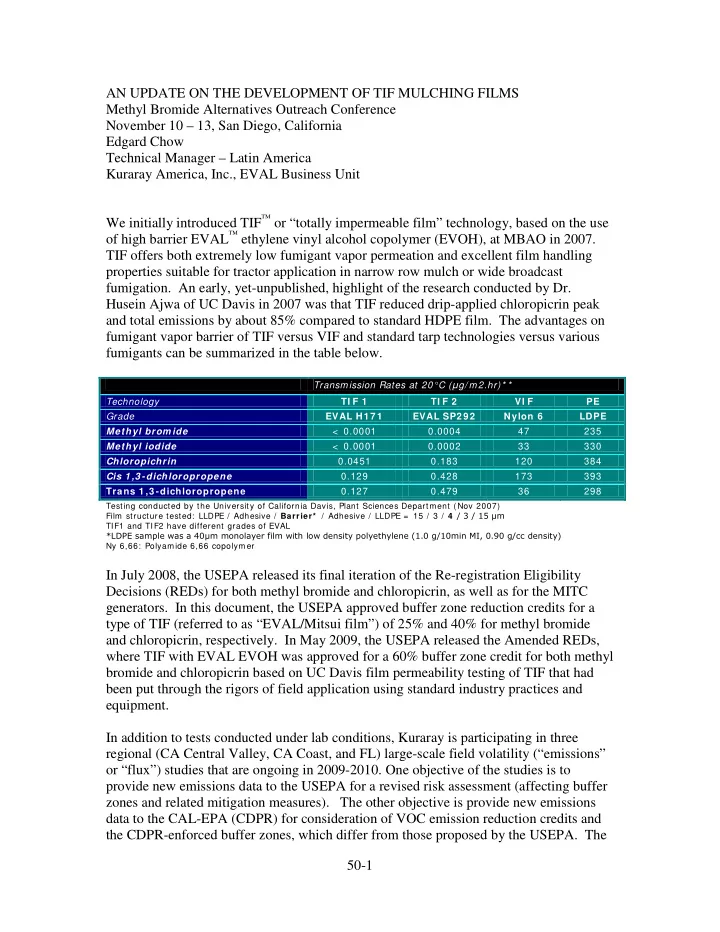
Husein Ajwa of UC Davis in 2007 was that TIF reduced drip-applied chloropicrin peak and total emissions by about 85% compared to standard HDPE film. The advantages on fumigant vapor barrier of TIF versus VIF and standard tarp technologies versus various fumigants can be summarized in the table below.
Transmission Rates at 20°C (μg/ m2.hr)* * Technology TI F 1 TI F 2 VI F PE Grade EVAL H17 1 EVAL SP2 92 Nylon 6 LDPE Methyl brom ide < 0.0001 0.0004 47 235 Methyl iodide < 0.0001 0.0002 33 330 Chloropichrin 0.0451 0.183 120 384 Cis 1 ,3 -dichloropropene 0.129 0.428 173 393 Trans 1 ,3 -dichloropropene 0.127 0.479 36 298
Testing conducted by the University of California Davis, Plant Sciences Department (Nov 2007) Film structure tested: LLDPE / Adhesive / Barrier* / Adhesive / LLDPE = 15 / 3 / 4 / 3 / 15 μm TIF1 and TIF2 have different grades of EVAL *LDPE sample was a 40μm monolayer film with low density polyethylene (1.0 g/10min MI, 0.90 g/cc density) Ny 6,66: Polyam ide 6,66 copolym er
In July 2008, the USEPA released its final iteration of the Re-registration Eligibility Decisions (REDs) for both methyl bromide and chloropicrin, as well as for the MITC
- generators. In this document, the USEPA approved buffer zone reduction credits for a
type of TIF (referred to as “EVAL/Mitsui film”) of 25% and 40% for methyl bromide and chloropicrin, respectively. In May 2009, the USEPA released the Amended REDs, where TIF with EVAL EVOH was approved for a 60% buffer zone credit for both methyl bromide and chloropicrin based on UC Davis film permeability testing of TIF that had been put through the rigors of field application using standard industry practices and equipment. In addition to tests conducted under lab conditions, Kuraray is participating in three regional (CA Central Valley, CA Coast, and FL) large-scale field volatility (“emissions”
- r “flux”) studies that are ongoing in 2009-2010. One objective of the studies is to