
SLIDE 1
Strengthening Disaster Risk Reduction across the Americas
A Regional Summit on the Contribution of Earth Observations Angelica Gutierrez/USA September 4, 2017
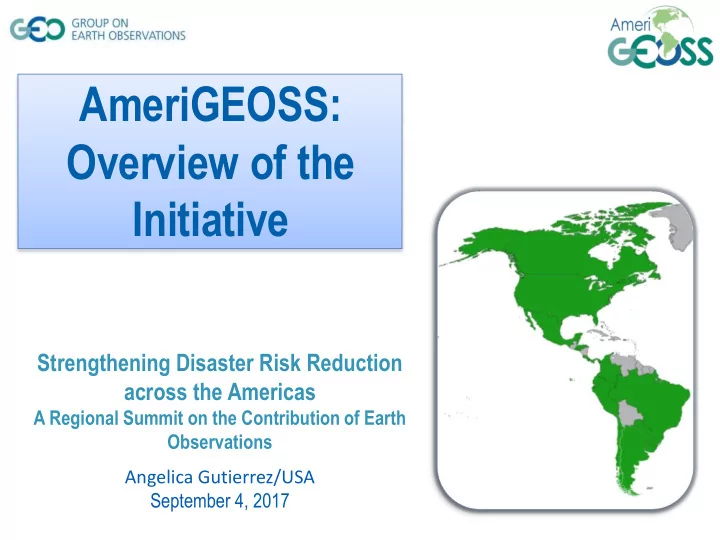
AmeriGEOSS: Overview of the Initiative Strengthening Disaster Risk - - PowerPoint PPT Presentation
AmeriGEOSS: Overview of the Initiative Strengthening Disaster Risk Reduction across the Americas A Regional Summit on the Contribution of Earth Observations Angelica Gutierrez/USA September 4, 2017 AmeriGEOSS Initiative Born in October
Strengthening Disaster Risk Reduction across the Americas
A Regional Summit on the Contribution of Earth Observations Angelica Gutierrez/USA September 4, 2017
Born in October 2014, launched in November 2015
Is a cooperative effort that: Reflects local, national, and regional interests of the GEO country- members for short and long-term planning, development, and implementation aligned with GEO activities. Is enabled by the institutional and technical capabilities of its country members and the resources of other global initiatives available for the benefit of the region. Seeks to increase institutional and personal capacity and engage experts, stakeholders, and decision makers in the process of decision making.
– Argentina – Bahamas – Belize – Brazil – Canada – Chile – Colombia – Costa Rica – Ecuador – Honduras – Mexico – Panama – Paraguay – Peru – United States – Uruguay
– Bolivia and Guatemala
Priority Areas
climate variability, climate change, and food security.
associated with early warnings, and for the generation of regional products
Associated with the management approach of water resources and data management and services.
building for better monitoring, management, and maintenance
ecosystems and biodiversity they support; and to predict future changes.
building.
5
Para la gestión de manejo de la Iniciativa se han creado grupos temáticos
trabajo de coordinación que proporcionan el marco de coordinación para asegurar el éxito de esta iniciativa durante la próxima década.
America’s Caucus – GEO Principals AmeriGEOSS Coordination Working Group (CWG) Agriculture and food security WG Disaster risk reduction WG Water resources WG Ecosystems and Biodiversity WG Foundational Activities WG
Disaster Resilience Working Group Activities
Risk Reduction as a first priority of understanding disaster risks, including floods, landslides, earthquakes, tsunamis, and volcanoes.
assessment.
regional risks, e.g. the Geohazard Supersites and Natural Laboratories (GSNL) and GEO Data Access for Risk Management (GEO-DARMA) initiatives.
Foundational Activities Working Group Activities Objective: To coordinate and leverage existing and planned national, regional, and international activities to address data access and sharing, interoperability, infrastructure and capacity building needs in the Americas. Activities: – Increased use of GEONETCast-Americas. – Development and launch of the AmeriGEOSS Community Platform. – Build capacity in coordination with GEO and CEOS Working Group for Capacity Building and Data Democracy (WGCapD), and through Community of Hydrologic and Spatial Information for Latin America and the Caribbean (CIEHLYC). – NASA contribution through ARSET and DEVELOP capacity building programs
Foundational Activities Working Group Activities Meetings with participation of AmeriGEOSS Community:
March 7-9, Montreal, Canada
countries across the Americas.
May 28-31.
Americas Caucus Member Countries Priorities and Highlights
9
Member Countries Disasters Priorities and Highlights
Argentina
capacity building activities in the region of Latin America and engagement of regional users under the Universal Access initiative to the Charter.
Health.
Bahamas, Belize
Bolivia*
Early Warning Systems.
mitigation of floods and droughts in vulnerable watersheds.
* GEO Observer
Member Countries Disasters Priorities and Highlights
Brazil
with GEOGLAM and takes part in the monthly meetings of the GEOGLAM crop monitor for AMIS, providing the Brazilian information to the board.
Week (June 2016 ) for training on examples and applications of products generated by GLAM platform in Brazil.
could jointly offer CBERS data to the effort.
Canada
Observation Satellites.
Member Countries Disasters Priorities and Highlights
Chile
experience with the disasters charter that is now supporting the universal access system.
management.
activities, wildfires; and in the case of floods, integration and management
variations from dry and wet areas, given the diverse Chilean geography.
Colombia
la UNGRD; 184 profesionales capacitados en Colombia por expertos de la NASA y USGS.
sábado 1º de abril de 2017.
Member Countries Disasters Priorities and Highlights
Costa Rica
Member Countries Disasters Priorities and Highlights
Ecuador
information (meteorological and hydrological forecasting, early warning systems, hydro-meteorological, hydrological forecasts of the most important rivers in Ecuador, among others) for disaster management. This information is referred to the National Secretariat for Risk Management and to the decentralized autonomous governments.
will be useful to the already developed experience and to be part of the International Disaster Charter and the universal access system. It is a priority to participate in the information provided by the two SAR satellites to develop an emergency management system.
DEWETRA program, already initiated by INAMHI in Ecuador.
handling of spatial images applied to risk management, as well as training workshops.
Member Countries Disasters Priorities and Highlights
Guatemala*
Honduras
Mexico
prevention, real-time response and recovery (>15 participating government entities).
disaster risk management, to include geodetic, physical/environmental, socio- demographic & economic layers (within joint International Development Cooperation Projects (AMEXCID, INEGI, CENAPRED, CEPREDENAC, CDEMA).
Panama
* GEO Observer
Member Countries Disasters Priorities and Highlights
Paraguay (Guyra Paraguay – GP)
Chaco region.
hydrology and health.
Peru (Space Agency of Peru, CONIDA)
Member Countries Disasters Priorities and Highlights
United States
improvements in risk resilience best practices across GEO member countries in the Americas.
data including the Disasters Charter that is now supporting the universal access system.
Framework guidelines and Sustainable Development Goals for disasters.
Uruguay
AmeriGEOSS Disasters Working Group
37
For more information, contact the AmeriGEOSS Coordination Working Group
Observers
38