AirCore: The gold standard for evaluation of satellite retrievals - - PowerPoint PPT Presentation

aircore the gold standard for evaluation of satellite
SMART_READER_LITE
LIVE PREVIEW

AirCore: The gold standard for evaluation of satellite retrievals - - PowerPoint PPT Presentation

AirCore: The gold standard for evaluation of satellite retrievals Colm Sweeney Debra Wunch Jack Higgs Anna Karion Tim Newberger Sonja Wolter Huilin Chen Marc Fischer Sebastien Biraud Greg Osterman NOAA/ESRL Boulder Questions?:


slide-1
SLIDE 1

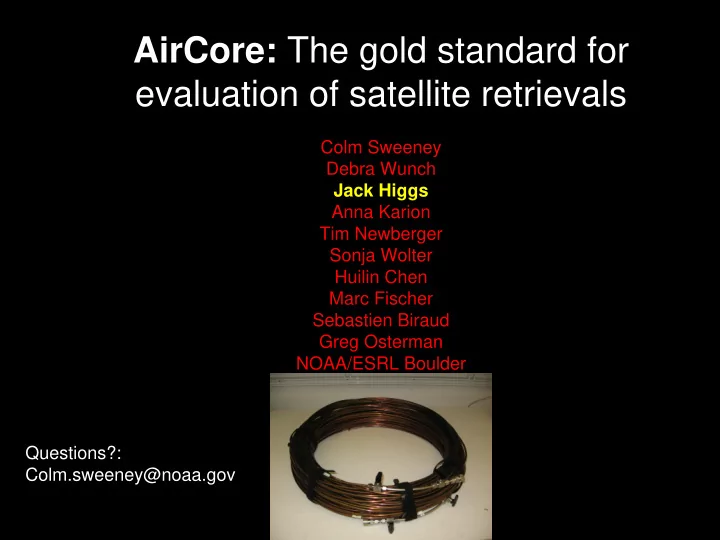
AirCore: The gold standard for evaluation of satellite retrievals

Colm Sweeney Debra Wunch Jack Higgs Anna Karion Tim Newberger Sonja Wolter Huilin Chen Marc Fischer Sebastien Biraud Greg Osterman NOAA/ESRL Boulder Questions?: Colm.sweeney@noaa.gov

slide-2
SLIDE 2

Outline

  • Why do we need AirCore measurements?
  • What is new about the AirCore?
  • Southern Great Plains (SGP) comparison
  • Where are we going?
slide-3
SLIDE 3

+

Model Satellite Global Network FLUXES TCCON

Roadmap to fluxes

slide-4
SLIDE 4

+

Model Satellite Global Network FLUXES

Need direct measurements of the total column to link remote measurements to ground network.

TCCON

Roadmap to fluxes

AirCore

slide-5
SLIDE 5

TCCON calibration

Typical aircraft profiles only go to 200 mbar

slide-6
SLIDE 6

Passive AirCore Sampling System

100,000 feet Fill Gas Captured profile

slide-7
SLIDE 7

Comparison with insitu measurements

CO2 (ppm) ‐0.07 ± 0.04 (±0.02%) CH4 (ppb) ‐0.1 ± 0.4 (±0.01%)

Column Mean offset

CH4 CO2

slide-8
SLIDE 8

AirCore v. Aircraft errors in estimate of total column

Sampling platform Sampling range Cost ($) Error in XCO2 Error in XCH4 Small aircraft 0 – 4 km 1.5K 0.77 ‐ 2.14 ppm 10 ppb Small aircraft

  • r Jet

0 – 8 km 2.5K 0.76 ppm 7 ppb Jet 0 – 12 km 10K 0 ‐ 0.40 ppm 6 ppb AirCore 0 – 30 km 4.2k 0.10 ppm 1 ppb AirCore can sample 99% of the column for half the price of any aircraft system and at ¼ the error

slide-9
SLIDE 9

High altitude mixing tracer

Fill Gas (10 ppm CO) End-member mixing Pressure (atm) Stratosphere

1 0.025

Free Troposphere

Maximum altitude = 30,000 m (100,000 ft, 0.01 atm) = 24,000 m (80,000 ft, 0.02 atm)

0.01

  • 0.005

Cut down alt.

slide-10
SLIDE 10

Low cost/light weight AirCore

24 m 24 m Tubing weight = 4 lbs Volume of tube = 0.8L 1/8” 1/4” Large AirCore Light AirCore Inlet Light weight

  • No reporting to FAA
  • potential to package in return vehicle
  • simple logistics
  • slightly reduced resolution
slide-11
SLIDE 11

Southern Great Plains (SGP) Field Test January 14, 2012 January 15, 2012

slide-12
SLIDE 12

AirCore-01 landing site

ARM‐SGP Jan 14, 2012 Medicine Lodge, KS

20 km

slide-13
SLIDE 13

AirCore-01 landing site

ARM‐SGP Jan 15, 2012, Carrier, OK

10 km

slide-14
SLIDE 14

Jan 15 landing locations

ARM/SGP Cental Facility AirCore ‐ 1 Landing Site AirCore ‐ 3 Landing Site

x x x 6.5 km

slide-15
SLIDE 15

CO2

  • Jan. 14, 2012
  • Jan. 15, 2012

SGP Tower

slide-16
SLIDE 16

CH4

  • Jan. 14, 2012
  • Jan. 15, 2012

SGP Tower

slide-17
SLIDE 17

CO

  • Jan. 14, 2012
  • Jan. 15, 2012
  • CO is a valuable mixing tracers to get near-ground

and high stratosphere mixing ratios

  • Organic layer in AirCore Sulfurinert is creating CO in

high ozone environments

slide-18
SLIDE 18

Calibrating TCCON CO2 Across Multiple Sites

  • Lamont (ARM‐SGP) Aircore consistent with previous results
  • Additional work required on uncertainty budget

AirCore AirCore

slide-19
SLIDE 19

CH4 CO2 2-D structure of a profile

slide-20
SLIDE 20

CH4 2-D structure of a profile

slide-21
SLIDE 21

Active Pumping AirCore

The tape recorder

Pump Actively pumping AirCore INLET

Glider

Putting AirCore where you want

slide-22
SLIDE 22

Goals for Passive AirCore: Logistics – Launching Logistics – Retrieval Logistics – Data analysis Science – improved priors Science – stratospheric age model Science – provide direct tie to WMO