After School Quality Data Collection Process and Objectives Ken - - PDF document

after school quality data collection process and
SMART_READER_LITE
LIVE PREVIEW

After School Quality Data Collection Process and Objectives Ken - - PDF document

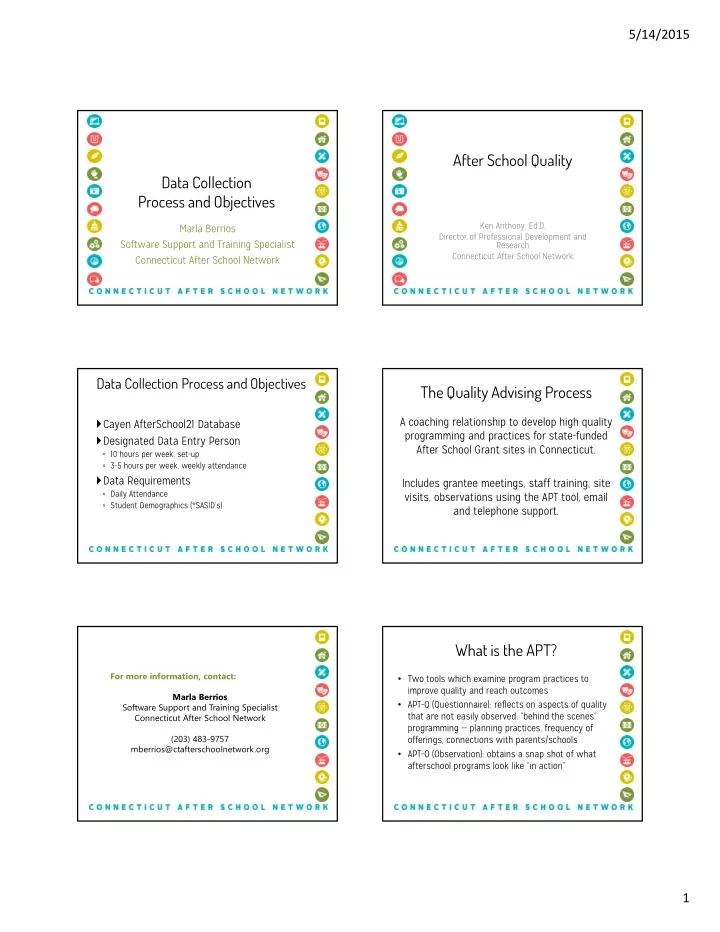
5/14/2015 After School Quality Data Collection Process and Objectives Ken Anthony, Ed.D. Marla Berrios Director of Professional Development and Software Support and Training Specialist Research Connecticut After School Network Connecticut


slide-1
SLIDE 1

5/14/2015 1

Data Collection Process and Objectives

Marla Berrios Software Support and Training Specialist Connecticut After School Network

Data Collection Process and Objectives

Cayen AfterSchool21 Database Designated Data Entry Person

  • 10 hours per week, set-up
  • 3-5 hours per week, weekly attendance

Data Requirements

  • Daily Attendance
  • Student Demographics (*SASID’s)

For more information, contact: Marla Berrios Software Support and Training Specialist Connecticut After School Network (203) 483-9757 mberrios@ctafterschoolnetwork.org

After School Quality

Ken Anthony, Ed.D. Director of Professional Development and Research Connecticut After School Network

The Quality Advising Process

A coaching relationship to develop high quality programming and practices for state-funded After School Grant sites in Connecticut. Includes grantee meetings, staff training, site visits, observations using the APT tool, email and telephone support.

What is the APT?

  • Two tools which examine program practices to

improve quality and reach outcomes

  • APT-Q (Questionnaire): reflects on aspects of quality

that are not easily observed: “behind the scenes” programming -- planning practices, frequency of

  • fferings, connections with parents/schools
  • APT-O (Observation): obtains a snap shot of what

afterschool programs look like “in action”

slide-2
SLIDE 2

5/14/2015 2

What are the Benefits?

 Research-based, scientifically field-tested instruments designed specifically for afterschool programs  Helps define and communicate desirable practices to staff  Reflect on how program may be contributing to youth outcomes  Stimulates discussion regarding strengths and areas needing improvement  Guides the creation of program improvement goals

High Quality Program Design

  • Starting Points

– What does the community need? – What do the students need? – What are the outcomes you hope to achieve? – How will the program be delivered? – Who will the program staff be? – How does the program link to the school day?

Program Content

  • High quality programs contain the following:

– Rich content that is engaging – Clear linkages to the school (relationships/partnerships) – Curriculum that is linked to the CT Frameworks – Intentionality in the design and delivery

  • High quality programs consider:

– How the transitions will be handled – A balance of academic, enrichment, and recreational activities – Effective homework help and tutoring

Stealth Learning

  • After School programs have the unique
  • pportunity to strengthen the learning of the

school day through “stealth” learning

– Core academic competencies are reinforced through hands on, experiential learning – These could be theme based with clear linkages to the school day – Consider how an “after school style” of learning differs from the school day

Infusing Academics into Content

  • Connections to content strands from the

state frameworks/pacing guides

  • Infused learning through complimentary

lesson planning

  • Boosts academic content of the school day

by engaging the students as active participants in the learning

After School Scheduling

  • How many hours per day/week does the

program meet?

  • Is there a mix of academic and recreational

activities in the schedule?

  • Are there planned transition times

– snack – homework, – enrichment

  • How is the sign out procedure handled for

safety?

slide-3
SLIDE 3

5/14/2015 3

Scheduling Example 1

Monday Tuesday Wednesday Thursday Friday 3-3:30 pm Snack 3:30-4:30 pm Homework Tutorial 4:30-6 pm Recreation Time & Academic Enrichment

Scheduling Example 2

Monday Tuesday Wednesday Thursday Friday 3:30 – 4 Space: Cafeteria Snack (60 students) Staff: 3 teachers; 4 HS TA* Snack (60) Snack (60) Snack (60) Snack (60) 4 – 4:30 Space: Cafeteria + 1 or 2 classrooms K-5 H/W help (60) Staff: 3 teachers; 4 HS TA K-5 H/W help (60) K-5 Field Trips, Games or Arts & Crafts, K-5 H/W help (60) K-5 H/W help (60) 4:30 – 5:30 Space: 1 classroom K-2 Enrichment (20) Staff:1 teacher; 2 HS TA K-2 Enrichment (20) Free yard play (60) Staff: 3 teachers; 4 HS TA K-2 Enrichment (20) K-2 Enrichment (20) 4:30 – 5:30 Space: 1 classroom 3-5 Art (20) Staff: 1 teacher; 1 HS TA 3-5 Dance (20) 3-5 Art (20 3-5 Dance (20) 4:30 – 5:30 Space: 3-5 Sports (20) Staff: 1 teacher; 1 HS TA 3-5 Sports (20) Student Council (10) 3-5 Sports (20) 3-5 Sports (20) 5:30 – 6 Space: Cafeteria Wrap up Staff: 1 teacher Wrap up Wrap up Wrap up Wrap up

Scheduling Example 3

Time Monday Tuesday Wednesday Thursday Friday

1:40- 2:00

Snack After School Teachers

2:00- 3:00

Yard/Board Games After School Teachers

2:40- 3:00 Snack After School Teachers Snack After School Teachers Snack After School Teachers Snack After School Teachers 3:00- 4:00 Homework & Literacy activity After School Teachers Homework & Literacy activity After School Teachers Homework & Literacy activity After School Teachers Homework & Literacy activity After School Teachers Science Friday UC Berkeley 3:00- 4:00 Tutoring group UC Berkeley BUILDS Tutoring group UC Berkeley BUILDS Tutoring group UC Berkeley BUILDS Tutoring group UC Berkeley BUILDS Games and art UC Berkeley BUILDS 4:00- 5:00 Computer 4 – 5th grades Joel Miranda Martial Arts 4-5th grades Destiny Arts Art 1st-3rd Grade Sally Brown Dance 4-5th grades Destiny Arts Art 1-3rd switch Sally Brown 4:00- 5:00 Sport and Rec Sports and Rec Sports and Rec Sports and Rec Sports and Rec 5:00- 5:45 Closing activity Closing activity Closing activity Closing activity Closing activity 5:45- 6:00 Dismissal Dismissal Dismissal Dismissal Dismissal

Scheduling Example 4

Monday Tuesday Wednesday Thursday Friday 3:30 – 4 Space: Cafeteria Snack (60 students) Staff: 3 teachers; 4 HS TA* Snack (60) Snack (60) Snack (60)

No Program

4 – 4:30 Space: Cafeteria + 1 or 2 classrooms

Grade 6 – 8 Homework Help Grade 6 – 8 Homework Help Grade 6 – 8 Homework Help Grade 6 – 8 Homework Help

4:30 – 5:30 Space: 1 classroom

Grade 6 Paint like Monet Grade 6 Hip Hop Aerobics Grade 6 – 7 Painting Seminar Grade 6 Hip Hop Aerobics

4:30 – 5:30 Space: 1 classroom

Grade 7 Paint like Picasso Grade 7 Robotics Grade 7 Robotics

4:30 – 5:30 Space:

Grade 8 Service Learning I Grade 8 Service Learning II Grade 8 Service Learning I Grade 8 Service Learning II

5:30 – 6 Space: Cafeteria Wrap up Staff: 1 teacher Wrap up Wrap up Wrap up

The keys to a high quality program

  • Choose the right activities
  • Choose the right mix of staff
  • Create clear linkages to the school day to

reinforce the learning

Important Points to Consider

Program Design

  • Do you get input from the children?
  • Is your schedule balanced (multiple options/activities)?
  • Are there opportunities for growth and exploration (for

both staff and children)?

  • How are you involving families?
  • What are you doing for Professional Development?
slide-4
SLIDE 4

5/14/2015 4 What does the CT After School Network offer?

  • Annual Fall Conference - November
  • Childhood Conversations - April
  • Summer Staff Kick-off - June
  • CLASP: Coaching and Learning for After School

Professionals - 4 full days

  • Seminars: Professional Development

What does the CT After School Network offer?

  • Seminars: Professional Development
  • Resource Library – sent to you by mail
  • Monthly Webinars
  • Training and Consultation Service – on-site
  • Website www.ctafterschoolnetwork.org
  • Literacy Strategies Guide on Resources page

For more information, contact: Ken Anthony, Ed. D. Director of Professional Development and Research Connecticut After School Network (860) 730-2942 kanthony@ctafterschoolnetwork.org

Staffing, Partnerships and Parent Involvement After School

Michelle Doucette Cunningham Executive Director Connecticut After School Network

Staffing After School

  • Best practice nationwide for staff to student

ratio is 1:10

  • Established role of a Site Coordinator

– Linkages to the school – Hiring/firing of staff – Connections with parents

  • Staff Credentials

Staffing Considerations

  • Does your program have consistent staff?
  • Does your program rely on consultants and

contractors to deliver the core content of the program? What are their qualifications?

  • Does your staff have opportunities to

showcase their talents and passions to the children?

slide-5
SLIDE 5

5/14/2015 5

Professional Development

  • Are you and your staff current in the field?

– Professional Development and peer networking helps build leadership capacity and maintain

  • verall program quality

– Orientation is not enough, linking to school district professional development offerings, getting training in specialized areas that you would like to develop in your program, and attending webinars are some ways to boost the skill set of your staff

NEW this year

  • Adequate supervision, training and staff

development is essential for ensuring a high quality after-school program.

  • The application should include both an
  • rganizational chart showing the number of

staff to supervisor ratio and a detailed description of plans to provide staff with necessary training.

NEW this year

  • Provide a description of the adequacy of

supervision and training for all staff that have contact with children

  • Grantees must provide training and support for

all staff members, including administrators and parents, in developing partnership skills, especially around understanding and appreciating diversity and developing skills to work with people from different backgrounds.

NEW this year

  • Quality Advisors will be asking for proof that

staff, volunteers and contractors have had all appropriate background checks:

– FBI Criminal Background – State Police – DCF Central Abuse Registry

  • Required to request the check within 30

days of the program start

  • Be sure to include this cost in your budget

Conditions for Program Success

YOUT H IMPACT S

Ac ade mic Soc ial/ behavior al Physic al Pre ve ntion

Afte r sc hool Pr

  • gr

ams

Be fore / afte r sc hool Summe r We e ke nd

Quality pr

  • gr

ams whic h have … Str

  • ng par

tne r ships with sc hools, familie s, and othe r CBOs. Ac c e ss to and sustaine d par tic ipation in… F AMIL Y IMPACT S

Conne c tions to Sc hool Involve me nt in L e arning

Grant Requirement

 All grantees must commit a minimum of five percent

  • f their grant budget to support parent involvement

activities including staff training to support parent involvement activities  Offers parents a broad range of activities to promote parent involvement. (10 pts.)  5% x $200,000 = $10,000

slide-6
SLIDE 6

5/14/2015 6

Appropriate uses of funds

  • Materials and training to help parents work with

their children

  • Training for staff on how to reach out to,

communicate with and work with parents

  • Transportation and child care costs to enable

parents to participate in meetings and training sessions.

Appropriate uses of funds

  • Training parents to enhance the involvement of
  • ther parents.
  • Establishing a parent advisory council.
  • Developing appropriate roles for community-based
  • rganizations and businesses in parent involvement

activities.

  • Providing such other reasonable support for

parental involvement activities as parents may request.

School/Community Partnerships

 Section B. Program Design: Provides a description of the partnership and working relationship between a local educational agency or school and community-based

  • rganization(s) or another public or private
  • rganization. (5 pts.)

 Section D. Management Plan: Provides a description of the coordination of proposed project, between parents, teachers, the community and students. Includes planning and preparation time for after-school teachers to align the program activities with the daily classroom

  • expectations. (10 pts.)

Meaningful Partnerships

  • Strength-based: Allow partners to do what they

do best

  • Complementary: Provide services that are not

provided by the main partner

  • Integrated: Regular meetings and structure that

promotes coordination

  • Cost-effective: Provides good values for the

services provided

  • Capacity-building: Strengthens both partners

For more information, contact: Michelle Doucette Cunningham Executive Director Connecticut After School Network (860) 730-2941 mdc@ctafterschoolnetwork.org

slide-7
SLIDE 7

5/14/2015 1

CONNECTICUT STATE DEPARTMENT OF EDUCATION

After-School Grant PROGRAM FUNDING OPPORTUNITIES Orientation/Bidder’s Conference

  • Dr. Agnes Quinones

After-School Program Manger

May 13, 2015 and May 22, 2015

CONNECTICUT STATE DEPARTMENT OF EDUCATION

Welcome and Introductions

  • Dr. Agnes Quiñones

General Grant Overview and Q&A

  • Dr. Agnes Quiñones

After School Snack Program Jackie Schipke, Associate Education Consultant Bureau of Health/Nutrition, Family Services and Adult Education, CSDE Data collection process and objectives Marla Berrios, Afterschool21 Training and Support Specialist CT After School Network After School Quality Ken Anthony, Director of Professional Development CT After School Network Program Staffing, Partnerships and Parent Involvement Michelle Doucette Cunningham, Executive Director CT After School Network Q and A / Wrap‐up

Agenda

CONNECTICUT STATE DEPARTMENT OF EDUCATION

The purpose is…

 to create programs that provide students

with academic, enrichment and recreational

  • pportunities designed to complement

their regular school day.

 to provide opportunities for the families of

these students to participate in educational programs.

CONNECTICUT STATE DEPARTMENT OF EDUCATION

Organizations eligible to apply for after school state funds

 Local education agencies (LEA’s).  Community‐based organizations (CBO’s).  Faith‐based organizations.  Other public and private entities.  A consortium of two or more agencies/

  • rganizations, or entities.

 Partnerships required ‐ one or more.  Signatures are required and very important.

CONNECTICUT STATE DEPARTMENT OF EDUCATION

After School Funding Allocation

  • Awaiting final vote on state budget – hoping for $4.5

million for each of the two years (pending state budget funding each year).

  • Grants range from $25,000 to a maximum of $200,000

each year.

  • Parent fees are allowed using a sliding fee scale.

CONNECTICUT STATE DEPARTMENT OF EDUCATION

Two Options

A: Elementary Schools B: Middle and High Schools

slide-8
SLIDE 8

5/14/2015 2

CONNECTICUT STATE DEPARTMENT OF EDUCATION

Hours of Operation‐ Minimums

 Elementary School: 9 hours per week, 4 days a

week.

 Middle School: 8 hours per week, 4 days a week,

can be two two‐day sessions (e.g. M/W & T/Th).

 High School: 5 hours per week, at least 2 days per

week.

 No “drop in” programs.  Must explain how the hours and schedule will meet

the needs of your students and families.

CONNECTICUT STATE DEPARTMENT OF EDUCATION

Weeks of Operation

 Minimum of 25 weeks, extra points for whole

year.

 First week of school to the last week of school

+15 points.

 at least 30 weeks +10 points.  less than 30 weeks +5 points.  less than 25 weeks ‐ will not be funded.

CONNECTICUT STATE DEPARTMENT OF EDUCATION

Attendance requirements

 Two measures required in the proposal and

are tracked monthly:

Total number of students served Number of students reaching minimum dosage  Actual attendance must be at least 80% for

each measure.

CONNECTICUT STATE DEPARTMENT OF EDUCATION

Number of students

 Total number of students to be served annually. This

may include before school, after school, school vacations and summer.

 Programs must show that 80% of target was

maintained in order to receive 2nd year funding.

 Example: Expect to enroll 100 students for after

school, each month at least 80 students must have attendance.

CONNECTICUT STATE DEPARTMENT OF EDUCATION

Minimum Dosage

 Elementary School: 60% of days the site is open  Middle School: 45 days  High School: 30 days  Programs must show that 80% of all students meet the target

in order to receive 2nd year funding.

 Example: Elementary school site is open 4 days per week for

25 weeks = 100 days

 How many students attended at least 60 days of

programming? Answer: 80

CONNECTICUT STATE DEPARTMENT OF EDUCATION

Supplement not Supplant

 Grantees must use program funds to

supplement and not supplant other Federal (21st CCLC), State, and local funds.

slide-9
SLIDE 9

5/14/2015 3

CONNECTICUT STATE DEPARTMENT OF EDUCATION

Checklist for Success

 Targeted vision, clear goals and measurable

  • bjectives—realistic/practical.

 Identify the services to be provided, the

days/hours of operation and who will participate (parents).

 Identify partners—roles/responsibilities/timelines.  Link program to a community need — students –

measurable terms.

CONNECTICUT STATE DEPARTMENT OF EDUCATION

Budgeting

 The average program ranges from $150,000 to

$200,000, serving two sites with a total of 150 students.

 ES/MS avg. cost: $1500‐2000  HS avg. cost: $1200‐1500  Budget form shows both grant budget and

  • ther funding sources/in‐kind.

CONNECTICUT STATE DEPARTMENT OF EDUCATION

Fiscal Health of Organization

 Schools and LEAs: letter of support from

superintendent attesting to program capacity to start on‐time.

 Others: Provide evidence that the organization

has adequate fiscal health to sustain at least three months of after‐school programming, and has adequate financial controls and policies.

CONNECTICUT STATE DEPARTMENT OF EDUCATION

Evidence of Fiscal Health

 Copy of IRS determination letter.  Organization chart.  List of Board of Directors with names and

affiliations.

 Organization’s most recent financial statements

and management letter (audited, if available).

 Organization’s annual operating budget and

actual income and expenses for the current fiscal year.

CONNECTICUT STATE DEPARTMENT OF EDUCATION

Requirements:

 5% of annual budget for parent engagement.  5% of annual budget for statewide evaluation & data

collection (you will be invoiced each year).

 Grantee meetings: in‐person & conference calls.  Quality Improvement: one outside observation,

quality improvement plan.

 Professional development: on‐site, in‐state trainings,

and out‐of‐state conferences.

 Data entry staff to enter student attendance.  Evaluation: End of year survey, teacher surveys,

grades, etc.

CONNECTICUT STATE DEPARTMENT OF EDUCATION

Grant Details and Deadline

 Grant deadline: June 15th, 2015 4:30 p.m.  Original and three copies  Cover page must have all required signatures

(LEA and Partner‐Lead agency)

 Cover page‐identify who you are! No

acronyms

 Grant review process  Competition notification and interview

process

slide-10
SLIDE 10

5/14/2015 4

CONNECTICUT STATE DEPARTMENT OF EDUCATION

Existing Grantees – Funding History

 Met program requirements: number of weeks,

days and hours, total # students targets, target # students attending 60% of program activities, & per student costs, from on‐line data collection system.

 Parent Engagement Reporting Form.  Quality Improvement Reporting Form.  Up to 30 points awarded total.

CONNECTICUT STATE DEPARTMENT OF EDUCATION Logic Model: A Visual Representation of a Theory of Change

PROGRAM GOALS What is the program trying to accomplish? e.g., program structures and institutional features PROGRAM ELEMENTS What are the strategies and activities used to achieve the goals? e.g., program processes and content PROGRAM ELEMENTS What are the strategies and activities used to achieve the goals? e.g., program processes and content DESIRED LONG-TERM OUTCOMES What positive results can be expected within

  • ne year?

e.g., grades, achievement, reduced risky behaviors

Adapted from Moving Towards Success: Framework for After-School Programs, Washington, DC: Collaborative Communications Group, 2005, pp. 4-5

DATA SOURCES AND PERFORMANCE MEASURES What data sources will you use? What will you measure? How will the data be used to evaluate and improve the program?

CONNECTICUT STATE DEPARTMENT OF EDUCATION

  • A. NEED FOR PROJECT

 Provides a description of the applicant community and the

needs of the target population. (5 pts.)

 Provides a description of how the proposed project will

remedy the risk factors for each target population. (10 pts.)

CONNECTICUT STATE DEPARTMENT OF EDUCATION

  • B. QUALITY OF PROJECT DESIGN

 Provides a description of the partnership and working

relationship between a local educational agency or school and community‐based organization(s) or another public or private

  • rganization. (5 pts.)

 Identifies target population, including number of students to

be served and addresses needs of target population. (10 pts.)

 Offers students a broad array of additional services, programs

and activities, such as youth development activities, drug and violence prevention programs, art, music and recreation, technology education, character education and complements the regular academic program of participating students. (5 pts.)

CONNECTICUT STATE DEPARTMENT OF EDUCATION

  • B. QUALITY OF PROJECT DESIGN

 Offers parents a broad range of activities to promote parent

  • involvement. (10 pts.)

 Documents logical and realistic project goals, objectives,

activities and timeline. (5 pts.)

 Provides a calendar that identifies the program’s start date,

end date, days of operation including any vacation and summer programming. (15 pts.)

 Describes how children will travel safely to and from the

program and home. (5 pts.)

CONNECTICUT STATE DEPARTMENT OF EDUCATION

Program Priorities

 Options A and B

Literacy (15 pts.) STEAM: Science, Technology, Engineering, Arts and Math (15 pts.) Wellness and Recreation Component (10 pts.)

 Option B only

College and Career Readiness (10 pts.)

slide-11
SLIDE 11

5/14/2015 5

CONNECTICUT STATE DEPARTMENT OF EDUCATION

  • C. ADEQUACY OF RESOURCES

 Provides a description of the adequacy of support, including

facilities, equipment, supplies and other resources, from the applicant organization or the lead applicant organization. (5 pts.)

 NEW – Provide a description of the adequacy of supervision

and training for all staff that have contact with children. (10 pts.)

CONNECTICUT STATE DEPARTMENT OF EDUCATION

  • C. ADEQUACY OF RESOURCES

 Demonstrates that costs are reasonable in relation to the

number of persons to be served and to the anticipated results and benefits. (10 pts.)

 Provide evidence that the organization has adequate fiscal

health to sustain at least three months of after‐school programming, and has adequate financial controls and

  • policies. (5 pts.)

CONNECTICUT STATE DEPARTMENT OF EDUCATION

  • D. QUALITY OF MANAGEMENT PLAN

 Describes how the organization will disseminate information

about the programs to the community in a manner that is understandable and accessible. (5 pts.)

 Provides description of the adequacy of the management plan

to achieve the objectives of the proposed project on time, within budget, including clearly defined responsibilities and milestones to accomplish project tasks. (10 pts.)

 Provides a description of the coordination of proposed

project, between parents, teachers, the community and

  • students. Includes planning and preparation time for after‐

school teachers to align the program activities with the daily classroom expectations. (10 pts.)

CONNECTICUT STATE DEPARTMENT OF EDUCATION

  • E. DISTRICT IMPROVEMENT PLAN

 CT Alliance Districts who submit proposals that have

a letter from the Principal(s) of the school(s) to be served that outlines how the after‐school program aligns with and supports the goals of the Alliance District Approved Plan. (5 pts.)

CONNECTICUT STATE DEPARTMENT OF EDUCATION

CSDE Curriculum Framework Links

CONNECTICUT STATE DEPARTMENT OF EDUCATION

CSDE Curriculum Framework Links

slide-12
SLIDE 12

5/14/2015 6

CONNECTICUT STATE DEPARTMENT OF EDUCATION

CSDE Curriculum Framework Links

CONNECTICUT STATE DEPARTMENT OF EDUCATION

CONTACT INFORMATION

 Dr. Agnes Quinones, Program Manager

agnes.quinones@ct.gov 860.807.2126

 Marie Aligata, Assistant

marie.aligata@ct.gov 860.807.2061

 Websites:

www.ct.gov/sde www.ctafterschoolnetwork.org

slide-13
SLIDE 13

5/14/2015 1

CONNECTICUT STATE DEPARTMENT OF EDUCATION

The United States Department of Agriculture

Afterschool Snack Program

May 2015 Jackie Schipke, M.B.A., R.D., S.N.S. Education Consultant, Connecticut State Department of Education

CONNECTICUT STATE DEPARTMENT OF EDUCATION

Child Nutrition Reauthorization Act 1998

Expanded the National School Lunch Program to provide reimbursements for snacks served to children in certain after school care programs. Goal is to promote health and well being of children and youth in the community.

CONNECTICUT STATE DEPARTMENT OF EDUCATION

Requirements for Participation

 Must be a sponsor of the National School Lunch Program  Must be operating an After School Care Program which provides children with regularly scheduled activities in an

  • rganized, structured supervised

environment, and includes educational

  • r enrichment activities.

Once an Afterschool Snack Program is approved in a school, ALL students staying after school may participate in the snack program, not only those enrolled in the approved After School Care Program.

CONNECTICUT STATE DEPARTMENT OF EDUCATION

Funding

All reimbursements that are received from the federal government accrue to the nonprofit school food service account in the school/district. Funds do not go to the After School Care Program.

CONNECTICUT STATE DEPARTMENT OF EDUCATION

How Much Funding?

The amount of reimbursement received for the snacks served is dependent upon either AREA ELIGIBILITY of the school/site or by the INDIVIDUAL ELIGIBILITY of the children enrolled in the After School Care Program.

CONNECTICUT STATE DEPARTMENT OF EDUCATION

AREA ELIGIBILITY

  • Determined annually
  • Based on the number
  • f free and reduced-price eligible

students each October

  • Schools must have 50% or more of

enrolled children eligible for meal benefits

http://www.sde.ct.gov/sde/cwp/view.asp?a=2626&q=333774 OCTOBER

M T W T F S S

1 2 3 4 5 6 7 8 9 10 11 12 13 14 15 16 17 18 19 20 21 22 23 24 25 26 27 28 29 30 31

slide-14
SLIDE 14

5/14/2015 2

CONNECTICUT STATE DEPARTMENT OF EDUCATION

An After School Program qualifies as area eligible if it is located in the attendance area of a school w hich has at least 50% of its enrollment eligible for free or reduced price meals during the month

  • f October.

AREA ELIGIBILITY

CONNECTICUT STATE DEPARTMENT OF EDUCATION

AREA ELIGIBLE SITES All snacks provided at these sites are served free of charge to all students

CONNECTICUT STATE DEPARTMENT OF EDUCATION

Tow ns w here all addresses are AREA ELIGIBLE

  • Ansonia
  • Bloomfield
  • Bridgeport
  • Danbury
  • Derby
  • East Hartford
  • East Haven
  • Hartford
  • Manchester
  • Meriden
  • New Britain
  • New Haven
  • New London
  • Norwich
  • Putnam
  • Sprague
  • Stamford
  • Waterbury
  • West Haven
  • Windham

CONNECTICUT STATE DEPARTMENT OF EDUCATION

INDIVIDUAL ELIGIBILITY

  • For schools/sites that are not in the

attendance area of an “Area Eligible” school

  • Snacks must be tracked by individual

student

  • Snacks are counted by individual

student eligibility and claimed as free, reduced or full pay

CONNECTICUT STATE DEPARTMENT OF EDUCATION

INDIVIDUAL ELIGIBILE SITES

  • Free and reduced price eligibility applications must

be maintained as well as a master list of eligibility for all enrolled students. The site could obtain this data from their current NSLP at the school.

  • Students are charged a fee for their snack, or the

After School Care Program will cover this expense.

  • Overt identification of student eligibility status is

prohibited.

CONNECTICUT STATE DEPARTMENT OF EDUCATION

Where are Afterschool Snacks Served?

Nutritious snacks may be served in

  • Schools
  • Faith-based After School Programs
  • Boys and Girls Clubs
  • Recreation Centers
  • …and other locations
slide-15
SLIDE 15

5/14/2015 3

CONNECTICUT STATE DEPARTMENT OF EDUCATION

What kind of foods are served in the Afterschool Snack Program?

In order to be claimed for reimbursement, the snacks must contain at least two different food component items. The snack menu is planned at the local level by the Food Service Director in the school district.

CONNECTICUT STATE DEPARTMENT OF EDUCATION

What kind of foods are served in the Afterschool Snack Program?

The food items served must be two of the following:

  • fluid milk
  • meat or meat alternate
  • vegetable(s) or fruit(s) or full strength

vegetable or fruit juice

  • whole grain or enriched bread or cereal

CONNECTICUT STATE DEPARTMENT OF EDUCATION

Specific Requirements for the Snack Served

Only one snack per child per day may be claimed Students are required to take the entire snack planned (two items)

CONNECTICUT STATE DEPARTMENT OF EDUCATION

Sample Snack Menus

Monday

Celery Sticks (4) and Peanut Butter (2 T) Fat-Free Choc. Milk (8 oz)

Tuesday

Cantaloupe & Watermelon cubes (3/4 cup) Whole Grain Pretzels (1 oz)

Wednesday

Goldfish Crackers (.75 oz) 100% Fruit Juice (3/4 cup)

Thursday

Yogurt (4 oz) Animal Crackers ( 1 oz)

Friday

Cheerios (3/4 cup) Low-Fat Milk (8 oz)

CONNECTICUT STATE DEPARTMENT OF EDUCATION

Monitoring Requirements

For school year programs, the Afterschool Snack Program must be reviewed two times per year. This is typically done by the Food Service Department:

  • The first review must take place during the

first four weeks of operation;

  • The second review any time during the
  • peration of the program during the school

year.

Monitoring forms may be found on our Web site: http://www.sde.ct.gov/sde/LIB/sde/pdf/DEPS/Nutrition/ Snack/On-SiteMonitoringSnacks.pdf

CONNECTICUT STATE DEPARTMENT OF EDUCATION

If you are not eligible under the requirements for the NSLP, you may still qualify for the At- Risk Meals Program under the Child and Adult Care Food Program. To find out more information, contact the Child Nutrition Programs.

What if your After School Care Program is not associated with a school which participates in the NSLP?

slide-16
SLIDE 16

5/14/2015 4

CONNECTICUT STATE DEPARTMENT OF EDUCATION

How Do I Start An Afterschool Snack Program?

1. Contact the Food Service Director for your school/district. 2. The Food Service Director must complete, and submit, an application form for each site. 3. The application and other important information may be found here:

http://www.sde.ct.gov/sde/cwp/view.asp?a=2626&q= 320648

CONNECTICUT STATE DEPARTMENT OF EDUCATION

Any questions about the Afterschool Snack Program should be directed to Jackie Schipke 860.807.2123 jackie.schipke@ ct.gov