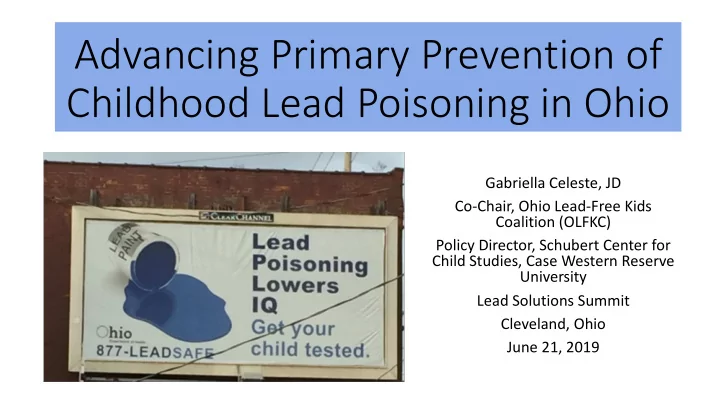
Advancing Primary Prevention of Childhood Lead Poisoning in Ohio - - PowerPoint PPT Presentation

advancing primary prevention of childhood lead poisoning
SMART_READER_LITE
LIVE PREVIEW

Advancing Primary Prevention of Childhood Lead Poisoning in Ohio - - PowerPoint PPT Presentation

Advancing Primary Prevention of Childhood Lead Poisoning in Ohio Gabriella Celeste, JD Co-Chair, Ohio Lead-Free Kids Coalition (OLFKC) Policy Director, Schubert Center for Child Studies, Case Western Reserve University Lead Solutions Summit


slide-1
SLIDE 1

Advancing Primary Prevention of Childhood Lead Poisoning in Ohio

Gabriella Celeste, JD Co-Chair, Ohio Lead-Free Kids Coalition (OLFKC) Policy Director, Schubert Center for Child Studies, Case Western Reserve University Lead Solutions Summit Cleveland, Ohio June 21, 2019

slide-2
SLIDE 2

We Know How Children Are Exposed to Lead

“Deteriorating lead-based paint and its resulting lead dust are the most common causes of elevated blood lead levels in children in Ohio.” ODH

Other sources include:

  • Soil contaminated

by lead dust particles

  • Water from lead

pipes and/or fixtures

slide-3
SLIDE 3

Home Risk Factors

If you answer “yes” to any of these questions, please consider having your home tested for lead:

  • Are there visible paint chips near the house (pre-1978),

fences, garages, or play structures?

  • Is your home located near a lead-producing industry

(battery plant, smelter, radiator repair shop, etc.)?

  • Is your home located near buildings or structures that are

being renovated, repainted, or demolished?

https://odh.ohio.gov/wps/portal/gov/odh/know-our-programs/childhood- lead-poisoning/about-lead/

slide-4
SLIDE 4

Leveraging a critical public moment...

Photo credit: Lisa DeJong/The Plain Dealer

Rachell Dissell, Brie Zeltner, The Plain Dealer (October 2015)

slide-5
SLIDE 5

Coalition- Building: Growing social capital for policy change...

slide-6
SLIDE 6

Highlighting & Translating Relevant Research to Build Case for Prevention & Early Intervention

slide-7
SLIDE 7

Defining (& Refining) the Social Problem... and Crafting State Policy Solutions: Prevention & Supports

Building Political Will...

Engaging stakeholders...

  • Pediatricians
  • Researchers
  • Housing specialists
  • Early care workers
  • Public health staff
  • Social policy experts
  • Families, etc.

...to inform policy ideas.

“For every $1 spent controlling lead hazards, at least $17 returned (and as much as $221) in health benefits, increased IQ, higher lifetime earnings, tax revenues, lower special education costs and reduced criminal activity.”

slide-8
SLIDE 8

OLFKC State Budget Policy Proposals in the Ohio Children’s Budget

  • 1. Broaden impact of SCHIP Lead Hazard Control

Program

  • 2. Create a Primary Prevention of Child Lead Poisoning

State-Local Demonstration Grant

  • 3. Increase access to effective lead screening & testing

with targeted strategies

  • 4. Strengthen enforcement of current lead inspection

laws with increased resources

  • 5. Prevent further harm by ensuring access to

developmental and behavioral supports like early intervention

  • 6. Convene a state task force to develop a

comprehensive primary prevention plan

slide-9
SLIDE 9

Coordinating with Child-Focused Partners to Build Case for Prevention & Early Intervention

slide-10
SLIDE 10

Using “wins” as building blocks for further policy & systems change...

slide-11
SLIDE 11

Early Intervention IDEA Part C Services (0-3):* Why Automatic Eligibility for Children with EBLLs Matters

* Starting July, 1, 2019 –

  • Parents can

request EI supports

  • ODH will

send EBLL tests results to DODD

slide-12
SLIDE 12

“School-Age” Services for Developmental Delays

Child with identified disability/delay may receive:

  • IEP with IDEA Part B (ages 3-5) and Part C supports; include “related services”:
  • Behavior & curriculum intervention specialists
  • Speech-language pathologists
  • Augmentative communication specialists
  • Occupational & physical therapists
  • Behavior Intervention Plan (BIP) – focus on positive behavioral supports
  • “Transition services” to ensure necessary supports upon leaving school
  • Special legal protections
slide-13
SLIDE 13

Supporting Political Leadership for Policy Change...

slide-14
SLIDE 14
slide-15
SLIDE 15

State Budget FY20-21 Update*

  • CHIP lead abatement program sustained ($10M over the biennium*)
  • Workforce development of lead specialists ($450,000 new funding)
  • New funding for early intervention supports to aid in new coverage for

children with EBLL ($23.7M)

  • New lead tax credit (up to $10,000/7 years) can incentivize private sector

investment in lead safe housing ($ 5M permitted in abatements/FY)

  • Screening & testing strategies with ODM’s focus on pediatric CPC and

potential changes to MCO contracts performance measures * RRP (Renovation Repair & Painting Rule) Amendment

slide-16
SLIDE 16

Ohio Dept. of Medicaid FY20- 21 Budget Priorities Lead Testing & Hazard Control

» Grow multi-agency efforts to increase reporting to ODH’s Lead Poisoning Surveillance » Work with ODH to use Medicaid dollars to perform environmental lead risk assessments in homes where kids with EBLLs » Work with DODD to ensure EBLL children have access to early intervention programs » Reenergize ODH partnership on lead hazard control/ abatement initiatives through the Children’s Health Insurance Program (CHIP) Health Services Initiatives program » Partner with health care providers & MCOs to advance appropriate blood lead testing

slide-17
SLIDE 17

Renovation, Repair, Painting (RRP) rule & prevention opportunity: Why RRP is Important

  • Renovations in pre-1978 structures can

disturb painted surfaces which can create lead paint chips and dust

  • Lead dust can harm workers as well as

children and others if they bring dust home on work clothing

  • Lead safe work practices are doable

and prevent exposure

slide-18
SLIDE 18

Source: USEPA Region 1 Guidance on EPA’s RRP Rule (June 5, 2019)

slide-19
SLIDE 19

Renovation, Repair, Painting (RRP) Rule: What RRP Requires for Who

WHO must follow RRP? Anyone hired to perform work in pre-1978 home or child-occupied facility (6sq.ft. of surface or more) WHAT does RRP Require?

  • Firm Certification*
  • Individual Renovator 8 hr Training & Certification*
  • Notify homeowners/tenants of lead hazards
  • Follow Lead-Safe work practices
  • Keep RRP records for 3 years

*Must renew every 5 years

slide-20
SLIDE 20

USEPA’s RRP Brochure must be provided in advance to home owners, tenants, child care operators and/or parents

  • f children

under 6 in child care facility.

slide-21
SLIDE 21
  • 1. Assume or test to determine if the job involves lead-based paint
  • 2. Safely set up work site & Post signs defining the work area
  • 3. Use dust-minimizing work methods & contain area (
  • 4. Dispose of waste in accordance with law
  • 5. Leave the work area clean

Renovation, Repair, Painting (RRP) What “Lead Safe” Work Practices Requires... If you think a worker is not doing what he is supposed to contact landlord and/or local health or building

  • department. Call EPA hotline 1-800-424-LEAD (5323)
slide-22
SLIDE 22

Ohio Benefits with RRP Authority - Advancing Prevention

  • Customer Service for Contractors with ODH

Training & On-Going Guidance

  • More reasonable & equitable fees
  • Lower & more appropriate penalties
  • Keeping Ohio Dollars in Ohio
  • Advances primary prevention
slide-23
SLIDE 23

OLFKC Call to Action State Budget & Beyond

  • RRP Rule Enforcement – Transferring Authority to Ohio
  • Preserve current investment, ensure effective implementation, and convene

a state lead task force to build a robust comprehensive lead prevention roadmap

  • Coordinate with other child-related priorities: infant mortality, home

visiting, safe & affordable housing and other social determinants of health.

  • Support local, innovative public-private partnerships prioritizing primary

prevention as models for Ohio What do you think should be other state priorities for future action...?

Contact OLFKC Co-Chairs: Patricia Barnes, patricia.barnes@ohhn.org or Gabriella Celeste, mgc36@case.edu