Advanced Tobacco Control Policies Practicum Julie Ralston Aoki - - PowerPoint PPT Presentation

advanced tobacco
SMART_READER_LITE
LIVE PREVIEW

Advanced Tobacco Control Policies Practicum Julie Ralston Aoki - - PowerPoint PPT Presentation

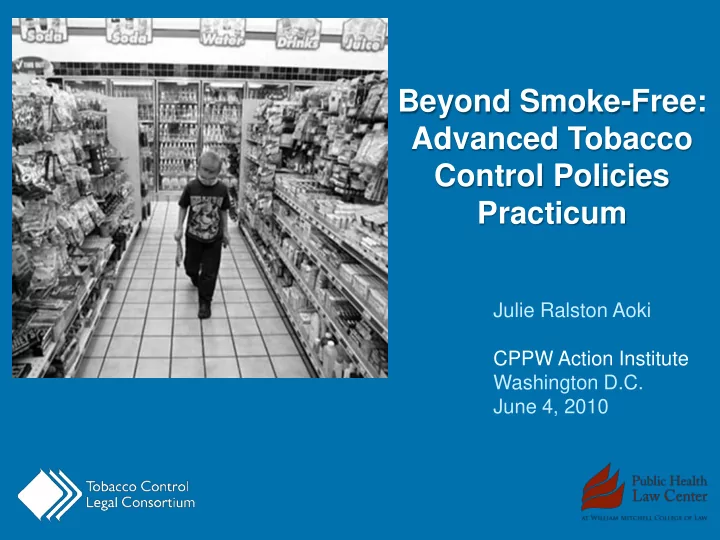
Beyond Smoke-Free: Advanced Tobacco Control Policies Practicum Julie Ralston Aoki CPPW Action Institute Washington D.C. June 4, 2010 www.PublicHealthLawCenter.org The Tobacco Control Legal Consortium The legal network for tobacco control

slide-1
SLIDE 1

Beyond Smoke-Free: Advanced Tobacco Control Policies Practicum

Julie Ralston Aoki CPPW Action Institute Washington D.C. June 4, 2010

slide-2
SLIDE 2

www.PublicHealthLawCenter.org

slide-3
SLIDE 3

The Tobacco Control Legal Consortium

The legal network for tobacco control policy.

slide-4
SLIDE 4

Education, Training and Materials

  • Legal Update
  • Law Synopses
  • Fact Sheets
  • Sample language
  • Case law
  • www.PublicHealthLawCenter.org
slide-5
SLIDE 5

Analysis, Interpretation, Education

www.tclconline.org – Federal Regulation of Tobacco Collection

slide-6
SLIDE 6

Perspective

  • Your mission, should you choose to accept it

(or, what I’m covering in this session):

  • Retailer location & density
  • Price promotions in the retail environment
  • Issues related to ads & promotions in the retail

environment

slide-7
SLIDE 7

Retailer Location & Density

Approach to take depends on many factors, including:

  • Legal landscape
  • Political

landscape

  • Goal(s)
  • Evidence base
slide-8
SLIDE 8

Licensing or Zoning?

http://www.phlpnet.org/healthy- planning/products/general-plans- and-zoning www.tclconline.org (publications, law synopses)

slide-9
SLIDE 9

Licensing or Zoning?

Power/Authority

  • Preemptive state law

regarding sale of tobacco products?

  • If not, home rule powers? Or

specific powers only granted by statute?

  • What’s been done in the past

with either tobacco or other products, such as alcohol?

slide-10
SLIDE 10

Licensing or Zoning?

Political Support

  • Who makes licensing decisions

in your jurisdiction? Zoning decisions?

  • Who would be most receptive?
  • Would one approach be easier

to “sell” to the community?

  • Who enforces these laws in

your community?

  • Are there issues related to

county/city overlap?

slide-11
SLIDE 11

Things to Consider Before Drafting

slide-12
SLIDE 12

Things to Consider Before Drafting

Findings/evidence –

  • What’s the problem?
  • How will this address it?
  • Is community-specific data available?
  • General studies?
slide-13
SLIDE 13

Things to Consider Before Drafting

Clear definitions and provisions –

  • What type of establishment (all

retailers, certain retailers)?

  • What is a ―playground‖ or a ―youth-
  • riented‖ facility?
  • If impose limitations based on number
  • f feet, how will that be measured?
slide-14
SLIDE 14

Things to Consider Before Drafting

What will you do about existing businesses?

  • Takings issues
  • Licenses: Limits on transferability?
  • Zoning: Conditional Use Permits

(CUPs) or ―Deemed Approved‖?

slide-15
SLIDE 15

The

slide-16
SLIDE 16

Things to Consider Before Drafting

What will you do about existing businesses?

  • Takings issues
  • Licenses: Limits on transferability?
  • Zoning: Conditional Use Permits

(CUPs) or ―Deemed Approved‖?

slide-17
SLIDE 17

Ho How w Does Zo Zoni ning ng Wor Work? k?

Each zoning g categ egory ry lists:

  • Permitt

mitted ed Uses

  • Prohibited

ibited Us Uses

  • Conditi

ition

  • nally

ally-per permitted mitted uses (CUP)

slide-18
SLIDE 18

Wh What is is a a CU CUP? P?

Individ vidual ual determ rminat nation ion of suitabil bilit ity y

  • Use must be legal

al under zoning ng law

  • Permit

mit ca can be denied d based on site-specifi pecific c fact ctor

  • rs
  • Permit

mit ca can be grante ted, d, with co condit itio ions ns impos

  • sed,

ed, such ch as:

  • No

No self-ser ervi vice ce displays ays

  • Follo

low w all tobacc acco

  • co

contr trol

  • l laws
  • If co

condit itio ions ns violat ated ed, , permit mit ca can be suspend nded ed or even revoked

  • ked
slide-19
SLIDE 19

Exa xample les s of C f CUP UPs

Lafayette, CA Milpitas, CA Oakland & Los Angeles, CA

slide-20
SLIDE 20

Exa xample les s of C f CUP UPs

  • Encinitas, CA
  • Marin County,

Pasadena, and San Rafael, CA

  • Mountain View, CA
  • Novato and

Oakland, CA

  • Henderson, NV

(non-exhaustive list)

slide-21
SLIDE 21

The

slide-22
SLIDE 22

CUP or ―Deemed Approved‖?

CUP

  • Usually apply to new uses (e.g., new retailers who will have to comply

with the new conditions)

  • Existing uses
  • Grandfather (wait-out; usual approach due to takings concerns) =

“legal non-conforming use”

  • Attrition
  • Allowed to remain for its natural life, but cannot be changed,

altered, or expanded

  • May be limits on transferability and ability to continue after
  • perations cease
  • Amortization (phase-out; rare, not allowed in some states)
  • Immediate elimination of use (buy-out; less common)

“Deemed Approved”

  • Newer, novel approach
  • Can still operate, but CUP conditions apply
slide-23
SLIDE 23

Summary: Location & Density

  • Approach depends on:
  • Goals
  • State law
  • Local government’s authority
  • Have evidence of the problem
  • Be able to articulate why your

approach is reasonable

  • Write the law clearly and define terms
  • Talk to local counsel about what might be the best way to

deal with applying (or not) the law to existing businesses

slide-24
SLIDE 24

Other uses for licensing or zoning codes

  • Regulate outdoor signage and

window signs at POS

  • Regulate placement of product

within stores near schools

  • Self-service display bans
  • Vending machine sales bans
  • Ban sales of loosies
  • Tobacco product look-a-like bans
  • Restrict distribution of free

samples

slide-25
SLIDE 25

Goals

  • Limit number of retailers?
  • Regulate density of retailers?
  • Decrease access by children?
  • Other?

Evidence?

  • What do you have, what do you need?

Power/Authority

  • Preemptive state law regarding sale of tobacco

products?

  • If not, home rule powers? Or specific powers only

granted by statute?

  • What’s been done in the past with either tobacco or
  • ther products, such as alcohol?

Political Support

  • Who makes licensing decisions in your jurisdiction?

Zoning decisions?

  • Who would be most receptive?
  • Would one approach be easier to ―sell‖ to the

community?

  • Who enforces these laws in your community?
  • Are there issues related to county/city overlap?
slide-26
SLIDE 26

Retail Price Promotions

slide-27
SLIDE 27

At Least Two Possible Options

www.trinketsandtrash.org

slide-28
SLIDE 28

Coupon Regulations

Possible Approaches

  • Prohibit distribution of

coupons in public areas and in private areas open to the public (with some exceptions for distribution to adults in some circumstances)

  • Prohibit the

redemption of coupons in retail stores

slide-29
SLIDE 29

Minimum Price Laws

  • Less opportunity for

price manipulation after tax increases

  • BUT creative

approaches to get around minimum price laws, such as:

  • Buy-downs
  • Master-type

programs

slide-30
SLIDE 30

Some Legal Issues to Consider

  • Preemptive state law regarding

price, sale, promotion of tobacco products?

  • If not, home rule powers? Or

specific powers only granted by statute?

  • Constitutional issues
slide-31
SLIDE 31

What’s been done in your state/county/city on these issues? If you think that you want to pursue some of these options, do you know whether you have power/authority to act?

  • Preemptive state law?
  • If not, home rule powers? Or specific powers only

granted by statute? All else being equal, is there one of these policy

  • ptions (or another option that we haven’t discussed)

that might seem like a good fit for your jurisdiction?

slide-32
SLIDE 32

Retail Ads & Promotions

  • Brief background information about

the law

  • Three policy options that seem

most legally defensible throughout the country

slide-33
SLIDE 33

Legal Background

slide-34
SLIDE 34

FCLAA – The Federal Cigarette Labeling & Advertising Act

The FCLAA provision: State or local governments may impose:

  • specific bans or restrictions
  • on the “time, place, and manner,”
  • “but not content,”
  • of the advertising or promotion of any cigarettes
slide-35
SLIDE 35

FCLAA

―Time‖

OR

slide-36
SLIDE 36

FCLAA

―Place‖

slide-37
SLIDE 37

FCLAA

―Manner‖

www.tobaccoinaustralia.org.au

slide-38
SLIDE 38

FCLAA

―But not content‖

www.trinketsandtrash.org

slide-39
SLIDE 39

FCLAA Summary

OK

  • Regulating time,

place or manner

  • f cigarette ads
  • Regulating non-

cigarette labels & ads NOT OK

  • Regulating the

content of cigarette ads

  • Cigarette label

requirements

slide-40
SLIDE 40
slide-41
SLIDE 41

1st Amendment

Protection Levels

slide-42
SLIDE 42

1st Amendment

Commercial Speech: “Speech related to the economic interests of the speaker”

slide-43
SLIDE 43

1st Amendment

Commercial Speech

www.trinketsandtrash.org

snus-news.blogspot.com

slide-44
SLIDE 44

www3.hants.gov.uk/underagesale s/underagesales- tobaccoretailers.htm

slide-45
SLIDE 45

Government Speech

slide-46
SLIDE 46

The Surgeon General Says:

Smoking Isn’t Cool.

Government Speech

slide-47
SLIDE 47

Government Speech

No test!!

But it must be VERY clear the government is the one giving the message.

slide-48
SLIDE 48

Government Speech

slide-49
SLIDE 49

Government Speech

Drafting tips

  • Warning must clearly be coming from

the government.

  • Say how the government made its

conclusions about the health effects

  • f using tobacco.
  • It doesn’t matter if the law requires

the manufacturer or retailer to pay for the ad.

slide-50
SLIDE 50

www3.hants.gov.uk/underagesales/underagesales-tobaccoretailers.htm

Compelled Factual Speech

slide-51
SLIDE 51

Compelled Factual Speech

Zauderer test

The required warning is:

  • 1. Strictly factual,
  • 2. Not controversial (undisputed), and
  • 3. Reasonably related to

a legitimate government interest.

slide-52
SLIDE 52

Compelled Factual Speech

Drafting tips

  • Include only indisputable facts.
  • Facts must be backed up by

research.

  • Warning or disclosure must be

intended to protect citizens’ health.

  • Show that consumers likely to be

deceived or otherwise harmed without the factual warning.

slide-53
SLIDE 53

www.trinketsandtrash.org

Conduct—Compelled or Restricted

liq.wa.gov/tobacco-new/faq.aspx

slide-54
SLIDE 54

Conduct—Compelled or Restricted

Why was the law enacted?

www.ehow.com/how_4732940_talk-much.html

slide-55
SLIDE 55

Conduct—Compelled or Restricted

O’Brien test

  • 1. Government has authority,
  • 2. Substantial government interest,
  • 3. Unrelated to suppressing free

expression, and

  • 4. The incidental restriction on speech is

no broader than necessary.

slide-56
SLIDE 56

Conduct—Compelled or Restricted

Drafting Tips

  • Clearly state the need for the law.
  • Purpose can’t be to limit communication.
  • Meet goal without unnecessary impact
  • n expression.
  • Findings must support that the law’s

purpose is to do something other than suppressing speech.

slide-57
SLIDE 57

The FCLAA and First Amendment hurdles can be

  • vercome with

careful drafting.

http://www.flickr.com/photos/livcheng/3804138060/

slide-58
SLIDE 58

Three possible policy options

  • Requiring retailers to post a P.O.S. warning from the

government about the harms of tobacco use

  • Requiring retailers to post a P.O.S. sign indicating that

tobacco use is harmful

  • Requiring tobacco packages to be displayed in a

certain way or banning self-service tobacco displays Discuss

  • Do any of these three seem like a good fit for your

jurisdiction? Any others?

  • If thinking about the second or third options, do you

have evidence for why the law is needed?

slide-59
SLIDE 59

A few final words . . .

The three great essentials to achieving something worthwhile:

  • hard work
  • stick-to-itiveness
  • common sense

http://www.archives.gov/exhibits/american_originals_iv/images/thomas_edison/thomas_edison.jpg

slide-60
SLIDE 60

Julie Ralston Aoki

www.publichealthlawcenter.org publichealthlaw@wmitchell.edu