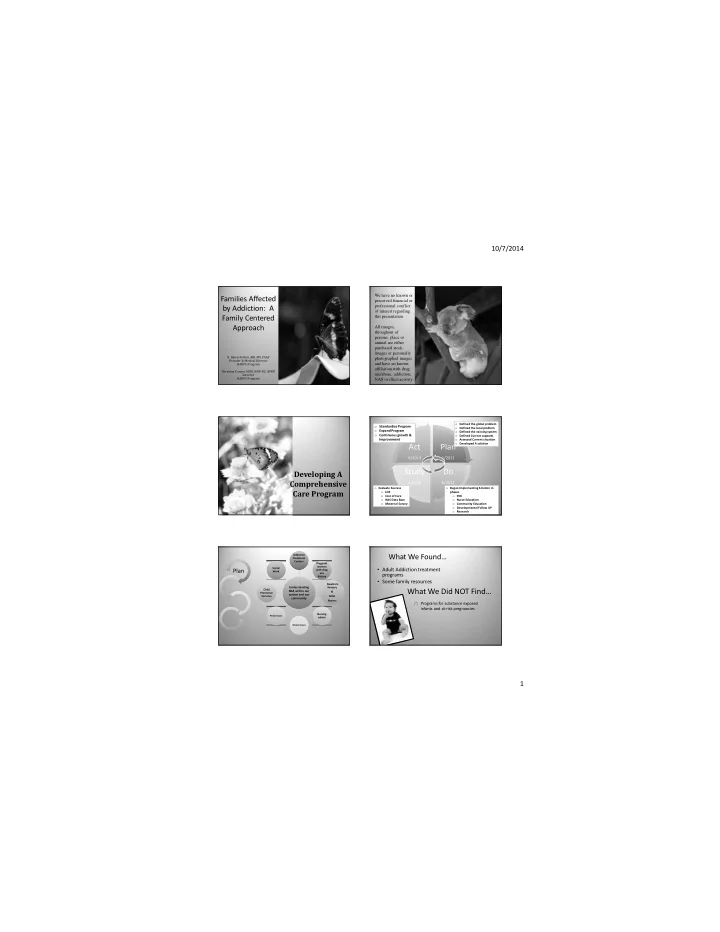
Act Act Plan Plan 6/2013 6/2013 1/2011 1/2011 Study Study - - PDF document

act act plan plan
SMART_READER_LITE
LIVE PREVIEW

Act Act Plan Plan 6/2013 6/2013 1/2011 1/2011 Study Study - - PDF document

10/7/2014 We have no known or Families Affected perceived financial or professional conflict by Addiction: A of interest regarding Family Centered this presentation Approach All images, throughout of persons, place or animal are either


slide-1
SLIDE 1

10/7/2014 1

  • K. Dawn Forbes, MD, MS, FAAP
Founder & Medical Director HARPS Program Christine Cooper, MSN, NNP-BC, APRN Director HARPS Program

Families Affected by Addiction: A Family Centered Approach

We have no known or perceived financial or professional conflict
  • f interest regarding
this presentation All images, throughout of persons, place or animal are either purchased stock images or personally photographed images and have no known affiliation with drug use/abuse, addiction, NAS or illicit activity.

Developing A Comprehensive Care Program

Plan

1/2011

Plan

1/2011

Do

6/2011

Do

6/2011

Study

1/2013

Study

1/2013

Act

6/2013

Act

6/2013
  • Defined the global problem
  • Defined the local problem
  • Defined the existingsystem
  • Defined Current supports
  • Assessed Current situation
  • Developed A solution
  • Began Implementing Solution in
phases
  • PNC
  • Nurse Education
  • Community Education
  • Developmental Follow UP
  • Research
  • Evaluate Success
  • LOS
  • Cost of Care
  • NAS Data Base
  • Maternal Survey
  • Standardize Program
  • Expand Program
  • Continuous growth &
Improvement Understanding NAS within our system and our community Understanding NAS within our system and our community Addiction Treatment Centers Addiction Treatment Centers Pregnant women with drug use history Pregnant women with drug use history Newborn Nursery & NICU Nurses Newborn Nursery & NICU Nurses Nursing admin Nursing admin Obstetricians Obstetricians Pediatricians Pediatricians Child Protective Services Child Protective Services Social Work Social Work

Plan

  • Adult Addiction treatment

programs

  • Some family resources

What We Found… What We Did NOT Find…

Programs for substance exposed infants and at-risk pregnancies
slide-2
SLIDE 2

10/7/2014 2

  • 4 Treatment Centers
  • Several pain clinics/prescribing pain

management MDs – Inconsistent, inaccurate or NO information about NAS – 2 treatment options

  • Detoxification
  • Maintenance
– Structured counseling/therapy during treatment – Deferred Payment during pregnancy
  • Rapid weaning for failure to pay after pregnancy
  • Changing clinics
  • Unstable treatment

What We Learned…

Many misconceptions… “Babies rarely have problems if your in treatment” “My first child did not withdraw so none of my babies will withdraw” “I am on a low dose so my baby will be fine” “I was told I can not breast feed if on methadone” “I don’t know what NAS is, but I don’t think my baby can catch it” When asked how they feel about delivering at a hospital.. “The hospital just wants to take away my baby” “The staff is mean and treats me bad” “I've been clean and in treatment for X years but everybody still treats me like I want to hurt my baby” Pregnant women with drug use history In general these moms where: Misinformed Carried extreme guilt Defensive Stigmatized Did not know Their infant was at a significant risk for NAS That NAS could require prolonged hospitalization interfere with bonding symptoms could last 6-9 months In-utero drug exposure, regardless of NAS, carried a risk of developmental issues Pregnant women with drug use history

Increased NAS Change in focus of care Limited staffing in the Nursery & NICU Limited or over burdened resources Social Work CPS WIC

Paradigm Shift in NICU Care

Nursing  Dealing with momsaddiction  Falling asleep while holding or providing care  Dealing with momswithdrawal  Maternal rapiddetox due to failure to pay  Return to illicit use  Breast feeding while mom is on medication/in treatment  Maternal Post Partum Depression (PPD)  Risk factors for child abuse  Limited parentingskills  Concernsof developmental outcomesof these infants which may be worsened by the home environment Nursing

Plan

 Paucity of evidence based best-practice guidelines  Significant addiction related stigma and misconceptions limiting help seeking  Inconsistent Scoring  Inconsistent, ineffective and insufficient maternal education about NAS/in-utero drug exposure  Insufficient long term developmental follow up  Limited funding  Poor Communication between all providers:  Obstetricians, Addiction Treatment Centers, Social Work/Child Protective Services, Pediatricians, Neonatologist  No Transparency between “the system” and families  No perceived Accessibility to the families  Increasing cost  Increasing length of stay  Increasing nursing frustration Define Problem/Etiologies…
slide-3
SLIDE 3

10/7/2014 3

Do

Helping At-Risk Pregnancies Succeed Program  Offered by Kosair Children’s Hospital Neonatal Specialist  A group of 15 neonatologist, 3 pediatricians and 6 neonatal nurse practioners  Covering NICUs in Louisville, Frankfort, Henderson and Southern Indiana areas  One of the few programs in the Nation  Comprehensive care for infants at risk of NAS from 1st trimester to 3 year developmental follow up offer at no cost HARPS Program Helping At-Risk Pregnancies Succeed Founder/Medical Director: Dawn Forbes, MD Director: Chris Cooper, APRN Pre-Natal Consultation 1st Trimester Monthly f/u calls SITC Group Counseling OB/Peds/Rx Centers Referrals Evidence Based NICU/NBN Care Standardized scoring Standardized Treatment protocol Parent Contract Bed Side Family Folder Comfort Care Environment/ NAS Unit Home Methadone Treatment Strict qualifications Developmental Follow Up BayleyII 0-3yrs old Nursing Education Finnegan Scoring/ FNAST Dialoguing *NAS Core Competency Nursing NAS Updates Community Outreach *Regional Hospital conferences *DCBS Training *OB/Peds support/reso urce *SITC pre- conception counseling *Court Referral Program *Middle/Hig h School education Research/Dat a Collection NAS Data Base National Survey (manuscript pending) SRSP student research MPH Intern Research *Treatment Protocol *RADARS Annual Conference EvidenceBased Best Practices 1st 10/19/2011 2nd 9/27/2012 3rd 3/2013 Phase 1 Phase 4 Phase 2 Phase 3

Comprehensive Care

  • 1. Preconception
  • 2. Pregnancy
  • 3. At birth
  • 4. Postpartum care and care for neonate/infant

Comprehensive Care

Preconception Universal screening at all primary care visits (GP, GYN) Referral to an effective treatment program if substance abuse noted Encourage delayed fertility till stable in treatment Educate regarding the risks of substance abuse in pregnancy and to the fetus

Comprehensive Care

Pregnancy

Referral of pregnantwomen to substanceabuse services Services to ensuregood pre-natal care and nutrition Coordinatingcare, ensuringmoms physical and psychological diagnosis are treated Universal screening OB TreatmentCenters Primary Care

Comprehensive Care

Pregnancy

Pre-natal consultation regarding effects of drug abuse and MAT to fetus/newborn In Office On-Site at Addiction Treatment Centers In-Hospital Upon admission to NBN and/or NICU

slide-4
SLIDE 4

10/7/2014 4

Pre-natal Consults Pre-natal Consults

! 1. Saves!Money!! a. Most!cost!effective!nutrition!available! b. Saves!$500/year!(Formula!cost!>$1200/year)! c. Decreases!doctors!visits!and!the!added!cost!of!health!care/medicine!! d. Decreases!missed!days!from!work!due!to!infants!illness! 2. Environmentally!friendly! a. Naturally6 renewable! b. Requires!no!packaging!or!disposal! 1. BF!does!NOT!likely!decrease!NAS!directly! a. Minimal/minute!amounts!of!methadone!cross!into!the!BM! 2. BM!is!better!tolerated!and!indirectly!decreases!symptoms!of!withdrawal! a. Decreased!reflux,!gas,!diarrhea,!constipation,!diaper!rash!which!leads!to!lower!NAS!scores! b. Better!tolerated!resulting!in!better!growth!and!nutrition!and!post!feed!sleep!which!leads!to!lower! NAS!scores! c. Lower!NAS!scores!result!in!lower!concentration/doses!of!medicine!needed!to!treat!the!infants! withdrawal! ! 1 1. The!AAP!states!that!use!of!the!following!drugs!are!contraindicated!in!breast!feeding! 1:! a. Marijuana! b. Cocaine! c. PCP! d. Unmonitored/non6prescribed!opiate!use! The!AAP!states!that!breast!feeding!is!NOT!recommended!when!moms!are!taking! amphetamines. The AAP states that although maternal smoking is not an absolute contraindication to breastfeeding, it should be “strongly discouraged” due to increased risk of respiratory illnesses and Sudden Infant Death Syndrome (SIDS). Smoking also can lead to low maternal milk supply and poor infant weight gain. 1 Although!no!direct!statement!from!the!AAP,!based!on!limited!data,!it!is!felt!to!be!safe!to!continue!breast! feeding!while!in!a!physician!monitored!buprenorphine,maintenance!program.! ! ! e x c l u s i v e f i r s t , 6 , m
  • n
t h s 1 1 Frequency of NAS Symptoms SYMPTOMS Frequency (%) COMMON High pitch/excessive cry 95 Continuous (high pitch) cry 54 DECREASED SLEEP Sleeps < 1 hour after feeds 65 Sleeps < 2 hours after feeds 66 Sleeps <3 hours after feeds 58 Hyperactive moro refles 62 TREMORS Mild tremors distrubed 96 Mod/Severe tremors disturbed 95 Sneezing (>3-4 in 4 hours) 83 Mild tremors undistrubed 77 Mod/Severe tremors undistrubed 67 Reflux/emesis 74 Increased muscle tone 82 Poor feeding 65 Excessive sucking 79 Respiratory rate > 60/Fast breathing 66 Loose stools 51 Sweating 49 LESS COMMON Excoriation 43 Projectile vomiting 12 Watery stools 12 Fever 29 Frequent Yawning (> 3-4 in 4 hours) 30 Mottling 33 Nasal stuffiness 33 If early symptoms not Respiratory rate > 60 with distress 28 treated infant can Dehydration 1 1 A Few Facts for Families 1. Families and friends may not understand that addiction is a disease. Below is some information that may help explain addiction. a. The American Society ofAddictionMedicine (ASAM) defines addiction as a Chronic Disease of brain reward, motivation,memory and related circuitry. b. Addiction, in part, is causedby high-risk life-style choices. It is similar to other illness caused by life- style choices, such as type 2 diabetes. For example both addiction and type 2 diabetes: i. Have a genetic component andoccur in families ii. Require life style changes to prevent and/or treat iii. Require medicine and life style changes to treat and treatment canbe life-long iv. Bothcan cause complications during pregnancy v. Both can cause symptoms in a newborn that require prolonged hospital/NICU care vi. No one Chooses to get addiction or Type 2 Diabetes 2. Being in treatment is safe for mom & baby during pregnancy. a. Being on a “pure form” of medicine gives the mom and baby a steady level of the drug and prevents on and off withdrawal b. Remember that ifmom is withdrawing, so is the baby 3. Baby’s are NOT BORN ADDICTED, but they can go through withdrawal in utero and after birth a. The sudden stop in the medicine/drug at birth (once the umbilical cordis cut) causes the baby to go “cold turkey” and withdrawal symptoms can occur 4. Neonatal Abstinence Syndrome (NAS) is a group of symptoms seen in babies exposed to certain substances during
  • pregnancy. These symptoms happen because the infant is either going through withdrawal, as seen in exposure
to opiates, caffeine, nicotine, barbiturates or SSRIs; or because the infant is experiencing toxicity from drugs such as cocaine or amphetamines. 5. All babies exposed to certain drugs/medicines during pregnancy will experience at least some withdrawal symptoms. a. 40% of babies will have mild symptoms that getbetter with“comfort care measures” (see handout) b. 60% of babies will have severe symptoms and require treatment with medicine and prolonged hospital stay 6. Moms “Dose” DOES NOT predict how bad the baby’s symptoms will be or if the baby will need medicine. How bad the baby’s withdrawal becomes is based on: a. How quickly the mom and the baby metabolize the drug/medicine b. The type of drug/medicine the mom takes during pregnancy 7. During pregnancy mom’s metabolism and blood volume will increase. These changes cancause moms to need a higher dose of medicines,including methadone and buprenorphine, to prevent withdrawal and/or craving. Page 1 of 2 !! ! Risks!associated!with!Tobacco/Cigarette!Smoking1! !!!!!!!!!!!!!!!!!!!!!!!!!!!!! ! Risks! during! Pregnancy:!!!!
  • ! Risks!to!
the!Baby!after!birth! IF!exposed!to!cigarette!smoke!during!pregnancy:!
  • "
" " " "
  • "
  • ! Risk to baby if mom is smoking and breast feeding 2:!
  • The AAP states that although maternal smoking is not an absolute contraindication to
breastfeeding, it should be “strongly discouraged” due to:! " Sudden Infant Death Syndrome (SIDS)! " Decreased maternal milk production/supply ! " Poor infant weight gain! Pediatrics * Revised 8/14/2014 Page 2 of 2! ! ! ! ! ! Risks!associated!with!Tobacco/Cigarette!Smoking! ! ! ! ! 2nd!hand!Smoke!exposure!during!Pregnancy!can!cause:!
  • Poor!fetal!growth!(20%)!
! ! ! 2nd! hand!Smoke!Exposure! to!Newborn!&!Mom! can!cause:!
  • SIDS!(Crib!
Death)!
  • Respiratory!illness!(colds,!pneumonia)!
  • Ear!infection!
  • Asthma!
  • Decreased!lung!growth!
  • Lung!Cancer!(30%)!!
  • Heart!disease!(30%)!
  • Increased!risk!of!smoking!as!a!teenager!
! ! EG Cigarettes!
  • Not!regulated!by!
the!FDA!
  • Puffing!activates!the!heating!device,!vaporizing!the!liquid!which!can!then!be!inhaled!
  • Little!data!on!health!risk!
to! mom,!pregnancy!or!baby!
  • Testing!has!
found!carcinogens!in!the!vapor!
  • Refillable!cartridges!can!expose!to!harmful!nicotine!levels
NAS Scores < 5 NAS Scores 5-7 NAS Scores > 8 1. Routine NB Care 2. Newborn discharge criteria 3. Discharge on DOL 3-4 4. Contact Pediatrician with Early follow-up 5. Developmental Clinic at 1, 3, 6, 9-18 and 36 months 6. Communicate to moms care providers 1. Routine NB Care 2. Supportive Care v Breast feeding/Sensitive formula, mylicon, small volume/frequent feeds v Quiet, low stimulus environment v Soothing music, swings, swaddling 3. Investigate other causes for symptoms v Non-Opiate Withdrawal (Caffeine, nicotine) v Infection 4. Discharge on DOL 4-5 5. Contact Pediatrician with Early follow-up 6. Home health visit 1-2 per week x 2 weeks for scoring; to assess feeding and weight gain; and provide support 7. Developmental Clinic at 1, 3, 6, 9-18 and 36 months 8. Communicate to moms care providers 1. Admit to NICU for withdrawal treatment
  • A. Medicines:
v Treated with morphine and clonidine v Morphine is decreased and stopped as infant tolerates v Clonidine will bestopped based on
  • symptoms. Some infants may go home on
clonidine. v Monitor 48-72hrs off morphine before discharge home
  • B. Supportive Care:
v Breast feeding/Sensitive formula, mylicon, small volume/frequent feeds v Increased calories v Quiet, low stimulus environment v Soothing music, swings, swaddling v Environment that includes parents as an essential part of the care team 2. Discharge usually 3-4 weeks 3. Contact Pediatrician with Early follow-up 4. Home health visit 1-2 per week x 2 weeks for scoring; to assess feeding and weight gain; and provide support 5. Developmental Clinic at 1, 3, 6, 9-18 and 36 months 6. Communicate to moms care provide NAS Scoring Categories vWell babies are admitted to thenewborn nursery to allow: voptimal bonding vbreast feeding vparental involvement in care vUrine and meconium toxicology screens are submitted vSocial work is consulted vFinnegan scoring is initiated at 4 hrs or when symptoms observed Revision 5/14/2014 NAS$ Morphine$ Practice$ Guidelines$ Appendix$ 3:$ Maternal$ History/Information$ Maternal$ Demographics: ! ! ! ! ! ! ! ! ! ! ! ! ! ! ! ! ! ! $ Current$ Pregnancy$ Complications$ (Check$ all$ that$ apply) ! ! ! ! ! ! ! ! ! Previous$ Pregnancy$ Complications$ (Check$ all$ that$ apply) ! ! ! Psychiatric$ history$ w/Treatment$ (Check$ all$ that$ apply):$ $ $ ! ! ! ! ! ! ! ! ! ! Other$ Medical$ History$ $ w/Treatment$ (Check$ all$ that$ apply):$ $ $ ! ! ! N A S $ M
  • r
p h i n e $ P r a c t i c e $ G u i d e l i n e s $ A p p e n d i x $ 3 : $ M a t e r n a l $ H i s t
  • r
y / I n f
  • r
m a t i
  • n
$ Pregnancy$ History:$ $ $ OB:'___________________________'Date'of'1st'PNC?'_____________________G:'_______,'P:'________(Term:'________,'Preterm:'________,'Ab:'________)' EDC:'_____________________________'''MFM'Consult'!'No'!'Yes'Dx:''___________________________________________.''' Meds'during'pregnancy:_____________________________________________________________________________________________________________________' Delivery'Hospital:'______________________________'''''Selected'Pediatrician:'___________________________' Previous$ pregnancies$ w/drug$ exposure?'!'No'!'Yes.'What'drug?'____________________________________''Prescribed:'! 'Yes'! 'No'' '''If'yes,'did'infant'have'NAS?'! 'No'! 'Yes.'If'NAS,'how'long'infant'hospitalized?'___________wks/days.''' '''Was'infant'treated'w/medicine?''! 'No''! 'Yes.'If'yes,'which'drug?'''!'Morphine''!'Methadone'! 'Clonidine'! 'Other'_________' Current$ Maternal$ Urine$ drug$ screen:$ $ Negative'_____;'Positive_______!'THC'!'Methadone'!'Subutex'!'Cocaine'!'Heroin e''!'Opiat e s ' ( l i s t ' _ _ _ _ _ _ _ _ _ _ _ _ _ _ _ _ _ _ _ _ _ _ _ _ _ _ _ _ _ _ ) ' ! ' O t h e r : ' _ _ _ _ _ _ _ _ _ _ _ _ _ _ _ _ ' Current$ Neonatal$ $ Urine$ drug$ screen:$ $ Negative'_____;'Positive_______!'THC'!'Methadone'!'Subu t e x ' ! ' C
  • c
a i n e ' ! ' H e r
  • i
n e ' ' ! ' O p i a t e s ' ( l i s t ' _ _ _ _ _ _ _ _ _ _ _ _ _ _ _ _ _ _ _ _ _ _ _ _ _ _ _ _ _ _ ) ' ! ' O t h e r : ' _ _ _ _ _ _ _ _ _ _ _ _ _ _ _ _ ' Current$ Neonatal$ Meconium$ drug$ screen:$ $ Negative'_____;'Positive_______!'THC'!'Methadone'!'Subutex'!'Cocaine'!'Heroin e''!'Opiates'(list'______________________________)'!'Other:'________________' Maternal$ Drug$ Use/Abuse$ History$ (Illicit,$ prescribed$
  • r$
maintenance$ treatment):$ $ 1.''Medication'Assisted'Treatment'(MAT):$ $ ! 'No'! 'Yes'@'! 'CBH'! 'SITC'!'JDAC'! 'Moore'!'Other'_________________________$ ' If'yes:'! 'Methadone'_____________mg'! 'Buprenorphine''_____________'mg'!'other'______________mg$ 2.''Drugs'of'abuse/use:''' ' Drug''#1:'__________________________dose:________________.''Dates'started:'__________________''Last'date'of'use:'__________________' ' '''Reason'for'drug:'!'illicit'! 'Prescribed'for'_________________________________________________________' ' Drug'#2:'______________________________dose:_______________.''Dates'started:'____________________''Last'date'of'use:'______________' ' '''Reason'for'drug:'! 'illicit'! 'Prescribed'for'_________________________________________________________' ' Drug'#3:'______________________________'dose:'______________.''Dates'started:'____________________''Last'date'of'use:'______________' ' '''Reason'for'drug:'!'illicit'!'Prescribed'for'_________________________________________________________' 3.''Other'Substances/frequency:''' ' !Alcohol__________oz/day'!'Tobacco'____________cigs/day' 'Caffeine Comments:$ ______________________ ______ P l a c e ' i n f a n t ' p a t i e n t ' s t i c k e r ' h e r e '

Comprehensive Care

At Birth

Universal Drug Screening of mothers on admission? Drug screening for infants at risk Monitoring infants for withdrawal signs using a validated scoring tool Family centered care and availability of support services Ensuring mom remains in treatment Coordinating care between neonatolist, pediatrician, OB, maternal treatment center, social services, Child protective services Evidence based bedside nursing care Evidence based treatment

Scoring Tool

 Scoring Tools for NAS evaluation allow periodic, recurrent, systemic, & objective evaluation of an infant at-risk.  3 most common tools:
  • 1. The Finnegan Neonatal Abstinence Scoring System
 31 item scale with symptoms weighted from 1-5  Score of 8 or greater indicates need for pharmacologic therapy  Most comprehensive of scales  Negative: Too cumbersome for routine use in some nurseries
  • 2. The Lipsitz Neonatal Drug-Withdrawal Scoring System
 11 item scale with symptoms weighted 0–3  Score of 4 as recommended for the institution of pharmacologic therapy  Has been recommended by the American Academy of Pediatrics  Negative: Subjective ratings of gross symptoms, 4 items are yes/no responses
  • 3. Ostrea tool
 6 item simple ranking (rather than numeric) scale  Easy to use  Negative:  does not allow for cumulative effect of multiple symptoms  Offers no guidelines for pharmacologic therapy  Insufficiently comprehensive Other Tools  The Neonatal Withdrawal Inventory  8 point checklist of 7 NAS symptomswith a 4 point behavioral distress scale  Pharmacotherapy with a score of 8  The Neonatal Narcotic Withdrawal Index  6 signs of NAS plus an “other” category of 12 signs weighted 0-2  Score of ≥5 indicates pharmacotherapy

Scoring Tool

Regardless of tool Essential to provide training

slide-5
SLIDE 5

10/7/2014 5

NAS Scores < 5 NAS Scores > 8 1. Routine NB Care 2. Newborn discharge criteria 3. Discharge on DOL # 3-4 4. Contact Pediatrician with Early follow-up 5. Developmental Clinic at 1, 3, 6, 9-18 and 36 months 6. Communicate to moms care providers 1. Routine NB Care 2. Supportive Care  Breast feeding/Sensitive formula, mylicon, small volume/frequentfeeds  Quiet, lowstimulus environment  Soothing music, swings, swaddling 3. Investigate othercausesforsymptoms  Non-Opiate Withdrawal (Caffeine, nicotine)  Infection 4. Discharge on DOL 4-5 5. Contact Pediatrician with Early follow-up 6. Home health visit 1-2 per week x 2 weeks for scoring; to assessfeeding and weight gain; and provide support 7. Developmental Clinic at 1, 3, 6, 9-18 and 36 months 8. Communicate to moms care providers 1. Admit to NICU forAbstinence Treatment
  • A. Medicine:
 Start morphine & clonidine  Increase Morphine as needed  Once smptoms stable, then wean morphine every 24-48 hrs till off  Monitor48 hrs off morphine before discharge
  • B. Supportive Care:
 Breast feeding/Sensitive formula, mylicon, small volume/frequentfeeds  Increased calories  Quiet, lowstimulus environment  Soothing music, swings, swaddling  Environment that includes parents as an essential part of the care team 2. Discharge usually3-4 weeks 3. Contact Pediatrician with Early follow-up 4. Home health visit 1-2 per week x 2 weeks for scoring; to assessfeeding and weight gain; and provide support 5. NeonatalHigh Risk Clinic for evaluation ofgrowth, behavior,and development at 1 month of age. 6. Developmental Clinic at 3, 6, 9-18 and 36 months 7. Communicate to moms care provide NAS Scoring Categories Well babies are admitted to the newborn nursery to allow: optimal bonding breast feeding parental involvementin care Urine and meconium toxicology screens are submitted Social work is consulted Finnegan scoring is initiated at 4 hrs or when symptoms Observed NAS Scores 5-7

Comprehensive Care

At Birth

Universal Drug Screening of mothers on admission? Drug screening for infants at risk Monitoring infants for withdrawal signs using a validated scoring tool Family centered care and availability of support services Ensuring mom remains in treatment Coordinating care between neonatologist, pediatrician, OB, maternal treatment center, social services, Child protective services Evidence based bedside nursing care Evidence based treatment

Interacting with Families of Addiction

 Health care providersoften have little understandingof addiction & NAS as disease  Families of addiction  Have difficulty retaininginformation  Require frequent reinforcement of information (Rules/scoring/care parameters)  These families respond well to pre-defined boundaries& expectations  And when they receive non-judgmental interactions  More likely to become involved with infants care  More likely to be open and up front about their addiction  More receptive to seeking community resources& help

Family Centered Care

! ! !Your!baby!has!been!admitted!to!the!Neonatal! Intensive! Care!Unit! (NICU)!because!he/she!is! experiencing!withdrawal!symptoms.! !These!symptoms!are!not! caused!by! addiction,!and!in!a! newborn,!withdrawal! is!called!Neonatal! Abstinence!Syndrome!(NAS).!!While!in!the!NICU!your!baby! will!be!treated! with!comfort!measures!and!most! likely!medication(s).!!Babies!need!to!stay!in!the! NICU!until!we!are!able! to!safely!stop!these! medications.! !! ! Please!understand!that! every!baby!in!the!NICU!needs!treatment!and!care!specific!to!their!illness.! ! Therefore! your!baby!may!have!a!different!schedule,!medicines!and!care!plan!than!other!babies! sharing!the!same!space.! ! As!parents! you! are!the!most!important! people!in!your!baby’s!life!and!are!an!important!part!of!the! care!team.!! ! As!part!
  • f!
the!team!it!is!important!for!you!to!understand!your! role!and!contribution!to!your!baby’s! care!plan.!Certain!limitations!and!guidelines!need!to!be!followed!closely!so!that!your!baby!may!get! better!as! soon!as!possible.! !These!guidelines!are!included!in!this! agreement!and!following!them!will! help!ensure!your!baby!receives!the! best!possible!care.! ! We!understand!that!withdrawal!is!a!sensitive!issue.!!We!are!not!allowed!and!will!not!share! information!about!your!baby’s!condition!without!your!permission.!!Therefore!it!is! important!to!let!us!know!who,! if! anyone,!may!receive!information!when!you!are!not! at! the! bedside.!!Also! we!need!to!know!if!it!is!ok!to!give! you!updates!about!your!baby!in!front!of! your!guest.!!Please!list! below!the!people!who!will! be!allowed!to!receive!information!about! your!baby.!! ! ! ! ! ! Please!initial:! ! _____!It! is!okay!to!give!me!updates!about!my!baby’s!condition!in!front!of!my!guests.! _____!It!is!NOT!okay!to!give!me!updates!about!my! baby’s!condition!in!front!of!my!guests.! ! MD/NNP!signature__________________________________!Print:!_____________________________________! ! Nurse!signature______________________________________!Print:! _____________________________________! ! Mother!signature____________________________________!Print:!______________________________________! ! Father/Significant!Other!signature_____________________________Print:!__________________________! Baby’s!Signature:! Foot!Print!here! Date:!____________________! Revised'5/7/2014' R e v i s e d ( 1 . S p a c e ! l i m i t a t i
  • n
s ! m a k e ! i t ! d i f f i c u l t ! t
  • !
m a i n t a i n ! a b s
  • l
u t e ! p r i v a c y ! a n d ! c
  • n
f i d e n t i a l i t y . ! ! I f ! y
  • u
! w
  • u
l d ! l i k e ! t
  • !
d i s c u s s ! y
  • u
r ! b a b y ’ s ! c
  • n
d i t i
  • n
!
  • r
! p l a n !
  • f
! c a r e ! i n ! a ! p r i v a t e ! s e t t i n g ! i n s t e a d !
  • f
! a t ! t h e ! b e d s i d e , ! p l e a s e ! l e t ! u s ! k n
  • w
. ! ! ! 2 . F
  • r
! t h e ! s a f e t y !
  • f
!
  • u
r ! N I C U ! p a t i e n t s !
  • u
r ! p
  • l
i c y ! d
  • e
s ! n
  • t
! a l l
  • w
! s h
  • e
s , ! s
  • c
k s , ! t
  • y
s , ! s t u f f e d ! a n i m a l s !
  • r
! a n y ! s i m i l a r ! i t e m ! i n !
  • r
! a r
  • u
n d ! t h e ! b a b y ’ s ! b e d . ! ! P i c t u r e s !
  • f
! t h e ! f a m i l y !
  • r
! d r a w i n g s ! f r
  • m
! s i b l i n g s ! a r e ! e n c
  • u
r a g e d . ! ! 3 . W e ! w a n t ! y
  • u
! t
  • !
b e ! a t ! t h e ! b e d s i d e ! f e e d i n g ! a n d ! p r
  • v
i d i n g ! c a r e ! a s ! m u c h ! a s ! p
  • s
s i b l e . ! ! S i n c e ! w e ! f e e d !
  • n
! d e m a n d ! a n d ! n
  • t
!
  • n
! a ! s c h e d u l e ! i t ! i s ! i m p
  • r
t a n t ! t
  • !
l e t ! t h e ! n u r s e ! k n
  • w
! w h e n ! y
  • u
! w i l l ! b e ! v i s i t i n g ! a n d ! t
  • !
p r
  • v
i d e ! u s ! w i t h ! a ! p h
  • n
e ! n u m b e r ! t
  • !
r e a c h ! y
  • u
. ! ! O n c e ! a n ! i n f a n t ! w a k e s ! w e ! t r y ! f e e d ! w i t h i n ! 1 5 ! m i n u t e s ! t
  • !
p r e v e n t ! t h e ! b a b y ! f r
  • m
! g e t t i n g ! t
  • !
u p ! s e t . ! ! P l e a s e ! k n
  • w
! t h a t ! i f ! y
  • u
r ! b a b y ! i s ! d i s t r e s s e d , ! d u e ! t
  • !
h u n g e r , ! w e ! m a y ! n e e d ! t
  • !
f e e d ! b e f
  • r
e ! y
  • u
! a r r i v e , ! e s p e c i a l l y ! i f ! l
  • n
g e r ! t h a n ! 1 5 ! m i n u t e s . ! ! ! 4 . B r e a s t f e e d i n g ! i s ! t h e ! r e c
  • m
m e n d e d ! a n d ! b e s t ! f
  • r
m !
  • f
! n u t r i t i
  • n
! f
  • r
! y
  • u
r ! n e w b
  • r
n . ! ! I n ! b a b i e s ! w i t h ! N A S , ! b r e a s t f e e d i n g ! i s ! b e t t e r ! t
  • l
e r a t e d ! w i t h ! l e s s ! s p i t t i n g , ! g a s , ! a n d ! l
  • s
e ! s t
  • l
s ! a n d ! m a y ! d e c r e a s e ! y
  • u
r ! b a b y ’ s ! s y m p t
  • m
s . ! H
  • w
e v e r , ! t h e r e ! a r e ! c i r c u m s t a n c e s ! i n ! w h i c h ! b r e a s t f e e d i n g ! i s ! n
  • t
! r e c
  • m
m e n d e d ! a n d ! i f ! y
  • u
! s m
  • k
e ! t h e r e ! a r e ! s p e c i a l ! g u i d e l i n e s ! t
  • !
f
  • l
l
  • w
. ! ! Y
  • u
r ! b a b y ’ s ! d
  • c
t
  • r
! w i l l ! m a k e ! y
  • u
! a w a r e ! i f ! t h e s e ! s i t u a t i
  • n
s ! a p p l y ! t
  • !
y
  • u
r ! b a b y . ! ! 5 . B a b y ’ s ! w i t h ! N A S ! h a v e ! d i f f i c u l t y ! s l e e p i n g ! a n d ! s e l f V s
  • t
h i n g . ! ! T h i s ! a g i t a t i
  • n
! a n d ! l a c k !
  • f
! s l e e p ! l e a d s ! t
  • !
w
  • r
s e n i n g ! d i s t r e s s ! a n d ! i n c r e a s e d ! N A S ! s c
  • r
e s . ! ! I t ! i s ! i m p
  • r
t a n t ! t h a t ! b a b y ’ s ! n
  • t
! b e ! a w a k e n e d ! u n l e s s ! g
  • i
n g ! t
  • !
l
  • n
g ! w i t h
  • u
t ! f e e d . ! T h i s ! i n c l u d e s ! l i m i t i n g ! t
  • u
c h i n g , ! s t r
  • k
i n g , ! p i c k i n g ! u p ! a n d ! h
  • l
d i n g ! w h e n ! t h e ! b a b y ! i s ! a s l e e p . ! ! Y
  • u
! c a n ! h e l p ! y
  • u
r ! b a b y ! b y ! b e i n g ! a v a i l a b l e ! t
  • !
h
  • l
d ! w h e n ! t h e ! i n f a n t ! a w a k e s ! a n d ! a r e ! e n c
  • u
r a g e d ! t
  • !
s i t ! b y ! t h e ! b e d s i d e . ! ! ! 6 . B a b i e s ! w i t h ! N A S ! a r e ! e x t r e m e l y ! s e n s i t i v e ! t
  • !
s t i m u l i ! i n ! t h e i r ! e n v i r
  • n
m e n t . ! ! P l e a s e ! s p e a k ! i n ! q u i e t ! v
  • i
c e s ! w h i l e ! i n ! t h e ! N I C U ! a n d ! l i m i t ! t h e ! n u m b e r !
  • f
! v i s i t
  • r
s ! i n ! a ! d a y . ! ! T h i s ! w i l l ! p r
  • t
e c t ! y
  • u
r ! b a b y ’ s ! s l e e p ! a n d ! d e c r e a s e ! d i s t r e s s ! f r
  • m
!
  • v
e r V s t i m u l a t i
  • n
. ! ! E v e n ! i f ! t h e ! b a b y ! a p p e a r s ! a s l e e p , ! v i s i t
  • r
s ! a n d ! s t i m u l a t i
  • n
! a t ! t h e ! b e d s i d e !
  • v
e r ! t h e ! c
  • u
r s e !
  • f
! t h e ! d a y ! c a n ! d i s r u p t ! t h e i r ! s l e e p ! p a t t e r n . ! ! 7 . ! ! ! A l l ! b a b i e s ! a r e ! v e r y ! s e n s i t i v e ! t
  • !
s m e l l s . ! ! S t r
  • n
g ! s m e l l s ! s u c h ! a s ! p e r f u m e , ! c
  • l
  • g
n e , ! a l c
  • h
  • l
! a n d ! c i g a r e t t e ! s m
  • k
e ! a r e ! i r r i t a n t s ! t
  • !
t h e m . ! ! C i g a r e t t e ! s m
  • k
e ! i n ! c l
  • t
h i n g ! i s ! c
  • n
s i d e r e d ! s e c
  • n
d ! h a n d ! s m
  • k
e ! a n d ! i s ! k n
  • w
n ! t
  • !
b e ! a ! h e a l t h ! h a z a r d . ! ! I f ! y
  • u
! s m e l l ! s t r
  • n
g l y !
  • f
! s m
  • k
e ! y
  • u
! w i l l ! b e ! a s k e d ! t
  • !
w e a r ! a ! p r
  • t
e c t i v e ! g
  • w
n !
  • r
! t a k e ! a ! s h
  • w
e r ! b e f
  • r
e ! h
  • l
d i n g ! y
  • u
r ! b a b y . ! ! ! ! ! ! 1 2 . P l e a s e ! k e e p ! u s ! u p d a t e d ! i f ! y
  • u
! m
  • v
e !
  • r
! c h a n g e ! y
  • u
r ! p h
  • n
e ! n u m b e r . ! ! I t ! i s ! i m p
  • r
t a n t ! t h a t ! w e ! b e ! a b l e ! t
  • !
r e a c h ! y
  • u
! a t ! a n y ! t i m e ! t
  • !
p r
  • v
i d e ! y
  • u
! w i t h ! u p d a t e s !
  • r
! c h a n g e s ! i n ! y
  • u
r ! b a b y ’ s ! c a r e !
  • r
! s t a t u s . ! ! ! 1 3 . O u r ! g
  • a
l ! i s ! t
  • !
p r
  • v
i d e ! a ! q u i e t , ! c a r i n g , ! r e s p e c t f u l ! e n v i r
  • n
m e n t ! f
  • r
! y
  • u
! a n d ! y
  • u
r ! b a b y , ! a s ! w e l l ! a s ! a l l ! b a b i e s ! i n ! t h e ! N I C U . ! ! P l e a s e ! b e ! m i n d f u l ! t h a t ! i n a p p r
  • p
r i a t e ! l a n g u a g e !
  • r
! b e h a v i
  • r
! i n ! t h e ! N I C U ! t
  • w
a r d s ! t h e ! s t a f f , ! y
  • u
r ! f a m i l y / g u e s t s !
  • r
!
  • t
h e r ! p a t i e n t s ! a n d ! t h e i r ! f a m i l i e s / g u e s t s ! i s ! u n a c c e p t a b l e . ! ! ! 1 4 . D u e ! t
  • !
s a f e t y ! r i s k s ! t
  • !
y
  • u
r ! b a b y ! a n d ! a l l ! p a t i e n t s , ! a n y
  • n
e ! k n
  • w
n , !
  • r
! s u s p e c t e d , ! t
  • !
b e ! i n t
  • x
i c a t e d !
  • r
! " u n d e r ! t h e ! i n f l u e n c e " ! w i l l ! n
  • t
! b e ! p e r m i t t e d ! i n ! t h e ! u n i t ! u n t i l ! s
  • b
e r . ! ! 1 5 . A l l ! N I C U ! p a r e n t s ! h a v e ! a c c e s s ! t
  • !
a ! l i c e n s e d ! c l i n i c a l ! s
  • c
i a l ! w
  • r
k e r ! a t ! n
  • !
c h a r g e ! w h i l e ! t h e ! b a b y ! i s ! i n ! t h e ! h
  • s
p i t a l . ! ! P l e a s e ! l e t ! y
  • u
r ! n u r s e ! k n
  • w
! i f ! y
  • u
! w
  • u
l d ! l i k e ! t
  • !
s p e a k ! w i t h ! t h e m . ! ! 1 6 . Y
  • u
! m a y ! r e q u e s t ! a ! m e e t i n g ! w i t h ! t h e ! C h a r g e ! N u r s e , ! A s s i s t a n t ! N u r s e ! M a n a g e r !
  • r
! N u r s e ! M a n a g e r ! t
  • !
d i s c u s s ! a n y ! i s s u e s ! y
  • u
! m a y ! h a v e ! w i t h ! t h e ! c a r e !
  • f
! y
  • u
r ! b a b y . ! ! 1 7 . P h y s i c i a n s ! a n d /
  • r
! N e
  • n
a t a l ! N u r s e ! P r a c t i t i
  • n
e r s ! w i l l ! p r
  • v
i d e ! y
  • u
! w i t h ! a n ! u p d a t e ! a b
  • u
t ! y
  • u
r ! b a b i e s ! s t a t u s ! a n d ! t r e a t m e n t ! p l a n !
  • n
! a ! d a i l y ! b a s i s . ! ! ! ! 8 . B a b i e s ! w i t h ! N A S !
  • f
t e n ! f e e l ! m
  • r
e ! s e c u r e ! a n d ! c
  • m
f
  • r
t a b l e ! w h e n ! t h e y ! a r e ! t i g h t l y ! s w a d d l e d ! w i t h ! t h e i r ! h a n d s ! u n d e r ! t h e i r ! c h i n . ! ! B u t ! t h e y ! c a n ! e a s i l y ! g e t ! h
  • t
! a n d ! m a y ! b e c
  • m
e ! s w e a t y . ! I n !
  • r
d e r ! t
  • !
m a i n t a i n ! c
  • n
s i s t e n c y ! i n ! y
  • u
r ! b a b y ’ s ! t e m p e r a t u r e , ! w h i c h ! c a n ! a f f e c t ! t h e i r ! s c
  • r
e s ! a n d ! t h e i r ! c
  • m
f
  • r
t , ! y
  • u
r ! b a b y ! w i l l !
  • n
l y ! n e e d ! t
  • !
b e ! i n ! a ! h
  • s
p i t a l ! t V s h i r t !
  • r
!
  • n
e s i e ! a n d ! a ! d i a p e r . ! ! I n ! a d d i t i
  • n
! a ! h
  • s
p i t a l ! b l a n k e t !
  • r
! s l e e p ! s a c k ! w i l l ! b e ! u s e d ! t
  • !
s w a d d l e . ! ! ! ! 9 . T
  • !
f u r t h e r ! d e c r e a s e !
  • v
e r V s t i m u l a t i
  • n
, ! c l
  • t
h i n g ! c a n ! b e ! c h a n g e d !
  • n
c e ! a ! d a y !
  • r
! i f ! s i g n i f i c a n t l y ! s
  • i
l e d . ! ! I f ! t h e ! b a b y ! i s ! a s l e e p ! a n d ! h a s ! s p i t ! u p !
  • n
! t h e !
  • n
e s i e ! t h e y ! w i l l ! b e ! c h a n g e d ! a t ! t h e ! n e x t ! f e e d i n g ! t i m e . ! ! T h e ! b a b y ! w i l l ! n
  • t
! b e ! d i s t u r b e d ! t
  • !
c h a n g e ! c l
  • t
h i n g . ! ! ! 1 . B a t h s ! a r e ! u s u a l l y ! g i v e n ! t w i c e ! a ! w e e k !
  • n
! T u e s d a y s ! a n d ! S a t u r d a y s . ! W e ! e n c
  • u
r a g e ! y
  • u
! t
  • !
s e t ! u p ! a ! c
  • n
v e n i e n t ! t i m e ! w i t h ! y
  • u
r ! n u r s e ! f
  • r
! b a t h s ! s
  • !
y
  • u
! c a n ! p a r t i c i p a t e ! a n d ! b
  • n
d ! w i t h ! y
  • u
r ! b a b y . ! ! I f ! y
  • u
r ! b a b y ! s i g n i f i c a n t l y ! s p i t s ! u p !
  • r
! i s ! v e r y ! s w e a t y , ! t h e ! n u r s e ! m a y ! n e e d ! t
  • !
g i v e ! a ! b a t h ! i n ! b e t w e e n ! s c h e d u l e d ! t i m e s . ! ! 1 1 . Y
  • u
! a r e ! s
  • !
c
  • n
n e c t e d ! t
  • !
y
  • u
r ! b a b y ! t h a t ! a n y ! c h a n g e ! f
  • r
! y
  • u
! m e a n s ! a ! c h a n g e ! f
  • r
! t h e ! b a b y . ! ! P l e a s e ! l e t ! u s ! k n
  • w
! i f ! y
  • u
! h a v e ! h a d ! a ! c h a n g e ! i n ! m e d i c a t i
  • n
!
  • r
! d
  • s
a g e , !
  • r
! i f ! t h e r e ! h a s ! b e e n ! a ! c h a n g e ! i n ! y
  • u
r ! m e d i c a l ! c
  • n
d i t i
  • n
. ! ! T h i s ! i s ! e s p e c i a l l y ! i m p
  • r
t a n t ! f
  • r
! m
  • m
! i f ! s h e ! i s ! b r e a s t f e e d i n g . ! ! ! ! ! ! ! ! ! !Your! baby!has!been!admitted!to!the!Neonatal!Intensive!Care!Unit! (NICU)! because!he/she! is! experiencing!withdrawal!symptoms.!! These!symptoms!are!not! caused! by!addiction,!and!in!a! newborn,!withdrawal!is!called!Neonatal!Abstinence! Syndrome!(NAS).!!While!in!the!NICU!your!baby! will!be!treated!with!comfort!measures! and! most! likely! medication(s).! !Babies!need!to!stay!in!the! NICU!until!we!are!able!to! safely! stop! these!medications.!!! ! Please!understand!that!every!baby!in!the!NICU! needs!treatment! and!care!specific!to!their! illness.!! Therefore!your!baby! may!have! a!different!schedule,!medicines!and! care!plan!than!other! babies! sharing!the!same!space.! ! As! parents!you!are!the!most!important!people!in!your!baby’s!life!and! are!an!important!part!
  • f!the!
care!team.!! ! As! part!of! the! team!it!is!important!for!you!to!understand!your!role! and!contribution!to!your!baby’s! care!plan.! Certain!limitations!and!guidelines! need!to!be! followed!closely!so!that!your!baby!may!get! better!as! soon!as!possible.! !These!guidelines!are! included!in!this!agreement!and!following!them!will! help!ensure!your!baby!receives!the!best!possible!care.! ! We!understand!that!withdrawal!is!a!sensitive!issue.!!We!are!not! allowed!and!will! not!share! information!about!your!baby’s!condition!without!your!permission.!!Therefore!it!is! important!to!let! us!know! who,!if! anyone,! may!receive!information! when!you! are! not!at! the! bedside.! !Also!we!need!to!know!if!it! is!ok!to!give! you!updates!about! your! baby!in!front!of! your!guest.!!Please!list! below! the! people!who!will! be!allowed!to!receive!information!about! your!baby.!! ! ! ! ! ! Please!initial:! ! _____!It!is!
  • kay!to!give!me!
updates!about!my! baby’s!condition! in!front!of!my! guests.! _____!It!is! NOT!okay!to!give!me!updates! about!my!baby’s!condition!in! front!of! my!guests.! ! MD/NNP!signature__________________________________!Print:!_____________________________________! ! Nurse!signature______________________________________!Print:!_____________________________________! ! Mother! signature____________________________________!Print:!______________________________________! ! Father/Significant!Other!signature_____________________________Print:!__________________________! Baby’s!Signature:! Foot!Print!here! Date:!____________________! Revised'5/7/2014' SupportingMothers with Addiction  Encourage momsattemptsto bond with infant  Encourage family involvement  Support moms recovery efforts  Positive maternal/family reinforcement can  Balance maternal guilt  Balance maternal low self-esteem  Improve ability to read infant cues  Improve ability to comfort infant  Improve ability to successfully care for infant  Therapeutic communicationtechniques  Empathy  Supportive attitudes  Compassionate care

Family Centered Care

What symptoms most commonly make parents feel rejected by their infant?

A. Irritability B. Hypertonia C. Avoidance of eye/face contact D. Poor/uncoordinated suck E. All of the Above
slide-6
SLIDE 6

10/7/2014 6 Family Centered Care

 Parents and/or guardian caregivers should be educated regarding the behavioral characteristics exhibited by infants that can make care more difficult  Irritable (less cuddly)  Tremulous  Increased Tone which can make them appear to “push away”  Poor feeding  Nurses often more effective feeders in the beginning making the mothers feel inadequate  Exaggerated rooting reflex  Can be interpreted as hunger which can lead to overfeeding  Overfeeding can lead to increased loose stools & dehydration  Poor sleeping patterns  Easily disturbed by normal household noises  Infants Tend to avoid making eye contact

Comprehensive Care

At Birth

Universal Drug Screening of mothers on admission? Drug screening for infants at risk Monitoring infants for withdrawal signs using a validated scoring tool Family centered care and availability of support services Ensuring mom remains in treatment Coordinating care between neonatolist, pediatrician, OB, maternal treatment center, social services, Child protective services Evidence based bedside care Evidence based treatment

Initial Treatment of NAS

Approximately 40% of exposed infants can be managed with supportive care & comfort measures  Minimize environmental stimuli  Decrease auto-stimulation  Intervene earlyif crying, hungry, distressed  Allow sleep pattern to drive care  Bundle assessments,interventionsand examinationswhen awake  Ad lib, demand feeding-smallvolume, frequent feeds  Increasedcalorie formula/EBM  Apply skin barrier/diaper cream BEFORE excoriation or skin breakdown occurs

Supportive/Comfort Care Methods

Vestibular stimulation Patting, Rocking, Swing, Glide Positioning Prone or right side-lying to promote rest and decrease energy expenditure Remember to return to back to sleep positioning once the infant’s withdrawal symptoms subside C position Vertical Rock Swaddling Helps infant learn to self soothing Provides boundaries to contain the infant Decreases excessive activity which can expend energy Infant massage

Comprehensive Care

At Birth

Universal Drug Screening of mothers on admission? Drug screening for infants at risk Monitoring infants for withdrawal signs using a validated scoring tool Family centered care and availability of support services Ensuring mom remains in treatment Coordinating care between neonatolist, pediatrician, OB, maternal treatment center, social services, Child protective services Evidence based bedside care Evidence based treatment
slide-7
SLIDE 7

10/7/2014 7 PHARMACOLOGICAL TREATMENT OF NAS Pharmacologic Treatment of NAS

 Approximately 60% of infants with NAS will require pharmacological intervention  Unclear if pharmacological intervention decreases NAS morbidity  Unclear if continued postnatal exposure increases the risk of morbidity, especially neurobehavioral  Withdrawal may be life threatening, but is ultimately self-limiting  Hospital stay can be 2 weeks to 2 months (8-80 days)  Primaryfocus is opioid withdrawal  AAP recommendstreating opiate withdrawal withan opiate  83% of US and 94% of UK physicians use an opioid as first line treatment  Phenobarbital is commonlyused as 2nd line treatment  Many drugs available and currently in use throughout the UnitedStates for NAS  Morphine  Methadone  Clonidine  Phenobarbital  Paregoric  Tincture of Opium  Diazepam  Chlorpromazine

Pharmacologic Treatment of NAS Difficult to Wean Infant & > 30 days:

Is your scoring tool still valid? Has metabolism for age changed necessitating change in frequency of dosing? Is care & environment developmentally appropriate?

Child Life, PT, OT, Tummy Time, visual stimulation

Other etiologies?

Consider MRI for causes of neural irritability

Comprehensive Care

Infancy

Services to ensure a safe environment and good nutrition for the infant Developmental evaluation and services as needed Comprehensive Discharge plan

Developmental Follow UP

Bayley III 0-3 Years Old All infants with in-utero drug exposure regardless of NAS Evaluation at 1 month 3 months  6 month  9-12 months  18-36 months
slide-8
SLIDE 8

10/7/2014 8 Long Term Outcomes for In-Utero Drug Exposure

Long-term outcomes are affected by numerous variables:

Poverty/Economics AdequateHousing Adequatenutrition Education Community Continued Exposureto substances (nicotine, THC) Exposureto Abuse, violence Functioningfamily unit Co-occurrenceof multiple factors makes it difficult to separate out the effect of a single factor Few studies have followed children beyond the first few years of life These infants/families are often lost to follow up These infants/families often can not access support services Severity of NAS,includingseizures, has not been correlated to long-term outcomes

Long Term Outcomes for In Utero Drug Exposure

Based on limited and varying data, long term effects may include:

Mild learning disabilities Attention deficit Hyperactivity Mild Developmental delays

Long Term Outcomes for Infants Exposed to Opiates In Utero

Comprehensive Care

Infancy

Services to ensure a safe environment and good nutrition for the infant Developmental evaluation and services as needed Comprehensive Discharge plan

 Early newborn follow up  Continued nutritional support  Social Services/CPS Safety plan & monitoringas appropriate  Needs assessments for the infant and the family  Mother’s substance abuse management  Monitorfor maternal signs of relapse and substance use  Coordinate a comprehensive approach to family- focused services Substance abuse treatment Mental health services Parenting support Social service WIC Early developmental intervention forinfant

Comprehensive discharge planning and postpartum care including:

What Changes have made the most Difference

  • 1. Nursing education about NAS/Addiction
  • 2. Nursing Scoring training

 FNAST  Nursing Core Competency  Bedsidetraining  Educational Conferences

  • 3. Prenatal Counseling
  • 4. Pharmacological treatment protocols
  • 5. Initial Comfort measures
  • 6. Private rooms

Increased Parental involvement

slide-9
SLIDE 9

10/7/2014 9

Study

 Increased maternal compliance with addiction treatment AND pre-natal care  Improved maternal/familyeducation about NAS and in-hospital care  Increased maternal/family satisfaction with NICU/NBN care (Improvedtransparency with in-hospital care)  Improved family engagement in bedside care  Decreased SW and CPS issues  Decreased bedside conflict between staff and family  Increased nursing satisfaction  Improved nursing education/understandingof addiction and NAS  Increased reliability in NAS scoring across nursingstaff within and across NICU’s  Improved communication across all levels of care providers Maternal, Nursing, OB, Treatment Center feedback…

THE END