Acknowledgements Department of Health Services Andrew Lawless, - - PDF document

acknowledgements
SMART_READER_LITE
LIVE PREVIEW

Acknowledgements Department of Health Services Andrew Lawless, - - PDF document

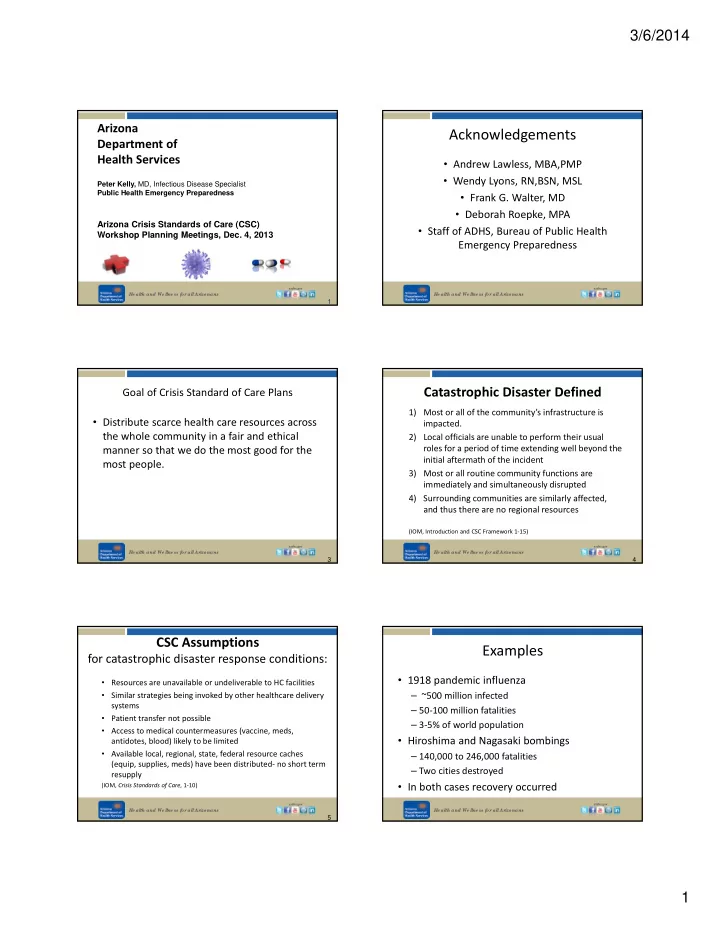
3/6/2014 Arizona Acknowledgements Department of Health Services Andrew Lawless, MBA,PMP Wendy Lyons, RN,BSN, MSL Peter Kelly, MD, Infectious Disease Specialist Public Health Emergency Preparedness Frank G. Walter, MD Deborah


slide-1
SLIDE 1

3/6/2014 1

He alth and We llne ss for all Ar izonans

azdhs.gov

1

Arizona Department of Health Services

Peter Kelly, MD, Infectious Disease Specialist Public Health Emergency Preparedness

Arizona Crisis Standards of Care (CSC) Workshop Planning Meetings, Dec. 4, 2013

He alth and We llne ss for all Ar izonans

azdhs.gov

Acknowledgements

  • Andrew Lawless, MBA,PMP
  • Wendy Lyons, RN,BSN, MSL
  • Frank G. Walter, MD
  • Deborah Roepke, MPA
  • Staff of ADHS, Bureau of Public Health

Emergency Preparedness

He alth and We llne ss for all Ar izonans

azdhs.gov

Goal of Crisis Standard of Care Plans

  • Distribute scarce health care resources across

the whole community in a fair and ethical manner so that we do the most good for the most people.

3

He alth and We llne ss for all Ar izonans

azdhs.gov

Catastrophic Disaster Defined

4

1) Most or all of the community’s infrastructure is impacted. 2) Local officials are unable to perform their usual roles for a period of time extending well beyond the initial aftermath of the incident 3) Most or all routine community functions are immediately and simultaneously disrupted 4) Surrounding communities are similarly affected, and thus there are no regional resources

(IOM, Introduction and CSC Framework 1‐15)

He alth and We llne ss for all Ar izonans

azdhs.gov

CSC Assumptions

for catastrophic disaster response conditions:

5

  • Resources are unavailable or undeliverable to HC facilities
  • Similar strategies being invoked by other healthcare delivery

systems

  • Patient transfer not possible
  • Access to medical countermeasures (vaccine, meds,

antidotes, blood) likely to be limited

  • Available local, regional, state, federal resource caches

(equip, supplies, meds) have been distributed‐ no short term resupply

(IOM, Crisis Standards of Care, 1‐10)

He alth and We llne ss for all Ar izonans

azdhs.gov

Examples

  • 1918 pandemic influenza

– ~500 million infected – 50‐100 million fatalities – 3‐5% of world population

  • Hiroshima and Nagasaki bombings

– 140,000 to 246,000 fatalities – Two cities destroyed

  • In both cases recovery occurred
slide-2
SLIDE 2

3/6/2014 2

He alth and We llne ss for all Ar izonans

azdhs.gov

Five Key Elements for all CSC Plans

7

  • A strong ethical grounding… based transparency,

consistency, proportionality, and accountability

  • Integrated and ongoing community and provider

engagement, education, and communication

  • The necessary legal authority and legal environment in

which CSC can be ethically and optimally implemented

  • Clear indicators, triggers, and lines of responsibility
  • Evidence‐based clinical processes and operations

He alth and We llne ss for all Ar izonans

azdhs.gov

Ethical Aspects of CSC

  • A Framework for Catastrophic Disaster
  • Response. (Hanfling D, Altevogt B M, Gostin L O. JAMA 2012;308:

675‐76.)

  • Ethics in Public Health Emergencies: An Arizona Code
  • f Public Health Emergencies Ethics. ( Feb 15, 2012, Lincoln

Center for Applied Ethics and the Public Health Law and Policy Program, Sandra Day O’Connor College of Law )

  • Revised Ethics in Public Health Emergencies

He alth and We llne ss for all Ar izonans

azdhs.gov

Key Points from “Framework”

  • “…adjusting practice standards and shifting the

balance of ethical concerns to emphasize the needs

  • f the community, while still providing the best

possible care for individuals within an environment

  • f significant resource restraints.”
  • Paradigm shift for health care providers. Resource

use allocated on basis of community needs not individual need.

He alth and We llne ss for all Ar izonans

azdhs.gov

Key Points from “Framework” 2

  • “… development of a “systems” approach that

ensures integration among key stakeholders, …”

  • “…all stakeholders follow consistent protocols that

consider legal and ethical considerations when crisis standard of care take effect.”

  • “Horizontal” coordination across full spectrum of

stakeholders – hospitals, clinics, EMS, public health dept, public safety agencies

He alth and We llne ss for all Ar izonans

azdhs.gov

Key Points from “Framework” 3

  • “Vertical” integration refers to consistency and

coordination of partners involved in emergency response to disasters. (federal, state, local, and tribal goverments )

He alth and We llne ss for all Ar izonans

azdhs.gov

slide-3
SLIDE 3

3/6/2014 3

He alth and We llne ss for all Ar izonans

azdhs.gov

Question #1: What is your level of support for the following statement: “Public health disasters may justify temporarily adjusting practice standards and shifting the balance of ethical concerns to emphasize the needs of the community, while still providing the best possible care for individuals within an environment of significant resource restraints.”*

* Source is Hanfling d, Altevoght, Gostin LO. A Framework for Catastrophic Disaster Response. JAMA 2012; 308: 675‐6. He alth and We llne ss for all Ar izonans

azdhs.gov

Question #2:

What is your level of support for the following statement: In a public health disaster use of “A systems approach ensures that all stakeholders follow consistent protocols that consider legal and ethical considerations when crisis standards of care take effect.”*

* Source is Hanfling d, Altevoght, Gostin LO. A Framework for Catastrophic Disaster Response. JAMA 2012; 308: 675‐6. He alth and We llne ss for all Ar izonans

azdhs.gov

Arizona Code of Public Health Emergency Ethics

  • Why this document ?
  • Succinct statement of principles
  • Broad enough to span venues of health care
  • Narrow enough address emergency only
  • In line with IOM CSC guidance

He alth and We llne ss for all Ar izonans

azdhs.gov

Application of Arizona Code

  • Use for planning, preparation or response to

declared states of emergency

  • Implement a CSC as defined by IOM
  • Does not apply localized emergency events of

limited duration… or events… that do not require use of scarce resources to protect or promote the public’s health

He alth and We llne ss for all Ar izonans

azdhs.gov

Question #3 Statement

17 Application: This model code is meant to apply to Arizona health care, public health, and emergency preparedness officials and practitioners in public and private sectors seeking to (1) plan, prepare, or respond to declared states of emergency or public health emergency in which the health of the public is at risk; or (2) implement a crisis standard of care as defined by the National Academies of Science Institute of Medicine (IOM).1 These combined events are characterized in the text below by the use of the single term “public health emergency.” The model code is not intended to apply to responses to localized emergency events of limited duration, state-wide emergencies that do not implicate the public’s health, or events that do not require critical decisions on the use of scarce resources to protect or promote the public’s health. In addition, the model code is intended to supplement, not supplant, relevant portions

  • f existing codes of ethics and professionalism for health care practitioners, hospitals,

hospice care, public health practitioners, emergency responders, or other relevant persons or entities.

He alth and We llne ss for all Ar izonans

azdhs.gov

Sections of the Arizona Code

  • 1. Stewardship of

Resources

  • 2. Duty to Care
  • 3. Soundness
  • 4. Fairness
  • 5. Reciprocity
  • 6. Proportionality
  • 7. Transparency
  • 8. Accountability
slide-4
SLIDE 4

3/6/2014 4

He alth and We llne ss for all Ar izonans

azdhs.gov

Section 1—Stewardship of Resources

He alth and We llne ss for all Ar izonans

azdhs.gov

Section 2—Duty to Care

He alth and We llne ss for all Ar izonans

azdhs.gov

Section 3—Soundness

He alth and We llne ss for all Ar izonans

azdhs.gov

Section 4—Fairness

He alth and We llne ss for all Ar izonans

azdhs.gov

Section 5—Reciprocity

He alth and We llne ss for all Ar izonans

azdhs.gov

Section 6—Proportionality

slide-5
SLIDE 5

3/6/2014 5

He alth and We llne ss for all Ar izonans

azdhs.gov

Section 7—Transparency

He alth and We llne ss for all Ar izonans

azdhs.gov

Section 8—Accountability