Accountable Care: A Value-Based Approach to Health Care - - PDF document

accountable care
SMART_READER_LITE
LIVE PREVIEW

Accountable Care: A Value-Based Approach to Health Care - - PDF document

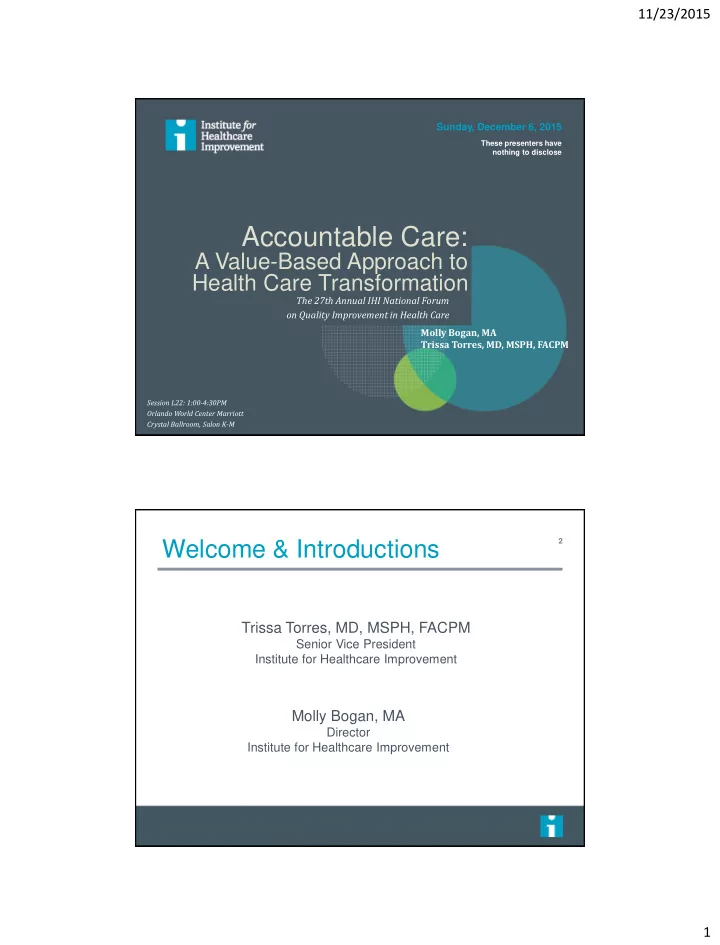
11/23/2015 Sunday, December 6, 2015 These presenters have nothing to disclose Accountable Care: A Value-Based Approach to Health Care Transformation The 27th Annual IHI National Forum on Quality Improvement in Health Care Molly Bogan, MA


slide-1
SLIDE 1

11/23/2015 1

Accountable Care:

A Value-Based Approach to Health Care Transformation

The 27th Annual IHI National Forum

  • n Quality Improvement in Health Care

Sunday, December 6, 2015

These presenters have nothing to disclose

Molly Bogan, MA Trissa Torres, MD, MSPH, FACPM

Session L22: 1:00-4:30PM Orlando World Center Marriott Crystal Ballroom, Salon K-M

Welcome & Introductions

2

Trissa Torres, MD, MSPH, FACPM

Senior Vice President Institute for Healthcare Improvement

Molly Bogan, MA

Director Institute for Healthcare Improvement

slide-2
SLIDE 2

11/23/2015 2

Welcome & Introductions

3

George Kerwin, FACHE

President/CEO Bellin Health

Richard Gitomer, MD

President & CQO Emory Healthcare Network

Objectives

4

Identify common challenges and solutions to running a successful ACO Recognize opportunities to accelerate their efforts to achieve cost- and quality-related improvements at scale Engage in active peer sharing and learning

slide-3
SLIDE 3

11/23/2015 3

Icebreaker

5

ACO start year Region Physician-driven v. Hospital-driven Employ or Contract physicians

6

Introduction to Accelerators

slide-4
SLIDE 4

11/23/2015 4

Healthcare is changing… US Affordable Care Act (ACA)

Bring Down Health Care Premiums (1/1/11) President Obama signs the Affordable Care Act. (3/23/2010) Prohibit Denying Coverage of Children Based on Pre-Existing Conditions (9/23/2010) Provide Free Preventative Care (9/23/2010) Increase Access to Services at Home and in the Community (10/1/1/11) Encouraging Integrated Health Systems &Launch of ACO Pioneer Program (1/1/12)

2010 2011 2012 2013 2014

Understanding and Fighting Health Disparities (3/1/12) Improving Preventative Health Coverage & Launch of SSP ACO model (1/1/13) Open Enrollment in the Health Insurance Marketplace Begins (10/1/13) Prohibiting Discrimination Due to Pre-Existing Conditions or Gender (1/1/14) Establishing the Health Insurance Marketplace (2014)

HHS to tie 90%

  • f all

traditional Medicare payments to quality or value by 2018

Definition

System designs that simultaneously improve three dimensions:

– Improving the health of the populations; – Improving the patient experience of care (including quality and

satisfaction); and

– Reducing the per capita cost of health care.

​Berwick DM, Nolan TW, Whittington J. The Triple Aim: Care, health, and cost. Health Affairs. 2008 May/June;27(3):759-769

slide-5
SLIDE 5

11/23/2015 5

Determinants of Health and their Contribution to Premature Death

Social circumstances 15% Environmental exposure 5% Health care 10% Behavioral patterns 40% Genetic predisposition 30%

Adapted from: McGinnis JM, Williams-Russo P, Knickman JR. The case for more active policy attention to health promotion. Health Aff (Millwood) 2002;21(2):78-93.

Proportional Contribution to Premature Death

Changing Healthcare Context

Fee for Service Pay for Performance Shared Savings Shared Risk Global Payment Focus on Individuals Individuals and Populations Individuals, Populations and Communities

Care

Care and Cost The Triple Aim

Do to

Do for Do WITH

slide-6
SLIDE 6

11/23/2015 6

Population Management

DEFINITION The design, delivery, coordination, and payment of services for a defined group of people to achieve specified cost, quality and health outcomes for that group of people.

11

http://www.ihi.org/communities/blogs/_layouts/ihi/community/blog/itemview.aspx?List=81ca4 a47-4ccd-4e9e-89d9-14d88ec59e8d&ID=50

Population Health

12 http://www.ihi.org/communities/blogs/_layouts/ihi/community/blog/itemview.aspx?List=81ca4a47-4ccd- 4e9e-89d9-14d88ec59e8d&ID=50

slide-7
SLIDE 7

11/23/2015 7

Managing Services for a Population

13

Delivery of Services at Scale

Community, Family and Individual Resources

Feedback Loops

Needs Assessment for Segment Service Design

Coordination Goals

Integrator

Population Segmentation Population Outcomes

Feedback Loops

Our Framework: Five Accelerators

14

  • Demonstrating effective leadership
  • Integrating data systems to support performance improvement
  • Building robust improvement infrastructure
  • Engaging providers and community stakeholders in care redesign
  • Leveraging payment models to achieve clinical and financial targets

Population Management

slide-8
SLIDE 8

11/23/2015 8

15

World Café

16

Break

See you back here at 2:30PM!

slide-9
SLIDE 9

11/23/2015 9

Rapid Fire Case Studies

17

George Kerwin, FACHE

President/CEO Bellin Health

Richard Gitomer, MD

President & CQO Emory Healthcare Network

Rapid Fire Case Studies

18

Richard Gitomer, MD

President & CQO Emory Healthcare Network

slide-10
SLIDE 10

11/23/2015 10

Accountable Care: A Values Based Approach to Health Care Transformation Emory Healthcare

Institute for Healthcare Improvement National Forum Learning Lab L22 December 6, 2015 Richard S. Gitomer, MD, MBA, FACP President & Chief Quality Officer Emory Healthcare Network rgitome@emory.edu Nothing to disclose

Objectives

  • Understand why we chose to pursue value-based payment models
  • Understand how we engaged physicians
  • Our approach to value-based contracting
  • Emory’s population management strategy

20

slide-11
SLIDE 11

11/23/2015 11

ehn.emoryhealthcare.org

Emory Healthcare Network Geographic Footprint

21

Emory Healthcare Network

5 Hospital Facilities

22

slide-12
SLIDE 12

11/23/2015 12

Increasing Accountability

Emory Value-Based Commercial Contracts

BCBSGA 32,000 BCBSGA 32,000 Aetna 18,000 BCBSGA 32,000 Aetna 19,000 4th Major Payor 32,000 Cigna 15,000 Medicare Advantage* 1,500 2014 2015 2016 2017 (Projected) BCBSGA 38,000 Aetna 19,000 Cigna 15,000 Medicare Advantage* 8,000 *Full Risk Capitation

23

Objectives

  • Understand why we chose to pursue value-based payment models
  • Understand how we engaged physicians
  • Our approach to value-based contracting
  • Emory’s population management strategy

24

slide-13
SLIDE 13

11/23/2015 13

TH THE E CI CINDERELLA PARABLE - The pace of change to varies significantly by market and health system

3-Year to 6-Year Time Horizon Operating Margin ($ in Millions)

Fee-for-service Accountable Care

Transition Zone Initial Pilots and Payer Demonstrations Completing Transition to a New Model Preparing for a Change in the Basis of Payment

Well-Timed Transition Lagging Transition

(Midnight)

World A World B

25

Commercial Insurance (Employer) Timeline

  • Market-specific
  • Employers increasingly unable to afford increasing costs
  • Communication challenge
  • Viewed as any other good or service – ↓ Cost & ↑ Value
  • Difficult to measure value – so low unit cost is assumed to be high value
  • Tension between short-term financial horizon & long-term investment for

value-based provider

  • Impact of private and public exchanges
  • Commoditization vs. Differentiation
  • Decisions: Plan → Network → Benefits

26

slide-14
SLIDE 14

11/23/2015 14

CMS’ Journey to World B

27

Source: Medicare ACOs Provide Improved Care While Slowing Cost Growth in 2014, Centers for Medicare & Medicaid Services. August 25, 2015 Source: Medicare ACOs Provide Improved Care While Slowing Cost Growth in 2014, Centers for Medicare & Medicaid Services. August 25, 2015

CMS Timeline – Alternative Payment by 2019

20 2016 – 20 2017 Data a Driv rive 20 2019 MIPS Sc Scor

  • re

Present to 2019

  • Sec. Burwell – Jan ‘15
  • ‘16
  • APM – 30%
  • 85% value-based
  • ‘18
  • APM – 50%
  • 90% value-based
  • Current programs
  • PQRS,

Meaningful use, Value based modifier ‘19 to ’26 MIPS

  • Payment updates
  • ‘15 – ‘19: 0.5%
  • ‘20 – ‘26: 0%
  • MIPS – Single Metric
  • Quality
  • Resource use
  • Improvement
  • Meaningful use
  • Max reduction
  • 4% to 9%
  • ‘19 score based on

‘16 & ‘17 data ‘19 to ’26 APM

  • Payment updates
  • ‘15 – ‘19: 0.5%
  • ‘20 – ‘26: 0%
  • Bonus – 5%
  • APM
  • Minimum % of

practice requirements (Medicare or total) After ‘26

  • Payment updates
  • MIPS: 0.25%
  • APM: 0.75%
  • MIPS maximum

reduction – 9% APM = Alternative Payment Model MIPS = Merit-Based Incentive Payment System Current System Medicare and CHIP Reauthorization Act (MACRA or SGR Repeal)

28

slide-15
SLIDE 15

11/23/2015 15

Objectives

  • Understand why we chose to pursue value-based payment models
  • Understand how we engaged physicians
  • Understand our approach to value-based contracting
  • Emory’s population management strategy

29

Recruitment & Provider Relations

What is your hook? What makes your network attractive to independent providers?

  • Safety in numbers in times of

uncertainty

  • Competitive rates
  • Access to expensive infrastructure
  • IT
  • Population management
  • Preservation of referral stream
  • CMS penalty avoidance

30

slide-16
SLIDE 16

11/23/2015 16

Governance – Why is it important?

  • Organizational credibility
  • Facilitates transparency
  • Transparency facilitates trust
  • Physician engagement
  • Structured to facilitate input from many constituencies
  • Trust and broad input facilitates engagement
  • Difficult decision-making
  • Success will require disruption of the status quo
  • Inclusive governance improves decision-making and facilitates execution

31

Governance: Emory’s Approach

Emory LHN Emory Midtown LHN Emory Johns Creek LHN Emory Saint Joseph’s LHN Southern Regional Medical Center LHN LaGrange LHN

Board of Managers

Physician Class Ex Officio Class 6 PCP’s & 6 Specialists (1 PCP & 1 Spec from each LHN) EHC CEO, EHC CMO/CQO, TEC Director, EHN President

Participation Committee 1 PCP & 1 Spec from each LHN Hospital CMO’s Value Management Team 1 PCP & 1 Spec from each LHN Hospital CQO’s

32

slide-17
SLIDE 17

11/23/2015 17

Board of Managers – Official decision- making body

Board of Managers

Physician Class Ex Officio Class 6 PCP’s & 6 Specialists (1 PCP & 1 Spec from each LHN) EHC CEO, EHC CMO/CQO, TEC Director, EHN President

Sample of Activities

  • Oversees & approves actions of the participation committee
  • Oversees and approves actions of the value management team
  • Key strategic decisions
  • Required EMR as condition of participation & limited EMR vendor choices
  • Required attendance at Quality Management Forum to qualify for shared

savings

33

Participation Committee Value Management Team

Participation Committee 1 PCP & 1 Spec from each LHN Hospital CMO’s Value Management Team 1 PCP & 1 Spec from each LHN Hospital CQO’s

Participation Committee

  • Recommended participation criteria to the Board
  • Reviews and approves all nominations & participants to the network
  • Makes recommendations to the Board concerning membership termination

Value Management Team

  • Oversees all value-related programs
  • Oversees individual and network performance
  • Makes recommendations to the participation committee re: performance issues

34

slide-18
SLIDE 18

11/23/2015 18

Objectives

  • Understand why we chose to pursue value-based payment models
  • Understand how we engaged physicians
  • Understand our approach to value-based contracting
  • Emory’s population management strategy

35

30 Mos 34 Mos 48 Mos

36

slide-19
SLIDE 19

11/23/2015 19

17 Mos 22 Mos 48 Mos First shared savings contract Initial design sessions Second shared savings contract First shared savings payout

37

Why a commercial strategy first?

  • Retrospective attribution
  • Benefit design did not support value-based

care

  • Membership turnover
  • Benefit from savings beyond one year

Contracting

Contracting Goals

  • “Fair share” of savings
  • Incentive vs. risk-sharing
  • Incentive contracts – P4P, bundles, & shared savings
  • Risk-sharing contracts – Capitation
  • Factors to be balanced
  • Infrastructure cost
  • Incentives
  • Investment for future performance– based on your strategy

38

slide-20
SLIDE 20

11/23/2015 20

Who manages the risk?

Mitigating Medical Management Risk

  • High risk patient management
  • Thoughtful use of resources
  • Reliable care processes

Mitigating Insurance Risk

  • Law of large numbers – Membership
  • Financial reserves

39

Objectives

  • Understand why we chose to pursue value-based payment models
  • Understand how we engaged physicians
  • Our approach to value-based contracting
  • Emory’s population management strategy

40

slide-21
SLIDE 21

11/23/2015 21 Efficient Care Reliable Care

Population Management ↑ Intended Care & ↓ Unintended Care

Avoidable Utilization

  • Avoidable ED visits
  • Avoidable hospitalizations
  • Other avoidable services
  • Avoidable harm

Care Plan Execution

  • Gaps in care

Intended Care

  • Inefficient care

41

Reliable Care

Population Management Care Coordination

  • Avoidable harm

Care Plan Execution

  • Gaps in care

Intended Care

  • Inefficient care

Care Coordination Program

  • Analytics
  • Data aggregation
  • Care coordinator program
  • Patient risk stratification
  • Outreach to highest risk (3.5%)
  • Patient-centered primary care
  • Team-based outreach
  • Outreach to “lower” high risk

Avoidable Utilization

  • Avoidable ED visits
  • Avoidable hospitalizations
  • Other avoidable services

42

slide-22
SLIDE 22

11/23/2015 22

Impact of Care Coordinator Outreach

5 10 15 20 25 30 35 40 45 50 May-14 Jun-14 Jul-14 Aug-14 Sep-14 Oct-14 Nov-14 Dec-14 Jan-15 Feb-15 Mar-15 Apr-15 # ED Visits Service Month

c-chart: EHN Care Coordinator Tracked Pts # ED Visits: Carecoord Overall (most recent 12 months)

Previous 12 months #ED AVG # ED Encounters UCL LCL 5 10 15 20 25 30 35 40 45 May-14 Jun-14 Jul-14 Aug-14 Sep-14 Oct-14 Nov-14 Dec-14 Jan-15 Feb-15 Mar-15 Apr-15 # Hospitalizations Discharge Month

c-chart: EHN Care Coordinator Tracked Pts - # Hospitalizations: Carecoord Overall (most recent 12 months)

# Hospital Encounters Previous 12 month AVG UCL LCL

Emergency Department Utilization Emergency Department Utilization

1,800 patient cohort: Approximate reduction of 15 ED visits/month and 7 hospitalizations/month for entire cohort

43

Population Management Analytics and Work Flow Redesign

Analytics & Work-Flow Redesign

  • Disease registry
  • Disease registry
  • Identify registry candidates
  • Identify missing care elements
  • Team-based work flow redesign
  • Visit-based standard work
  • Proactive outreach
  • Avoidable harm

Care Plan Execution

  • Gaps in care

Intended Care

  • Inefficient care

44

slide-23
SLIDE 23

11/23/2015 23

Analytics & Decision-Support Platform

Data & Analytics Challenges

  • Disparate data sources
  • Non-analyzable data sources (paper, non-discrete electronic data)
  • Data acquisition, normalization, & transformation
  • Data presentation: Accessible, understandable, & timely

Emory Solutions

  • Financial analytics platform (based on paid claims)
  • Financial measurement & limited clinical measurement
  • Disease registry platform – Point of care and population-level analytics
  • Care coordination platform – Stratification & work-flow support

45

Analytics & Decision-Support Platform

Provider Feedback Decision Support Disease Registries

46

slide-24
SLIDE 24

11/23/2015 24

Develop Population Management Capabilities

NCQA Level III Patient Centered Medical Home Recognition

  • Training Program
  • Cohorts of 8-10

practices per trainer

 WORKING AS A TEAM Coordinate care with all working at the top of their license  USING DATA How to use cost & quality data to achieve practice & network success  MANAGING CARE FOR POPULATIONS Prospectively managing patients with chronic conditions  ENGAGING PATIENTS Skills to empower patient self-management  COORDINATING CARE WITH THE MEDICAL NEIGHBORHOOD Facilitate high functioning relationships with specialists  IMPROVING QUALITY Learn quality improvement techniques  PRODUCING EVIDENCE FOR NCQA RECOGNITION Assist in creation of documentation for NCQA recognition

47

Efficient Care Reliable Care

Population Management Episode-Specific Redesign

  • Avoidable harm

Intended Care

  • Inefficient care

Episode-Specific Redesign

  • Analytics
  • Identify unnecessary variation
  • Multidisciplinary team redesign
  • Eliminate unnecessary variation
  • Develop new “care plan”
  • Execution & sustainability
  • Decision support
  • Measurement and feedback

48

slide-25
SLIDE 25

11/23/2015 25

Episode-Specific Redesign – Cardiology

Door to Balloon Time Radial Artery Access Bivalirudin Use

49

Episode-Specific Redesign – Colorectal Surgery

50

slide-26
SLIDE 26

11/23/2015 26

System Transformation

Emory Healthcare Network Advantage

51

Emory Healthcare Network Advantage

In collaboration with CareMoreTM

Risk Stratification

High Risk Low Risk Mod Risk

Healthy Start Visit Hospitalization Prospective Risk Analytics PCP Referral

Unstable High Risk Rising Risk Moderate Risk Rising Risk High Risk Low Risk Extensivis t Care Ctr Care Ctr PCP PCP Care Ctr PCP Care Ctr Care Ctr PCP

High Risk Low Risk Mod Risk

Medicare Advantage Enrollees

Outcomes Readm 10% v. 18% Avg HbA1c 7.08% 57% fewer amputation s Fewer Bed Days Hosp – 63% SNF – 67%

Risk Stabilization Life Happens

52

slide-27
SLIDE 27

11/23/2015 27

Emory Healthcare Network Advantage

In collaboration with CareMoreTM

Coordinated Care Centers

  • Staff
  • Extensivists
  • Advanced Practice Providers
  • Nurse Coordinators (RN)
  • Care Coordinators (MA)
  • Administrative Staff
  • 30 clinical programs (e.g. diabetes, CKD, wound, …)

53

The PCP’s Sidekick

Clinical Programs

  • Executed by Care Center APPs
  • Evidence-based protocols
  • 30 clinical program
  • Diabetes, CKD, Wound…

PCP Extensivist Care Center & Advanced Practice Providers Improved Patient Outcomes Care Coordination Team Specialty Care, Acute Care, SNF Care Coordination Team

  • Nurse coordinator (RN)
  • Care coordinator (MA)

Support to Clinical Team

  • Specialists, Skilled Nursing

Facilities, Hospitals

  • Referrals, prior auth., etc.

54

slide-28
SLIDE 28

11/23/2015 28

Questions & Comments

The Emory Healthcare Network

55

Rapid Fire Case Studies

56

George Kerwin, FACHE

President/CEO Bellin Health

slide-29
SLIDE 29

11/23/2015 29

Session Objectives

Describe how Bellin has organized itself to manage the health of populations. Share two critical areas of redesign necessary to successfully manage the health of populations. Stimulate sharing and learning with attendees.

P57

Bellin is Organized to Assume Financial Risk for Our Population

P58

slide-30
SLIDE 30

11/23/2015 30

Serving a Market of 636,682 People

Bellin Hospital, a 220-bed community hospital with proven excellence in heart and vascular care; orthopedics and sports medicine; family programs and services; cancer care; and minimally invasive procedures including robotic surgery Bellin Health Oconto Hospital, a 10-bed critical-access hospital in Oconto Bellin Medical Group and NorthReach Healthcare, a 121-member primary care group with 32 clinic sites and proven excellence in disease management and wellness care Employer Clinics, 83 clinics located within employer facilities FastCare Retail Clinics, 4 retail clinics located in grocery and discount retail stores Physician Partners, Ltd incorporates all of Bellin Health System, their employed providers and approximately 116 independent providers Bellin Psychiatric Center, a dominant provider of in- and outpatient behavioral health services, staffed by 10 psychiatrists, 4 psychologists and 24 licensed mental health & addiction therapists Unity Hospice, providing hospice and palliative care services

Develop Capability

P59

Develop Capability

KEY TOOLS

Electronic Medical Record (EMR), enterprise-wide using Epic software Patient Registry, CareManager software integrated into the EMR Health Risk Appraisal from Healics integrated into the EMR Access Platform

P60

slide-31
SLIDE 31

11/23/2015 31

Develop Capability

P61

Develop Capability

Nine Steps to Achieving Population Health (handout)

1. Understand the population 2. Define GOALS for the population – 3 W’s 3. Create high level design – Match demand & capacity 4. Activate the team 5. Engage the individual 6. Measure outcomes 7. Provide feedback 8. 30 day improvement plans 9. Recalibrate GOALS

P62

slide-32
SLIDE 32

11/23/2015 32

Move from Insuring Risk to Managing Health

P63

Low Risk High Risk

High gh Coord rdin inati ation

  • n

TODAY

  • $
  • $

Low Coord rdin inati ation

  • n

Insure Health Manage Health

A Shift in the Corridor

P64

slide-33
SLIDE 33

11/23/2015 33

Organization-wide Alignment (handout)

P65

Two Key Areas of Redesign

P66

slide-34
SLIDE 34

11/23/2015 34

Medication Refill Chronic Disease Management

PROVIDER

Test Results Acute Visits Preventative Visits Patient Orders/Triage RN CMA/ LPN Referral to Specialist Referral to Ancillary Services Managing Messages, Test Results, Calling Patients Paper Work

OLD MODEL OF PATIENT CARE

P67

  • 1. Redesign Patient Care

NEW MODEL OF CARE

P68

slide-35
SLIDE 35

11/23/2015 35

CareManager Data Integration Platform

Front Line Engagement (POC)

Evidence-based Guidelines & Programs (inform all 9 steps) Patient-specific Care Plan (inform all 9 steps)

Patient Engagement (Care Plan) Extended Care Team Program (CW) Performance & Stratification (Registry)

Socio- Economic Data Sources (inform all 9 steps) EHR Claims Access to care HRA Patient

Quality Performance (Reporting)

4 5 4 5 2 1 6 3 8 7 9

P69

  • 2. Develop Actionable Data

Transitioning to Assuming Financial Risk for Our Population

P70

slide-36
SLIDE 36

11/23/2015 36

Low Risk High Risk

High gh Coord rdin inati ation

  • n

TODAY

  • $
  • $

Low Coord rdin inati ation

  • n

Insure Health Manage Health

Payment Models along the Corridor

P71

Risk Models Shared Savings Quality Metrics PMPM Management Fee Tiered to Create Steerage Results Linked to Future Increases Base Fee Schedule

Bellin as an Employer

P72

slide-37
SLIDE 37

11/23/2015 37

Health Results

P73

Cost Results

  • $2.5
  • $1.9
  • $2.1
  • $1.3
  • $1.2
  • $0.6
  • $1.1
  • $2.0
  • $1.7
  • $2.6
  • $2.5
  • $2.2

$0.8 $0.5 2014 2013 2012 2011 2010 2009 2008 2007 2006 2005 2004 2003 2002 2001

Bellin's Cost Difference Compared to Average (In Millions)

$22.7+ Million Saved

P74

slide-38
SLIDE 38

11/23/2015 38

Medicare & Medicaid

P75

What’s at Risk with the Various CMS Performance Programs?

P76

slide-39
SLIDE 39

11/23/2015 39

Estimated $26.6M of CMS Performance Programs

Reporting Programs

Type 2013 2014 2015 2016 2017 Inpatient Quality Reporting Penalty

  • Outpatient

Quality Reporting Penalty

  • Inpatient Rehab

Reporting Penalty

  • Home Health

Quality Reporting Penalty

  • Inpatient Psychiatric

Quality Reporting Penalty

  • Ambulatory Surgery

Centers Reporting Penalty

  • 2%

2% 2% 2% 2% 2% 2% 2% 2% 2% 2% 2% 2% 2% 2% 2% 2% 2% 2% 2% 2% 2% 2% 2% 2% 2% 2% 2%

P77

Performance Programs

Type 2013 2014 2015 2016 2017 Wisconsin Medicaid Pay for Performance Penalty & Incentive

  • / +

Medicare Value-Based Purchasing Penalty & Incentive

  • / +

Readmission Reduction (5 Conditions) Penalty

  • Hospital Acquired

Conditions Penalty

  • Meaningful Use*

Incentive Penalty in 2015 if no EHR.

+ /-

Physician Quality Reporting System (PQRS)* Incentive & Penalty

+ / -

Pioneer Program Incentive

+

Estimated $26.6M of CMS Performance Programs

1.5% 1.5% 1.5% 1.5% 1.5 % 1% 2% 1.50% 1.75% 1.25% 2% 3% 3% 3% 1% 1% 1% 1% +.5% +.5%

  • 2.5%
  • 6%
  • 4%

P78

slide-40
SLIDE 40

11/23/2015 40

Commercial

P79

Commercial Customers

P80

Total $ (1,692,274) 1,388,165 $

  • $

32,754,477 $ Strategic Partner Contract Type Value Based $ (Penalty/Dow nside) Value Based $ (Incentive / Upside) Value Based $ (Expected) Strategic Partner Total Spend (P12 Mo) Ariens Pay for Performance

  • Employer ROI
  • $

92,016 $

  • $

1,073,409 $ Ashwaubenon School District Shared Savings

  • $
  • $
  • $

1,031,691 $ Associated Bank - Downtown (GBAC) HRA Improvement (29,405) $

  • $
  • $

1,832,324 $ Associated Bank - Holmgren (GBSC) Likelihood to Recommend

  • $
  • $
  • $
  • $

Bellin Full Risk (1,190,000) $ 680,000 $

  • $

10,990,539 $ Belmark Pay for Performance

  • Employer ROI
  • $

113,251 $

  • $

808,663 $ Brown County HRA Improvement (43,656) $

  • $
  • $

2,318,047 $ City of Green Bay HRA Improvement (21,768) $

  • $
  • $

990,862 $ Green Bay Packers Pay for Performance

  • Employer ROI
  • $

3,375 $

  • $

742,864 $ Howard Suamico Shared Savings

  • $
  • $
  • $

1,977,010 $ JBS Shared Savings

  • $
  • $
  • $

1,074,385 $ LaForce, Inc. Pay for Performance

  • Employer ROI
  • $

78,854 $

  • $

393,612 $ NEW Curative Pay for Performance

  • Employer ROI
  • $

52,395 $

  • $

74,250 $ NWTC Cost Plus Triple Aim (462,153) $

  • $
  • $

1,929,993 $ Oconto Schools /WEA Pay for Performance

  • Employer ROI
  • $

233,769 $

  • $

950,924 $

slide-41
SLIDE 41

11/23/2015 41

Moving Up The Corridor

P81

Low Risk High Risk

High gh Coord rdin inati ation

  • n

TODAY

  • $
  • $

Low Coord rdin inati ation

  • n

Insure Health Manage Health

A Shift in the Corridor

Fee for Service Contracts United Premium Designation Program United Medicare Advantage ACP Program Medicare Advantage P4P Network Medicare Advantage CHF Population Commercial P4P Anthem Blue Priority About Health Anthem Shared Savings Medicaid Super Utilizer Population United Value Based Contract Bundled Payment Programs Pioneer Strategic Partners P82

slide-42
SLIDE 42

11/23/2015 42

83

Questions?

84

Energizer

slide-43
SLIDE 43

11/23/2015 43

ACO Panel

85

George Kerwin, FACHE

President/CEO Bellin Health

Richard Gitomer, MD

President & CQO Emory Healthcare Network

86

Closing & Reflections

slide-44
SLIDE 44

11/23/2015 44

Thank You!

87

Trissa Torres ttorres@ihi.org Molly Bogan mbogan@IHI.org

Please let us know if you have any questions or feedback following today’s session.