
SLIDE 1
A127 Economic Growth Corridor Task Force
Friday, 28th June 2019
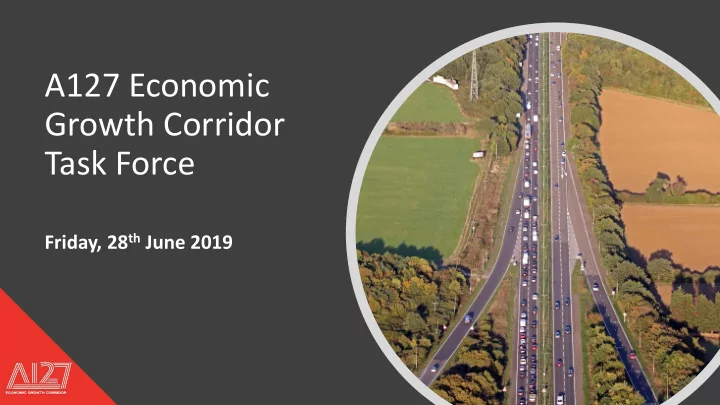
A127 Economic Growth Corridor Task Force Friday, 28 th June 2019 - - PowerPoint PPT Presentation
A127 Economic Growth Corridor Task Force Friday, 28 th June 2019 Welcome and Introductions Agenda 1. Introduction and Recap including A127 air quality update 2. Transport Appraisal Update Business cases requirements Background
Friday, 28th June 2019
together to develop a long-term vision for transport on the A127 economic growth corridor.
corridor (and its sphere of influence) in enabling economic growth across South Essex:
well as the A127 road itself
produce.
leading to the business area to the south of it, have poor air quality that breaks national limits
included a 50mph speed limit on a section of the A127 (approx. between Fortune of War and Pound Lane junction), cycling, electric charging and travel planning measures
for the 50mph speed limit. This is now being progressed, and a consultation will take place over the summer, with a view to implementing the change by the end of March 2020
exercise to identify if any charging Clean Air Zone options (excluding the A127 itself) could bring about compliance in the shortest possible time
(Business Case Requirements)
1) Understand the Current and (2) future context and conditions in the study area 3) Establish the need for intervention 4a) Identify intervention specific objectives to address the identified need 4b) Define geographic area for intervention to address 5) Generate Options, reflecting a range of modes, approaches and scales of intervention 6) Undertake initial sift. Discard option that would fail to address objectives or are unlikely to pass key viability and acceptability criteria 7) Develop and assess potential options, to identify the better performing ones. Reporting: Option Assessment Report (OAR), Strategic Outline Business Case (SOBC)
STAGE 3 – IMPLEMENTATION, MONITORING & EVALUATION STAGE 1 – OPTION DEVELOPMENT STAGE 2 – FURTHER APPRAISAL
We are here
Section 1 2 3 4 5 6 7 8 9 10 ALL
Average Speed (mph)
AM peak (08:00-09:00)
11.0 42.9 37.3 30.9 39.3 41.9 22.7 26.0 12.4 15.8 22.2
PM peak (17:00-18:00)
13.5 51.5 48.4 42.3 52.9 49.4 37.8 39.8 13.6 13.6 26.4 Gallows Cnr M25 A128 Dunton Noak Bridge Nevendon Fairglen Rayleigh Weir Progress Road Southend Victoria Nestuda Way
Source: Essex Highways analysis of Teletrac data received via Department for Transport
longer than off-peak.
and Nestuda Way to Progress Road.
Section 1 2 3 4 5 6 7 8 9 10 AADF (vehicles 2-way) 37,418 68,107 85,000* 64,626 71,677 68,107 80,270 64,719 46,373 38,220 Volume/Capacity Ratio 0.54* 0.91 0.98* 0.69* 0.97 0.88 0.95 0.92 0.64* 0.52* Hours/day V/C>0.85
2.25 3.50 2.50
M25 A128 Dunton Noak Bridge Nevendon Fairglen Rayleigh Weir Progress Road Southend Victoria Nestuda Way
** ** At busiest
time of day
average per day (2-way AADF).
At 85% journey times become unreliable.
Sources: Department for Transport, 2018: Road Traffic Statistics, Essex Highways, 2018: Continuous Count Database * Estimated Values
Section 1 2 3 4 5 6 7 8 9 10 ALL
Average Speed (mph)
AM peak (08:00-09:00)
17.1 42.7 43.0 44.5 54.3 51.4 37.1 19.2 15.1 11.3 25.3
PM peak (17:00-18:00)
27.4 21.7 26.7 35.4 28.3 21.4 27.6 16.6 21.0 13.4 22.3 Gallows Cnr M25 A128 Dunton Noak Bridge Nevendon Fairglen Rayleigh Weir Progress Road Southend Victoria Nestuda Way
the road itself
Source: Essex Highways analysis of Teletrac data received via Department for Transport
Sources: Department for Transport, 2018: Road Traffic Statistics, Essex Highways, 2018: Continuous Count Database
Section 1 2 3 4 5 6 7 8 9 10 AADF (vehicles 2-way) 37,418 68,107 85,000* 64,626 71,677 68,107 80,270 64,719 46,373 38,220 Volume/Capacity Ratio 0.52* 0.88 0.99* 0.74* 1.01 0.85 0.91 0.83 0.56* 0.47* Hours/day V/C>0.85
1.00 3.75
M25 A128 Dunton Noak Bridge Nevendon Fairglen Rayleigh Weir Progress Road Southend Victoria Nestuda Way
**
eastbound direction.
hours a day.
* Estimated Values
** At busiest
time of day
(see next slide)
Source: Office of National Statistics, Census 2011
1 3 2 4 5 6 7 8 9 + Hospital
Airport Sea Port Key:
Source: Office of National Statistics, Census 2011
4 5 7 6 1 2 3 + Hospital
Airport Sea Port Key:
Source: Essex County Wide Model Phase 2 ID Origin Destination Trips %Total 1 Basildon (urban) Havering 509 16% 2 Basildon (urban) Brentwood 438 14% 3 Basildon (urban) Thurrock 147 5% 4 Basildon (urban) Northern London 109 4% Total 3,106 100% Location and direction of traffic flow assessment
On A127 west of Basildon:
Local (between Districts adjoining A127)
(to/from Greater London, central Essex and parts of Herts, Beds and Kent)
(to/from rest of UK) The largest movements are from Basildon to Havering (16% of all trips) and Basildon to Brentwood (14% of all trips) 53% of all westbound car trips
Source: Essex County Wide Model Phase 2 ID Origin Destination Trips %Total 1 Havering Basildon (urban) 635 23% 2 Brentwood Basildon (urban) 461 17% 3 Havering Southend-on-Sea 112 4% 4 Thurrock Basildon (urban) 99 4% Total 2,759 100% Location and direction of traffic flow assessment
On A127 west of Basildon:
Local
The largest movements are from Havering to Basildon (23% of all trips) and Brentwood to Basildon (17% of all trips) 60% of all eastbound car trips
have a destination in urban Basildon.
Source: Essex County Wide Model Phase 2 ID Origin Destination Trips %Total 1 Southend-on-Sea Basildon (urban) 496 14% 2 Castle Point Basildon (urban) 278 8% 3 Southend-on-Sea Chelmsford 264 7% 4 Southend-on-Sea Thurrock 204 6% 5 Southend-on-Sea GL East 146 4% Total 3,585 100%
On A127 west of Basildon:
Local
The largest movements are from Southend to Basildon (14% of all trips) and Castle Point to Basildon (8% of all trips) 57% of all westbound car trips
Location and direction of traffic flow assessment
ID Origin Destination Trips %Total 1 Basildon (urban) Southend-on-Sea 313 12% 2 Chelmsford Southend-on-Sea 238 9% 3 Maldon Southend-on-Sea 162 6% 4 Thurrock Southend-on-Sea 157 6% 5 Havering Southend-on-Sea 151 6% Total 2,518
Source: Essex County Wide Model Phase 2 Location and direction of traffic flow assessment
On A127 west of Basildon:
Local
The largest movements are from Basildon to Southend-on- Sea and Chelmsford to Southend-on-Sea 66% of all westbound car trips
have a destination in Southend-on-Sea.
Southend, Basildon, Brentwood and Havering.
Key points:
A127 Brentwood Basildon Southend-on-Sea
Option Trunk Road Non-Trunk Road Public Transport Infrastructure Central Government: Road Investment Strategy (RIS3 – unconfirmed) Up to full amount
(RIS 1 national total is £25.3bn)
N/A If included in Trunk Road scheme Central Government: Large Local Majors N/A £50 - £100 million Central Government: Major Road Network N/A £20 - £50 million Central Government: SELEP N/A Up to £20 million Central Government (Homes England): Housing Infrastructure Fund Up to £250 million (HIF1) Further HIFs unconfirmed Central Government: Growth Deal Government funding tied to delivery of new homes Central Government: Public Works Loan Body Prior loans up to £350m historically Local Authority financing Capital financing / rates / taxes Private financing Municipal bonds/ road user charging/S106/CIL
towards children and parents
travel-themed posters and giving their views on the future of travel
understanding of how the corridor could better serve the residents.
take part via social media and dedicated communications from local councils. Paper surveys will also be available at summer engagement events.
issues in their area, opportunities to improve transport in the local area, current modes of transport used and likelihood to adopt different types of transport in future.
Summer 2019
June 2019
Task Force Meeting No. 3
Workshop
engagement
July 2019 Aug 2019
engagement
Sept 2019 Oct 2019
Task Force Meeting No. 4
Nov 2019 Jan 2020
Option Assessment
Dec 2019
Option Development Task Force Meeting No. 5
Report
Business Case
Feb 2020
Development
engagement
PROJECT OBJECTIVES
Environment Improve air quality, reduce pollution and manage the impacts on surrounding communities Improve the net environmental impact of transport on local communities Reduce by design the impact of new infrastructure on built natural and historic environments No net ecology loss Embed innovation technology at the heart of any solutions and maintenance/incident management strategies Connectivity: Manage congestion and improve journey time reliability Provide sustainable travel alternatives for short and medium trips especially those on the A127 corridor Promote active travel measures for shorter journeys, improving the health opportunities for local populations Ensure the efficient movement of goods and people Manage congestion and improve journey time reliability Embed innovation and the use of technology at the heart of any proposed solutions Economic Growth: Support and facilitate sustainable economic growth along the corridor. Recognising the role that the A127 corridor plays in the South Essex economy Short Term: Support existing economies (e.g. Basildon Enterprise Corridor) and understand the impact of strategic growth across the corridor) Medium Term: Address growth issues arising from existing and emerging local plans Long Term: Plan infrastructure for the future in association with the Joint Strategic Plan Embed innovation and the use of technology at the heart of any proposed solutions Unlocking growth within the region Safety and Resilience: Improve safety and network resilience Provide a safe and secure network for all users including reducing the perception of the fear of crime Improve safety for all users Reduce the severance of key walking, cycling and horse-riding corridors Reduce the occurrence of incidents and improve clear up times reducing the impact of congestion Embed innovation and the use of technology at the heart of any proposed solutions Asset Management: Effective management and maintenance of all transport assets The network is fit for purpose with all aspects effectively and proactively managed including: Structures, embankments, carriageway pavement, safety barriers & sustainable travel infrastructure Embed innovation and the use of technology at the heart of any proposed solutions and maintenance/incident management strategies