Section 2.4 CS340-Discrete Structures
A What is |A|? B Solution: 0 3x+4 1000 iff -4/3 x 996/3 a 1 - - PowerPoint PPT Presentation
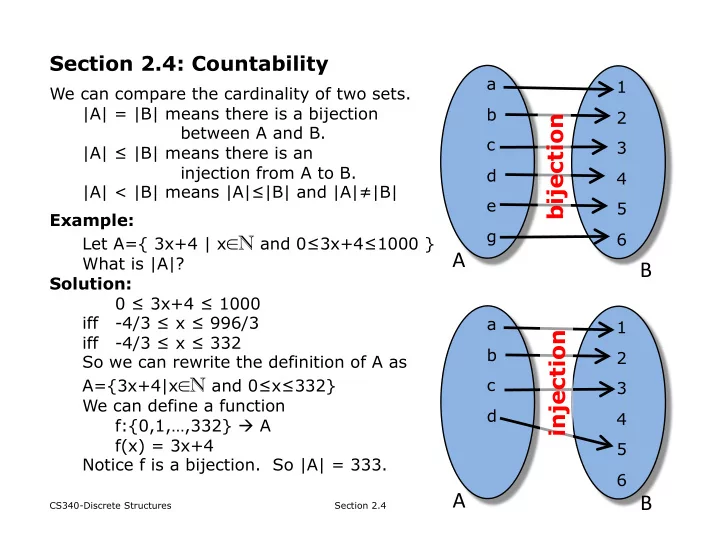
Section 2.4: Countability a 1 We can compare the cardinality of two sets. |A| = |B| means there is a bijection b bijection 2 between A and B. c 3 |A| |B| means there is an injection from A to B. d 4 |A| < |B| means |A| |B|
Section 2.4 CS340-Discrete Structures Page 2
Countable
Finite sets: The set S is countable if |S| = |Nn| for some n. {0,1,2,…,n} Countably Infinite Sets: The set S is countable if |S| = |N| Uncountably Infinite Sets: If a set is not countable, it is uncountable.
Z is countable: |Z| = |N|
To prove this we need to find a bijection between Z and N. Let f:NZ be defined by f(2k)=k and f(2k+1)=-(k+1). x 1 2 3 4 5 6 7 f(x)
- 1 1 -2 2 -3 3 -4 …
Section 2.4 CS340-Discrete Structures Page 3
Some Countability Results
S⊆N implies S is countable. S is countable iff |S| ≤ |N|. Subsets and images of countable sets are countable. If each of the sets S0, S1, … Sn, … is countable, then so is their union: S0 ∪ S1 ∪ … Sn ∪ …
N x N is countable.
Section 2.4 CS340-Discrete Structures Page 4
Some Countability Results
S⊆N implies S is countable. S is countable iff |S| ≤ |N|. Subsets and images of countable sets are countable. If each of the sets S0, S1, … Sn, … is countable, then so is their union: S0 ∪ S1 ∪ … Sn ∪ …
N x N is countable.
Proof: Step 1: List all pairs of natural numbers like this:
0,0
0,1 1,0 0,2 1,1 2,0 0,3 1,2 2,1 3,0 …
Section 2.4 CS340-Discrete Structures Page 5
Some Countability Results
S⊆N implies S is countable. S is countable iff |S| ≤ |N|. Subsets and images of countable sets are countable. If each of the sets S0, S1, … Sn, … is countable, then so is their union: S0 ∪ S1 ∪ … Sn ∪ …
N x N is countable.
Proof: Step 1: List all pairs of natural numbers like this: Step 2: Assign a number from N to each pair.
0,0
0,1 1,0 0,2 1,1 2,0 0,3 1,2 2,1 3,0 … This is Cantor’s Bijection: n = ((x+y)2 + 3x + y)/2 0: 1: 2: 3: 4: 5: 6: 7: 8: 9:
Section 2.4 CS340-Discrete Structures Page 6
Example: Is N x N x N countable? Let Sn = { (x,y,z) ∈ N3 | x+y+z = n } Each of the sets S0, S1, … Sn, … is countable (actually, each is finite). Their union S0 ∪ S1 ∪ … Sn ∪ … is the set N3. Since their union is countable, N3 is countable.
Section 2.4 CS340-Discrete Structures Page 7
Facts:
Countably Infinite Sets The set of rational numbers Q is countably infinite. The set A* of all finite strings over a finite alphabet is countably infinite. Uncountably Infinite Sets The set of real numbers is not countable! |N| < |R| Let [0,1] be the closed interval of real numbers 0≤x≤1. The closed interval [0,1] is uncountably infinite! The powerset of a countably infinite set is uncountable! |N| < |power(N)|
Section 2.4 Page 8
Diagonalization Example: Alphabet = {a,b,c} Consider the set of all (possibly infinite) strings over A. Assume it is countable. {S0,S1, S2, …} = {abcabc…, bbbbb…, cacacac…, …} Then we can list all the elements in some order.
Section 2.4 CS340-Discrete Structures Page 9
Diagonalization Example: Alphabet = {a,b,c} Consider the set of all (possibly infinite) strings over A. Assume it is countable. {S0,S1, S2, …} = {abcabc…, bbbbb…, cacacac…, …} List each string as a row in a matrix, in order. 1 2 3 … n … S0 a b c a … b … S1 b b b b … b … S2 c a c a … c … S3 c b a c … b … S4 c c c c … c … S5 a a a a … a … … …
Section 2.4 CS340-Discrete Structures Page 10
Diagonalization Example: Alphabet = {a,b,c} Consider the set of all (possibly infinite) strings over A. Assume it is countable. {S0,S1, S2, …} = {abcabc…, bbbbb…, cacacac…, …} List each string as a row in a matrix, in order. 1 2 3 … n … S0 a b c a … b … S1 b b b b … b … S2 c a c a … c … S3 c b a c … b … S4 c c c c … c … S5 a a a a … a … … … Consider the diagonal: abcc…a… Change every character. ab ba ca to create a new string. Now we have the string baaa…b… This string differs from every string in the table. This string cannot be in the table. Contradiction!
Section 2.4 CS340-Discrete Structures Page 11
Diagonalization
(Cantor’s Technique to show that R is uncountable) Let A be an finite alphabet of symbols with at least 2 elements {a,b,…} Look at all strings over A, including infinitely long strings. Assume that this set of strings is countable. Then let S0,S1,…,Sn,… be a listing of all these strings. List all strings in rows in an infinite 2-D matrix. Each string Sn fills one row of the matrix. Sn = (an0, an1, … ann, …) Now construct the following string (this is the diagonal): S = (a00, a11, … ann, …) Now modify S to give S’. S’ = (f(a00), f(a11), … f(ann), …) where f(x) is a function that changes the symbol to a different symbol. Example: if x=a then f(x) is b; if x≠a then f(x) is a. S’ cannot be anywhere in the matrix, since it will differ from every string by at least one symbol. But we have listed all elements in the matrix. Contradiction! The set must be uncountably infinite!
Section 2.4 CS340-Discrete Structures Page 12
Application to Real Numbers Just consider the interval [0.0, 1.0]. All numbers have a decimal representation. 0.025 0.31415926536… = Pi/10 0.99999999999… = 1.0 Irrational numbers have an infinitely long decimal expansion. Apply Cantor’s Diagonalization Method: Alphabet={0,1,2,3,4,5,6,7,8,9} Assume the set is countable. List these numbers in a table in any order. Look at the digits on the diagonal. Construct a new number that differs from each number. This new number can’t be in the table. Proof by contradiction: Therefore the set must be uncountable!
Section 2.4 CS340-Discrete Structures Page 13
Application to Powersets
Consider a countably infinite set, S. S = { a0, a1, … } power(S) = the set of all subsets of S. Is power(S) countable? Represent a subset of S as a bit string. {a0, a1, a2, , a4, , a6, , a8 } 1 1 1 0 1 0 1 0 1 0 0 0 0 … 1 if the element is in the subset; 0 if it is not. Each subset corresponds to an infinitely long bit string. Is |power(S)| = |set of bitstrings| countable? Apply Cantor’s Diagonalization Method: Alphabet={0,1} Assume the set is countable. List these numbers in a table in any order. Look at the bits on the diagonal. Construct a new bitstring that differs from all others. This new sitstring can’t be in the table. Proof by contradiction: Therefore power(S) must be uncountable!
Section 2.4 CS340-Discrete Structures Page 14
Cantor’s Result: |A| < |power(A)| for any set A |N| < |power(N)| < |power(power(N))| < … Example: Show that |[0,1]| = |power(N)| We can represent each number in [0,1] as a binary string. 0.8125 = 0.11010000… We can also look at that string as a representation of a subset of N: 11010000… = {0,1,3} There is a bijection between [0,1] and power(N). So |[0,1]| = |power(N)| Countable Uncountable Beyond Uncountable!!!
Section 2.4 CS340-Discrete Structures Page 15