A little stochastic calculus: Hull, ch. 13 & 14. Assume dS S = - - PDF document

a little stochastic calculus hull ch 13 14
SMART_READER_LITE
LIVE PREVIEW

A little stochastic calculus: Hull, ch. 13 & 14. Assume dS S = - - PDF document

A little stochastic calculus: Hull, ch. 13 & 14. Assume dS S = .dt + .dz , or dS = .Sdt + .Sdz . Geometric Brownian Motion, where & are resp. the mean & SD of the ctsly compounded annual rate of return on


slide-1
SLIDE 1

1

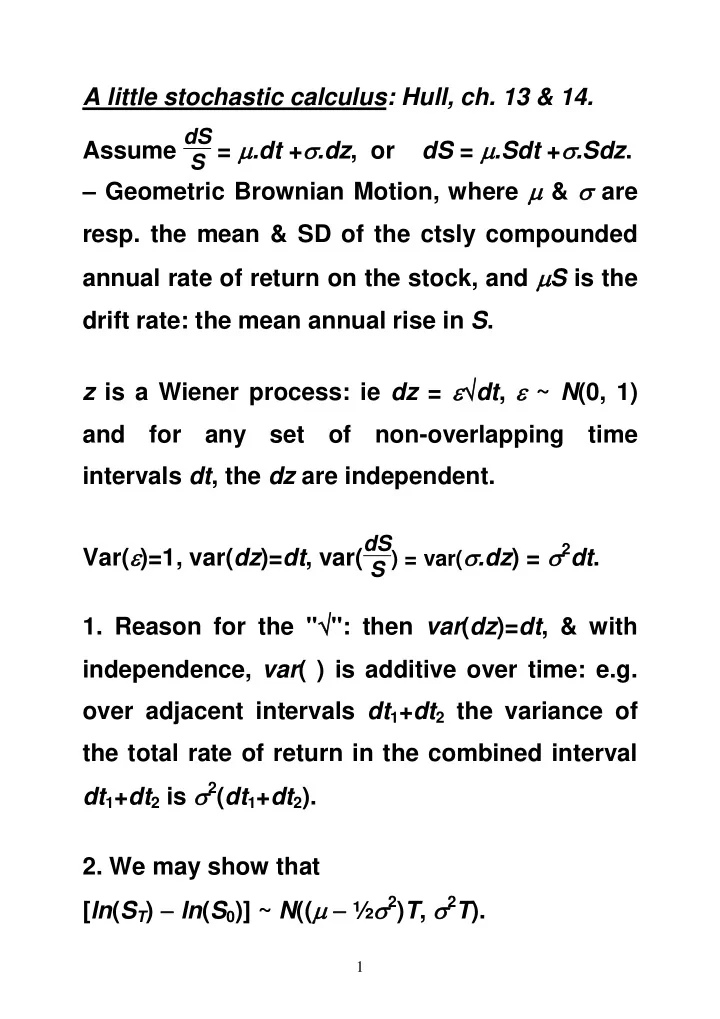
A little stochastic calculus: Hull, ch. 13 & 14. Assume dS

S = .dt +.dz, or dS = .Sdt +.Sdz.

– Geometric Brownian Motion, where  &  are

  • resp. the mean & SD of the ctsly compounded

annual rate of return on the stock, and S is the drift rate: the mean annual rise in S. z is a Wiener process: ie dz = dt,  ~ N(0, 1) and for any set of non-overlapping time intervals dt, the dz are independent. Var()=1, var(dz)=dt, var(dS

S ) = var(.dz) = 2dt.

  • 1. Reason for the "": then var(dz)=dt, & with

independence, var( ) is additive over time: e.g.

  • ver adjacent intervals dt1+dt2 the variance of

the total rate of return in the combined interval dt1+dt2 is 2(dt1+dt2).

  • 2. We may show that

[ln(ST)  ln(S0)] ~ N((  ½2)T, 2T).

slide-2
SLIDE 2

2

  • 3. Set up a portfolio in the stock and a call

written on it. Both affected by same source of uncertainty: movements in S. In dt, c and S are perfectly correlated, and you can form a riskless hedge. c=c(S), so c has the same underlying stochastic process as S. [Technically: use Itô's lemma to get stochastic process for c. Also need this to prove 2.] The value of the portfolio is  = c + hS d = dc + hdS, which turns out not to involve z if the hedge ratio h is appropriately chosen: can eliminate risk d =RFdt implied 'no arbitrage' price of option. B&S's partial differential equation for c in terms of S and t, with  and RF as parameters. Doesn't involve . Solve, s.t. a boundary condition c(T) = max (STE, 0) 

slide-3
SLIDE 3

3

c = SN(d1)  EeRFTN(d2) the B&S equation. The ds are functions of S, T, , RF, E, and N(d) is the area under the LH tail of the normal curve up to d.

  • 4. Alternatively: at expiry, call is worth either

ST E or 0, and the expected value of this is (where E is the expectation operator): E(STSTE) E.prob(STE). Given the distribution

  • f S (2. above), replacing  with RF (for a risk-

neutral world), we may evaluate this. In a risk neutral world, all cashflows are discounted at RF, and if we multiply the expression by eRFT , we get the B&S equation, thus giving us an interpretation of its two parts.

slide-4
SLIDE 4

4

Some problems with quantitative finance

  • 1. A common thread: 'normality' as the source
  • f risk. Probably discounts the true P(extreme

events) so that options (and other) derivatives are mispriced just when they are needed most. e.g. 5% of the probability lies outside  1.96 S.Ds. 1% outside  2.58 S.Ds. 0.27% outside  3 S.Ds 0.006% outside  4 S.Ds.

  • v. (a) The Fyffes data:

3405 observations Jan. 91-Nov. 05, mean daily change +0.04% with S.D. 2.22%. On 39 days the change exceeded 3 S.Ds, compared with an expectation (if normal) of 9

  • days. Of the 39, 19 days had changes exceeding

4 S.D.s, v. an expectation of 0.2 days.

slide-5
SLIDE 5

5

(b) Other evidence of 'fat tails': the 'volatility smile'. See Hull, ch. 19. If the market believes stock returns obey Geometric Brownian Motion (GBM) (i.e. prices lognormal) then European options' (no div.) prices will be consistent with the B&S model, given the market's average view of volatility, . Invert this logic: given T, RF and S, apply B&S to the price of an option at any E, and the implied standard deviation ISD that you get should be , no matter what E you use:

Volatility ISD= S Exercise price E

slide-6
SLIDE 6

6

In fact for equity options a plot of ISD v. E frequently looks something like: As put (& call) prices are positively related to , this suggests that the market is placing a higher value on FOTM puts (& calls at those execrcise prices, because of put-call-parity) than B&S, i.e. the market is not consistent with B&S.  the market puts a higher probability than GBM/lognormal on exercising FOTM puts: it has detected that the lower tail of the distribution is in fact fatter than GBM/lognormal.

ISD Efotm put S Exercise price E Volatility

Far

  • ut-of-the-money

(FOTM) puts have a much higher ISD than at-the-money puts. Calls likewise at these low values of E.

slide-7
SLIDE 7

7

  • 2. In view of 1., how to model stock prices?

Perhaps Merton's 'Jump diffusion process': combines GBM with possibility of discrete jumps, generated by a Poisson process.

  • 3. Pricing of derivatives in general depends on

the pricing of a replicating PF: e.g. c = price of a stock/cash combination; futures F likewise. What if the other markets aren't frictionless & liquid? restrictions on short selling?

____

Conclusion: Pricing models & trading strategies based on normality/GBM, in a world of market frictions, can incorrect action. The underlying 'riskless arbitrage' won't be riskless. Note the implications when B&S is used to compute the 'hedge ratio': e.g. for 'delta hedging'; e.g. for constructing synthetic options from other assets.