
SLIDE 1
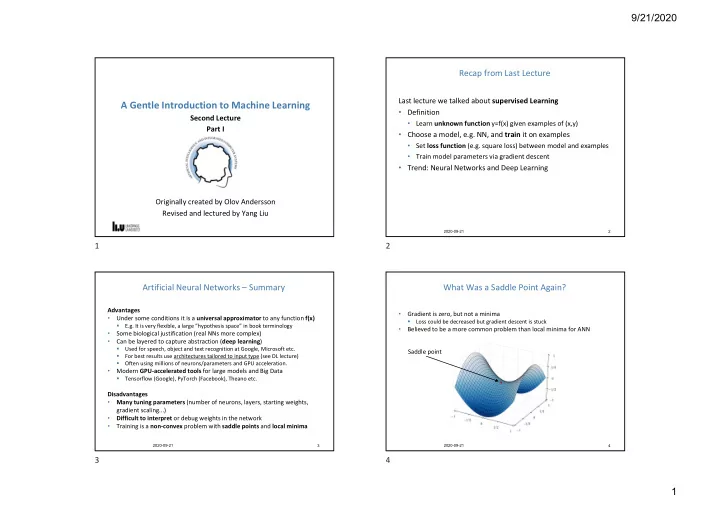
9/21/2020 1 A Gentle Introduction to Machine Learning
Second Lecture Part I Originally created by Olov Andersson Revised and lectured by Yang Liu
Recap from Last Lecture
Last lecture we talked about supervised Learning
- Definition
- Learn unknown function y=f(x) given examples of (x,y)
- Choose a model, e.g. NN, and train it on examples
- Set loss function (e.g. square loss) between model and examples
- Train model parameters via gradient descent
- Trend: Neural Networks and Deep Learning
2020-09-21 2
Artificial Neural Networks – Summary
Advantages
- Under some conditions it is a universal approximator to any function f(x)
- E.g. It is very flexible, a large ”hypothesis space” in book terminology
- Some biological justification (real NNs more complex)
- Can be layered to capture abstraction (deep learning)
- Used for speech, object and text recognition at Google, Microsoft etc.
- For best results use architectures tailored to input type (see DL lecture)
- Often using millions of neurons/parameters and GPU acceleration.
- Modern GPU‐accelerated tools for large models and Big Data
- Tensorflow (Google), PyTorch (Facebook), Theano etc.
Disadvantages
- Many tuning parameters (number of neurons, layers, starting weights,
gradient scaling...)
- Difficult to interpret or debug weights in the network
- Training is a non‐convex problem with saddle points and local minima
2020-09-21 3
What Was a Saddle Point Again?
2020-09-21 4
- Gradient is zero, but not a minima
- Loss could be decreased but gradient descent is stuck
- Believed to be a more common problem than local minima for ANN