A A novel international fram ew ork l i i l f k for - - PowerPoint PPT Presentation

a a novel international fram ew ork l i i l f k for
SMART_READER_LITE
LIVE PREVIEW

A A novel international fram ew ork l i i l f k for - - PowerPoint PPT Presentation

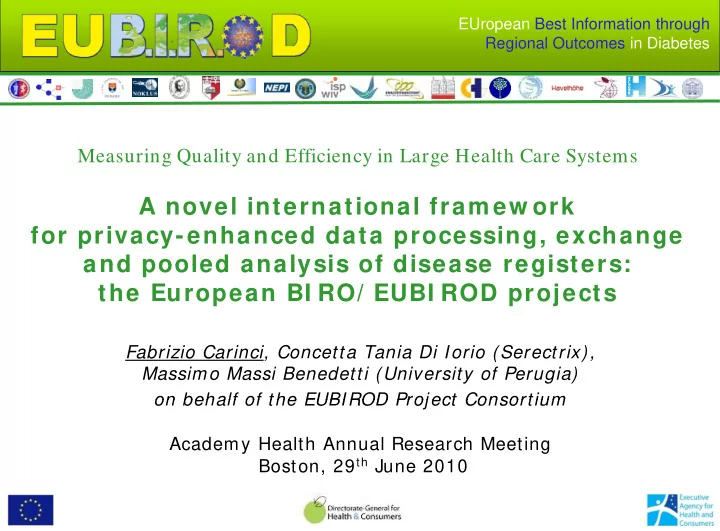
EUropean Best Information through Regional Outcomes in Diabetes Measuring Quality and Efficiency in Large Health Care Systems A A novel international fram ew ork l i i l f k for privacy-enhanced data processing, exchange and pooled


slide-1
SLIDE 1

EUropean Best Information through Regional Outcomes in Diabetes

Measuring Quality and Efficiency in Large Health Care Systems

A l i i l f k A novel international fram ew ork for privacy-enhanced data processing, exchange and pooled analysis of disease registers: and pooled analysis of disease registers: the European BI RO/ EUBI ROD projects

Fabrizio Carinci, Concetta Tania Di Iorio (Serectrix), Massimo Massi Benedetti (University of Perugia)

  • n behalf of the EUBIROD Project Consortium
  • n behalf of the EUBIROD Project Consortium

Academy Health Annual Research Meeting Boston 29th June 2010 Boston, 29 June 2010

slide-2
SLIDE 2

Diabetes Registers: different fruits g

slide-3
SLIDE 3

Types of Registers yp g

“Population-based” “Di M t” “Disease Management” “Specialistic”

slide-4
SLIDE 4

Unified model: cathedral or bazaar?

slide-5
SLIDE 5

Best Information through Regional Outcomes (BIRO) (BIRO)

Three ear project in diabetes f nded b the Health

  • Three year project in diabetes funded by the Health

Information Strand, Public Health Program, DG-SANCO, European Commission European Commission

  • Start: 1st December 2005
  • Total cost: 1 2Mn€ - Total EU contribution: 715 000€
  • Total cost: 1.2Mn€ - Total EU contribution: 715,000€
  • Aim: “to provide European health systems with an ad

hoc evidence and population-based diabetes hoc, evidence and population based diabetes information system”

  • Seven partners from academia and governmental

Seven partners from academia and governmental institutions, sharing an extensive experience in diabetes research/chronic care management

slide-6
SLIDE 6

Coordination rather than unification: a pragmatic model a pragmatic model

Ingredients = Standardized Data Recipe = Dictionary Discard Heterogeneity Product = Indicators

slide-7
SLIDE 7

Fundamental BIRO definitions

Region Region a network sharing a common homogeneous framework for the collection of health information (e g group of the collection of health information (e.g. group of professionals/centres, local health authority, single provinces, regions, states, or group of states) p o ces, eg o s, states, o g oup o states) Statistical Object Statistical Object An element of a distributed information system carrying essential data in the form of embedded, partial essential data in the form of embedded, partial aggregate components, required to compute a summary measure or relevant parameter for the whole population from multiple sites

slide-8
SLIDE 8

BIRO Infrastructure: “Privacy by Design”

DI IORIO CT et al J Med Ethics 2009 Dec;35(12):753 61 DI IORIO CT et al, J Med Ethics. 2009 Dec;35(12):753-61.

slide-9
SLIDE 9

The complete BIRO model www biro project eu www.biro-project.eu

Local Global Local Global

Trasmission

Regional Register BIRO Mapping Local Report Statistical Analysis

A

BIRO Standard

Global

Report

Aggregate Tables

...

Report

slide-10
SLIDE 10

BIRO Ingredients: Required Data g q

  • Core dataset (“Merge Table”)

A ti it T bl (t f d th id h )

  • Activity Table (transfer,death, residency change)
  • Structural profile (n.physicians, nurses)
  • Population profile (catchment area)
slide-11
SLIDE 11

BIRO Core EU Dataset

  • 1. ID Patient

25 Foot Examination

  • 1. ID Patient
  • 2. ID Centre
  • 3. Type of Diabetes
  • 4. Sex
  • 5. Date of Birth
  • 25. Foot Examination
  • 26. Foot Pulses
  • 27. Foot vibration
  • 28. End Stage Renal Failure
  • 29. Renal Dyalisis
  • 6. Date of Diagnosis
  • 7. Episode Date
  • 8. Smoking Status
  • 9. N.Cigarettes (x day)

10 Alcohol Intake (g/ da ) y

  • 30. Renal Transplant
  • 31. Stroke
  • 32. Foot Ulceration
  • 33. Acute Myocardial Infarction

34 L

  • 10. Alcohol Intake (g/x day)
  • 11. Weight
  • 12. Height
  • 13. BMI

14 Systolic Blood Pressure

N=48

  • 34. Laser
  • 35. Hypertension
  • 36. Blindness
  • 37. Amputation

38 Antihypertensive Medication

  • 14. Systolic Blood Pressure
  • 15. Dyastolic Blood Pressure
  • 16. HbA1c
  • 17. Creatinine
  • 18. Microalbumin
  • 38. Antihypertensive Medication
  • 39. Hypoglicemic Drug Therapy
  • 40. Oral Drug Therapy
  • 41. Pump Therapy
  • 42. Nasal Therapy
  • 19. Total Cholesterol
  • 20. HDL
  • 21. Tryglicerides
  • 22. Eye Examination

23 R ti th St t py

  • 43. Average Injections (x day)
  • 44. Self monitoring
  • 45. Diabetes Specific Education
  • 46. Lipid Lowering Therapy

47 A ti l t l t Th

  • 23. Retinopathy Status
  • 24. Maculopathy Status
  • 47. Anti-platelet Therapy
  • 48. Patient enrollment in DMP for diabetes
slide-12
SLIDE 12

Common Interface: the “BIROBox”

slide-13
SLIDE 13

BIRO Indicators (N=72)

htt / / bi j t / d t / d l d / D BIRO M h df http:/ / www.biro-project.eu/ documents/ downloads/ D14_4_BIRO_Monograph.pdf

Demographic Characteristics (N=2) Clinical Characteristics (N=18) Clinical Characteristics (N=18) Health System (N=21) P l ti (N 3) Population (N=3) Standardized / Risk Adjusted (N=28) E id i l i l (N 2) – Epidemiological (N=2) – Process (N=16) – Intermediate Outcomes (N=7) – Terminal Outcomes (N=3)

slide-14
SLIDE 14

The BIRO Statistical Engine: Automated Local & Global Report Delivery Automated Local & Global Report Delivery

slide-15
SLIDE 15

Standardization

(AHRQ Quality Indicators) (AHRQ Quality Indicators)

Risk adjustment model (in each region/overall) Y(%) =  + (females)+ (age class1)+  (age class4) Y(%) = 0+1(females)+2(age_class1)+...k(age_class4)

Source unit Source unit

Yi expected= 0+1(females)+2(age_class1)+...k(age_class4)

Predi x 100 = Expected Rate

Standardized Rate= (observed rate/expected rate)*population rate

slide-16
SLIDE 16

Challenging Bias in Disease Registers

“active” Patients People with Patients INDICATORS

OUTCOMES

Numerator

  • with

Diabetes INDICATORS

  • Denominator

Total Regional Catchment Area Total Regional Population

DATA

slide-17
SLIDE 17

www.eubirod.eu

University of Perugia (I) y g ( ) Serectrix snc (I) University of Dundee (GB) Joanneum Research (A) NOKLUS (N) NOKLUS (N) Paulescu Institute (RO) University of Malta (M) Republic of Cyprus (CY) S hl k I tit t (S) Sahlgrenska Institute (S) University of Debrecen (H) Institute of Public Health (B) IDF (B) Adelaide Meath Hospital (IRL) CBO (NL) Centre Hospitalier (LUX) University of Ljubljana (SLO)

BIRO 11/2005 8/2011 9/2008 5/2009 EUBIROD

y j j ( ) IMABIS Foundation (E) Medical University Silesia (PL) Havelhoe Hospital (D) Hillerod University Hospital (DK)

EUBIROD

Hillerod University Hospital (DK) Vuk Vrhovak University (HR) N=153,290

slide-18
SLIDE 18

EUBIROD: complete, refine, measure, disseminate

http:/ / www.eubirod.eu/ academ y p / / / y

slide-19
SLIDE 19

Watch this space! p

www.eubirod.eu