5/29/2013 Picture of the Day In the hit-or-miss fishery, any one - - PDF document

5 29 2013
SMART_READER_LITE
LIVE PREVIEW

5/29/2013 Picture of the Day In the hit-or-miss fishery, any one - - PDF document

5/29/2013 Picture of the Day In the hit-or-miss fishery, any one of the roughly 50 permit holders and their crews can become instantly Patent Reform wealthy or go bust. In 2008, two boats caught more than 10,000 tons of the 14,386-ton


slide-1
SLIDE 1

5/29/2013 1

Patent Reform

174

Picture of the Day

175

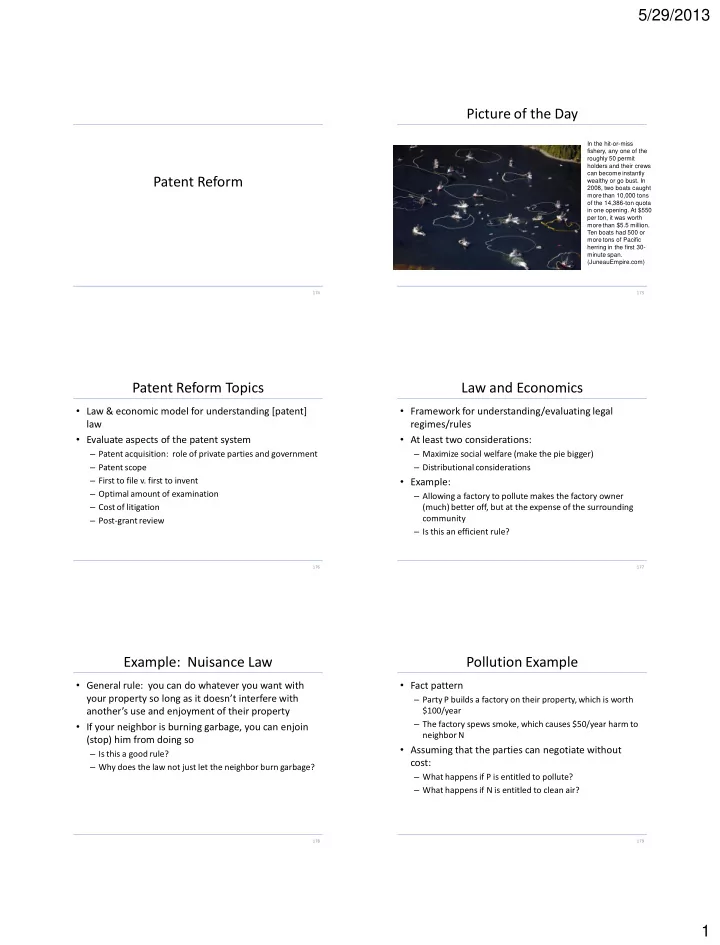
In the hit-or-miss fishery, any one of the roughly 50 permit holders and their crews can become instantly wealthy or go bust. In 2008, two boats caught more than 10,000 tons

  • f the 14,386-ton quota

in one opening. At $550 per ton, it was worth more than $5.5 million. Ten boats had 500 or more tons of Pacific herring in the first 30- minute span. (JuneauEmpire.com)

Patent Reform Topics

  • Law & economic model for understanding [patent]

law

  • Evaluate aspects of the patent system

– Patent acquisition: role of private parties and government – Patent scope – First to file v. first to invent – Optimal amount of examination – Cost of litigation – Post-grant review

176

Law and Economics

  • Framework for understanding/evaluating legal

regimes/rules

  • At least two considerations:

– Maximize social welfare (make the pie bigger) – Distributional considerations

  • Example:

– Allowing a factory to pollute makes the factory owner (much) better off, but at the expense of the surrounding community – Is this an efficient rule?

177

Example: Nuisance Law

  • General rule: you can do whatever you want with

your property so long as it doesn’t interfere with another’s use and enjoyment of their property

  • If your neighbor is burning garbage, you can enjoin

(stop) him from doing so

– Is this a good rule? – Why does the law not just let the neighbor burn garbage?

178

Pollution Example

  • Fact pattern

– Party P builds a factory on their property, which is worth $100/year – The factory spews smoke, which causes $50/year harm to neighbor N

  • Assuming that the parties can negotiate without

cost:

– What happens if P is entitled to pollute? – What happens if N is entitled to clean air?

179

slide-2
SLIDE 2

5/29/2013 2

The Coase Theorem

  • In the absence of transaction costs, the allocation of

initial entitlements is irrelevant, because the parties will negotiate an efficient allocation

– Corollary: Job of the law is to “lubricate” transactions

  • Transaction costs:

– Getting the parties together – Negotiating, creating contracts – Obtaining information – Enforcement

180

Transaction Costs

  • Assume high transaction costs:

– Party P builds a factory on their property, which is worth $100/year – The factory spews smoke, which causes $50/year harm to neighbor N – It costs $30 to each party to negotiate

  • What happens if P is entitled to pollute?
  • What happens if N is entitled to clean air?
  • Lesson: if transaction costs are high, then place the

entitlement with the party that values it most

181

Cheapest Cost Avoider

  • Assume abatement:

– Party P builds a factory on their property, which is worth $100/year; can install smoke scrubber for $10 – The factory spews smoke, which causes $50/year harm to neighbor N; can install air filter for $20

  • With and without transaction costs:

– What happens if P is entitled to pollute? – What happens if N is entitled to clean air?

  • Lesson: if transaction costs are high, then place the

entitlement against the party that that is the cheapest cost avoider

182

Liability Rules v. Property Rules

  • Property rules protect entitlement via injunctions
  • Liability rules protect entitlements via damages
  • There are thus four combinations, e.g.:

183

Entitlement Property Rule Liability Rule P entitled to pollute P can pollute at will (N may buy entitlement) N can stop P, but must pay damages to P N entitled to clean air N can enjoin P from polluting (P may buy entitlement) P can pollute, but must pay damages to N

Rules of Thumb

  • Property rules make sense when private parties can

efficiently negotiate reallocation of the entitlement

  • Liability rules make sense when we do not know who

values the entitlement most and when the transaction costs are high

– Determining damages can be difficult – Courts are an inefficient mechanism for recovering damages – Under- / Over-estimation leads to inefficiently high / low levels of activity

184

The Patent Context

  • In the patent context, L & E teaches:

– Select rules that correctly allocate rights when transaction costs are high – Reduce transaction costs – Internalize externalities

  • Example areas:

– First to file v. first to invent – Patent scope – Liability rules v. property rules – Registration system v. examination system v. reward system

185

slide-3
SLIDE 3

5/29/2013 3

Patent Scope

  • Narrow patents

– Reduced incentives to invent – Competitive environment for improvements

  • Increase breadth

– Increase incentives to invent, possibly wasteful – Blockages (especially in cumulative technologies), follow-

  • n parties are less likely to engage in invention

– But holders of broad patent may be able to coordinate

  • perations of other parties to make follow on inventions

186

Modifying Patent Scope

  • Levers:

– Change standard for non-obviousness – Change the claim breadth (e.g., limit to just concrete examples disclosed in spec) – After-emerging technologies (strict enablement) – Eliminate doctrine of equivalents (non-literal infringement) – Change the duration

187

Liability Rules v. Property Rules

  • Injunctions used to be an automatic remedy.
  • Problems with property rules in patents:

– Endowment effect – Hard to value innovation ex ante – The time and cost for an improver to protect his improvement is high (need to get a patent) – Patent boundaries are uncertain

  • Courts are taking a harder look at issuing injunctions

now.

– Injunction granted only when damages remedy is insufficient

188

Patent Validity as Public Good

  • Patent validity is a public good with a collective

action problem

– When a large number of parties are held up by patent troll, it is very difficult to coordinate action – Free riding: sit back and let other parties shoot down patent OR just negotiate privately with the patent holder

  • Who is responsible for assuring validity?

– Right now, public/private approach: USPTO does some work, while private parties fight it out in court

189

Examination vs. Registration

  • Examination or registration?
  • How much examination is optimal?
  • Current situation: In 2010, approximately $1.9B in

fees

– Works out to be about $4K per application (based on about 500K applications filed)

190

Patent Fees

  • In 2010, approximately $1.9B in fees

191

slide-4
SLIDE 4

5/29/2013 4

Reducing Examination: Registration

  • Why not get rid of the examination function of the

patent office, move to registration-based system.

  • Let parties fight out validity in court.
  • Assumptions:

– Litigation costs = $20B/year – Reduce fees ($2B decreases to $0.5B) – Decreases acquisition costs from $20K/patent to $2K/patent ($10B decreases to $2B) – Increases the number of patents by 100% – Litigation costs double

  • $32B (current system) vs. $42.5B (reg. system)

192

Hard Look: Increasing Examination

  • Assumptions:

– Litigation costs = $20B/year – Double fees ($2B increases to $4B) – Increases acquisition costs from $20K/patent to $40K/patent ($10B increases to $15B) – Decreases the number of patents by 30% – Decreases litigation costs by 30% (~ $6B)

  • $32B (current system) vs. $33B (hard look)

193

Overview post-grant proceedings

  • Concepts

– The patent office is more efficient at determining validity than the court – The patent holder’s competitor is best situated to invalidate patent

  • Five types of post-grant proceeding:

– Ex parte reexamination – Inter partes review - 102 – Post grant review – Supplemental examination – Business method review

194

Post grant proceedings

Type Who Reason Timing Notes Ex parte reexamination Anyone 102/103 patents/pubs Anytime Inter partes review Third party

  • nly

102/103 patents/pubs > 9 months after issue Estoppel; Stays concurrent court case Post-grant review Third party

  • nly

Any < 9 months after issue Estoppel; Stays concurrent court case Supplemental exam Owner only Any Anytime Business method review Third party that was sued 102/103 patents/pubs Anytime < 2020

195

Opposition

  • Europe provides a more robust opposition system

– Different types of evidence/reasons for reexam – No estoppel provision

  • Much higher rates of opposition: about 6% of issued

patents

  • Outcomes: 1/3 each revoked, reduced, maintained

– Compare in US:

  • Inter partes: 45% revoked, 45% reduced, 10%

maintained

  • Ex parte: 10% revoked, 70% reduced, 20% maintained

196

Reward System

  • Reward system

– Ex post rewards provided to inventors based on the social welfare contributed – Solves the monopoly pricing problem, improves social welfare – Collect taxes to obtain reward money – Distribute rewards based on use of invention – No more patent litigation

  • The hard part?

197