4/19/2013 Fast and reliable Portable and easy to install - - PDF document

4 19 2013
SMART_READER_LITE
LIVE PREVIEW

4/19/2013 Fast and reliable Portable and easy to install - - PDF document

4/19/2013 Fast and reliable Portable and easy to install PRESERVING, GENERATING, AND VISUALIZING KNOWLEDGE OF ARCHITECTURALLY SIGNIFICANT REQUIREMENTS IN SOURCE CODE Institute for Software Research Distinguished Speaker Series University


slide-1
SLIDE 1

4/19/2013 1

PRESERVING, GENERATING, AND VISUALIZING KNOWLEDGE OF ARCHITECTURALLY SIGNIFICANT REQUIREMENTS IN SOURCE CODE Institute for Software Research Distinguished Speaker Series University of California, Irvine April 19th, 2013

  • Dr. Jane Cleland-Huang

DePaul University

Research funded by the US National Science Foundation under Grants CCF-0959924 and CCF-1265178.

Fast and reliable Portable and easy to install

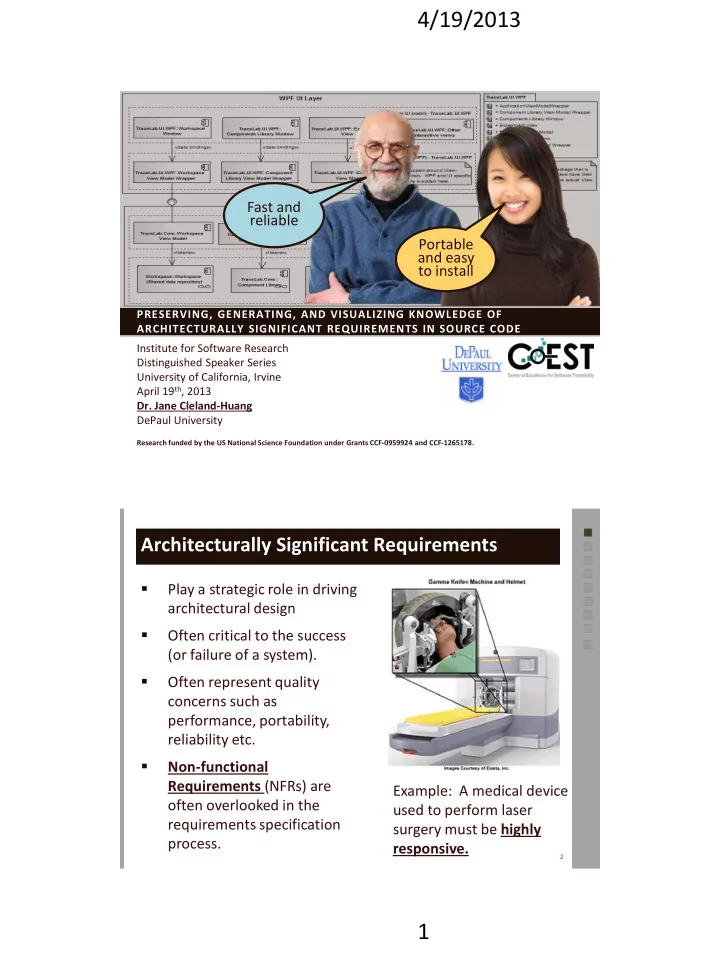
Architecturally Significant Requirements

  • Play a strategic role in driving

architectural design

  • Often critical to the success

(or failure of a system).

  • Often represent quality

concerns such as performance, portability, reliability etc.

  • Non-functional

Requirements (NFRs) are

  • ften overlooked in the

requirements specification process.

2

Example: A medical device used to perform laser surgery must be highly responsive.

slide-2
SLIDE 2

4/19/2013 2

Talk Outline

  • Architecturally Significant Requirements and their

impact on architectural design.

  • Focus on agile projects
  • Examples from TraceLab project
  • Establishing and utilizing trace links between quality

concerns and code

  • Patterns of traceability
  • Archie tool
  • Recovering architectural knowledge
  • Machine learning techniques

3

Working with ASRs

4

  • In practice ASRs (especially NFRs) are often not elicited and

are not clearly specified.

  • Many Software Requirements Specifications simply

don’t include NFRs.

  • Similarly, many agile projects fail to include ASR-related

user stories.

  • Is there a better way?
  • In our TraceLab project we adopted a persona-driven

approach which enabled us to discover architecturally significant requirements early in the project and to use our knowledge to make informed decisions about architectural design and implementation.

slide-3
SLIDE 3

4/19/2013 3

ASRs in TraceLab

5

  • TraceLab is a US $2 Million Project

funded by the National Science Foundation

  • Developed by collaborators at DePaul University, College of

William and Mary, Kent State Univ., and Univ. of Kentucky.

  • Intended to empower future traceability research through

facilitating innovation and creativity, increasing collaboration between traceability researchers, decreasing the startup costs and effort of new traceability research projects, and fostering technology transfer.

  • Provides an environment in which researchers can design

and execute experiments, share components and datasets, and comparatively evaluate results in a controlled setting.

ASRs in TraceLab

6

slide-4
SLIDE 4

4/19/2013 4

Competing Tradeoffs

7

We want to write components in C#. No we have to write in C. I want to just reuse my R and MatLab scripts. I don’t want to do any programming. It better be as fast as running experiments that I write myself. I’m not using other people’s components unless I know they are going to work. I’m willing to share with others, but not until after I’ve published. We only have 3 years to deliver everything!!

Traditional HCI Personas

8

We decided to represent the conflicting needs through developing a set of architecturally-savvy personas. Traditionally persona construction involves surveying users, classifying them, formulating hypotheses of use, validating, creating scenarios, and finally designing personas. Too time consuming for our project i.e. too much upfront effort that would retard the achievement of

  • ur goals.

Solution: Persona sketches.

Reused courtesy Cynthia Putnam

slide-5
SLIDE 5

4/19/2013 5

Architecturally-Savvy Personas (Lite)

9

Jane Cleland-Huang, Adam Czauderna, Ed Keenan: A Persona-Based Approach for Exploring Architecturally Significant Requirements in Agile Projects. REFSQ 2013: 18-33

Meet Karly…

10

Karly Age: 26, PhD Student

Karly is a new PhD student. She is interested in tracing requirements to software architecture. She has contacts with a local company who will allow her to access their data for her experiments; however this data is proprietary (i.e. protected by a NDA) and so she cannot share it with anyone else. She predicts that it will take her about 6 months to set up her traceability environment, but then she discovers

  • TRACY. Karly is quite a good programmer, but is much

more interested in the process side of her research.

Fast trace retrieval: Platform selection: Language selection: Reliability: Extensibility: Ease of component upload Ease of installation Highly intuitive interface Extensive document compatibility Data confidentiality Broad adoption

My user stories:

  • 1. I need to be able to maintain confidentiality of my data.

2.I need to be able to create my own components and integrate them with existing experiments.

  • 3. I need to be able to setup new benchmarks for

comparative purposes.

4.I need to be able to program components in C#.

slide-6
SLIDE 6

4/19/2013 6

Meet Jack..

11

Jack is married and has two young children. He has recently

been hired by the TRACY project into the role of Software Architect/Developer. He has 6 years of experience as a software developer and 2 years as a lead architect in a successful gaming

  • company. He has taken the job on the TRACY project because

he is excited by the challenge of working in a research oriented project. Jack is very motivated to build a high quality product. Jack has never worked in an academic research setting before. He is very collaborative and is looking forward to working with the other developers, academics, and students on the project.

Fast trace retrieval: Platform selection: Language selection: Reliability: Extensibility: Ease of component upload Ease of installation Highly intuitive interface Extensive document compatibility Data confidentiality Broad adoption

My user stories:

  • 1. I need to develop the TraceLab framework in a language

which supports rapid prototyping.

  • 2. I need the framework language to easily interface with, and

call, components written in other languages.

  • 3. I need the platform to provide natural support for the

separation of model and view components.

  • 4. I need libraries to support GUI development.

Jack, 34 Architect

Meet the full ensemble…

12

Tom Karly Jack

Glen Age: 23 MS Student at Hillsbury College Glen is an MS student who has been helping his advisor to build TraceLab components. He has never contributed to an open source project before, so he needs to figure

  • ut how to make

contributions to

  • TraceLab. Glen is very

collaborative and is looking forward to working with the other researchers on the project. Wayne Age:46 Technical Project Mgr ABC Corp Wayne is the technical manager for a very large systems engineering project. He could be described as an early adopter, as he prides himself in keeping an eye out for good ideas that could help his organization. Wayne wants to improve the efficiency

  • f traceability practices

in his organization and is interested in using TraceLab. Mary Age: 51 NSF Program Officer Mary is the funding

  • fficer for the grant.

She is concerned that the project delivers on time and ultimately meets all major goals in terms of adoption, research advancements, and technology transfer.
slide-7
SLIDE 7

4/19/2013 7

Understand key concerns

13

Process steps:

  • 1. Analyze

persona needs.

  • 2. Identify primary

drivers.

  • 3. Extract all

related user stories.

  • 4. Assign to

personas.

  • 5. Brainstorm

architectural design solutions and evaluate leading contenders.

  • 6. Evaluate against

personas.

Design solutions for key concerns

14

Process steps:

  • 7. Identify

architectural risks associated with the proposed solution and their mitigations.

  • 8. Consider and

document impacts upon personas.

slide-8
SLIDE 8

4/19/2013 8

Architectural design

15

Supports build-now/port-later decision    

Decision 2: Workflow architecture

16

Options ⁻ Pipe-and-filter ⁻ Services ⁻ Precedence graph + Blackboard

slide-9
SLIDE 9

4/19/2013 9

Decision 2: Workflow architecture

17

Our approach is generalizable..

We created five Architecturally Savvy Personas for a Mechatronics Traceability project that we are working on with Siemens. The personas highlighted different kinds of concerns from those highlighted by the TraceLab personas

Elaine, Age 50 Mechanical Engineer

Elaine is a mechanical engineer with over 20 years of experience working for Company X She is in charge of modeling the mechanisms for a railway gate. Her model needs to integrate with other models that describe the signaling process for the railway system. Elaine is aware that the crossing-gate must comply to a number of regulatory codes and she would like to be able to view the relevant codes from within her model. Elaine has access rights to update her model and to read requirements. Fast trace retrieval Access control Extensibility to new case tools Interoperability

  • f data formats

Remote access Trace GUIs as plugins John is the compliance officer for company X. His job is to ensure that all regulatory codes are met by the delivered product and to generate reports to demonstrate this. He is a very detail-oriented person and takes great pride in his job. No products have ever been recalled under his watch for non-compliance purposes. My user stories: 1.I need to be able to access all regulatory codes that impact the model I am currently working on. 2.I would like to control who views the models I am working on, and which version they view. 3.When I trace between my model and requirements, I need the traces to be returned within 30 seconds. 4.I need trace information to be displayed as an integral part of the model I am working in. My user stories: 1.I need to be able to generate a report which shows a list of all elements in the design that help satisfy each relevant regulatory

  • code. The report should generate within 2 minutes.

2.I need to view traces created in a wide variety of products. 3.I need to be able to generate and view traces for remote (i.e. globally distributed) models. Fast trace retrieval Access control Extensibility to new case tools Interoperability

  • f data formats

Remote access Trace GUIs as plugins.

Stanley, Age 50 Compliance Officer

slide-10
SLIDE 10

4/19/2013 10

SCRUM+ ASPs

19

Product backlog of features as prioritized by customer Sprint-sized architectural chunks associated with specific features.

 Select features

plus their associated architectural components for the Sprint backlog. Backlog tasks expanded by team Daily scrum meeting 24 hours 30 days

 Identify preliminary personas 

Elaborate individual personas and explore quality concerns

Explore architectural decisions and trade-offs

Evaluate solution with respect to persona’s goals. Deliver potentially shippable product.

Update personas

Break architecture into sprint- sized chunks. Construct software, including architecture, incrementally.

So what did we learn?

20

  • Emerging and analyzing quality concerns early allowed us

to make more informed architectural decisions.

  • Sketching out architecturally savvy personas (ASPs) enables

us to think about quality concerns in a more tangible way.

  • Our approach fits naturally into the SCRUM-like process we

had adopted for the project.

  • A light-weight approach for integrating NFR-thinking into a

fast-paced, agile, development environment.

slide-11
SLIDE 11

4/19/2013 11

Talk Outline

  • Architecturally Significant Requirements and their

impact on architectural design.

  • Focus on agile projects
  • Examples from TraceLab project
  • Establishing and utilizing traceability links between

quality concerns and code

  • Patterns of traceability
  • Archie tool
  • Recovering architectural knowledge
  • Machine learning techniques

21

Change Cycle: Ideal World

22

Source Code Environment Change IS-A Architecture Intended Architecture

Influences Align Results in Change in code Change Reasoning

Ideal World: Architectural information is documented during the Architectural design phase and is updated regularly to reflect the current system architecture.

Slide used courtesy of Mehdi Mirakhorli

slide-12
SLIDE 12

4/19/2013 12

Change Cycle: Real World

23

Real World: Architectural information is outdated and does not reflect the current architecture of the system.

Source Code Environment Change IS-A Architecture Intended Architecture

Influences Results in Change in code Drifts From Erodes the architecture

Slide used courtesy of Mehdi Mirakhorli

Architectural Degradation

24

  • 1. Intended and

implemented architecture diverge.

  • 2. Architecture

violations (i.e. strict layering bypassed,

  • r pipe-and-filter

pipeline violated); cyclic dependencies; dead code; code clones; metric

  • utliers etc.

System becomes brittle starts to erode.

slide-13
SLIDE 13

4/19/2013 13

Tracing Concerns to Code

25

Requirements traceability is the ability to describe and follow the life of a requirement, in both a forward and backward direction, i.e. from its

  • rigins, through its

development and spec- ification, to its subsequent deployment and use, and through periods of

  • ngoing refinement and

iteration in any of these phases.”

Gotel and Finkelstein,1994.

Tracing Concerns to Code

We can use the Softgoal Interdependency Graph (SIG) notation to capture the goal refinements that lead to our architectural decisions.

Decision-Centric Traceability of Architectural Concerns , Jane Cleland-Huang, Mehdi Mirakhorli, Adam Czauderna, and Mateusz Wieloch , Traceability in Emerging Forms of Software Engineering, May 2013.

slide-14
SLIDE 14

4/19/2013 14

Tracing Concerns to Code

27

Only certain kinds of architectural decisions are traceable to code.

Customized Views

28

A custom view shows the impact of the architectural decision to pass data using serialization, on higher level quality concerns.

slide-15
SLIDE 15

4/19/2013 15

Customized Views

29

A persona / user perspective upon architectural decisions.

Some decisions occur across multiple projects

30

Can we find better ways to trace quality concerns to code when common architectural decisions are made?

slide-16
SLIDE 16

4/19/2013 16

Some decisions recur across projects

31

Due to complexity of the problem, we tackled tactics first.

  • Tactics are pervasive in fault-tolerant and/or high-

performance systems.

  • Tactics seem to have an interesting relationship to change.

Tactic Occurrence Across Projects

32

Tactics tend to be found in safety-critical, and/or other kinds of performance-centric systems.

Courtesy Mehdi Mirakhorli

slide-17
SLIDE 17

4/19/2013 17

Tactic Traceability Patterns

33

  • Mehdi Mirakhorli and Jane Cleland-Huang, Using Tactic Traceability Information Models to Reduce the Risk of Architectural Degradation during System

Maintenance, International Conference on Software Maintenance, Williamsburg, USA, September, 2011

  • Mehdi Mirakhorli and Jane Cleland-Huang, “A Pattern System for Tracing Architectural Concerns”, Pattern Languages of Programming, Portland, USA,

October, 2011

Reliability goal Availability goal Heartbeat tactic Requirement Rationale <<Component> Emitter <<Component> Receiver <<Component> Fault Monitor

helps helps justifies Is realized by Emits heartbeat Receives heartbeat is monitored by sends pulse

Emitter Receiver Fault Monitor

maps maps maps

Archie…

slide-18
SLIDE 18

4/19/2013 18

Talk Outline

  • Architecturally Significant Requirements and their

impact on architectural design.

  • Focus on agile projects
  • Examples from TraceLab project
  • Establishing and utilizing traceability links between

quality concerns and code

  • Patterns of traceability
  • Archie tool
  • Recovering architectural knowledge
  • Machine learning techniques

35

TRACE RETRIEVAL

36

Trace Retrieval

In contrast, architectural concerns are often NOT unique in individual systems – so we can train our traceability engine to recognize them across projects.

slide-19
SLIDE 19

4/19/2013 19

TRACE RETRIEVAL

37

Tactic Detector

Our tactic detector uses a previously designed classifier – now implemented in TraceLab.

Normalizes the frequency with which term t occurs in the requirement with respect to the length of the requirement. Computes the percentage

  • f documents of type Q

containing term t Decreases the weight

  • f terms

that are project specific.

  • J. Cleland-Huang, R. Settimi, X.Zou, P. Solc, “Automated Detection and Classification of Quality

Requirements”, Requirements Engineering Journal, Springer-Verlag, August, 2006. pp. 36-45

 

Computes the likelihood that requirement r traces to Query q.

38

Classification Approach

slide-20
SLIDE 20

4/19/2013 20

Towards Automation

39

Tactic-Grained Classification

0.2 0.4 0.6 0.8 1 0.1 0.3 0.5 0.7 0.9 F-Measure Classification Threshold

Scheduling

0.2 0.4 0.6 0.8 1 0.1 0.3 0.5 0.7 0.9 F-Measure Classification Threshold

Resource Pooling

Legend 0.2 0.4 0.6 0.8 1 0.1 0.3 0.5 0.7 0.9 F-Measure Classification Threshold

Scheduling

0.2 0.4 0.6 0.8 1 0.1 0.3 0.5 0.7 0.9 F-Measure Classification Threshold

Resource Pooling

0.2 0.4 0.6 0.8 1 0.1 0.3 0.5 0.7 0.9 F-Measure Classification Threshold

Heartbeat

0.2 0.4 0.6 0.8 1 0.1 0.3 0.5 0.7 0.9 F-Measure Classification Threshold

Heartbeat

Description-trained Code-trained

40

slide-21
SLIDE 21

4/19/2013 21

Tactic-trained Classification / Code Trained

0.2 0.4 0.6 0.8 1 0.1 0.3 0.5 0.7 0.9 F-Measure Classification Threshold

Audit Trail

0.2 0.4 0.6 0.8 1 0.1 0.3 0.5 0.7 0.9 F-Measure Classification Threshold

Authentication

Legend 0.2 0.4 0.6 0.8 1 0.1 0.3 0.5 0.7 0.9 F-Measure Classification Threshold

Audit Trail

0.2 0.4 0.6 0.8 1 0.1 0.3 0.5 0.7 0.9 F-Measure Classification Threshold

Authentication

Description-trained Code-trained

41

HADOOP Case Study

42

slide-22
SLIDE 22

4/19/2013 22

More Challenging: Identifying Roles

43

Reliability goal Availability goal Heartbeat tactic Requirement Rationale <<Component> Emitter <<Component> Receiver <<Component> Fault Monitor

helps helps justifies Is realized by Emits heartbeat Receives heartbeat is monitored by sends pulse

Emitter Receiver Fault Monitor

maps maps maps

Finding Roles is Hard

We integrated light-weight structural approaches – but only evaluated them in a single case study.

44

slide-23
SLIDE 23

4/19/2013 23

Tactic-trained Classification / Code Trained

45

Using Generated Links to mitigate Architectural Decay

  • Are automatically reconstructed

traceability links good enough for use?

  • Evaluated the usefulness of the

generated fine-grained traceability links for supporting software maintenance.

  • Utilized Hadoop change logs for

the past four releases, and simulated the scenario in which generated links were used to control the generation of notification messages.

You are modifying Datanode.java. This file appears to play the role of heartbeat emitter in the heartbeat tactic. This class therefore contributes to reliability and availability goals. Tell me more. Please confirm the role of this class in the heartbeat tactic: Heartbeat emitter (Prob 79%) Heartbeat sender (Prob 75%) Supporting role Unrelated to heartbeat

46

slide-24
SLIDE 24

4/19/2013 24

Visualizations

47

Conclusions

48

  • Managing quality concerns (aka NFRs) is a complete life-

cycle activity.

  • Elicit them early
  • Design to satisfy them
  • Preserve them
  • If necessary, rediscover them
slide-25
SLIDE 25

4/19/2013 25

49

Tackle cutting edge problems in software traceability. Build a supportive community of researchers.

PRESERVING, GENERATING, AND VISUALIZING KNOWLEDGE OF ARCHITECTURALLY SIGNIFICANT REQUIREMENTS IN SOURCE CODE Institute for Software Research Distinguished Speaker Series University of California, Irvine April 19th, 2013

  • Dr. Jane Cleland-Huang

DePaul University

Any questions?

Research funded by the US National Science Foundation under Major Research Instrumentation Grants CCF-0959924 and CCF-1265178.