3 rd National Guardianship Summit Convened in October 2011 at - - PDF document

3 rd national guardianship summit
SMART_READER_LITE
LIVE PREVIEW

3 rd National Guardianship Summit Convened in October 2011 at - - PDF document

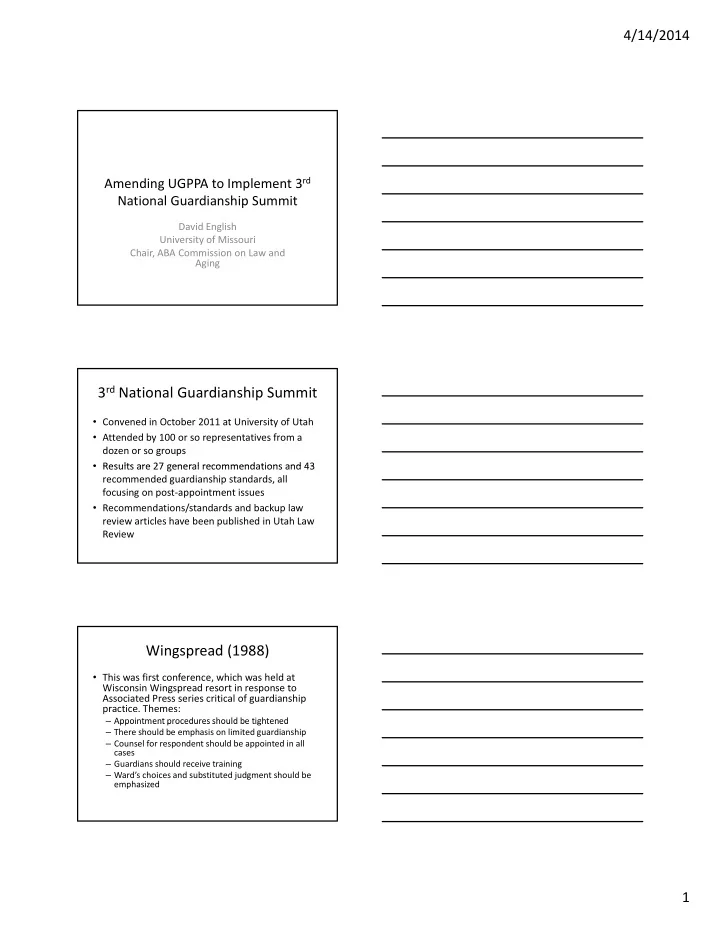
4/14/2014 Amending UGPPA to Implement 3 rd National Guardianship Summit p David English University of Missouri Chair, ABA Commission on Law and Aging 3 rd National Guardianship Summit Convened in October 2011 at University of Utah Attended


slide-1
SLIDE 1

4/14/2014 1

Amending UGPPA to Implement 3rd National Guardianship Summit p

David English University of Missouri Chair, ABA Commission on Law and Aging

3rd National Guardianship Summit

  • Convened in October 2011 at University of Utah
  • Attended by 100 or so representatives from a

dozen or so groups

  • Results are 27 general recommendations and 43
  • Results are 27 general recommendations and 43

recommended guardianship standards, all focusing on post‐appointment issues

  • Recommendations/standards and backup law

review articles have been published in Utah Law Review

Wingspread (1988)

  • This was first conference, which was held at

Wisconsin Wingspread resort in response to Associated Press series critical of guardianship

  • practice. Themes:

– Appointment procedures should be tightened Appointment procedures should be tightened – There should be emphasis on limited guardianship – Counsel for respondent should be appointed in all cases – Guardians should receive training – Ward’s choices and substituted judgment should be emphasized

slide-2
SLIDE 2

4/14/2014 2

Wingspan (2001)

  • This was second conference, which was held

at Stetson University College of Law.

  • Produced series of recommendations largely

reinforcing and refining recommendations reinforcing and refining recommendations made at Wingspan.

The UGPPA

  • Stands for Uniform Guardianship and Protective

Proceedings Act.

  • Under Act, a “guardian” is appointed to make

personal decisions. A “conservator” is appointed in a “protective proceeding” to make decisions regarding property.

  • UGPPA originally approved in 1969, but extensive

amendment occurred in 1982 and 1997.

  • Act, even if not enacted by a state in total, has

influenced all reform efforts.

Implementing 3rd Summit

  • Implementation Committee appointed to

implement recommendations of 3rd National

  • Summit. Committee tasked with

recommending revisions to UGPPA recommending revisions to UGPPA.

  • Third Summit also encouraged creation of

WINGS [Working Interdisciplinary Network Guardianship Stakeholders] in individual states.

slide-3
SLIDE 3

4/14/2014 3

Revising the UGPPA

  • Implementation Committee divided

recommendations/standards into following categories: S‐statutory; P‐practice standard; E‐ educational; O‐other educational; O other

  • David English and Linda Whitton of

Implementation Committee then revised, reclassifying some S as P or E but also some P

  • r E as S

Classification Results

  • Of 70 recommendations/standards, 33 are

classified as partially or fully statutory

  • The 33 items fall into the following statutory

categories: g

– Order of appointment – Duties and powers – Reporting – Compensation – Termination

Main Themes

  • Terminology [R1.7]
  • Transparency of duties [R1.1]
  • Reporting to court [S1.1, 2.2]
  • Fees [S 3 1 R3 2]
  • Fees [S 3.1, R3.2]
  • Substituted judgment [R1.5]
  • Financial decisions [S 4.1‐4.6, 4.8‐4.9, 4.12]
  • Health‐care decisions [S 5.1‐5.3]
  • Residential decision‐making [S 6.1, 6.3‐6.4]
slide-4
SLIDE 4

4/14/2014 4

Terminology [R1.7]

  • “Where possible, the term person under

guardianship should replace terms such as incapacitated person, ward, or disabled person ” person.

Transparency of duties [R1.1]

  • State statutes should set forth the mandatory

duties of guardians. Court or administrative rules should set forth guardian standards.

Reporting to Court

  • The guardian shall develop and implement a plan

setting forth short‐term and long‐term goals for meeting the needs of the person‐‐plan shall emphasize "person‐centered philosophy.“ S1.1

  • The guardian and conservator shall keep the

court informed about the well‐being of the person and the status of the estate through personal care and financial plans, inventory and appraisals, and annual reports and accountings. S2.2

slide-5
SLIDE 5

4/14/2014 5

Fees

  • Advance disclosure of fees, including basis,

changes, and detailed explanation. S3.1

  • Factors in setting fees. R3.2

Substituted Judgment [R1.5]

  • States should adopt by statute a decision‐

making standard that provides guidance for using substituted judgment and best interest principles in guardian decisions principles in guardian decisions.

  • These standards should emphasize self‐

determination and the preference for substituted judgment.

Financial Decisions

  • Role of substituted judgment in financial
  • decisions. S4.1‐4.5
  • Avoidance of conflicts of interest and self‐
  • dealing. S4.6

g

  • Role of conservation and prudent

management in addition to substitute

  • judgment. S4.8
  • Bond requirement. S4.9
  • Power to delegate. S4.12
slide-6
SLIDE 6

4/14/2014 6

Health Care Decision‐Making [1]

  • The guardian, in making health care decisions
  • r seeking court approval for a decision, shall

maximize the participation of the person. S5.1

  • The guardian shall

g

– Acquire a clear understanding of the medical facts – Acquire a clear understanding of the health care

  • ptions and risks and benefits of each

– Encourage and support the individual in understanding the facts and directing a decision. S5.2

Health Care Decision‐Making [2]

  • To the extent the person cannot currently direct

the decision, the guardian shall act in accordance with the person's prior directions, expressed desires, and opinions about health care; or, if unknown and unascertainable,

– Act in accordance with the person's prior general statements, actions, values and preferences; or, if unknown and unascertainable, – Act in accordance with reasonable information received from professionals and persons who demonstrate sufficient interest in the person's welfare, to determine the person's best interests. S5.3

Residential Decision‐Making [1]

  • Protocol for ascertaining person’s goals on

residential placement. S6.1

  • The guardian shall have a strong priority for

home or other community based settings home or other community‐based settings, when not inconsistent with the person's goals and preferences. S6.3

slide-7
SLIDE 7

4/14/2014 7

Residential Decision‐Making [2]

  • The guardian shall make and implement a

person‐centered plan that seeks to fulfill the person's goals, needs, and preferences. The plan shall emphasize the person's strengths plan shall emphasize the person s strengths, skills, and abilities to the fullest extent in

  • rder to favor the least restrictive setting. S6.4