2019 Rural Challenges in Health Care Presented by Raymond T. Hino, - - PowerPoint PPT Presentation

2019 rural challenges in health care
SMART_READER_LITE
LIVE PREVIEW

2019 Rural Challenges in Health Care Presented by Raymond T. Hino, - - PowerPoint PPT Presentation

2019 Rural Challenges in Health Care Presented by Raymond T. Hino, MPA, FACHE 2018 2019 President California State Rural Health Association (CSRHA) Slides Provided by Brock Slabach, MPA, FACHE Sr. Vice President National Rural Health


slide-1
SLIDE 1

2019 Rural Challenges in Health Care

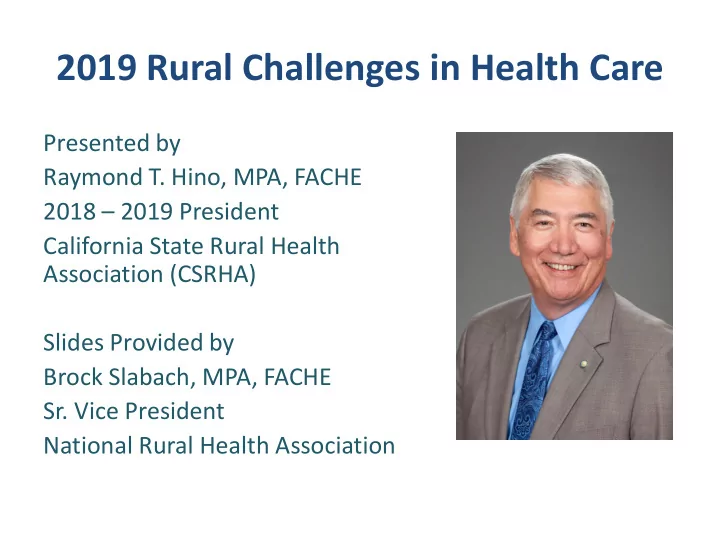
Presented by Raymond T. Hino, MPA, FACHE 2018 – 2019 President California State Rural Health Association (CSRHA) Slides Provided by Brock Slabach, MPA, FACHE

  • Sr. Vice President

National Rural Health Association

slide-2
SLIDE 2

Join Us 2019 Annual California State Rural Health Conference Roseville, California September 23-24, 2019

slide-3
SLIDE 3

Improving the health of the 62 million who call rural America home.

NRHA is non-profit and non-partisan.

slide-4
SLIDE 4

National Rural Health Association Membership

slide-5
SLIDE 5

Destination NRHA

Plan now to attend these upcoming events.

Policy Institute—February 5-7, 2019• Washington, DC Annual Conference—May 7-10, 2019• Atlanta, GA Rural Hospital Innovation Summit—May 7-10, 2019• Atlanta, GA RHC/CAH Conference—September 17-20, 2019• Kansas City, MO World Rural Health Conference—Oct. 12-15, 2019• Albuquerque, NM Visit RuralHealthWeb.org

for details and discounts.

5

slide-6
SLIDE 6

The State of Rural America

  • Workforce

Shortages

  • Vulnerable

Populations

  • Chronic

Poverty

slide-7
SLIDE 7
  • 6,000 areas in the U.S. are primary care health shortage areas;
  • 4,300 areas are dental health shortage areas; and
  • 3,500 areas are short of mental health shortage areas.
slide-8
SLIDE 8

Rural Mortality Rates.

A Rural Divide in American Death

Center for Disease Control January, 2017 Study:

“The death rate gap between urban and rural America is getting wider”

  • Rates of the five leading causes of death — heart disease, cancer, unintentional injuries, chronic respiratory

disease, and stroke — are higher among rural Americans.

  • Infant mortality rates are 20% higher than in large urban counties.
  • Mortality is tied to income and geography.
  • Minorities, especially Native Americans die consistently prematurely nation-wide, but more pronounced in rural.
  • Startling increase in mortality of white, rural women. Causes:
  • Risky lifestyle (smoking, alcohol abuse, opioid abuse, obesity)
  • Environmental cancer clusters
  • Suicides

January 2017

slide-9
SLIDE 9
slide-10
SLIDE 10
slide-11
SLIDE 11

Prevalence of Medicare Patients with 6 or more Chronic Conditions

slide-12
SLIDE 12

The Rural Opioid Crisis

slide-13
SLIDE 13

Poverty in Rural America

  • In 1980, 70% of rural

Americans living in poverty were working.

  • Today, less than half of the

rural poor are working.

slide-14
SLIDE 14

Persistent Poverty in Rural America

  • At the turn of the century, about 1 in 5

rural counties had a poverty rate higher than 20 percent. Today, about

  • ne in three rural counties — 657

counties — have similarly high rates of poverty. Carsey Institute of Public Policy, November 2017 “Rural poverty skyrockets as jobs move away,”

The Hill, December 5, 2017

slide-15
SLIDE 15
slide-16
SLIDE 16
slide-17
SLIDE 17

Now, mo more t than ev ever…an inves estmen ent i is need eded ed i in…

Rural Health Clinics Critical Access Hospitals

slide-18
SLIDE 18

Rural Health Clinics Advocacy

  • 4,400 RHCs nationwide

furnish primary care and preventive health services in rural and underserved areas.

  • Rural Health Clinics across

rural America face long- standing challenges:

  • inadequate

reimbursement rates;

  • workforce shortages;

and

  • technology

challenges.

slide-19
SLIDE 19

Ra Rais ising RH RHC C Caps

  • Prospects of Raising the RHC Cap ($110

per visit proposal by the Senate Rural Health Caucus)

  • Medicare Spending on Rural Health

Clinics remains woefully low (1% of all Medicare spending)

slide-20
SLIDE 20

RHC HC M Mode dernization A Act

  • Provides overdue and common-sense regulatory reform
  • Payment Reform
slide-21
SLIDE 21

Hospital Closure Crisis

slide-22
SLIDE 22

Rural H Hosp spital C Closu sures a and Risk sk o

  • f Closu

sures

35% Percent Vulnerable

X

94

slide-23
SLIDE 23

Rural Hospital Closures Continue…

slide-24
SLIDE 24

Rur ural H l Hea ealth Safety Net is Under Under Fire Pressure

Current and Pending Health Policies Negatively I m pact Rural Providers Total Rural Hospitals Operating in the Red Jum ped Four Percentage Points Since Last Year

slide-25
SLIDE 25

Why are hospitals losing money?

RURAL PROVIDERS ARE SUBSIDIZING CARE.

Impact of Bad Debt

  • Medicare and Medicaid bad debt has increased by nearly 50%

since the ACA was signed into law.

  • Private bad debt?
  • Bad debt cuts cause $3.8 billion over 10 years to be lost.
slide-26
SLIDE 26

Impact of t of Sequestr trati tion

  • Projected impact of the Sequester to rural hospitals and communities within one year.1

Revenue Lost within 1 year2 Jobs Lost within 1 year3 GDP Lost within 1 year4

$ 3 2 0 M 7 ,1 0 0 $ 8 0 0 M

  • Median rural hospital loses $71,000 from sequestration;
  • Rural Health Clinics net payment decrease from Medicare is 1.62% of capitated rate.

.

slide-27
SLIDE 27

Maternity Ca Care is Di Disap appe pearing ng i in Ru Rural A America

  • In 1985, 24% of rural

counties lacked OB services. Today, 54% of rural counties are without hospital based

  • bstetrics.
  • More than 200 rural

maternity wards closed between 2004 and 2014.

slide-28
SLIDE 28

Rur ural Ob l Obstetric ric Fa Factors

  • Rural areas have higher rates of chronic

conditions that make pregnancy more challenging, higher rates of childbirth- related hemorrhages and higher rates

  • f maternal and infant deaths.
  • Half of rural women in rural

communities live more than the recommended 30 minutes from a hospital offering maternity services.

  • Workforce shortages and medical

liability costs.

slide-29
SLIDE 29

Rur ural l Vict ctories ries: Appr Appropria priatio ions ns

  • First time in more than

a decade, a L-HHS Bill has been approved by Congress.

  • Unprecedented

Funding for:

  • Rural Health Safety

Net;

  • Opioid prevention

funding;

  • National Institute of

Health.

  • Remember also
  • perating off of 2-7ear

budget bill that passed in February, which included significant rural funding.

slide-30
SLIDE 30

The De he Details

  • Medicare Rural Hospital Flexibility Grants - $53. 6 million -- $3.2

million over NRHA request.

  • Of Rural Hospital Flexibility Grants funds, $19.9 million is specifically

provided for the Small Rural Hospital Improvement Grant.

  • State Offices of Rural Health (SORH)

$10 million to help the SORH improve rural health care across our country.

  • Telehealth Programs: The bill focuses resources toward efforts and

programs to help rural communities, including $25.5 million, $2 million above FY2018, for Telehealth.

  • Workforce: The committee appropriated $40.25 million, $2 million

above FY2018 for Area Health Education Centers (AHECs). An additional $15,000,000 will be available through September 30, 2021 to support the Rural Residency Development Program.
slide-31
SLIDE 31

Ex Examples o

  • f R

Rural Focu cus i in Appropriations Bill

 New Grant dollars for Obstetric Shortages: Senators Lisa

Murkowski (R-AK) and Heidi Heitkamp (D-BD) $1 million grants for the purchase and implementation of telehealth services or

  • ther necessary technology and equipment to improve care

coordination and delivery for pregnant women in rural (Sens. Heitkamp (D-ND) and Murkowski (R-AK)).

 Coal Workers Surveillance Program Improvements. (Sens.

Manchin (D-WV), Shelley Moore Capito (R-WV), Sherrod Brown (D-OH), and Bob Casey (D-PA).

slide-32
SLIDE 32

Save Rural Hospitals Act

Rural hospital stabilization (Stop the bleeding)

  • Eliminat ion of Medicare S

equest rat ion for rural hospit als;

  • Reversal of all “ bad debt ” reimbursement cut s (Middle Class Tax Relief and Job Creat ion Act of 2012);
  • Permanent ext ension of current Low-Volume and Medicare Dependent Hospit al payment

levels;

  • Reinst at ement of S
  • le Communit y Hospit al “ Hold Harmless” payment s;
  • Ext ension of Medicaid primary care payment s;
  • Eliminat ion of Medicare and Medicaid DS

H payment reduct ions; and

  • Est ablishment of Meaningful Use support payment s for rural facilit ies st ruggling.
  • Permanent ext ension of t he rural ambulance and super-rural ambulance payment .

Rural Medicare beneficiary equity. Eliminat e higher out -of pocket

charges for rural pat ient s (t ot al charges vs. allowed Medicare charges.)

Regulatory Relief

  • Eliminat ion of t he CAH 96-Hour Condit ion of Payment (S

ee Crit ical Access Hospit al Relief Act

  • f 2014);
  • Rebase of supervision requirement s for out pat ient t herapy services at CAHs and rural PPS

S ee P AR TS Act );

  • Modificat ion t o 2-Midnight Rule and RAC audit and appeals process.

Future of rural health care (Bridge to the Future)

Innovation model for rural hospitals who continue to struggle.

slide-33
SLIDE 33

Future Model: Community Outpatient Model

  • 24/7 emergency Services
  • Flexibility to Meet the Needs of Your Community through Outpatient Care:
  • Meet Needs of Your Community through a Community Needs Assessment:
  • Rural Health Clinic
  • FFQHC look-a-like
  • Swing beds
  • No preclusions to home health, skilled nursing, infusions services observation care.
  • TELEHEALTH SERVICES AS REASONABLE COSTS.—For purposes of this subsection, with respect to

qualified outpatient services, costs reasonably associated with having a backup physician available via a telecommunications system shall be considered reasonable costs.”.

  • “The amount of payment for qualified outpatient services is equal to 105

percent of the reasonable costs of providing such services.”

  • $50 million in wrap-around population health grants.
slide-34
SLIDE 34

Miscellaneous Bills/Issues

  • Save Rural Hospitals Act (SRHA) introduced by Graves/Loebsack reverses

sequestration/bad debt, regulatory reform and introduces new model: Community Outpatient Hospital (COH) (HR 2957)

  • Rural Emergency Medical Center (REMC) introduced by Lynn Jenkins, et.
  • al. in Congress July, 2018. New model introduction (HR 5678)
  • Rural Emergency Acute Care Hospital (REACH) Act introduced by

Grassley/Gardner/Klobuchar allows 50 bed or less CAH/Hospital to convert to Rural Emergency Hospitals and receive 110% of reasonable cost

  • MedPAC report on freestanding emergency departments, rural and

urban released June, 2018.

  • Critical Access Hospital Relief Act which removes the 96 hour physician

certification for payment requirement upon admission. (HR 5507)

  • Association Health Plans regulations released yesterday, removes

Essential Health Benefits (EHB) provisions from offered plans.

  • Star Ratings July, 2018 release delayed.
  • NQF Core set of Rural Relevant measures released September, 2018.
slide-35
SLIDE 35
  • The purpose of the 340B program is to enable covered entities “to

stretch scarce federal resources as far as possible, reaching more eligible patients and providing more comprehensive services.”

  • House E&C Health Subcommittee considered over twelve bill and

concept papers in a July 12, 2018 hearing

  • Some proposals out of these bills/documents:
  • Rescind OPPS reductions of 28% that CMS imposed last year (HR 4392)
  • Limit orphan drug exclusions under the 340B program (HR 2889)
  • Moratorium on new 340B sites (HR 4170)
  • Require DSH to submit reporting of low-income utilization of services (HR 5598)
  • Raise DSH percentage to qualify for 340B participation
  • Re-define “patient” for purposes of the program
  • Require implementation of GAO recommendations regarding Contract Pharmacy
  • Establish minimum 1% threshold for charity care to participate in 340B savings\
  • Unclear how much, if any, of the discussed changes would impact CAH

participation in 340B

  • Major advocacy priority for NRHA

340B Concerns Continue…

slide-36
SLIDE 36

Regulatory Victories with Administration

slide-37
SLIDE 37

New “ ew “rural lens” at C CMS

“For the first time, CMS is organizing and focusing our efforts to apply a rural lens to the vision and work of the agency.” CMS Administrator Seema Verma Five objectives to achieve the agency’s vision for rural health:

  • Apply a rural lens to CMS programs and

policies

  • Improve access to care
  • Advance telehealth and telemedicine
  • Empower patients in rural communities
  • Leverage partnerships
slide-38
SLIDE 38

Admin inis istrativ tive V Vict ctorie ries: New F w Federal A Assistan ance for Rural Ho Hosp spitals

  • HHS Vulnerable Rural Hospital Assistance Program
  • Targeted, in-depth assistance program to

vulnerable rural hospitals with communities struggling to maintain access to care.

  • Funding with be utilized to help rural hospitals stay

financially stable, keep care local, and best meet needs of the community.

  • Currently being rolled out - - likely available in

October.

  • USDA Rural Hospital Assistance Program
  • Help struggling hospitals who have received a

USDA loan.

  • Offers hand-on technical and financial assistance
  • Goal to keep rural hospital doors open.
slide-39
SLIDE 39

Summary: Grassroots Push

  • To Congress: Work together to solve problems
  • Closure crisis worsens
  • Congress and Administration continue to address SUD with

resources: Evaluate for your rural community

  • Health equity worsens (new push for obstetric shortages and oral

health integration.)

  • Critical Access Hospitals and Rural Health Clinics not only provide

access to care, but are economic engines for their community’s economic health, an important social determinant of health

  • Keep up the great work and Go Rural!
slide-40
SLIDE 40

crsha.org