20 Years of Evolutionary Multi-Objective Optimization: What Has Been - - PowerPoint PPT Presentation

20 years of evolutionary multi objective optimization
SMART_READER_LITE
LIVE PREVIEW

20 Years of Evolutionary Multi-Objective Optimization: What Has Been - - PowerPoint PPT Presentation

Outline Introduction Historical Highlights The Current State Future Challenges Conclusions 20 Years of Evolutionary Multi-Objective Optimization: What Has Been Done and What Remains To Be Done Carlos A. Coello Coello Evolutionary


slide-1
SLIDE 1

Outline Introduction Historical Highlights The Current State Future Challenges Conclusions

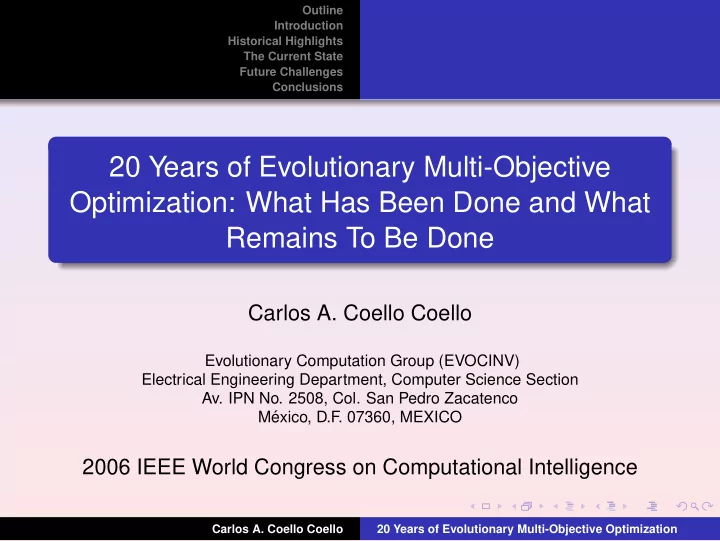
20 Years of Evolutionary Multi-Objective Optimization: What Has Been Done and What Remains To Be Done

Carlos A. Coello Coello

Evolutionary Computation Group (EVOCINV) Electrical Engineering Department, Computer Science Section

  • Av. IPN No. 2508, Col. San Pedro Zacatenco

M´ exico, D.F. 07360, MEXICO

2006 IEEE World Congress on Computational Intelligence

Carlos A. Coello Coello 20 Years of Evolutionary Multi-Objective Optimization

slide-2
SLIDE 2

Outline Introduction Historical Highlights The Current State Future Challenges Conclusions

Outline of Topics

1

Introduction

2

Historical Highlights

3

The Current State

4

Future Challenges

5

Conclusions

Carlos A. Coello Coello 20 Years of Evolutionary Multi-Objective Optimization

slide-3
SLIDE 3

Outline Introduction Historical Highlights The Current State Future Challenges Conclusions

Motivation

Most problems in nature have several (possibly conflicting)

  • bjectives to be satisfied (e.g., design a bridge for which want

to minimize its weight and cost while maximizing its safety). Many of these problems are frequently treated as single-objective optimization problems by transforming all but

  • ne objective into constraints.

Carlos A. Coello Coello 20 Years of Evolutionary Multi-Objective Optimization

slide-4
SLIDE 4

Outline Introduction Historical Highlights The Current State Future Challenges Conclusions

The Multi-Objective Optimization Problem

Find the vector x∗ =

  • x∗

1, x∗ 2, . . . , x∗ n

T which will satisfy the m inequality constraints: gi( x) ≤ 0 i = 1, 2, . . . , m (1) the p equality constraints hi( x) = 0 i = 1, 2, . . . , p (2) and will optimize the vector function

  • f(

x) = [f1( x), f2( x), . . . , fk( x)]T (3)

Carlos A. Coello Coello 20 Years of Evolutionary Multi-Objective Optimization

slide-5
SLIDE 5

Outline Introduction Historical Highlights The Current State Future Challenges Conclusions

Notion of Optimality in MOPs

Having several objective functions, the notion of “optimum” changes, because in MOPs, we are really trying to find good compromises (or “trade-offs”) rather than a single solution as in global optimization. The notion of “optimum” that is most commonly adopted is that originally proposed by Francis Ysidro Edgeworth in 1881.

Carlos A. Coello Coello 20 Years of Evolutionary Multi-Objective Optimization

slide-6
SLIDE 6

Outline Introduction Historical Highlights The Current State Future Challenges Conclusions

Notion of Optimality in MOPs

This notion was later generalized by Vilfredo Pareto (in 1896). Although some authors call Edgeworth-Pareto optimum to this notion, we will use the most commonly accepted term: Pareto

  • ptimum.

Carlos A. Coello Coello 20 Years of Evolutionary Multi-Objective Optimization

slide-7
SLIDE 7

Outline Introduction Historical Highlights The Current State Future Challenges Conclusions

Pareto Optimality

Definition We say that a vector of decision variables x∗ ∈ F is Pareto

  • ptimal if there does not exist another

x ∈ F such that fi( x) ≤ fi( x∗) for all i = 1, . . . , k and fj( x) < fj( x∗) for at least

  • ne j.

Carlos A. Coello Coello 20 Years of Evolutionary Multi-Objective Optimization

slide-8
SLIDE 8

Outline Introduction Historical Highlights The Current State Future Challenges Conclusions

Pareto Optimality

Explanation of the Definition In words, this definition says that x∗ is Pareto optimal if there exists no feasible vector of decision variables x ∈ F which would decrease some criterion without causing a simultaneous increase in at least one other criterion. Unfortunately, this concept almost always gives not a single solution, but rather a set of solutions called the Pareto optimal set. The vectors x∗ correspoding to the solutions included in the Pareto optimal set are called nondominated. The plot of the objective functions whose nondominated vectors are in the Pareto optimal set is called the Pareto front.

Carlos A. Coello Coello 20 Years of Evolutionary Multi-Objective Optimization

slide-9
SLIDE 9

Outline Introduction Historical Highlights The Current State Future Challenges Conclusions

Pareto Front

Carlos A. Coello Coello 20 Years of Evolutionary Multi-Objective Optimization

slide-10
SLIDE 10

Outline Introduction Historical Highlights The Current State Future Challenges Conclusions

Mathematical Programming Techniques

Currently, there are over 30 mathematical programming techniques for multiobjective optimization. However, these techniques tend to generate elements of the Pareto optimal set

  • ne at a time. Additionally, most of them are very sensitive to

the shape of the Pareto front (e.g., they do not work when the Pareto front is concave or when the front is disconnected).

Carlos A. Coello Coello 20 Years of Evolutionary Multi-Objective Optimization

slide-11
SLIDE 11

Outline Introduction Historical Highlights The Current State Future Challenges Conclusions

Why Evolutionary Algorithms?

Evolutionary algorithms seem particularly suitable to solve multiobjective optimization problems, because they deal simultaneously with a set of possible solutions (the so-called population). This allows us to find several members of the Pareto optimal set in a single run of the algorithm, instead of having to perform a series of separate runs as in the case of the traditional mathematical programming techniques. Additionally, evolutionary algorithms are less susceptible to the shape or continuity of the Pareto front (e.g., they can easily deal with discontinuous or concave Pareto fronts), whereas these two issues are a real concern for mathematical programming techniques.

Carlos A. Coello Coello 20 Years of Evolutionary Multi-Objective Optimization

slide-12
SLIDE 12

Outline Introduction Historical Highlights The Current State Future Challenges Conclusions

Historical Highlights

The potential of evolutionary algorithms in multiobjective

  • ptimization was hinted by Rosenberg in his PhD thesis, which

dates back to the 1960s. However, the first actual implementation of a multi-objective evolutionary algorithm is due to David Schaffer, who proposed the Vector Evaluated Genetic Algorithm (VEGA) in 1984.

Carlos A. Coello Coello 20 Years of Evolutionary Multi-Objective Optimization

slide-13
SLIDE 13

Outline Introduction Historical Highlights The Current State Future Challenges Conclusions

Historical Highlights

In the old days, two types of approaches were normally adopted with evolutionary algorithms: 1. Aggregating functions: They basically transform a multi-objective optimization problem into a scalar

  • ptimization problem. For example, a linear aggregating

function normally has the form: min k

i=1 wifi(

x) where wi ≥ 0 are the weighting coefficients representing the relative importance of the k objective functions of our problem.

Carlos A. Coello Coello 20 Years of Evolutionary Multi-Objective Optimization

slide-14
SLIDE 14

Outline Introduction Historical Highlights The Current State Future Challenges Conclusions

Historical Highlights

Linear aggregating approaches are the oldest mathematical programming method proposed to solve multi-objective optimization problems, since they can be derived from the Kuhn-Tucker conditions for nondominated solutions. Linear aggregating functions are considered “evil” by most EMO researchers because of their limitations (they cannot generate nonconvex portion of the Pareto front). Note however, that nonlinear aggregating functions do not have this limitation.

Carlos A. Coello Coello 20 Years of Evolutionary Multi-Objective Optimization

slide-15
SLIDE 15

Outline Introduction Historical Highlights The Current State Future Challenges Conclusions

Historical Highlights

2. Lexicographic ordering: In this method, the user is asked to rank the objectives in order of importance. The optimum solution is then obtained by minimizing the objective functions, starting with the most important one and proceeding according to the assigned order of importance

  • f the objectives.

Carlos A. Coello Coello 20 Years of Evolutionary Multi-Objective Optimization

slide-16
SLIDE 16

Outline Introduction Historical Highlights The Current State Future Challenges Conclusions

Historical Highlights

It is worth noting that the ε-constraint method, which is the second oldest mathematical programming technique proposed for solving multi-objective optimization problems (it can also be derived from the Kuhn-Tucker conditions for nondominated solutions) was scarcely used during the early days of EMOO. The ε-constraint method transforms a multi-objective

  • ptimization into several constrained single-objective
  • ptimization problems.

Carlos A. Coello Coello 20 Years of Evolutionary Multi-Objective Optimization

slide-17
SLIDE 17

Outline Introduction Historical Highlights The Current State Future Challenges Conclusions

Historical Highlights

David Goldberg’s seminal book on genetic algorithms (published in 1989) introduced the notion of Pareto ranking: individuals in a multi-objective evolutionary algorithm must be selected based on Pareto dominance, such that all nondominated individuals are considered equally good among themselves. He also pointed out the importance of maintaining diversity as to allow the generation of several (different) nondominated solutions in a single run. Fitness sharing was proposed for that sake.

Carlos A. Coello Coello 20 Years of Evolutionary Multi-Objective Optimization

slide-18
SLIDE 18

Outline Introduction Historical Highlights The Current State Future Challenges Conclusions

Historical Highlights

The basic expression adopted in fitness sharing is the following: φ(dij) =

  • 1 −
  • dij

σsh

α , dij < σshare 0,

  • therwise

(4) where α = 1, dij indicates the distance between solutions i and j, and σshare is the niche radius (or sharing threshold). By using this parameter, the fitness of the individual i is modified as: fsi = fi M

j=1 φ(dij)

(5) where M is the number of individuals that are located in the neighborhood of the i-th individual.

Carlos A. Coello Coello 20 Years of Evolutionary Multi-Objective Optimization

slide-19
SLIDE 19

Outline Introduction Historical Highlights The Current State Future Challenges Conclusions

Historical Highlights

Masahiro Tanaka proposed the first scheme to incorporate user’s preferences into a multi-objective evolutionary algorithm in a paper published in 1992.

Carlos A. Coello Coello 20 Years of Evolutionary Multi-Objective Optimization

slide-20
SLIDE 20

Outline Introduction Historical Highlights The Current State Future Challenges Conclusions

Historical Highlights

Carlos M. Fonseca and Peter J. Fleming proposed the Multiobjective Optimization Genetic Algorithm (MOGA) in 1993. MOGA would remain as one of the most popular (and effective) multi-objective evolutionary algorithms during many years. MOGA uses a selection operator based on Pareto ranking and fitness sharing to maintain diversity.

Carlos A. Coello Coello 20 Years of Evolutionary Multi-Objective Optimization

slide-21
SLIDE 21

Outline Introduction Historical Highlights The Current State Future Challenges Conclusions

Historical Highlights

Jeffrey Horn proposed the Niched Pareto Genetic Algorithm (NPGA) in 1993. The NPGA uses a tournament selection based on Pareto ranking and fitness sharing to maintain

  • diversity. However, not all the population needs to be ranked,

since only a sample is used each time. The NPGA was fast and very competitive.

Carlos A. Coello Coello 20 Years of Evolutionary Multi-Objective Optimization

slide-22
SLIDE 22

Outline Introduction Historical Highlights The Current State Future Challenges Conclusions

Historical Highlights

Kalyanmoy Deb proposed the Nondominated Sorting Genetic Algorithm (NSGA) in 1994. The NSGA adopts a Pareto ranking selection based on layers of dominance and dummy fitnesses. Fitness sharing is adopted to maintain diversity. The NSGA was slow and not very effective.

Carlos A. Coello Coello 20 Years of Evolutionary Multi-Objective Optimization

slide-23
SLIDE 23

Outline Introduction Historical Highlights The Current State Future Challenges Conclusions

Historical Highlights

In 1995, Carlos M. Fonseca and Peter J. Fleming published the first survey of the field in the Evolutionary Computation journal. Back then, it was possible to claim that one had read ALL the existing literature on evolutionary multi-objective optimization.

Carlos A. Coello Coello 20 Years of Evolutionary Multi-Objective Optimization

slide-24
SLIDE 24

Outline Introduction Historical Highlights The Current State Future Challenges Conclusions

Historical Highlights

Carlos M. Fonseca also made two other important contributions to the field in those days:

1

He proposed in 1996 the first performance measure that did not require the true Pareto front of the problem beforehand (called “attainment surfaces”).

2

He proposed in his PhD thesis (and published it in a paper from 1998) a mechanism to modify the Pareto dominance relationship in order to handle constraints. Several other people came up with a similar formulation, not knowing of this early contribution from Fonseca.

Carlos A. Coello Coello 20 Years of Evolutionary Multi-Objective Optimization

slide-25
SLIDE 25

Outline Introduction Historical Highlights The Current State Future Challenges Conclusions

Historical Highlights

In 1998, Eckart Zitzler and Lothar Thiele introduced the Strength Pareto Evolutionary Algorithm (SPEA) at a

  • conference. The next year, this approach was published in the

IEEE Transactions on Evolutionary Computation. SPEA uses an external archive to retain the nondominated solutions found during the search. This notion of elitism would soon become

  • popular. A new wave of algorithms was about to arrive.

Carlos A. Coello Coello 20 Years of Evolutionary Multi-Objective Optimization

slide-26
SLIDE 26

Outline Introduction Historical Highlights The Current State Future Challenges Conclusions

Historical Highlights

In December 1998, Carlos Coello launched the EMOO repository, which started with about 100 bibliographic references. Today, the EMOO repository contains over 2400 bibliographic references, which include 136 PhD theses, 21 masters theses, 607 journal papers and 1376 conference papers.

Carlos A. Coello Coello 20 Years of Evolutionary Multi-Objective Optimization

slide-27
SLIDE 27

Outline Introduction Historical Highlights The Current State Future Challenges Conclusions

Historical Highlights

In 1999, Coello Coello published a revised survey on evolutionary multi-objective optimization. Many papers had been published since Fonseca’s survey, but it was still possible to claim that one had read them ALL.

Carlos A. Coello Coello 20 Years of Evolutionary Multi-Objective Optimization

slide-28
SLIDE 28

Outline Introduction Historical Highlights The Current State Future Challenges Conclusions

Historical Highlights

In 1999, Joshua D. Knowles and David Corne introduced the Pareto Archive Evolution Strategy (PAES). The next year, this approach was published in the Evolutionary Computation

  • journal. PAES uses a (1+1) evolution strategy combined with a

very clever external archive which is responsible of both storing nondominated solutions and distributing them in a uniform way (in objective function space).

Carlos A. Coello Coello 20 Years of Evolutionary Multi-Objective Optimization

slide-29
SLIDE 29

Outline Introduction Historical Highlights The Current State Future Challenges Conclusions

Historical Highlights

Knowles has also made other important contributions to the field, such as some theoretical work on archiving, a proposal for “multi-objectivization” of single-objective optimization problems, a study of the limitations of performance measures, and the design of memetic multi-objective evolutionary algorithms.

Carlos A. Coello Coello 20 Years of Evolutionary Multi-Objective Optimization

slide-30
SLIDE 30

Outline Introduction Historical Highlights The Current State Future Challenges Conclusions

Historical Highlights

In 2000, Kalyanmoy Deb and his students introduced the Nondominated Sorting Genetic Algorithm-II (NSGA-II). Two years later, this approach was published in the IEEE Transactions on Evolutionary Computation. The NSGA-II is very fast and effective. It uses a crowded-comparison operator which takes into consideration both the nondomination rank of an individual and its crowding distance. It also uses a plus selection (i.e., parents and children are merged together and the best individuals from their union are selected). Today, the NSGA-II is not only very popular, but it is also normally the algorithm that one has to defeat in order to get a paper published in this field.

Carlos A. Coello Coello 20 Years of Evolutionary Multi-Objective Optimization

slide-31
SLIDE 31

Outline Introduction Historical Highlights The Current State Future Challenges Conclusions

Historical Highlights

Deb has also made other numerous (and very important) contributions to the field, including several methodologies to generate multi-objective test functions, a proposal of a run-time performance measure, and a proposal of a mechanism to control elitism, just to name a few.

Carlos A. Coello Coello 20 Years of Evolutionary Multi-Objective Optimization

slide-32
SLIDE 32

Outline Introduction Historical Highlights The Current State Future Challenges Conclusions

Historical Highlights

In 2000, the Evolutionary Computation journal published a special issue on evolutionary multi-objective optimization, edited by Kalyanmoy Deb and Jeffrey Horn.

Carlos A. Coello Coello 20 Years of Evolutionary Multi-Objective Optimization

slide-33
SLIDE 33

Outline Introduction Historical Highlights The Current State Future Challenges Conclusions

Historical Highlights

In 2001, Zitzler and his colleagues introduced SPEA2. Less popular than the NSGA-II, SPEA2 is still being used by several researchers.

Carlos A. Coello Coello 20 Years of Evolutionary Multi-Objective Optimization

slide-34
SLIDE 34

Outline Introduction Historical Highlights The Current State Future Challenges Conclusions

Historical Highlights

The first conference that specializes in evolutionary multi-objective optimization (EMO’2001) took place in March, 2001, in Z¨ urich, Switzerland. The reception of 87 submissions from 27 countries was a clear indication that the field was bigger than expected.

Carlos A. Coello Coello 20 Years of Evolutionary Multi-Objective Optimization

slide-35
SLIDE 35

Outline Introduction Historical Highlights The Current State Future Challenges Conclusions

Historical Highlights

In 2001, Kalyanmoy Deb published the first monographic book

  • n evolutionary multi-objective optimization: Multi-Objective

Optimization using Evolutionary Algorithms. The book became very successful (it is now in its third reprint).

Carlos A. Coello Coello 20 Years of Evolutionary Multi-Objective Optimization

slide-36
SLIDE 36

Outline Introduction Historical Highlights The Current State Future Challenges Conclusions

Historical Highlights

In 2002, Zitzler and his colleagues published a conference paper in which they indicated the limitations of many of the performance measures (“metrics”) normally adopted to validate multi-objective evolutionary algorithms in a quantitative way (many of them are not Pareto compliant). An extended version

  • f this paper was published in 2003 in the IEEE Transactions on

Evolutionary Computation.

Carlos A. Coello Coello 20 Years of Evolutionary Multi-Objective Optimization

slide-37
SLIDE 37

Outline Introduction Historical Highlights The Current State Future Challenges Conclusions

Historical Highlights

In 2002, Laumanns and his colleagues introduced a relaxed form of Pareto dominance called ǫ-dominance. ǫ-dominance allows to control the granularity of the approximation of the Pareto front obtained. As a consequence, it is possible to accelerate convergence using this mechanism (if we are satisfied with a very coarse approximation of the Pareto front).

Carlos A. Coello Coello 20 Years of Evolutionary Multi-Objective Optimization

slide-38
SLIDE 38

Outline Introduction Historical Highlights The Current State Future Challenges Conclusions

Historical Highlights

In 2002, Carlos A. Coello Coello, David A. Van Veldhuizen and Gary B. Lamont published the second monographic book on evolutionary multi-objective optimization: Evolutionary Algorithms for Solving Multi-Objective Problems. The book also became very successful (the second edition is coming up soon!).

Carlos A. Coello Coello 20 Years of Evolutionary Multi-Objective Optimization

slide-39
SLIDE 39

Outline Introduction Historical Highlights The Current State Future Challenges Conclusions

Historical Highlights

In 2003, the IEEE Transactions on Evolutionary Computation published a special issue on evolutionary multi-objective

  • ptimization edited by Carlos A. Coello Coello.

Carlos A. Coello Coello 20 Years of Evolutionary Multi-Objective Optimization

slide-40
SLIDE 40

Outline Introduction Historical Highlights The Current State Future Challenges Conclusions

Historical Highlights

EMO’2003 took place in Faro, Portugal in April, 2003. This time, 100 papers from 27 countries were received.

Carlos A. Coello Coello 20 Years of Evolutionary Multi-Objective Optimization

slide-41
SLIDE 41

Outline Introduction Historical Highlights The Current State Future Challenges Conclusions

Historical Highlights

In 2004, the first book entirely devoted to applications of multi-objective evolutionary algorithms is published.

Carlos A. Coello Coello 20 Years of Evolutionary Multi-Objective Optimization

slide-42
SLIDE 42

Outline Introduction Historical Highlights The Current State Future Challenges Conclusions

Historical Highlights

In November 2004, J¨ urgen Branke, Kalyanmoy Deb, Kaisa Miettinen and Ralph Steuer organized a seminar on Practical Approaches to Multi-Objective Optimization at the International Conference and Research Center for Computer Science in Schloss Dagstuhl. The purpose was to bring together leading researchers in EMOO and Operations Research. The second Dagstuhl seminar will take place this year (in December).

Carlos A. Coello Coello 20 Years of Evolutionary Multi-Objective Optimization

slide-43
SLIDE 43

Outline Introduction Historical Highlights The Current State Future Challenges Conclusions

Historical Highlights

EMO’2005 took place in Guanajuato, M´ exico in March, 2005. The reception of 115 papers from 30 countries clearly indicates that the field is still growing.

Carlos A. Coello Coello 20 Years of Evolutionary Multi-Objective Optimization

slide-44
SLIDE 44

Outline Introduction Historical Highlights The Current State Future Challenges Conclusions

Historical Highlights

Two special issues are scheduled to be published between 2006 and 2007 (one in the European Journal of Operational Research and another one in the Journal of Heuristics). Also, several books dealing with this topic were published during 2005.

Carlos A. Coello Coello 20 Years of Evolutionary Multi-Objective Optimization

slide-45
SLIDE 45

Outline Introduction Historical Highlights The Current State Future Challenges Conclusions

Historical Highlights

EMO’2007 will take place in Sendai, Japan. For more information, visit: http://www.is.doshisha.ac.jp/emo2007/

Carlos A. Coello Coello 20 Years of Evolutionary Multi-Objective Optimization

slide-46
SLIDE 46

Outline Introduction Historical Highlights The Current State Future Challenges Conclusions

Research representative of the current trends

Many variations of known algorithms and several “new” approaches including several hybrids. Much more comparative studies than in the old days. Many novel applications. Efficiency is now a concern. Studies of robustness. Focalized search mechanisms. Local search (e.g., memetic multi-objective evolutionary algorithms). Very little work on theory.

Carlos A. Coello Coello 20 Years of Evolutionary Multi-Objective Optimization

slide-47
SLIDE 47

Outline Introduction Historical Highlights The Current State Future Challenges Conclusions

Research representative of the current trends

The transformation of single-objective problems into a multi-objective form that somehow facilitates their solution (see for example: Knowles & Corne, 2001). Attempts to extend other heuristics (e.g., particle swarm

  • ptimization, artificial immune systems, differential

evolution, scatter search, cultural algorithms, etc.). Links between EMOO and Operations Research (e.g., computing Nadir points using MOEAs as in (Deb et al., 2006)). The use of relaxed forms of Pareto dominance (for example, ε-dominance).

Carlos A. Coello Coello 20 Years of Evolutionary Multi-Objective Optimization

slide-48
SLIDE 48

Outline Introduction Historical Highlights The Current State Future Challenges Conclusions

Some Applications

Design of groundwater remediation systems. Shape optimization. Fault-tolerant systems design. Computational fluid dynamics. Supersonic jet design. Design of control systems. Financial applications (e.g., optimal selection of investment portfolios).

Carlos A. Coello Coello 20 Years of Evolutionary Multi-Objective Optimization

slide-49
SLIDE 49

Outline Introduction Historical Highlights The Current State Future Challenges Conclusions

Number of papers published per year (up to mid 2006)

Carlos A. Coello Coello 20 Years of Evolutionary Multi-Objective Optimization

slide-50
SLIDE 50

Outline Introduction Historical Highlights The Current State Future Challenges Conclusions

Future Challenges

How to deal with problems that have “many” objectives (see for example: Purshuose, 2003)? How to compare (in a quantitative way) the performance of several MOEAs? Can we produce MOEAs that perform a very low number

  • f objective function evaluations and can handle problems
  • f large dimensionality?

Will we ever listen to practitioners when designing our MOEAs (i.e., do we really need the true Pareto front)?

Carlos A. Coello Coello 20 Years of Evolutionary Multi-Objective Optimization

slide-51
SLIDE 51

Outline Introduction Historical Highlights The Current State Future Challenges Conclusions

Future Challenges

What are the sources of difficulty of a multi-objective

  • ptimization problem for a MOEA?

Can we properly handle constraints using multi-objective concepts? What about the incorporation of user’s preferences into a MOEA? What about tools to visualize trade-offs among more than 3

  • bjectives?

Is there room for more MOEAs? Do we really need them?

Carlos A. Coello Coello 20 Years of Evolutionary Multi-Objective Optimization

slide-52
SLIDE 52

Outline Introduction Historical Highlights The Current State Future Challenges Conclusions

To Conclude

Evolutionary multi-objective optimization is a very exciting field which is always looking for newcomers. Many challenges lie ahead, which keep this research area very active. Note however that some thought must be given to the future of the field (face new challenges rather than performing only work by analogy). This field is in desperate need of theoreticians. Many more applications are in the horizon (e.g., in computer vision, operating systems, etc.).

Carlos A. Coello Coello 20 Years of Evolutionary Multi-Objective Optimization