
SLIDE 1
δ-Tolerance Closed Frequent Itemsets
James Cheng Yiping Ke Wilfred Ng Department of Computer Science and Engineering The Hong Kong University of Science and Technology {csjames, keyiping, wilfred}@cse.ust.hk Abstract
In this paper, we study an inherent problem of mining Frequent Itemsets (FIs): the number of FIs mined is often too large. The large number of FIs not only affects the min- ing performance, but also severely thwarts the application
- f FI mining. In the literature, Closed FIs (CFIs) and Max-
imal FIs (MFIs) are proposed as concise representations of
- FIs. However, the number of CFIs is still too large in many
cases, while MFIs lose information about the frequency of the FIs. To address this problem, we relax the restrictive definition of CFIs and propose the δ-Tolerance CFIs (δ- TCFIs). Mining δ-TCFIs recursively removes all subsets of a δ-TCFI that fall within a frequency distance bounded by δ. We propose two algorithms, CFI2TCFI and MineTCFI, to mine δ-TCFIs. CFI2TCFI achieves very high accuracy on the estimated frequency of the recovered FIs but is less effi- cient when the number of CFIs is large, since it is based on CFI mining. MineTCFI is significantly faster and consumes less memory than the algorithms of the state-of-the-art con- cise representations of FIs, while the accuracy of MineTCFI is only slightly lower than that of CFI2TCFI.
1 Introduction
Frequent Itemset (FI) mining [1, 2] is fundamental to many important data mining tasks such as associations [1], correlations [6], sequences [3], episodes [13], emerging pat- terns [8], indexing [17] and caching [18], etc. Over the last decade, a huge amount of research has been conducted on improving the efficiency of mining FIs and many fast algo- rithms [9] have been proposed. However, the mining oper- ation can easily return an explosive number of FIs, which not only severely thwarts the application of FIs, but also di- rectly affects the mining efficiency. To address this problem, Maximal Frequent Itemsets (MFIs) [4] and Closed Frequent Itemsets (CFIs) [14] are proposed as concise representations of FIs. MFIs are also FIs but none of their proper supersets is an FI. Since an FI of size n has (2n − 1) non-empty subset FIs, mining MFIs ef- fectively addresses the problem of too many FIs. However, most applications are not only interested in the patterns rep- resented by the FIs, but also require their occurrence fre- quency in the database for further analysis. For example, we need the frequency of the FIs to compute the support and confidence of association rules. MFIs, however, lose the frequency information of most FIs. On the contrary, the set of CFIs is a lossless representa- tion of FIs. CFIs are FIs that have no proper superset with the same frequency. Thus, we can retrieve the frequency
- f the non-closed FIs from their closed supersets. However,
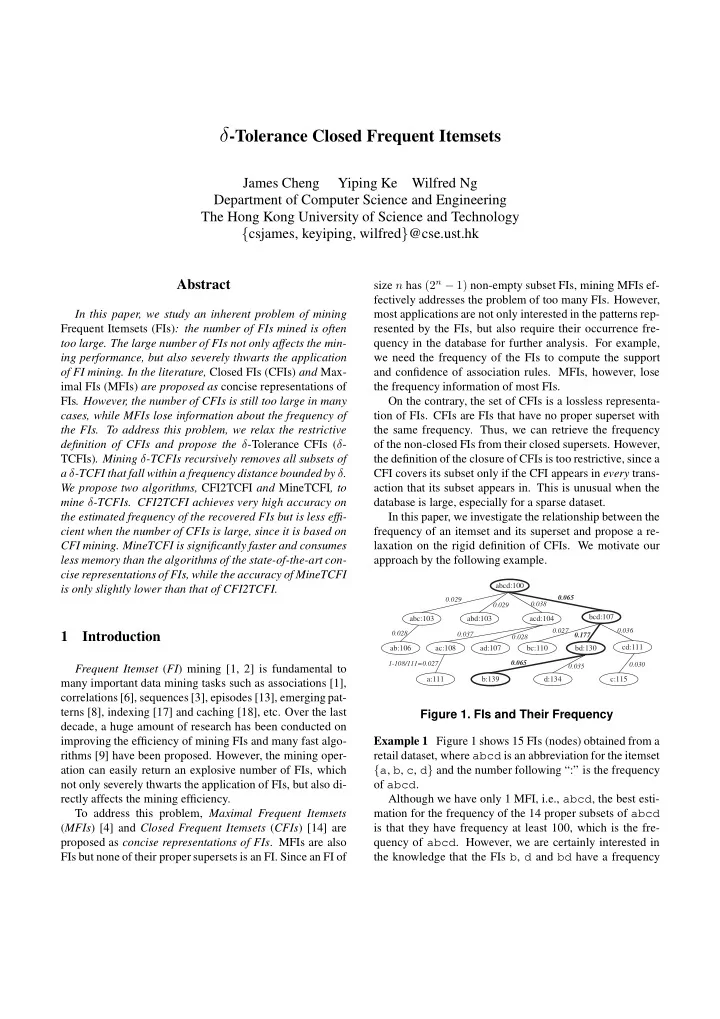
the definition of the closure of CFIs is too restrictive, since a CFI covers its subset only if the CFI appears in every trans- action that its subset appears in. This is unusual when the database is large, especially for a sparse dataset. In this paper, we investigate the relationship between the frequency of an itemset and its superset and propose a re- laxation on the rigid definition of CFIs. We motivate our approach by the following example.
abcd:100 abd:103 abc:103 acd:104 bcd:107 ab:106 ac:108 ad:107 bc:110 bd:130 cd:111 a:111 b:139 c:115 d:134
0.029 0.029 0.038 0.065 0.028 0.037 0.028 0.027 0.177 0.036 1-108/111=0.027 0.065 0.035 0.030
Figure 1. FIs and Their Frequency Example 1 Figure 1 shows 15 FIs (nodes) obtained from a retail dataset, where abcd is an abbreviation for the itemset {a, b, c, d} and the number following “:” is the frequency
- f abcd.