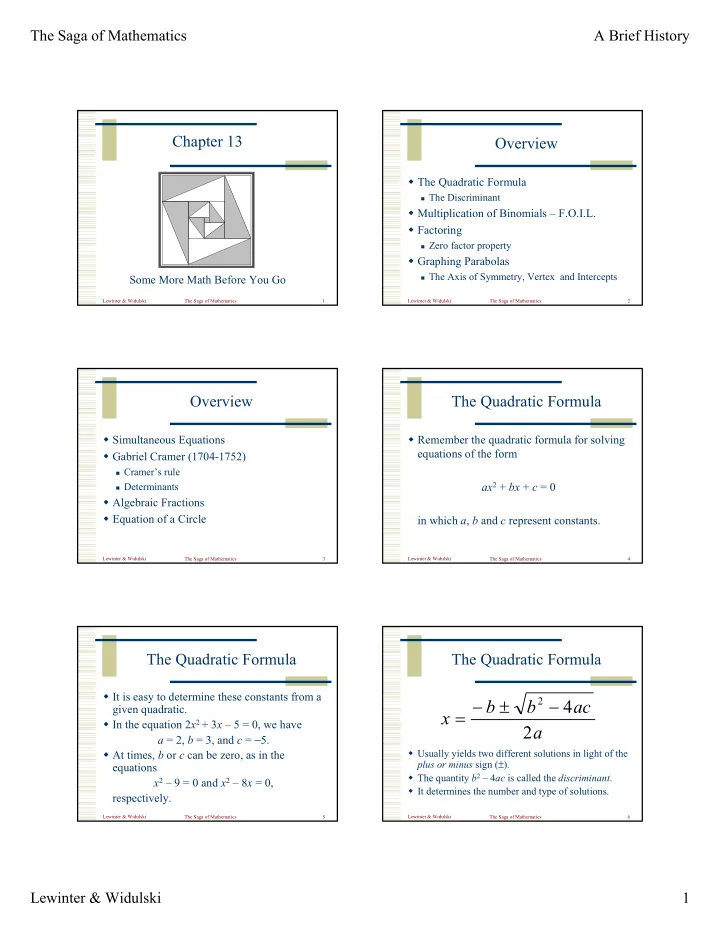
2 It is easy to determine these constants from a b b 4 ac - - PDF document

2
SMART_READER_LITE
LIVE PREVIEW

2 It is easy to determine these constants from a b b 4 ac - - PDF document

The Saga of Mathematics A Brief History Chapter 13 Overview The Quadratic Formula The Discriminant Multiplication of Binomials F.O.I.L. Factoring Zero factor property Graphing Parabolas The Axis of Symmetry, Vertex


slide-1
SLIDE 1

The Saga of Mathematics A Brief History Lewinter & Widulski 1

Lewinter & Widulski The Saga of Mathematics 1

Chapter 13

Some More Math Before You Go

Lewinter & Widulski The Saga of Mathematics 2

Overview

The Quadratic Formula

The Discriminant

Multiplication of Binomials – F.O.I.L. Factoring

Zero factor property

Graphing Parabolas

The Axis of Symmetry, Vertex and Intercepts Lewinter & Widulski The Saga of Mathematics 3

Overview

Simultaneous Equations Gabriel Cramer (1704-1752)

Cramer’s rule Determinants

Algebraic Fractions Equation of a Circle

Lewinter & Widulski The Saga of Mathematics 4

The Quadratic Formula

Remember the quadratic formula for solving equations of the form ax2 + bx + c = 0 in which a, b and c represent constants.

Lewinter & Widulski The Saga of Mathematics 5

The Quadratic Formula

It is easy to determine these constants from a given quadratic. In the equation 2x2 + 3x – 5 = 0, we have a = 2, b = 3, and c = −5. At times, b or c can be zero, as in the equations x2 – 9 = 0 and x2 – 8x = 0, respectively.

Lewinter & Widulski The Saga of Mathematics 6

The Quadratic Formula

a ac b b x 2 4

2 −

± − =

Usually yields two different solutions in light of the plus or minus sign (±). The quantity b2 – 4ac is called the discriminant. It determines the number and type of solutions.

slide-2
SLIDE 2

The Saga of Mathematics A Brief History Lewinter & Widulski 2

Lewinter & Widulski The Saga of Mathematics 7

The Discriminant

If b2 – 4ac > 0, then there are two real roots. If b2 – 4ac = 0, then there is one real (repeated) root, given by x = –b/2a. If b2 – 4ac < 0, that is, if it is a negative number, it follows that no real number satisfies the quadratic equation. This is because the square root of a negative number is not real!

Lewinter & Widulski The Saga of Mathematics 8

Imaginary Numbers

Mathematicians invented the so-called imaginary number i to deal with the square roots of negative numbers. If one accepts this bizarre invention, every negative number has a square root, e.g.,

1 − = i

( )

i 3 1 9 1 9 9 = − = − = −

Lewinter & Widulski The Saga of Mathematics 9

Example

Let’s solve the quadratic equation x2 – 5x + 6 = 0 using the formula. Note that a = 1, b = −5, and c = 6. The discriminant is

( ) ( )( )

1 24 25 6 1 4 5

2

= − = − −

Lewinter & Widulski The Saga of Mathematics 10

Example (continued)

It’s positive so we will have two solutions. They are denoted using subscripts:

2 2 1 5 and 3 2 1 5

2 1

= − = = + = x x

Lewinter & Widulski The Saga of Mathematics 11

Problem Solving (Falling Objects)

In physics, the height H of an object dropped

  • ff a building is modeled by the quadratic

equation H = –16T2 + H0 where T is time (in seconds) elapsed since the object was dropped and H0 is the height (in feet) of the building. If the building is 100 feet tall, determine at what time the object hits the ground?

Lewinter & Widulski The Saga of Mathematics 12

Multiplication of Binomials

Example: Multiply 2x + 1 by x –3 The work is arranged in columns just as you would do with ordinary numbers.

3 5 2 2 3 6 3 1 2

2 2

− − + − − − × + x x x x x x x

slide-3
SLIDE 3

The Saga of Mathematics A Brief History Lewinter & Widulski 3

Lewinter & Widulski The Saga of Mathematics 13

F.O.I.L.

The first term in the answer, 2x2, is the product of the first terms of the factors, i.e., 2x and x, . The last term in the answer, –3, is the product of the last terms of the factors, i.e., +1 and –3. The middle term, –5x, is the result of adding the

  • uter and inner products of the factors when they

are written next to each other as (2x + 1)(x – 3).

Lewinter & Widulski The Saga of Mathematics 14

F.O.I.L.

The outer product is 2x × –3, or – 6x, while the inner product is (+1) × x, or +x. As the middle column of our chart shows, −6x and +x add up to –5x. You may remember this by its acronym F.O.I.L. which stands for first, outer, inner and last.

Lewinter & Widulski The Saga of Mathematics 15

F.O.I.L.

( )( ) =

− + 3 1 2 x x

First: 2x × x = 2x2

2

2x

Outer: 2x × (–3) = –6x

x 6 − x + 3 −

Inner: (+1) × x = +x Last: (+1) × (–3) = –3

3 5 2

2

− − = x x

Lewinter & Widulski The Saga of Mathematics 16

Factoring

Let’s look at the quadratic equation x2 – 5x + 6 = 0 Can this be factored into simple expressions of first degree, i.e., expressions involving x to the first power? x2 is just x times x. On the other hand, 6 = 6 × 1 = –6 × –1 = 3 × 2 = –3 × –2.

Lewinter & Widulski The Saga of Mathematics 17

Factoring

How do we decide between the possible answers (x + 6)(x + 1) (x – 6)(x – 1) (x + 3)(x + 2) (x – 3)(x – 2) The middle term, −5x, is the result of adding the inner and outer products of the last pair of factors!

Lewinter & Widulski The Saga of Mathematics 18

Factoring

So the quadratic equation x2 – 5x + 6 = 0 Can be written as (x – 3)(x – 2) = 0 How can the product of two numbers be zero? Answer: One (or both) of them must be zero!

slide-4
SLIDE 4

The Saga of Mathematics A Brief History Lewinter & Widulski 4

Lewinter & Widulski The Saga of Mathematics 19

Zero Factor Property

Zero Factor Property: If ab = 0, then a = 0 or b = 0. To solve the equation for x, we equate each factor to 0. If x – 3 = 0, x must be 3, while if x – 2 = 0, x must be 2. This agrees perfectly with the solutions obtained earlier using the quadratic formula.

Lewinter & Widulski The Saga of Mathematics 20

Graphing Parabolas

Quadratic expressions often occur in equations that describe a relationship between two variables, such as distance and time in physics, or price and profit in economics. The graph of the relationship y = ax2 + bx + c is a parabola.

Lewinter & Widulski The Saga of Mathematics 21

Graphing Parabolas

  • Follow these easy steps and you will never

fear graphing parabolas ever again.

  • 1. Determine whether the parabola opens up or

down.

  • 2. Determine the axis of symmetry.
  • 3. Find the vertex.
  • 4. Plot a few extra well-chosen points.

Lewinter & Widulski The Saga of Mathematics 22

Graphing Parabolas

If a is positive, the parabola opens upward. If a is negative, the parabola is upside down (like the trajectory of a football). a > 0 a < 0

Lewinter & Widulski The Saga of Mathematics 23

The Axis of Symmetry

Every parabola has an axis of symmetry – a vertical line acting like a mirror through which one half of the parabola seems to be the reflection of the other half. The equation of the axis of symmetry is

a b x 2 − =

Lewinter & Widulski The Saga of Mathematics 24

The Vertex

The vertex is a very special point that lays on the parabola.

It is the lowest point on the parabola, if the

parabola opens up (a > 0), or

It is the highest point on the parabola, if the

parabola opens down (a < 0).

It lays on the axis of symmetry, making its x- coordinate equal to –b/2a.

slide-5
SLIDE 5

The Saga of Mathematics A Brief History Lewinter & Widulski 5

Lewinter & Widulski The Saga of Mathematics 25

The Vertex

To get the y-coordinate, insert this x value into the original quadratic expression. Finally, pick a few well-chosen x values and find their corresponding y values with the help of the equation and plot them. Then connect the dots and you shall have a decent sketch indeed.

Lewinter & Widulski The Saga of Mathematics 26

The Intercepts

Sometimes the easiest points to plot are the intercepts, i.e., the points where the parabola intersects the x– and y– axes.

To find the x-intercepts, insert y=0 into the

  • riginal quadratic expression and solve for x

using the quadratic formula or by factoring.

The y-intercept is given by the point (0, c).

Let’s do an example.

Lewinter & Widulski The Saga of Mathematics 27

Example

  • Graph the parabola y = x2 – 4x – 5.
  • 1. Since a = 1 > 0, the parabola opens up.
  • 2. The equation of the axis of symmetry is

x = –(–4)/(2×1) = 2.

  • 3. Plugging this value into the equation, tells us

that the vertex is (2, –9).

  • 4. Solving x2 – 4x – 5 = 0 will give us the x-

intercepts of (–1, 0) and (5, 0).

Lewinter & Widulski The Saga of Mathematics 28

Example (continued)

y x axis (2,–9) (0,–5) (5,0) (–1,0)

Lewinter & Widulski The Saga of Mathematics 29

Linear Equations ax + by = c

Solve the equation x + y = 10. There are infinitely many pairs of values which satisfy this equation.

Including x = 3, y = 7, and x = −5, y = 15, and

x = −100, y = 110. Then there are decimal solutions like x = 2.7, y = 7.3, and so on and so forth.

The solution set is represented by its graph which is a straight line.

Lewinter & Widulski The Saga of Mathematics 30

Simultaneous Equations

Simultaneous equations or a “system of equations” is a collection of equations for which simultaneous solutions are sought. Example: x + y = 10 x − y = 6 Solving a system of equations involves finding solutions that satisfy all of the equations. The system above has x=8 and y=2 or (8, 2) as a solution.

slide-6
SLIDE 6

The Saga of Mathematics A Brief History Lewinter & Widulski 6

Lewinter & Widulski The Saga of Mathematics 31

Simultaneous Equations

Recall, the solution set for a linear equation in two variables is a straight line. Geometrically, we are looking for the intersection

  • f the two straight lines.

There are three possibilities:

There is a unique solution (i.e. the lines intersect in

exactly one point)

There is no solution (i.e., the lines do not intersect at all) There are infinitely many solutions (i.e., the lines are

identical)

Lewinter & Widulski The Saga of Mathematics 32

Geometrically

unique solution no solution infinitely many solutions

Lewinter & Widulski The Saga of Mathematics 33

Simultaneous Equations

When there is no solution, we say the system is inconsistent. There are several methods for solving systems of equations including:

The Graphing Method The Substitution Method The Method of Addition (or Elimination) Using Determinants Lewinter & Widulski The Saga of Mathematics 34

Simultaneous Equations

  • To solve a system by the graphing method, graph both

equations and determine where the graphs intersect.

  • To solve a system by the substitution method:
  • 1. Select an equation and solve for one variable in terms of the other.
  • 2. Substitute the expression resulting from Step 1 into the other

equation to produce an equation in one variable.

  • 3. Solve the equation produced in Step 2.
  • 4. Substitute the value for the variable obtained in Step 3 into the

expression obtained in Step 1.

  • 5. Check your solution!

Lewinter & Widulski The Saga of Mathematics 35

Simultaneous Equations

  • To solve a system by the addition (or elimination)

method:

  • 1. Multiply either or both equations by nonzero constants to
  • btain opposite coefficients for one of the variables in the

system.

  • 2. Add the equations to produce an equation in one variable

and solve this equation.

  • 3. Substitute the value of the variable found in Step 2 into

either of the original equations to obtain another equation in

  • ne variable. Solve this equation.
  • 4. Check your answer!

Lewinter & Widulski The Saga of Mathematics 36

Example

Since the coefficients of y are opposites, we can add the two equations to obtain 6x = 24. Solving for x gives x = 4. We then substitute this into one of the original equations and solve for y which results in y = 6. So the solution is (4, 6).

   = − = + 14 5 10 y x y x

Solve:

slide-7
SLIDE 7

The Saga of Mathematics A Brief History Lewinter & Widulski 7

Lewinter & Widulski The Saga of Mathematics 37

Problem Solving

A plane with a tailwind flew 5760 miles in 8

  • hours. On the return trip, against the wind,

the plane flew the same distance in 12 hours. What is the speed of the plane in calm air and the speed of the tailwind?

Let

x = speed of the plane in calm air y = speed of the tailwind

Use the formula: distance = rate × time

Lewinter & Widulski The Saga of Mathematics 38

Problem Solving

This yields the following system: 8x + 8y = 5760 12x – 12y = 5760 Use the method of elimination to solve.

12(x – y) 12 x – y Against the wind 8(x + y) 8 x + y With the wind distance time rate

Lewinter & Widulski The Saga of Mathematics 39

Gabriel Cramer (1704-1752)

Cramer published articles

  • n a wide range of topics:

geometry, philosophy, the

aurora borealis, the law, and

  • f course, the history of

mathematics.

He also worked with many famous mathematicians, including Euler, and was held in such high regard that many of them insisted he alone edit their work.

Lewinter & Widulski The Saga of Mathematics 40

Determinants

Determinants are mathematical objects which are very useful in the analysis and solution of systems

  • f linear equations.

A determinant is a function that operates on a square array of numbers. The 2×2 determinant is defined as

C B D A D C B A × − × =

Lewinter & Widulski The Saga of Mathematics 41

Example

( ) ( )

14 6 8 6 8 2 3 2 4 2 3 2 4 = + = − − = − × − × = −

Lewinter & Widulski The Saga of Mathematics 42

Cramer’s Rule

Cramer’s rule says that the solution of a system such as Ax + By = C Dx + Ey = F can be found by calculating the three determinants Dx, Dy and D. These three are defined by the following:

slide-8
SLIDE 8

The Saga of Mathematics A Brief History Lewinter & Widulski 8

Lewinter & Widulski The Saga of Mathematics 43

Cramer’s Rule

E D B A D F D C A D E F B C D

y x

= = = and , ,

Lewinter & Widulski The Saga of Mathematics 44

Cramer’s Rule

The determinant D is called the determinant

  • f coefficients, since it contains the

coefficients of the variables in the system. The x-determinant Dx is simply D with the column containing the coefficients of x replaced by the constants from the system, namely, C and F. Similarly for the y-determinant Dy.

Lewinter & Widulski The Saga of Mathematics 45

Cramer’s Rule

The solution of the system is provided of course that D is not 0.

D D y D D x

y x

= = and

Lewinter & Widulski The Saga of Mathematics 46

Example

Solve the following system using Cramer’s rule: x + y = 4 3x + 4y = 5 The three determinants Dx, Dy and D are given on the next slide.

Lewinter & Widulski The Saga of Mathematics 47

Example (continued)

7 12 5 4 3 5 1 5 3 4 1 11 5 16 1 5 4 4 4 5 1 4 1 3 4 1 3 4 1 4 3 1 1 − = − = × − × = = = − = × − × = = = − = × − × = =

y x

D D D

Lewinter & Widulski The Saga of Mathematics 48

Example (continued)

Since D ≠ 0, the system has a solution, namely and 7 1 7 11 1 11 − = − = = = = = D D y D D x

y x

slide-9
SLIDE 9

The Saga of Mathematics A Brief History Lewinter & Widulski 9

Lewinter & Widulski The Saga of Mathematics 49

Algebraic Fractions

  • In order to add (or subtract) algebraic

fractions, you need to find the LCD.

  • To find the LCD:
  • 1. Factor each denominator completely, using

exponents to express repeated factors.

  • 2. Write the product of all the different factors.
  • 3. For each factor, use the highest power of that

factor in any of the denominators.

Lewinter & Widulski The Saga of Mathematics 50

To Add (or Subtract) Algebraic Fractions

  • 1. Find the LCD
  • 2. Multiply each expression by

missing factors missing factors

  • 3. Add (or Subtract)
  • 4. Simplify

Lewinter & Widulski The Saga of Mathematics 51

Example

( )( ) ( ) ( )( ) ( ) ( )( ) ( ) ( ) ( )( ) ( )( ) ( )( )

2 2 6 2 2 6 3 6 3 2 2 2 3 2 3 2 2 2 3 2 2 2 3 2 2 2 3 2 3 + − = + − − + + = + − − + + = + − − + + − + = + − = = + + − x x x x x x x x x x x x x x x x x x x LCD x x

Add:

Lewinter & Widulski The Saga of Mathematics 52

Solving Equations Involving Algebraic Fractions

Multiply both sides of the equation by the LCD. Be sure to use the distributive property when necessary! Solve the resulting equation after simplifying both sides.

Lewinter & Widulski The Saga of Mathematics 53

Example

( ) ( ) ( ) ( ) ( ) ( ) ( ) ( )( ) ( )( )

11 5 5 5 6 6 6 11 5 6 5 5 6 5 5 6 6 11 5 6 5 5 5 6 5 6 6 11 5 5 − = − +       − =       − +       − −       − =       + − − − = = + − x x x x x x x x x x x x x x x x x x x x x x x LCD x x x

Solve:

Lewinter & Widulski The Saga of Mathematics 54

Example (continued)

( )( )

15

  • r

2 15 2 30 17 150 85 5 55 11 150 30 6

2 2 2 2

= = − − = + − = + − = − = − + x x x x x x x x x x x x

slide-10
SLIDE 10

The Saga of Mathematics A Brief History Lewinter & Widulski 10

Lewinter & Widulski The Saga of Mathematics 55

Example (continued)

Be sure to check your answers and watch out for extraneous roots. Remember you can not divide by zero, so if an answer results in a denominator having a value of zero that answer is an extraneous root. Let’s look at an example!

Lewinter & Widulski The Saga of Mathematics 56

Example

2 2 1 3 2 3 + − − = + − x x x x

Solve:

Lewinter & Widulski The Saga of Mathematics 57

Problem Solving (Work)

Neil needs 15 minutes to do the dishes, while Bob can do them in 20 minutes. How long will it take them if they work together?

Let x = the time it takes them working together

Neil can do 1/15 of the work in 1 minute. Bob can do 1/20 of the work in 1 minute. Together:

x 1 20 1 15 1 = +

Lewinter & Widulski The Saga of Mathematics 58

Problem Solving (Uniform Motion)

Judy drove her empty trailer 300 miles to Saratoga to pick up a load of horses. When the trailer was finally loaded, her average speed was 10 mph less than when the trailer was empty. If the return trip took her 1 hour longer, what was her average speed with the trailer empty?

Let x = the average speed

Use the formula: distance = rate × time

Lewinter & Widulski The Saga of Mathematics 59

Equation of a Circle

To find the equation of a circle centered at (a, b) with radius R, we use Pythagorean theorem. It follows that (x – a)2 + (y – b)2 = R2. R (a, b) (x, y) (x – a) (y – b)