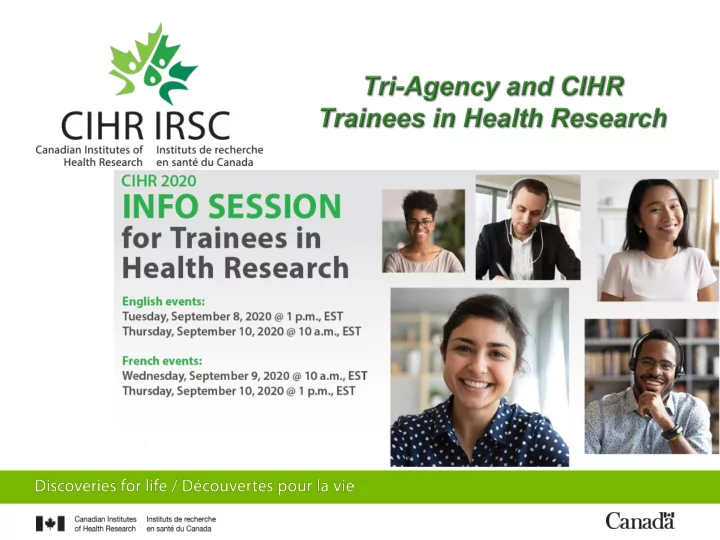
2 3 https://cihr-irsc.gc.ca/e/51917.html News for researchers - - PowerPoint PPT Presentation
2 3 https://cihr-irsc.gc.ca/e/51917.html News for researchers This dedicated Scholarships, Fellowships and Salary webpage contains Awards valuable information, Frequently asked questions such as: Funding opportunities
2
3
4
This dedicated webpage contains valuable information, such as:
News for researchers Scholarships, Fellowships and Salary Awards Frequently asked questions Funding opportunities COVID-19 Resources
https://cihr-irsc.gc.ca/e/51917.html
5
- Canada Graduate Scholarships - Masters Awards (CGS M)
- Frederick Banting and Charles Best Canada Graduate Scholarship
Doctoral Awards (CGS D)
- Doctoral Foreign Study Award (DFSA)
- Vanier Canada Graduate Scholarships (Vanier CGS)
- Michael Smith Foreign Study Supplement (MSFSS)
- CIHR Fellowship
- Banting Postdoctoral Fellowship
From any CIHR web page, modify the URL link by entering these 5 digits (http://www.cihr-irsc.gc.ca/e/35273.html) for an easy access to complete listing of current and archived opportunities.
It is searchable and can be sorted by Institute, program type, or target applicant
Throughout this presentation, tips and advice will be provided as each
- f the programs are being described. Be aware that most of these tips can be
applied regardless of the program.
6
This program funds high caliber scholars who are engaged in eligible Masters
- r, in some cases, doctoral programs in Canada.
Annual Stipend: $17,500 Term: Up to 12-months Application Deadline: December 1, 2020
For more information about this program: CGSMA-BESCBM@cihr-irsc.gc.ca
7
- Open to Canadian citizens and permanent residents of Canada
- Be enrolled in, have applied for, or will apply for full-time admission* to an eligible graduate
program (master’s or doctoral) at a Canadian institution with a CGS M allocation
- Have completed, as of December 31 of the year of application:
– between zero and 12 months of full-time studies (or full-time equivalent) in the program for which funding is requested; or, – between four and 12 months of full-time study (or full-time equivalent) in an eligible master’s program for which the degree requirements will be completed before activation of the award, allowing it to be activated during the subsequent doctoral program for which funding is requested
- Have achieved a first-class average as determined by the host institution, in each of the
last two completed years of study (full-time equivalent)
This list is not exhaustive - Review the program’s literature for full list of eligibility requirements
Eligibility Criteria
8
To apply to this funding opportunity, you are to submit an application via the Research Portal, and not ResearchNet.
Candidates should inform their selected references to consult the Information for References hosted on NSERC web page to find out best practices and considerations as well as educate them about unconscious bias.
9
If you select Health as your Field of Research, you must also provide a CIHR Personal Identification Number (PIN). It takes up to one full working day to process your CIHR PIN Request.
For applicants to CGS M specifically:
For program-related information, contact the Faculty of Graduate Studies (or its equivalent) at the institution(s) where you intend to hold the award.
For technical matters related to the Research Portal: contact the Helpdesk or complete an On-line Services Support Request
10
- Vanier Canada Graduate Scholarships (Vanier CGS)
― Nomination process
- Frederick Banting and Charles Best Canada
Graduate Scholarships – Doctoral Awards (CGS D) ― If proposed location of research is at a Canadian Institution
- CIHR Doctoral Foreign Study Award (DFSA)
― If proposed location of research is located abroad
CGS D and DFSA are now 2 distinct funding opportunities.
Funding is available for Doctoral studies in Canada and abroad, from these three envelopes of funding:
New since last year
11
Annual Value: $50,000 Duration : 3 years Application Deadline :
- November 3, 2020
(Institution nominations)
Open to Canadians, permanent residents
- f Canada, and foreign citizens and offered
by CIHR, NSERC and SSHRC. Aims to attract and retain world-class doctoral students by supporting students who demonstrate both leadership skills and a high standard of scholarly achievement in graduate studies. Applicants must be nominated by a Canadian Institution with a Vanier quota and awards can only be held at the nominating institution.
For more information about this program: www.vanier.gc.ca Email: Vanier@cihr-irsc.gc.ca
12
13
Nominations will be evaluated and selected based on the following three (3) criteria (weighted equally): Selection Criteria
Candidates should consult the Selection Criteria on the website for more detailed information Academic Excellence As demonstrated by past academic results and by transcripts, awards, and directions Research Potential As demonstrated by the candidates research history, interest in discovery, proposed research and its potential contribution to advancement of knowledge in field and anticipated outcomes Leadership (Potential and Demonstrated Ability) Personal achievement, involvement in academic life, volunteerism/community outreach, civic engagement or
- ther
14
- Objective
- Description
- Eligibility
- Program of Study
- Deadlines
- Selection Process
- Selection Criteria
The Doctoral Foreign Study Award (DFSA) program has also aligned with the harmonized CGS D aspects. CIHR, NSERC and SSHRC have worked collaboratively on the Canada Graduate Scholarships – Doctoral program (CGS D) in removing barriers and having consistent processes across the three agencies to simplify the application and adjudication processes.
What is harmonized
The program supports high-caliber students engaged in doctoral programs in all academic disciplines (applicants should complete the agency application that is best aligned with their research subject matter)
15
Starting this year, candidates may need to provide up to two new forms as part of their application that will help Institutions for eligibility determination, if applicable. Voluntary Self-Identification for Indigenous Applicants - Optional Self-Declaration of No Institutional Affiliation with a quota - Optional We heard you…
For candidates that have not been affiliated with an Institution with a quota for CIHR within the calendar year of their application. For candidates that wants to self- identify as an Indigenous person (First Nation, Inuk (Inuit), or Métis) within their application.
16
http://www.nserc-crsng.gc.ca/Students-Etudiants/PG-CS/CGSD- BESCD_eng.asp
Supervisor’s CV is no longer a requirement, although at least one primary supervisor must still be identified as part of the application.
17
http://www.cihr-irsc.gc.ca/e/50513.html
It is strongly suggested that you familiarize yourself with the information contained in these links to increase the success of your application.
18
Overview
Value Stipend of $30,000 per year Research Allowance of $5,000 per year Duration 36 months Tenure CGS D Canadian institutions DFSA Abroad Application Deadline Directly to CIHR : October 17 – see Notes Through a Canadian Institution: Contact your institution Similarly to last year, each institution will review and submit their best applications to CIHR based on their quotas.
Notes:
- 1. Remember that each Canadian Institution may set an internal deadline in advance of CIHR.
Consult with your Institution to find out about their internal deadline.
- 2. If deadline falls on a weekend, deadline is set to next business day before 8:00 p.m.
CIHR is embarking into it’s second year of setting Quotas for the CGS D program.
19
* If pursuing a doctoral degree in a health- related field abroad, applicants must apply to the CIHR Doctoral Foreign Study Award (DFSA) competition. These applicants must manually enter the foreign institution in the “Other” field under “Institution Paid” within their ResearchNet application.
20
Applications submitted through the Institution Deadline will be set by the institution* The institution will review all applications received and submit the best applications to CIHR (according to their quota) INSTITUTION DEADLINE Applications submitted directly to CIHR Deadline is on October 17 before 8:00 pm (ET) AGENCY DEADLINE
Applications from self-identified Indigenous applicants may be submitted beyond the institution’s quota.
- Quota. Maximum number of applications an institution can
forward to the agency.
CGS D (Non-Quotas) & DFSA CGS D (Quotas)
* There could be an internal deadline in advance of the CIHR deadline. Don’t wait to the last minute – Start working on your application several weeks before the deadline.
21
- Open to Canadian citizens and permanent residents of Canada, as of the application
deadline
- Have completed no more than 24 months of full-time study in their doctoral program
by December 31 of the year of application if previously enrolled in a Master’s Program
- Have completed no more than 36 months of full-time study in their doctoral program
by December 31 of the year of application if enrolled in a joint program, e.g., MD/PhD, MA/PhD, regardless if previously enrolled in a Master’s Program
- Have completed no more than 36 months of full-time study in their doctoral program
by December 31 of the year of application if enrolled directly from a bachelor’s to a PhD program (with no time spent in a master’s program)
Harmonized Eligibility Criteria
An applicant who commenced studies in a doctoral program directly from an undergraduate program (i.e., never enrolled in a Master’s program) must be enrolled in their doctoral program at the time of application - These applicants may be eligible to apply to the CGS M program for their first year of doctoral funding.
22
- Applicants can submit a maximum of one scholarship application per academic year to
either CIHR, NSERC or SSHRC. Nominations to the Vanier CGS program and applications to the Banting Postdoctoral Fellowships program do not count toward this limit (other exceptions may apply to CIHR internships)
- Applicants cannot have already received a doctoral-level scholarship from CIHR, NSERC
- r SSHRC (does not apply to CIHR Fellowships)
Harmonized Eligibility Criteria – Cont’d
An eligible doctoral program must include a significant research component. Eligibility is based on the number of months of full-time study in the degree for which the applicant is requesting funding by December 31 of the calendar year of application. Two-terms of part-time study count as one term of full-time study.
23
- 1. Research Ability or Potential (50%)
- Quality of research proposal
- Relevant training
- Research experience and achievements relative to stage of study
- Quality of contributions to advance the field of research
- Sound judgment and critical thinking skills
- Demonstration of responsible and ethical research conduct
- Enthusiasm for research, originality, initiative, autonomy, relevant
community involvement and outreach
- Oral and written scientific communication skills
- 2. Relevant experience and achievements obtained within
and beyond academia (50%)
- Scholarships, awards and distinctions (amount, duration and prestige)
- Academic record
- Professional, academic and extracurricular activities as well as collaborations
with supervisors, colleagues, peers, students and members of the community
Selection Criteria
Annex A of the CIHR Reviewers’ Guide provides detailed information of these evaluation criteria
24
Tasks Useful Information to Know
Identify Participants
- In addition to yourself, you must also identify a supervisor.
- If only one supervisor, it must be selected as “Primary Supervisor”.
- CV is not required for the supervisor.
Identify Sponsors
- Only 2 sponsor assessments are required.
- Applicants can manage the deadline by which sponsors must submit their
assessment.
- Refer your sponsors to the Information to Sponsors web page, so they
can follow best practices and limit unconscious bias. Enter Proposal Information
- Use full page allowances and adhere to format guidelines (e.g. font, page
limits).
- Carefully read instructions related to Training Expectations and
Research Project Summary sections, as they align with the evaluation criteria.
- Proofread your application (grammar and orthography).
It is important for candidates to familiarize themselves with the CIHR Doctoral Research Awards – Application instructions
25
Tasks Useful Information to Know
Attach Other Application Materials
- Order the transcripts several weeks before the deadline (must include
all undergraduate and graduate studies, completed or ongoing).
- Complete the Doctoral Studies Timelines form – it must be uploaded
as one single PDF with transcripts.
- Complete the Confirmation of Scientific Area form – it must be
uploaded as one single PDF.
- NEW - Optional ! For candidates who have not been affiliated with an
Institution with a quota for CIHR within the calendar year of their application a Self-Declaration of No Institutional Affiliation with a quota form must be included – it must be uploaded as one single PDF under “Other”.
- NEW – Optional ! For candidates who want to self-identify as an
Indigenous person (First Nation, Inuk (Inuit), or Métis) within their application a Voluntary Self-Identification for Indigenous Applicants form must be included – it must be uploaded as one single PDF under “Other”. Apply to Priority Announcements / Funding Pools (Optional)
- It increases funding success if the application is relevant to a specific
CIHR research area – can be considered for up to three areas.
- The Canada Graduate Scholarship to honor Nelson Mandela is now
listed as a Priority Announcement.
Two new optional forms have been created based on last year’s feedback received.
26
Tasks Useful Information to Know
Print/Upload Signature Pages
- Only the supervisor’s signature is required (maximum of two supervisors
can be identified per application).
- Institutional signatures are not required at time of application.
Preview
- Ensure consistency between the various sections of the application.
- Show the complete application to your supervisor and other researchers
for feedback.
- Refer to the Flowchart to validate how your application is to be
submitted:
- For CGS D ► a Canadian Institution, with or without quota; or,
- For DFSA ► Directly to CIHR
Consent and Submit
- Be particularly careful when determining if your application should be
submitted to a Canadian Institution or directly to CIHR for your application to not be rejected. Note: For CGS D application submitted to an institution with a quota, it is the responsibility of the Scholarships Liaison Officer (or equivalent) to inform applicants of the outcome of the institution’s internal selection process Applicants may submit their application in the official language of their choice.
27
- Banting Postdoctoral Fellowship
Endorsement from Host Institution required Intended for students pursuing research training
- CIHR Fellowship
Intended to:
- PhD holder pursuing a Post-PhD
- Health Professional pursuing a graduate
degree or a research training.
Funding is available for Post-Docs and Post-Health professionals in Canada and abroad from these envelopes of funding:
Depending on expertise requirements, there are opportunities for Postdoctoral Fellows to participate in evaluating applications for CIHR’s Doctoral Research
- Awards. For more information, please see the peer review pilot studies.
Peer Review Opportunity
28
Annual Value: $70,000 Duration: 2 years Application Deadline: ► October 1, 2020 Aims to attract and retain top-tier postdoctoral talent nationally and internationally; Develop their leadership potential; Position them for success as research leaders of tomorrow, positively contributing to Canada's economic, social and research-based growth through a research-intensive career. Note: Institutions may have prior internal deadlines For more information about this program: http://banting.fellowships-bourses.gc.ca Email: Banting@cihr-irsc.gc.ca
29
30
Applications are evaluated based on the following three criteria (weighted equally): 1) Research excellence and leadership in the research domain 2) Quality of applicant's proposed research program 3) Institutional commitment and demonstrated synergy between applicant and institutional strategic priorities
Selection Criteria
Applicants should read the Selection committee guide prior to commencing their application as it contains valuable information on how these criteria are evaluated.
31
Annual Stipend: From $21,000 to $55,000 Annual Research Allowance: $5,000 Term: Up to 5 years Application Deadline: December 1, 2020
This program provides support for highly qualified candidates in all areas of health research at the post-PhD degree or post-health professional degree stages to add to their experience by engaging in health research either in Canada or abroad.
Stipend and term is determined based on the candidate’s educational background and proposed location of research. Canadian Institutions may have an internal deadline ahead of CIHR.
Application Deadline, Notice
- f Decision and
Funding Start Date will also be delayed by two months.
Launch has been delayed to September 2020 due to COVID-19
32
- The candidate must be a trainee.
- A primary supervisor must be identified on the application. An additional supervisor may
also be identified.
- As of the application deadline, the candidate must hold or be completing a PhD or
regulated health professional degree.
- The candidate must expect to have completed all degree requirements by the latest
date on which they may commence their award.
- Health Professional degree holders may request support to pursue a graduate degree
- r to pursue post-degree research.
- Canadian citizens and permanent residents are eligible to hold awards in Canada or
abroad; Foreign applicants are eligible to hold awards in Canada only.
Complete Program literature is outlined under the CIHR Health Research Training Award Programs webpage, under tab specific to “Postdoctoral/degree fellows”.
Eligibility Criteria
33
- 1. Achievements and Activities of the
Candidate (60%)
- Training Expectations (10%)
- Proposed Research Project (10%)
- Honours, Awards and Academic Distinction (10%)
- Publications and Related Research Achievements (30%)
2. Sponsor’s Assessment of the Candidate’s Characteristics and Abilities (20%) 3. Research Training Environment (20%)
Evaluation Criteria
Annex A of the CIHR Reviewer’s Guide for Fellowship Awards provides detailed information on these Evaluation criteria
34
Candidates are encouraged to…
Start at least several weeks before the deadline Work on the research proposal in collaboration with your supervisor Proofread your application (grammar and
- rthography)
Show the complete application to your supervisor and other researchers for feedback Ensure consistency between the various sections of your application Ensure that the overall goal of the project is clearly explained
All ResearchNet tasks must be listed as complete in order to allow successful application submission.
- Do not wait until the
last minute to submit your application!
35
Candidates are encouraged to… (Cont’d)
Follow instructions and adhere to format guidelines (e.g., font, page limits) Use full page allowances and/or characters limits Obtain the CCV confirmation number from your supervisor(s) in order to attach their CCV to the application Submit CCV well in advance of the competition deadline (during peak periods, there can be a delay between the time that the CCV is being submitted and when ResearchNet is able to validate it, which could prevent successful submission of the application).
Incomplete or late applications will not be accepted.
36
http://www.cihr-irsc.gc.ca/e/50513.html “One-stop shop” location where to find useful information to increase application success – Have a look!
37 37
38
This program funds existing Canadian Vanier and Canada Graduate Scholarship (CGS) Master’s or Doctoral award recipients interested in building global linkages and international networks through the pursuit of exceptional short- term research experiences at research institutions outside of Canada.
To benefit from this program, candidates must have accepted or hold a CGS (Masters or Doctoral) or CGS Vanier and not have previously held a CGS MSFSS.
Supplement: up to $6,000 Term: 2 to 6 months Application Deadline: June 10 and October 10 each year
39
It offers additional sources of funding for highly rated applications that are relevant to specific CIHR research priority areas. Candidates may request to be considered for up to three priority announcement research areas within their application. Priority Announcements are offered through the Fellowship and Doctoral Research Awards programs (CGS D & DFSA).
40
… And why not to access a PDF version
- f the Sponsor Assessment form to
help you better understand what it consists of? https://cihr-irsc.gc.ca/e/797.html
Candidates should choose sponsors that know them well enough to be able: to assess their potential to provide specific examples of their behaviour with respect to each characteristic on the sponsor assessment form Candidates are responsible to inform their selected sponsors to consult the Information for Sponsors web page for useful tips.
Applicants can manage the deadline by which sponsors must submit their assessments.
- By default, the Sponsor
Required Deadline in ResearchNet is set for two days before the application deadline. However, applicants can adjust this to any date prior to the application deadline.
To know….
41
This restriction also applies to the Canada Graduate Scholarships – Master (CGS M) competition, even if the platform used is the Research Portal, and not ResearchNet.
Applicants may only submit an application to one competition per academic year (September 1st to August 31st) for funding from any of these granting agencies:
- Canadian Institutes of Health Research (CIHR)
- Natural Sciences and Engineering Research Council of Canada
(NSERC)
- Social Sciences and Humanities Research Council of Canada
(SSHRC)
Any exceptions to this rule will be indicated within the funding opportunity to which you are applying. Applications submitted to more than one competition
42 42
43
1 2 3
Training Webpages Training Tools & Modules Individual Development Plans
http://www.cihr-irsc.gc.ca/e/50507.html http://www.cihr-irsc.gc.ca/e/50517.html http://www.cihr-irsc.gc.ca/e/50516.html
44
Global Health Research Training Module Sex and Gender Considerations The TCPS2 Tutorial Course on Research Ethics Research Involving First Nations, Inuit, and Métis Peoples of Canada Unconscious Bias Training Module CIHR Research Data Management (RDM) Learning Module Ethics in Research: A Science Lifecycle Approach
http://www.cihr-irsc.gc.ca/e/50517.html
CIHR has created a series of research training tools and modules to ensure trainees are aware of and can integrate emerging practices to advance rigorous and responsible research.
45
IDPs help map one’s career by encouraging the identification of career goals and the intentional planning of short and long-term strategies to attain the goals. CIHR encourages the use of Individual Career Development Plans (IDPs) to empower trainees to prepare for the career(s) of their choice. What are Individual Development Plans (IDPs)? 5 steps to develop and complete an effective IDP
For more information on how to fill out an IDP, check out the CIHR IDP webpage for useful resources, including: Step by step guide to IDP IDP tip sheet IDP learning modules
(for trainees and mentors)
CIHR IDP Form (revised) ** Alternate IDP forms may exist at your university.
46
Active career management, such as using the IDP tool, has been shown to:
Learn more about the benefits of IDPs for:
- Trainees
- Mentors
- Canadian Economy
Decrease time to degree completion Increase success in securing research funding (e.g., scholarships and awards) Enhance access to career advice Create better career outcomes for trainees Increase career satisfaction
47 47
48
CIHR has committed to identifying and eliminating systematic biases against any individual or group that would hinder access to CIHR funds. Reliable and comparable data is essential to identify, track and monitor equitable access to research funds. – Data collection has been harmonized across the Tri Agencies Five questions: gender, age, Indigenous identity, visible minority identity, and person with disabilities. – Each question has “I prefer not to answer” option All applicant participants on submissions to all CIHR programs are asked to fill out an Equity and Diversity Questionnaire.
49
CIHR is committed to ensuring the fair treatment of all participants, and the questionnaire is a tool that will allow CIHR to monitor the equity performance of its programs. You are invited to view more information at the following links:
- Message from the Associate Vice-President: CIHR launches new
Equity and Diversity Questionnaire for applicants
- How to complete the Equity and Diversity Questionnaire
- Frequently Asked Questions about the Equity and Diversity