12/30/2013 This Weeks Learning Objectives You will be able to - - PDF document

12 30 2013
SMART_READER_LITE
LIVE PREVIEW

12/30/2013 This Weeks Learning Objectives You will be able to - - PDF document

12/30/2013 This Weeks Learning Objectives You will be able to Describe the information that needs to be 1 understood before cochlear implantation should be considered Describe ways to address family assumptions 2 about cochlear implant


slide-1
SLIDE 1

12/30/2013 1

Karen L. Anderson, PhD

Supporting Success for Children with Hearing Loss

Aural Hab: Child

This Week’s Learning Objectives You will be able to …

Describe the information that needs to be understood before cochlear implantation should be considered 1 Describe ways to address family assumptions about cochlear implant outcomes 2 Describe the work needed to develop auditory skills and benchmarks for performance 3

2 2014 (c) Supporting Success for Children with Hearing Loss http://webcasts.successforkidswithhearingloss.com

Describe red flags identifying issues with the cochlear implant 4 5 Describe issues with other implantable devices

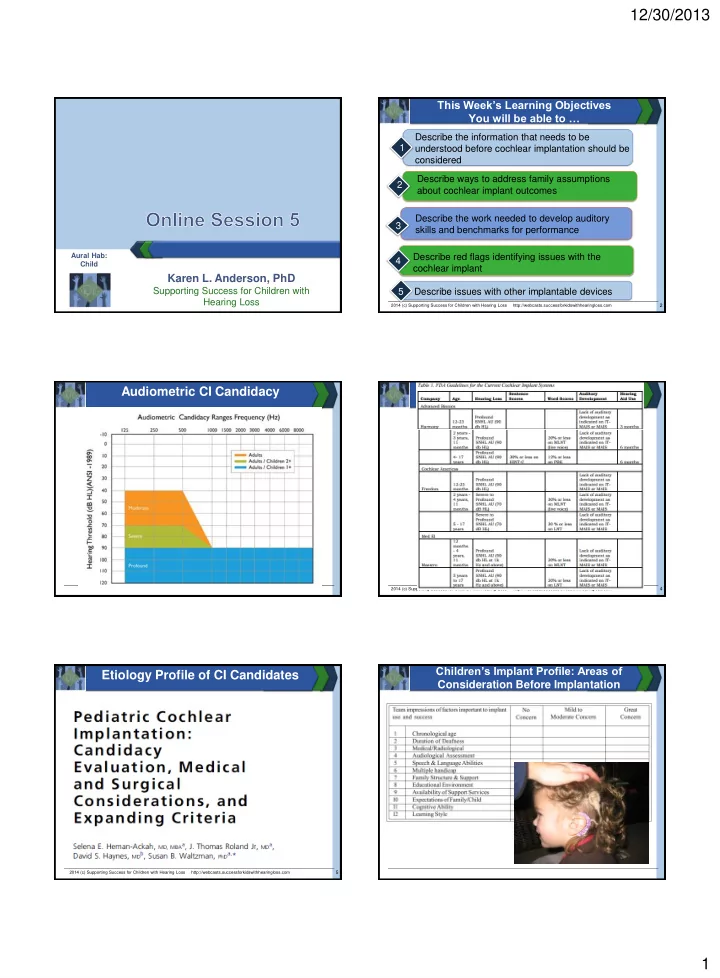
Audiometric CI Candidacy

2014 (c) Supporting Success for Children with Hearing Loss http://webcasts.successforkidswithhearingloss.com 4

Etiology Profile of CI Candidates

  • 15-44% have SNHL of unknown cause
  • 40-50% genetic etiology
  • Must undergo 3-6 month hearing aid trials

The audiologic evaluation is used to identify current aural performance and to GUIDE AURAL REHABILITATION after implantation.

2014 (c) Supporting Success for Children with Hearing Loss http://webcasts.successforkidswithhearingloss.com 5

Children’s Implant Profile: Areas of Consideration Before Implantation

slide-2
SLIDE 2

12/30/2013 2

Complications of CI

  • Complications occur in 10% of pediatric cases
  • Complications breakdown:
  • 50% infection in wound or OME
  • 20% hemotoma or sematoma (blood in tissues)
  • 10% CSF fistulas
  • 20% device failure

2014 (c) Supporting Success for Children with Hearing Loss http://webcasts.successforkidswithhearingloss.com 7

Expanding Candidacy

Implantation <12 months!

  • Speech perception testing at 9 years post-CI

– scoring between 76-100%

  • Implanted between 24-36 months = 20%
  • Implanted between 12-23 months = 38%
  • Implanted prior to 12 months = 100% (superior

speech understanding!)

  • Also:
  • R/E language skills growth similar to typically hearing
  • Receptive language growth exceeding CI at any

subsequent age and commensurate with age peers.

2014 (c) Supporting Success for Children with Hearing Loss http://webcasts.successforkidswithhearingloss.com 8

Invisible Barriers

  • Any abnormal auditory system, even with the

best technology will

  • Not restore normal hearing levels (-10 to +10 dB)
  • Have greater speech perception,

discrimination, speech processing and decreased comprehension in

  • NOISE
  • REVERBERATION
  • DISTANCE

2014 (c) Supporting Success for Children with Hearing Loss http://webcasts.successforkidswithhearingloss.com 9

Future of Cochlear Implants

As technology is refined,

  • there will be less audiological follow-up needed to provide

appropriate care for cochlear implant patients.

  • development of remote and/or self programming techniques, some
  • f which are currently being used in pilot programs.
  • As the age of implantation decreases, less speech-language

services will be required due to being able to take advantage of natural language development.

  • The educating of children with hearing loss will also change.
  • will probably be a shift in the future that the SLPs and DHH

teachers will need to focus more on the “other disabilities” rather than the hearing loss.

  • Furthermore, with reimbursement for services continuing to

decline, more innovative practice patterns will be needed for cochlear implant centers to remain open for services.

http://div9perspectives.asha.org/content/19/1/32.full.pdf+html

Current Practices in Pediatric Cochlear Implantation, Tamala S. Bradham, Geneine Snell, and David Haynes

2014 (c) Supporting Success for Children with Hearing Loss http://webcasts.successforkidswithhearingloss.com

10

Make It Yours

Patient 1 - Bo: age 8 months, deaf in right ear, mild sloping to severe high frequency loss in left ear. Standard hearing aids since 6 weeks. Good family support. Patient 2 - Sidney: age 3 years, same HL, inconsistent family support, limited language, behavior issues 2015: What could communication abilities be like? What are the hearing device options you would consider for these children? 2025: Considering the trends, what may be different about hearing device options? How could the role of the audiologist be different?

2014 (c) Supporting Success for Children with Hearing Loss http://webcasts.successforkidswithhearingloss.com 11

Parents are interested in CI because...

  • 95% of children with hearing loss are born to

families with no history of childhood HL

  • They want the hearing loss to ‘go away’
  • They want ‘the best’ for their child
  • At adulthood they want their child to be…

highly educated, employable, marriable, etc.

  • If their child is implanted, then he will be

‘normal’ and they won’t have to do anything ‘extra’

  • ‘Like glasses only for ears’

2014 (c) Supporting Success for Children with Hearing Loss http://webcasts.successforkidswithhearingloss.com 12
slide-3
SLIDE 3

12/30/2013 3

  • I just read about cochlear

implants on the internet…

  • It sounds like implants are much

better than hearing aids.

  • Kids can talk just like other kids

when they get cochlear implants.

  • He has this hearing loss and the

teachers are saying he isn’t learning (you know there are cognitive delay issues).If he uses implants learning should be better, right?

2014 (c) Supporting Success for Children with Hearing Loss http://webcasts.successforkidswithhearingloss.com 13

Listen for Intent

  • Is there a concern about auditory response

and language learning with the hearing aids?

  • Is the child’s hearing loss changing?
  • Is this a family who has been involved and

empowered through early intervention and is seeking information?

  • Is this a family who has been inconsistent

and is seeking an ‘easier answer’ to the hard work of early intervention?

  • Is this a multicultural family concerned about

their child’s future as a (marriageable) adult?

  • Etc.

2014 (c) Supporting Success for Children with Hearing Loss http://webcasts.successforkidswithhearingloss.com 14

The Power of the Analogy

  • Hearing loss is invisible
  • “Language” is not

inherently understood (other than i.e. “Spanish”)

  • Predicting language and

learning delays because

  • f this invisible barrier is
  • ften not really ‘heard’
  • Analogies can get

effectively across the ‘domino consequences’ of hearing loss

2014 (c) Supporting Success for Children with Hearing Loss http://webcasts.successforkidswithhearingloss.com 15

The Olympic Skater

Babies brains are designed to learn words, language and eventually reading. All they have to do is be exposed to

  • speech. Babies with hearing loss need help to learn this. Lets

think about an analogy….

  • Everyone in your family for generations has been a talented
  • skater. You believe that your child could go to the Olympics!
  • You buy her skates. Will that be enough?
  • You bring her to the ice rink and she puts on her skates once

a month. Will that do it?

  • You hire a coach with a really good reputation for training

good skaters, but she misses a lot of the lessons.

  • She doesn’t have other people to skate with regularly or to

consistently model and encourage her to use new skills. For a child with hearing loss, getting the device is the easy part!

2014 (c) Supporting Success for Children with Hearing Loss http://webcasts.successforkidswithhearingloss.com 16

The Olympic Listener/Talker/Learner

Babies brains are designed to learn words, language and eventually reading. All they have to do is be exposed to

  • speech. Babies with hearing loss need help to learn this. Lets

think about an analogy….

  • Everyone in your family for generations has been a talented
  • talker. You want your child to get a good education.
  • You get her hearing aids or a CI. Will that be enough?
  • The hearing devices are puts on once a month. Will that do

it? A couple of hours a day? All waking hours a day!

  • You have an early intervention teacher with a really good

reputation for working with families of children with hearing

  • loss. YOU are people who will teach your baby to listen!
  • Language is learned through overhearing and interaction!.

For a child with hearing loss, getting the device is the easy part!

2014 (c) Supporting Success for Children with Hearing Loss http://webcasts.successforkidswithhearingloss.com 17

Make It Yours

  • Think of another analogy that would get across
  • the ‘domino effect’ of not addressing the hearing loss in

a timely way, or

  • Why a CI isn’t a ‘quick fix’ to the hearing world
  • Be creative! There are many types of families

(interests, age, ethnicity, family goals for child, etc). One analogy isn’t enough.

2014 (c) Supporting Success for Children with Hearing Loss http://webcasts.successforkidswithhearingloss.com 18

slide-4
SLIDE 4

12/30/2013 4

After the CI…..

Long-term predicted outcome after implantation

  • A. Auditory verbal/oral communicator (25%)
  • children implanted under the age of three years
  • developed awareness of sound within the first few weeks
  • f implant, association of sound with events by three

months, single word use with understanding and emerging phrases by one year post-implant, and use of spoken intelligible language to express needs and feelings by 24 months post-implant.

  • these children became auditory verbal/oral communicators

and learners within 3 years of implantation

  • generally entered the mainstream for education with

continued speech/language support services.

2014 (c) Supporting Success for Children with Hearing Loss http://webcasts.successforkidswithhearingloss.com 19

2009

After the CI…..

Long-term predicted outcome after implantation

  • B. Both, auditory /oral communicator with visual assist (46%)
  • encountered difficulty developing auditory and verbal/oral

skills (intensive speech/language therapy & auditory training.

  • association of sound with events did not develop until 6 -10

months, single-word use with understanding and emerging phrases developed by 12 -18 months, spoken intelligible language to express wants/needs by 36 months post-CI.

  • became auditory verbal/oral communicators but required

considerable visual assistance for learning (speechreading)

  • subtle to moderate difficulties with speech and/or language

development, making additional therapy necessary.

  • entered a modified mainstream for education.

2014 (c) Supporting Success for Children with Hearing Loss http://webcasts.successforkidswithhearingloss.com 20

After the CI…..

Long-term predicted outcome after implantation

  • C. Complementary, auditory verbal/oral skills assist primary

visual communication (29%)

  • After three years of CI use, 70% maintained performance

at the projected slower language development.

  • Many peaked in their performance at a key word-

acquisition stage and could use stereotypical phrases.

  • 15% performed at B expectations. 15% became non-users
  • Awareness of sound by 4 months post-CI, association of

sound 6-14 months, understanding/emerging phrases around 3+ years post-CI

  • CI provides added quality to life
  • Benefit from DHH classes with ASL as primary mode

2014 (c) Supporting Success for Children with Hearing Loss http://webcasts.successforkidswithhearingloss.com 21

After the CI…..

Long-term predicted outcome after implantation

  • D. Does not benefit from implant
  • Some children who are deaf are not CI candidates
  • Usually manifest other factors as their primary impediment

to learning

  • Parents should be advised to weigh risk vs benefit of CI
  • If such children are implanted, they should use a visual

learning system as a primary teaching method.

Each child must always be viewed as a unique individual.

2014 (c) Supporting Success for Children with Hearing Loss http://webcasts.successforkidswithhearingloss.com 22

Expected Educational Outcomes

  • Many parents have a goal of full mainstreaming
  • Many B candidates may require intense support

services for academic support

  • It is appropriate to mainstream when the child can

comprehend information auditorilly and express needs and thoughts verbally.

  • Mainstream can be considered 2-3 years post-CI

for A candidates

  • Mainstreaming is most effective when initiated in

grades PS, K, 1, with kindergarten being ideal

  • Specific expectations for Total Communication

users vs Auditory/Oral

2014 (c) Supporting Success for Children with Hearing Loss http://webcasts.successforkidswithhearingloss.com 23

Specifics of What is Worked on…

  • Auditory milestones
  • Pre-Speech, Speech, Speech Intelligibility
  • Language Hierarchies!

2014 (c) Supporting Success for Children with Hearing Loss http://webcasts.successforkidswithhearingloss.com 24

Auditory Skills Pyramid Hierarchy of Speech Hierarchy of Language

slide-5
SLIDE 5

12/30/2013 5

Expectations … Only with Teaming!

2014 (c) Supporting Success for Children with Hearing Loss http://webcasts.successforkidswithhearingloss.com 25

Outcomes must be monitored

Because of ongoing assessment and diagnostic therapy, the team is able to constantly monitor progress through established benchmarks. Areas of concern or “red flags” may arise during this

  • monitoring. If red flags are identified, the team may
  • recommend reprogramming the device
  • an integrity check of the internal equipment
  • utilize behavior charts to increase the amount of time the

child is wearing the device

  • incorporate different therapy strategies
  • increase the amount or type of therapy being provide
  • add sensory modalities
  • consult with colleagues or referring to other professionals.

2014 (c) Supporting Success for Children with Hearing Loss http://webcasts.successforkidswithhearingloss.com

26

Model of Child Aural Habilitation

2014 (c) Supporting Success for Children with Hearing Loss http://webcasts.successforkidswithhearingloss.com 27

Assessment

Define the impact of the hearing loss on life function Under what situations is the child’s ability to function impaired? When/how will participation be restricted? Talk about abilities not dB

Personal Factors – Skills

  • Language

use/communication

  • Socialization skills
  • Psychosocial/self-concept
  • Additional Learning

Challenges Environmental Factors

  • Speech perception under

varying conditions

  • Ability to attend / fatigue
  • Speechreading benefit
  • Accommodations currently

in various environments

Red Flags – Abilities to Assess

2014 (c) Supporting Success for Children with Hearing Loss http://webcasts.successforkidswithhearingloss.com

Does s/he demonstrate:

  • Poor speech perception of soft speech (35 dB),

conversational (45-50 dB) or loud speech (70 dB)

  • Perception at 70dB should be 12% better than 50 dB
  • Poor speech recognition for either/or single words and

sentences (can have poor word/high sentence or vice versa)

  • Inconsistent wear of technology (pops off the head piece)
  • Reliance on visual cues (average cognition)
  • Slow development of audition, speech, language
  • Turning up volume/sensitivity (complaining of not hearing)
  • Vocalization (amount/loudness) doesn’t change when CI is

in use (voice is quiet or whispered)

28

Iowa Medial Consonant Test

  • Worth the time! Doing

the Ling sounds and WDS testing does NOT inform you as to the completeness of the child’s speech perception.

  • Administer the sounds

from 10 feet to a friend wearing

  • earplugs. How long

did it take to do?

2014 (c) Supporting Success for Children with Hearing Loss http://webcasts.successforkidswithhearingloss.com 29

Also age-appropriate speech perception tests: Age 3-5 years: NU-CHIPS (open set) Age 6-8: PBK words Age 9+: W-22 words HINT Sentences, etc

Collaboration – A Necessity!

2014 (c) Supporting Success for Children with Hearing Loss http://webcasts.successforkidswithhearingloss.com 30

slide-6
SLIDE 6

12/30/2013 6

Make It Yours

Actual issue:

We have had a few students complaining about difficulties hearing their peers once FM was introduced. After researching this with Cochlear, it turns out that using the Cochlear N5 with DAi (either ML14i or euro-adapter with MLxi), raises the Threshold Sound Pressure Level (TSPL) of the CI from 25 to 35 dB. This means that the dynamic range is reduced by 10 dB. I inquired with Cochlear as to whether avoiding the DAI via the use of a MyLink would maintain the 25 dB TSPL. The answer was that the use of the MyLink changes the Instantaneous Input Dynamic Range (IIDR) to 30 which means that the TSPL is raised to 35. This makes the FM

  • f benefit only during teacher instruction and a true barrier peer-to-peer speech.

Cochlear's recommendation is to remove the receivers when the FM is not in use

  • r when the student will rely on that 10 dB. (e.g. during quiet or distance speech

using CI only). Our rep checked the repair code associated with the DAI port and there is no indication of any high repair volume related to the repeated in and out of the receivers (meaning folks don’t know to do this).

Whether you were an audiologist working at the schools or the CI center, what collaboration/teaming would need to occur to come up with a solution to this issue? What are some things you would need to know about the students’ capabilities? Educational support? Etc.

2014 (c) Supporting Success for Children with Hearing Loss http://webcasts.successforkidswithhearingloss.com 31

Implantable Bone Conduction System

Bone Anchored Hearing Aids (BAHA)

  • For treatment of mixed and conductive

hearing loss

  • Air-bone gap of at least 30 dB HL
  • As with CI, it is important that the patient

have realistic expectations.

Device BC Average (at 0.5, 1, 2, and 3k Hz.) BAHA 3 (BP100) ≤ 45 dB HL BAHA 3 Power (BP110) ≤ 55 dB HL BAHA Cordelle II ≤ 65 dB HL

Candidacy

  • Conductive hearing loss
  • Mixed hearing loss
  • Unilateral sensorineural hearing loss (SSD)

BAHA Softband

  • Can be used in younger

children (under age 5) when they are too young for the surgery.

  • Can be used with any

patient if surgery is not an option or if patient isn’t sure.

  • In Europe the BAHA has been implanted

successfully in children less than 3 years old however, the fixture (titanium implant) has a higher rate of fixture loss.

  • Fixture failure rates of children < 5 years is 40%
  • Fixture failure rates of children 5–10 years is 8%
  • Children over the age of 10 years have 1% fixture

loss

Complications

slide-7
SLIDE 7

12/30/2013 7

Hearing Level and BAHA

  • 2010 Arkansas study of 10 children; 6m – 16 yrs
  • Figure 5. Mean threshold as a function of frequency for the unaided

condition as well as the four device conditions. *p , .05.

Challenge – Retention!

2014 (c) Supporting Success for Children with Hearing Loss http://webcasts.successforkidswithhearingloss.com 38

Hearing Henry Headband www.hearinghenry.com www.silkawear.com www.meandmybow.com www.forwerd.net Slikawear CI Band Me and My Bow Forwerd

Make It Yours

  • You have a mom and her active 16 month little boy come
  • in. He is a CI user and the headpiece is continually popping
  • ff. What can you options/strategies can you suggest to

mom?

2014 (c) Supporting Success for Children with Hearing Loss http://webcasts.successforkidswithhearingloss.com 39

Summary

  • KNOW CI candidacy and red flag issues
  • Use analogies to clarify understanding about

cochlear implants not being a miracle fix

  • Recognize the effort required to develop

audition, speech, language, literacy – the CI is the easy part. Be able to pull out hierarchies!

  • Be prepared to provide information to families

about possible outcomes (A, B, C)

  • Collaborate – you DO need to know how the

child is progressing in order to validate the CI

  • Support families with children – BAHA users

2014 (c) Supporting Success for Children with Hearing Loss http://webcasts.successforkidswithhearingloss.com 40

Consistent use of devices that provide optimal speech perception is the foundation

  • f all auditory

learning

41 2014 (c) Supporting Success for Children with Hearing Loss http://webcasts.successforkidswithhearingloss.com

Preview for Next Week

Working with Multicultural Families

  • impact of multicultural influences on and strategies

for working with families of children with hearing loss

  • appropriate expectations for and use of language

translators and sign language interpreters

2014 (c) Supporting Success for Children with Hearing Loss http://webcasts.successforkidswithhearingloss.com 42