11 Application Layer Application Layer DNS: Domain Name System - - PDF document

11
SMART_READER_LITE
LIVE PREVIEW

11 Application Layer Application Layer DNS: Domain Name System - - PDF document

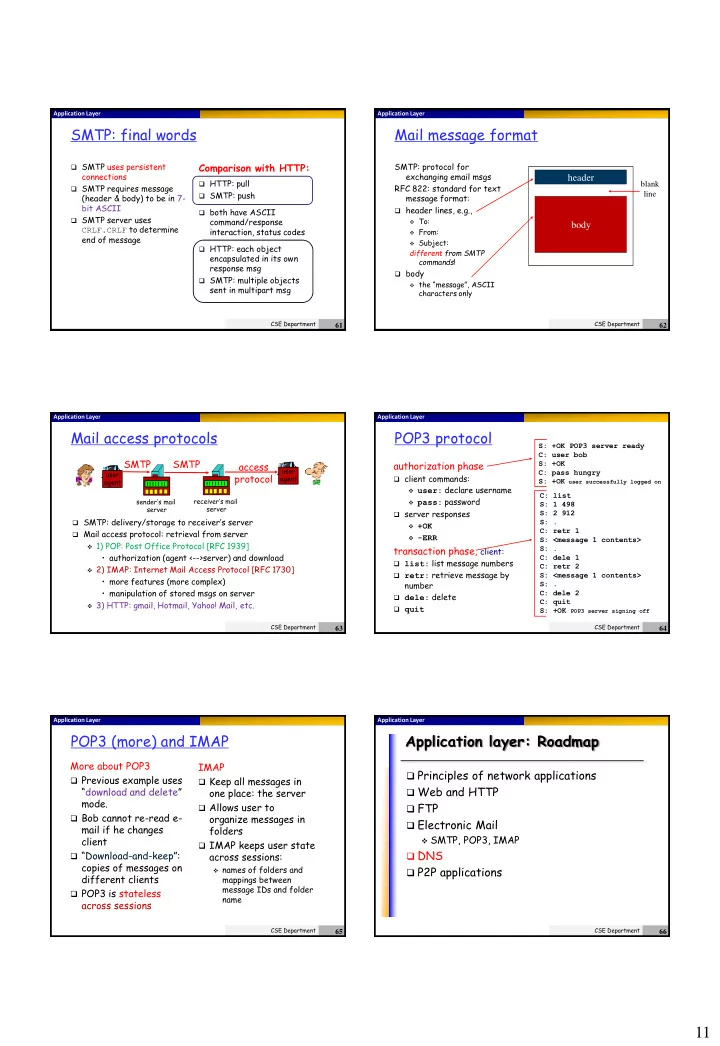
Application Layer Application Layer SMTP: final words Mail message format SMTP uses persistent Comparison with HTTP: SMTP: protocol for connections exchanging email msgs header HTTP: pull blank SMTP requires message RFC 822:


slide-1
SLIDE 1

11

Application Layer

SMTP: final words

 SMTP uses persistent

connections

 SMTP requires message

(header & body) to be in 7- bit ASCII

 SMTP server uses

CRLF.CRLF to determine end of message

Comparison with HTTP:

 HTTP: pull  SMTP: push  both have ASCII

command/response interaction, status codes

 HTTP: each object

encapsulated in its own response msg

 SMTP: multiple objects

sent in multipart msg

CSE Department

61

Application Layer

Mail message format

SMTP: protocol for exchanging email msgs RFC 822: standard for text message format:

 header lines, e.g.,

 To:  From:  Subject:

different from SMTP commands!  body

 the “message”, ASCII

characters only

header body

blank line

CSE Department

62

Application Layer

Mail access protocols

 SMTP: delivery/storage to receiver’s server  Mail access protocol: retrieval from server

 1) POP: Post Office Protocol [RFC 1939]

  • authorization (agent <-->server) and download

 2) IMAP: Internet Mail Access Protocol [RFC 1730]

  • more features (more complex)
  • manipulation of stored msgs on server

 3) HTTP: gmail, Hotmail, Yahoo! Mail, etc. user agent sender’s mail server user agent

SMTP SMTP access protocol

receiver’s mail server

CSE Department

63

Application Layer

POP3 protocol

authorization phase

 client commands:

 user: declare username  pass: password

 server responses

 +OK  -ERR

transaction phase, client:

 list: list message numbers  retr: retrieve message by

number

 dele: delete  quit C: list S: 1 498 S: 2 912 S: . C: retr 1 S: <message 1 contents> S: . C: dele 1 C: retr 2 S: <message 1 contents> S: . C: dele 2 C: quit S: +OK POP3 server signing off S: +OK POP3 server ready C: user bob S: +OK C: pass hungry S: +OK user successfully logged on

CSE Department

64

Application Layer

POP3 (more) and IMAP

More about POP3

 Previous example uses

“download and delete” mode.

 Bob cannot re-read e-

mail if he changes client

 “Download-and-keep”:

copies of messages on different clients

 POP3 is stateless

across sessions IMAP

 Keep all messages in

  • ne place: the server

 Allows user to

  • rganize messages in

folders

 IMAP keeps user state

across sessions:

 names of folders and

mappings between message IDs and folder name

CSE Department

65

Application Layer

Application layer: Roadmap

 Principles of network applications  Web and HTTP  FTP  Electronic Mail

 SMTP, POP3, IMAP

 DNS  P2P applications

CSE Department

66

slide-2
SLIDE 2

12

Application Layer

DNS: Domain Name System

People: many identifiers:

 SSN, name, passport #

Internet hosts, routers:

 IP address (32 bit) -

used for addressing datagrams

 “name”, e.g.,

ww.yahoo.com - used by humans

Q: map between IP addresses and name ? Domain Name System:

 distributed database

implemented in hierarchy of many name servers

 application-layer protocol

host, routers, name servers to communicate to resolve names (address/name translation)

 note: core Internet

function, implemented as application-layer protocol

 complexity at network’s

“edge”

CSE Department

67

Application Layer

Most commonly used names

1 张伟 290607 2 王伟 281568 3 王芳 268268 4 李伟 260980 5 王秀英 246737 6 李秀英 244637 7 李娜 244223 8 张秀英 236266 9 刘伟 234352 10 张敏 233708 11 李静 232686 12 张丽 232533 13 王静 231914 14 王丽 226724 15 李强 223950 16 张静 221483 17 李敏 213606 18 王敏 213603 19 王磊 209757 20 李军 199772 21 刘洋 199642 22 王勇 198720 23 张勇 197859 24 王艳 194371 25 李杰 191759 26 张磊 191065 27 王强 190266 28 王军 189999 29 张杰 189117 30 李娟 187701 31 张艳 181752 32 张涛 177993 33 王涛 177978 34 李明 177898 35 李艳 176676 36 王超 174891 37 李勇 173615 38 王娟 171785 39 刘杰 166929 40 王秀兰 166111 1 李霞 165189 42 刘敏 164133 43 张军 162773 44 李丽 162497 45 张强 159914 46 王平 155617 47 王刚 154600 48 王杰 154113 49 李桂英 153218 50 刘芳 152189

CSE Department

68

Application Layer

Most Popular Names in US, 2009

Boys Rank Name % +/- 1. Jacob 0.995 (0) 2. Ethan 0.938 (+1) 3. Michael 0.891 (-1) 4. Alexander 0.860 (+2) 5. William 0.844 (+3) 6. Joshua 0.831 (-2) 7. Daniel 0.827 (-2) 8. Jayden 0.815 (+3) 9. Noah 0.814 (+6) 10. Anthony 0.770 (-3) 11. Christopher 0.770 (-2) 12. Aiden 0.756 (+4) 13. Matthew 0.753 (-3) 14. David 0.727 (0) 15. Andrew 0.700 (-3) 16. Joseph 0.700 (-3) 17. Logan 0.684 (+2) 18. James 0.669 (-1) 19. Ryan 0.620 (-1) Girls Rank Name % +/- 1. Isabella 1.102 (+1) 2. Emma 0.885 (-1) 3. Olivia 0.861 (+1) 4. Sophia 0.836 (+3) 5. Ava 0.786 (0) 6. Emily 0.759 (-3) 7. Madison 0.754 (-1) 8. Abigail 0.711 (0) 9. Chloe 0.589 (+1) 10. Mia 0.565 (+4) 11. Elizabeth 0.543 (-2) 12. Addison 0.528 (0) 13. Alexis 0.491 (+2) 14. Ella 0.478 (+5) 15. Samantha 0.477 (-4) 16. Natalie 0.466 (-3) 17. Grace 0.409 (+4) 18. Lily 0.400 (+6) 19. Alyssa 0.395 (-3) 20. Ashley 0.387 (-2)

CSE Department

69

Application Layer

DNS

Why not centralize DNS?

 single point of failure  traffic volume  distant centralized

database

 maintenance

doesn’t scale! DNS services

 hostname to IP

address translation

 host aliasing

 Canonical, alias names

 mail server aliasing  load distribution

 replicated Web

servers: set of IP addresses for one canonical name

CSE Department

70

Application Layer

Root DNS Servers com DNS servers

  • rg DNS servers

edu DNS servers poly.edu DNS servers umass.edu DNS servers yahoo.com DNS servers amazon.com DNS servers pbs.org DNS servers

Distributed, Hierarchical Database

Client wants IP for www.amazon.com; 1st approx:

 client queries a root server to find com DNS server  client queries com DNS server to get amazon.com

DNS server

 client queries amazon.com DNS server to get IP

address for www.amazon.com

CSE Department

71

Application Layer

DNS: Root name servers

 contacted by local name server that can not resolve name  root name server:

 contacts authoritative name server if name mapping not known  gets mapping  returns mapping to local name server

13 root name servers worldwide

b USC-ISI Marina del Rey, CA l ICANN Los Angeles, CA e NASA Mt View, CA f Internet Software C. Palo Alto, CA (and 36 other locations) i Autonomica, Stockholm (plus 28 other locations) k RIPE London (also 16 other locations) m WIDE Tokyo (also Seoul, Paris, SF) a Verisign, Dulles, VA c Cogent, Herndon, VA (also LA) d U Maryland College Park, MD g US DoD Vienna, VA h ARL Aberdeen, MD j Verisign, ( 21 locations)

CSE Department

72

slide-3
SLIDE 3

13

Application Layer

TLD and Authoritative Servers

 Top-level domain (TLD) servers:

 responsible for com, org, net, edu, etc, and all

top-level country domains uk, fr, ca, jp.

 Network Solutions maintains servers for com TLD  Education for edu TLD

 Authoritative DNS servers:

 organization’s DNS servers, providing

authoritative hostname to IP mappings for

  • rganization’s servers (e.g., Web, mail).

 can be maintained by organization or service

provider

CSE Department

73

Application Layer

Local Name Server

 does not strictly belong to hierarchy  each ISP (residential ISP, company,

university) has one.

 also called “default name server”

 when host makes DNS query, query is sent

to its local DNS server

 acts as proxy, forwards query into hierarchy

CSE Department

74

Application Layer

requesting host

cis.poly.edu gaia.cs.umass.edu

root DNS server local DNS server

dns.poly.edu

1 2 3 4 5 6

authoritative DNS server dns.cs.umass.edu

7 8 TLD DNS server

DNS name resolution example

 Host at cis.poly.edu

wants IP address for gaia.cs.umass.edu iterated query:

 contacted server replies with name of server to contact  “I don’t know this name, but ask this server”

CSE Department

75

Application Layer

requesting host

cis.poly.edu gaia.cs.umass.edu

root DNS server local DNS server

dns.poly.edu

1 2 4 5 6

authoritative DNS server dns.cs.umass.edu

7 8 TLD DNS server 3

recursive query:

 puts burden of name resolution on contacted name server  heavy load?

DNS name resolution example

CSE Department

76

Application Layer

DNS: caching and updating records

 once (any) name server learns mapping, it caches

mapping

 cache entries timeout (disappear) after some

time

 TLD servers typically cached in local name

servers

  • Thus root name servers not often visited

 update/notify mechanisms under design by IETF

 RFC 2136  http://www.ietf.org/html.charters/dnsind-charter.html CSE Department

77

Application Layer

DNS records

DNS: distributed db storing resource records (RR)

 Type=NS

 name is domain (e.g.

foo.com)

 value is hostname of

authoritative name server for this domain

RR format: (name, value, type, ttl)  Type=A

 name is hostname  value is IP address

 Type=CNAME

 name is alias name for some

“canonical” (the real) name

www.ibm.com is really servereast.backup2.ibm.com

 value is canonical name

 Type=MX

 value is name of mailserver

associated with name

CSE Department

78

slide-4
SLIDE 4

14

Application Layer

DNS protocol, messages

DNS protocol : query and reply messages, both with same message format msg header

 identification: 16 bit # for query, reply to query uses same #  flags:

 query or reply  recursion desired  recursion available  reply is authoritative CSE Department

79

Application Layer

DNS protocol, messages

Name, type fields for a query RRs in response to query records for authoritative servers additional “helpful” info that may be used

CSE Department

80

Application Layer

Inserting records into DNS

 example: new startup “Network Utopia”  register name networkutopia.com at DNS registrar

(e.g., Network Solutions)

 provide names, IP addresses of authoritative name server

(primary and secondary)

 registrar inserts two RRs into com TLD server:

(networkutopia.com, dns1.networkutopia.com, NS) (dns1.networkutopia.com, 212.212.212.1, A)  create authoritative server

 Type A record for www.networkuptopia.com;  Type MX record for networkutopia.com CSE Department

81

Application Layer

Application layer: Roadmap

 Principles of network applications  Web and HTTP  FTP  Electronic Mail

 SMTP, POP3, IMAP

 DNS  P2P applications

CSE Department

82

Application Layer

Pure P2P architecture

 no always-on server  arbitrary end systems

directly communicate

 peers are intermittently

connected and change IP addresses

 Topics:

 File distribution  Searching for information

peer-peer

CSE Department

83

Application Layer

Peer-2-Peer Architectures

 Unstructured

 Centralized: Napster  Decentralized: Gnutella  Hierarchical : KaZaA

 Structured

 DHT-based

CSE Department

84